
Supervised learning is a type of machine learning in which a model learns from examples that include both an input and a known target, or label. The goal is to learn a relationship between the inputs and targets so the model can make useful predictions on new data. Common supervised-learning tasks include classification, such as predicting whether an email is spam, and regression, such as estimating a numerical value like delivery time or energy demand. Supervised learning is one of the most widely used machine-learning approaches, but it is not the only one. Modern systems may also use unsupervised learning, reinforcement learning, self-supervised learning, transfer learning, or combinations of several approaches.
Last reviewed and updated: September 1, 2026.
Prerequisite: Start with Types of Machine Learning to see where supervised learning fits within the broader field.
What Is Supervised Learning?
In supervised learning, the training data contains examples with known answers. A simple dataset might look like this:
| Input | Label |
|---|---|
| Email text and metadata | Spam |
| Email text and metadata | Not spam |
| House features | Sale price |
The model uses many examples like these to learn patterns that help it predict labels for new inputs. The word supervised does not mean a person watches every prediction. It refers to the fact that the learning process is guided by target values during training.
How Supervised Learning Works
Leakage-safe workflow
Define the problem → collect and inspect data → establish train/validation/test splits → fit learned preprocessing on training data only → train → validate and tune → run one final held-out test → deploy, perform inference, and monitor
The final test set never feeds back into feature choices, preprocessing, model selection, hyperparameter tuning, or threshold selection.
A typical supervised-learning workflow includes several stages. The ordering matters because using information from validation or test data while building the system can produce overly optimistic results.
1. Define the prediction problem
First, decide what the model should predict and how success will be measured. Examples include:
- Is this transaction likely to be fraudulent?
- Which product category does this item belong to?
- What is the expected delivery time?
- What is the probability that a machine will need maintenance soon?
A well-defined target is important because the model will optimize toward the objective and labels you provide.
2. Collect and inspect labeled data
Training examples need both inputs and target values. Labels may come from human annotation, existing records, sensors, historical outcomes, or rules that create provisional labels.
Label quality matters. Incorrect, inconsistent, delayed, or systematically biased labels can limit model performance even when the dataset is large. Learn more in What Is a Dataset in Machine Learning?.
3. Establish training, validation, and test splits
Create the evaluation split before any preprocessing or feature engineering that learns from the data. Many workflows distinguish among:
- Training data, used to fit preprocessing transformations and model parameters.
- Validation data, or cross-validation folds, used to compare models, tune hyperparameters, select thresholds, and make development decisions.
- Test data, kept untouched until the system and evaluation plan are finalized, then used once for a final estimate on unseen data.
The exact split strategy depends on the problem. Time-series, grouped, medical, geographic, and user-level datasets may require special splitting rules to prevent leakage. See Google’s guidance on dividing datasets and read Training vs Testing Data for the broader foundation.
4. Fit preprocessing and engineer features using training data
Raw data often needs cleaning, transformation, encoding, scaling, or feature engineering. Any preprocessing step that learns statistics, categories, feature relationships, thresholds, or target-related information must be fit on the training data only, then applied unchanged to validation and test data. This includes learned imputation, scaling, feature selection, principal component analysis, and similar transformations. Pipelines can help keep these steps together and reduce leakage risk. See scikit-learn’s data-leakage guidance, Data Preprocessing Explained, and Feature Engineering Explained.
5. Train the model
During training, the model adjusts its parameters to reduce a loss function that measures how far its predictions are from the training targets. Different algorithms learn in different ways.
6. Validate and tune
Use validation data or cross-validation to compare candidate models, tune hyperparameters, choose decision thresholds, and refine the system. Evaluation should match the real objective: classification may use accuracy, precision, recall, F1, ROC-AUC, PR-AUC, or log loss, while regression may use mean absolute error, mean squared error, root mean squared error, or R-squared.
No single metric is best for every problem. The cost of different errors, class imbalance, calibration, decision thresholds, and real-world consequences all matter. See Model Evaluation Metrics Explained.
7. Run the final held-out test
After the model, preprocessing, features, thresholds, and evaluation plan are fixed, evaluate the chosen system on the held-out test set. Do not use those results to continue tuning. If test performance triggers more development, that test set has effectively become part of validation and a new independent test set is needed.
8. Deploy, perform inference, and monitor
Inference is the stage where a trained model uses its learned parameters to make predictions on new inputs. During training, parameters change; during inference, the trained parameters are used. After deployment, teams may monitor prediction quality, input data quality, distribution shift, latency, reliability, fairness across relevant groups, changing conditions, and whether the model still supports the intended outcome.
Supervised learning is therefore not just a training step. It is part of a larger system lifecycle.
Classification vs Regression
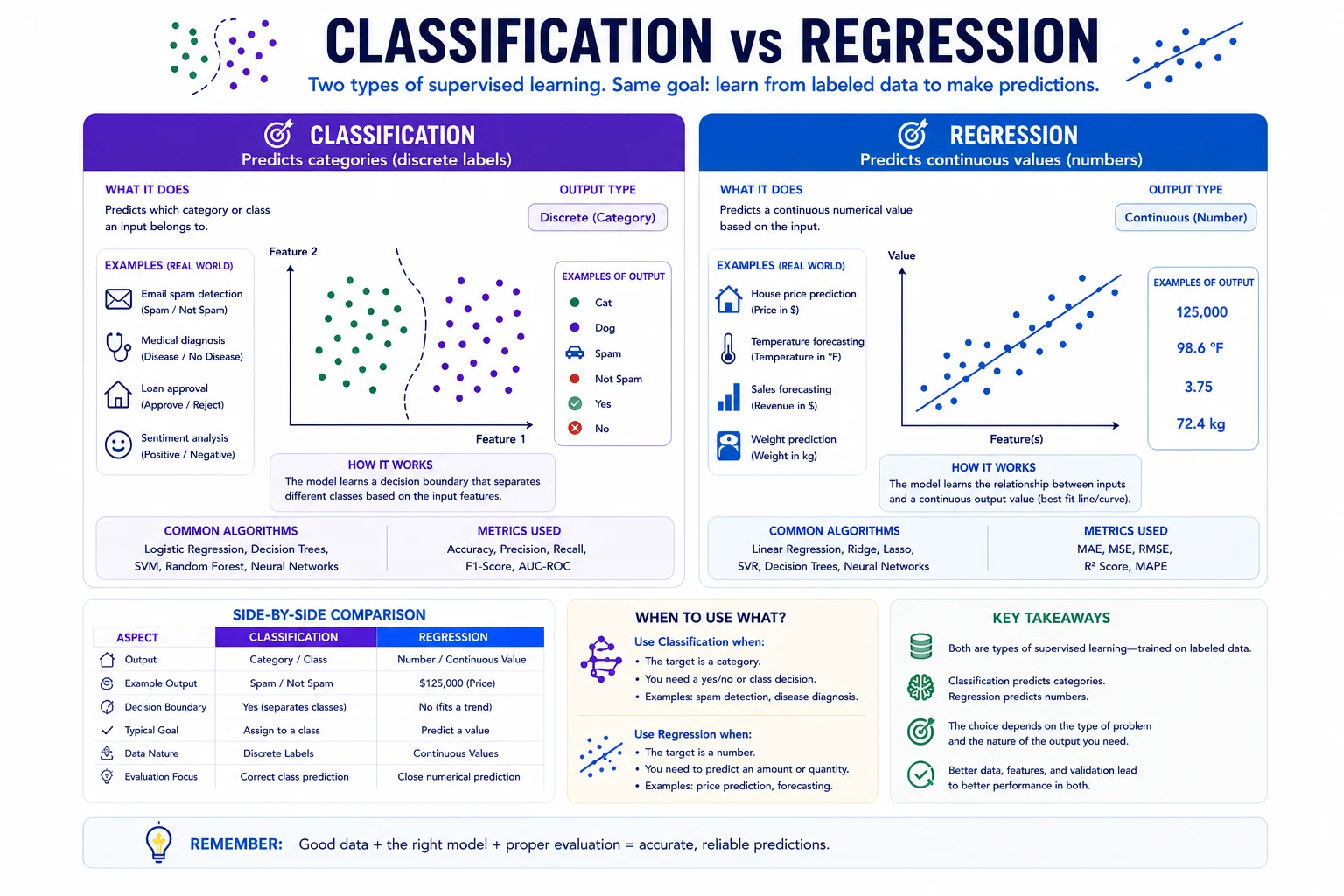
Most beginner supervised-learning examples fall into two broad categories: classification and regression.
Classification
Classification predicts a category or class. Examples include:
- Spam vs not spam.
- Fraudulent vs legitimate transaction.
- Defective vs acceptable product.
- Customer support topic classification.
- Image category recognition.
Classification can involve two classes, many classes, or multiple labels per example. Read Classification and Regression in Machine Learning.
Regression
Regression predicts a continuous numerical value. Examples include:
- Predicting delivery time.
- Estimating electricity demand.
- Forecasting equipment temperature under known conditions.
- Estimating house prices from property features.
Financial-market forecasting is also sometimes framed as regression, but it is a much more difficult setting because markets are noisy, adaptive, nonstationary, and influenced by factors not captured in a simple training dataset.
Common Supervised Learning Algorithms
These are compact examples of algorithms that can solve supervised tasks; the dedicated algorithm guides cover their mechanics in depth.
Linear and logistic regression
Linear Regression predicts numerical values. Logistic Regression is commonly used for classification by estimating class probabilities.
Decision trees
Decision trees make predictions through a sequence of feature-based splits. They are intuitive and can model nonlinear relationships. See Decision Trees Explained.
Random forests
Random forests combine many decision trees to improve robustness and predictive performance. Read Random Forest Explained.
Support vector machines
Support vector machines find decision boundaries that separate classes and can also be adapted for regression. See Support Vector Machines Explained.
K-nearest neighbors
KNN predicts based on nearby examples in feature space. Its behavior depends strongly on how distance is defined and how features are scaled. Read K-Nearest Neighbors Explained.
Neural networks
Neural networks can be trained in supervised settings for classification and regression, especially when the input is complex data such as images, text, or audio. However, modern deep-learning systems are not trained only with supervised labels. Self-supervised pretraining, weak supervision, transfer learning, reinforcement learning, and other approaches are also common. See Neural Networks Explained and Deep Learning Explained.
Real-World Applications of Supervised Learning
Fraud detection
Models can learn from historical transactions labeled as fraudulent or legitimate. In practice, fraud systems often combine supervised models with rules, anomaly detection, graph methods, and human investigation.
Medical decision support
Supervised models can assist with tasks such as image classification, risk estimation, triage support, and document analysis. These systems should not be described as automatically replacing clinical diagnosis. Performance needs rigorous validation, appropriate regulatory treatment, and human oversight for consequential uses. See AI in Healthcare.
Customer support
Models can classify tickets, predict routing categories, estimate urgency, or suggest likely responses.
Manufacturing
Supervised learning can support defect detection, predictive maintenance, quality control, and demand forecasting when reliable labeled outcomes are available.
Computer vision
Image classifiers and object detectors are often trained with labeled images or annotations, although modern vision systems frequently begin with pretrained representations before task-specific supervised fine-tuning. Read Computer Vision Explained.
Advantages of Supervised Learning
Clear training objective
The model is trained toward a defined target, which makes the learning objective relatively straightforward to specify.
Direct evaluation
When reliable labels exist, predictions can be compared against known outcomes using task-specific metrics.
Broad algorithm support
A wide range of mature methods exist for classification and regression, from interpretable linear models to large neural networks.
Strong performance on well-defined tasks
Supervised methods can perform extremely well when the data, labels, evaluation design, and deployment conditions are aligned.
Limitations of Supervised Learning
Labels can be expensive or difficult to obtain
Many real-world problems require expert annotation, manual review, or waiting for outcomes to occur.
Label quality can be imperfect
Historical records may contain mistakes, inconsistent definitions, missing outcomes, or social and institutional biases.
More data does not automatically mean better performance
Additional examples can help when they are relevant, representative, accurately labeled, and useful to the model. More duplicated, biased, outdated, or low-quality data may not improve performance and can sometimes make it worse.
Overfitting
A model may fit training examples well while failing to generalize to new data. Learn more in Overfitting vs Underfitting.
Data leakage
A model may appear highly accurate if training features accidentally contain information that would not be available at prediction time.
Distribution shift
Real-world inputs can change after deployment. Customers, products, markets, sensors, fraud strategies, or medical populations may differ from the data used during development.
Wrong metric or evaluation design
A model can look successful under one metric while failing the actual business objective. Evaluation should reflect the intended use and consequences of errors.
Supervised vs Unsupervised vs Reinforcement Learning
This table compares the learning signal and typical tasks associated with the three introductory paradigms.
| Approach | Main learning signal | Typical tasks |
|---|---|---|
| Supervised learning | Labeled examples | Classification and regression |
| Unsupervised learning | Structure in data without task labels | Clustering, dimensionality reduction, anomaly exploration |
| Reinforcement learning | Rewards or feedback from interaction | Sequential decision-making and control |
These categories are useful introductions, but modern machine-learning systems often combine approaches. A model may be pretrained with self-supervised learning, fine-tuned with labeled examples, and then adapted using preference or reinforcement-based feedback. See Types of Machine Learning.
Does Supervised Learning Generalize Beyond Its Training Data?
That is the goal, but it is not guaranteed. A supervised model learns statistical relationships from training examples. If those relationships also hold in new data, the model can generalize successfully. Generalization depends on factors such as:
- Data representativeness.
- Model capacity.
- Feature quality.
- Regularization.
- Training procedure.
- Leakage prevention.
- Evaluation design.
- Distribution stability.
The model does not need to have seen every exact future example. It needs to learn patterns that remain useful outside the training set.
Sources and Further Reading
- Google for Developers: Supervised Learning — an introduction to labeled examples, features, models, and prediction tasks.
- Google Machine Learning Crash Course: Dividing Datasets — guidance on training, validation, and held-out test sets.
- NIST Computer Security Resource Center: Machine Learning — a standards-based definition of machine learning.
- scikit-learn: Common Pitfalls and Recommended Practices — guidance on splitting before learned preprocessing and fitting transformations on training data only.
Frequently Asked Questions
What is supervised learning in simple terms?
It is machine learning from examples that include known target values. The model learns a relationship between inputs and those targets so it can make predictions on new data.
Does supervised learning always require human labeling?
No. Labels can come from people, historical records, sensors, system events, or other processes. Human annotation is only one source.
Is all deep learning supervised?
No. Deep-learning models can be trained with supervised, self-supervised, unsupervised, reinforcement-learning, and hybrid approaches.
Is supervised learning better than unsupervised learning?
Not universally. The right method depends on the problem and the available data. If you have a clear prediction target and reliable labels, supervised learning may be appropriate. If the goal is to explore structure without target labels, unsupervised methods may be better suited.
Does adding more training data always improve the model?
No. More data can help, but quality, relevance, representativeness, labeling, model choice, and training method all matter.
What is the difference between validation and testing?
Validation data is used during development to compare models or tune decisions. A final held-out test set is used after those choices are made to estimate performance more independently.
Where to Learn Next
Continue the main curriculum with the next learning paradigm:
Optional supervised-learning deep dive
Explore Classification and Regression to compare the two main supervised task families in more detail.