

Last reviewed: August 28, 2026
AI ethical considerations include how artificial-intelligence systems affect people, organizations, rights, opportunities, safety, and society.
The subject goes beyond asking whether an AI model is “good” or “bad.” Ethical risk can arise from the data used to build a system, the objective being optimized, how people deploy it, who is affected, what decisions it influences, and whether responsibility remains clear when something goes wrong.
If you are new to the subject, start with What Is Artificial Intelligence? for the broader technical foundation.
What Is AI Ethics?
AI ethics is the study and practice of identifying, evaluating, and managing the effects artificial-intelligence systems can have on people and society.
It asks practical questions such as:
- Who could benefit or be harmed?
- What data is collected, and was it used appropriately?
- Could the system produce unequal outcomes?
- What should people be told about the system and its limitations?
- Who has authority to approve, stop, monitor, or change it?
- What evidence shows that safeguards work in the real world?
Ethics overlaps with governance, safety, privacy, security, and law, but it is not identical to any one of them. A system can meet a minimum legal requirement and still raise legitimate ethical concerns.
Major Ethical Issues in AI
Fairness and discrimination
AI systems can produce unequal outcomes across groups because of biased or incomplete data, historical inequalities, label choices, proxy variables, model design, or the decision process surrounding the model.
There is no single universal fairness metric. Different definitions of fairness can conflict, so organizations need to identify which harms and affected populations matter for the specific use case. Technical testing should be combined with domain knowledge, affected-stakeholder input, decision review, and ongoing monitoring.
The OECD AI Principles, updated in 2024, frame fairness alongside human rights, privacy, transparency, robustness, safety, and accountability rather than treating fairness as one isolated technical score.
For measurement fundamentals, see Model Evaluation Metrics Explained.
Privacy
AI systems can create privacy risks through training data, prompts, logs, retrieval systems, model outputs, biometric information, and connections to external applications.
Important privacy questions include:
- Was the data collected and used appropriately?
- Does the system expose personal or confidential information?
- How long is information retained?
- Who can access it?
- Can individuals exercise applicable rights over their data?
- Can information supplied for one purpose be reused for another?
Privacy protection depends on the use case and applicable law. Useful controls can include data minimization, access restrictions, retention limits, encryption, logging, privacy testing, and clear user choices.
Transparency and explainability
Transparency can mean different things: telling people that AI is being used, documenting how a system was developed, explaining the factors relevant to a decision, or labeling AI-generated content.
Not every model can provide a simple human-readable explanation of its internal computation. Transparency requirements should therefore be tied to the decision and affected user rather than reduced to one technical explainability technique.
A disclosure does not automatically make a system fair or safe. The information must be understandable, relevant, timely, and useful to the person receiving it.
Accountability
AI does not remove organizational responsibility.
Accountability requires identifying who is responsible for design, procurement, deployment, authorization, monitoring, incident response, and decisions made with AI assistance. The OECD AI Principles tie accountability to the roles, context, and ability to act of the people and organizations involved across the AI lifecycle.
A model cannot be the final accountable party for a business, clinical, legal, educational, financial, employment, or governmental decision. Responsibility must remain attributable to people and organizations with authority over the system and its use.
Reliability and safety
AI systems can fail because of hallucinations, distribution shift, weak evaluation, adversarial inputs, software defects, poor integrations, or unexpected interactions with users and tools.
The appropriate safety controls depend on the consequences of failure. A low-stakes writing assistant and a system influencing medical treatment should not be evaluated or governed in the same way.
Security
AI introduces familiar cybersecurity risks as well as AI-specific attack surfaces such as prompt injection, model extraction, poisoning, unsafe tool execution, and manipulation of retrieval sources.
Security must cover the deployed system—not only the model. Permissions, integrations, data flows, monitoring, incident response, and recovery procedures all matter. Read AI in Cybersecurity for deeper technical coverage.
Human autonomy
AI can influence choices, rank opportunities, personalize information, or automate decisions. Ethical deployment should consider whether people understand the system’s role and whether meaningful human control is preserved where required.
Simply placing a person “in the loop” does not guarantee meaningful oversight. The reviewer needs appropriate information, time, expertise, independence, and authority to challenge or stop the system.
Contestability and redress
People materially affected by an AI-assisted decision need a practical way to question the outcome, provide relevant information, and seek review by someone with authority to correct it. Redress means addressing harm when something goes wrong. Clear contact routes, accessible explanations, review procedures, and records of corrections make these safeguards usable. UNESCO’s Recommendation on the Ethics of Artificial Intelligence calls for mechanisms to investigate and remedy AI-related harm; specific legal rights depend on the jurisdiction and context.
Environmental and resource sustainability
Responsible AI also considers the resources used across a system’s lifecycle. Training, everyday operation, hardware production, and retirement can have environmental costs. UNESCO recommends assessing energy use, carbon emissions, and raw-material impacts. Teams should consider whether AI is needed for the task, use proportionate systems, and weigh environmental costs alongside expected benefits rather than assume every AI application improves sustainability.
Model Risk vs. System Risk
An important distinction is the difference between a model and the complete deployed system.
A model may have particular accuracy, bias, or hallucination characteristics, but real-world risk also depends on:
- User-interface design
- Data pipelines
- Retrieval systems
- Human review
- Tool permissions
- Business rules
- Monitoring
- Organizational incentives
Responsible AI therefore requires system-level evaluation, not just model benchmarking.
AI Governance in 2026
AI ethics asks which values, harms, and tradeoffs matter. AI governance turns those principles into roles, decisions, controls, and ongoing review. AI regulation establishes legal obligations for covered actors and uses. The three are connected, but each answers a different question.
In the European Union, the AI Act uses a risk-based regulatory framework. Its requirements are being phased in rather than beginning on one universal date. The European Commission’s Article 50 transparency guidelines, published July 20, 2026, explain transparency obligations for certain AI systems that apply from August 2, 2026.
In the United States, the NIST AI Risk Management Framework 1.0 remains an important voluntary framework. Its four core functions are Govern, Map, Measure, and Manage. NIST describes risk management as continuous across the AI lifecycle and states that AI RMF 1.0 is being revised.
Organizations operating internationally may also face national, state, sector-specific, privacy, consumer-protection, employment, financial, healthcare, or safety requirements.
Ethics and legal compliance overlap, but they are not identical. Compliance establishes enforceable obligations; ethics also asks whether the system’s purpose, tradeoffs, and effects are acceptable.
Explainability Is Context Dependent
Different stakeholders need different forms of explanation.
- A model developer may need technical diagnostics.
- A regulator may need documentation and evidence.
- A customer may need to understand why a decision affected them.
- An operator may need to know when a system is uncertain or outside its intended use.
The right explanation depends on the system, decision, audience, risk, and applicable requirements. More explanation is not always better; useful explanation is the goal.
Generative AI Ethics
Generative AI introduces or amplifies several ethical issues:
- Unsupported or fabricated information
- Training-data provenance
- Copyright and licensing disputes
- Impersonation and synthetic media
- Privacy leakage
- Manipulative or deceptive content
- Unequal access and impact
- Over-reliance and inappropriate anthropomorphism
- Prompt injection and unsafe tool use
NIST’s Generative AI Profile treats these as system-level risks requiring governance, evaluation, and monitoring rather than as quirks solved by better prompting.
Governance depends on how a model is trained, integrated, deployed, monitored, and used. The existence of a generative model does not settle whether a particular application is responsible.
AI and Employment
AI can automate tasks, augment workers, change job design, and create new roles.
Claims that AI will either eliminate most jobs or create universal productivity gains should be treated as forecasts rather than established facts. Employment effects vary by occupation, task, industry, geography, adoption rate, regulation, and organizational response.
Ethical questions include who benefits from productivity gains, whether workers receive notice and support, how performance-monitoring systems affect autonomy, and whether new opportunities are accessible to people whose work changes.
From Ethical Principles to Operating Controls
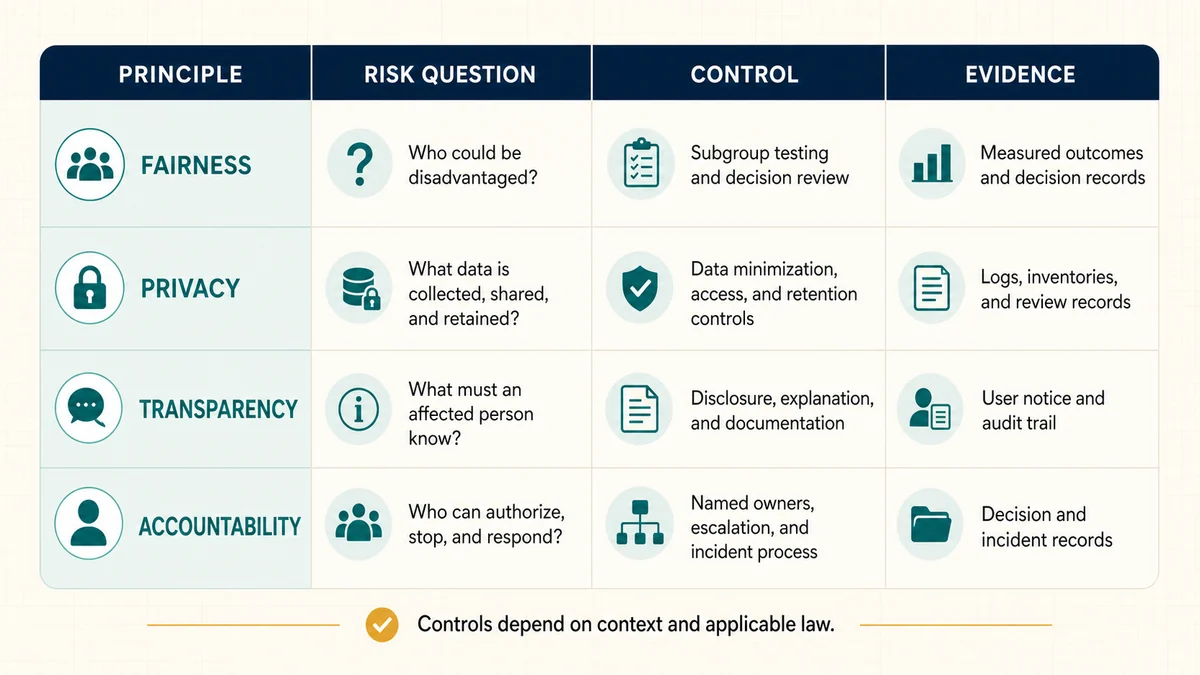
Principles become useful when they are translated into risk questions, controls, accountable owners, and evidence.
On small screens, scroll horizontally to compare the four columns. Keyboard users can focus the table and use the left and right arrow keys.
| Principle | Risk question | Example control | Evidence |
|---|---|---|---|
| Fairness | Who could be disadvantaged? | Subgroup testing and decision review | Measured outcomes and documented decisions |
| Privacy | What data is collected, shared, and retained? | Minimization, access, and retention controls | Logs, inventories, and review records |
| Transparency | What must an affected person know? | Disclosure, explanation, and documentation | User notice and audit trail |
| Accountability | Who can authorize, stop, and respond? | Named owners, escalation, and incident process | Decision and incident records |
Controls must be adapted to the use case, affected people, evidence, and applicable law.
A Practical Responsible-AI Process
Organizations can translate ethical principles into operating practice through six recurring activities:
- Govern: Define the intended use, affected people, accountable owners, legal obligations, and decision authority.
- Map: Identify foreseeable harms, misuse, affected populations, data dependencies, and system context.
- Measure: Test reliability, fairness, privacy, security, robustness, and other relevant impacts using methods appropriate to the use case.
- Manage: Decide whether deployment should proceed, define mitigations, establish human-control and escalation requirements, and document limitations.
- Monitor: Track real-world behavior, incidents, complaints, and changes in models, data, suppliers, laws, or use cases.
- Reassess: Revisit whether the system remains appropriate as evidence and context change.
This process follows the logic of NIST’s Govern–Map–Measure–Manage framework while making monitoring and reassessment explicit. It is a starting structure, not a universal checklist.
Ethical Questions by Application
The principles are broad, but their consequences depend on the setting. These guides examine sector-specific use and risk:
- AI in Healthcare
- AI in Finance
- AI in Education
- AI in Social Media
- AI in Agriculture — farmer-data rights, data sovereignty, and smallholder access to digital tools.
For longer-term scenarios and forecasts, see The Future of Artificial Intelligence.
Frequently Asked Questions
What are the main ethical concerns with AI?
Common concerns include fairness, discrimination, privacy, transparency, accountability, safety, security, human autonomy, labor impacts, and misuse. The importance of each concern depends on the system and its real-world context.
Is ethical AI the same as legal compliance?
No. Law establishes enforceable obligations, while ethics considers broader questions of harm, fairness, responsibility, power, and acceptable use. A system can satisfy a minimum legal rule and still raise ethical concerns.
Can AI be completely unbiased?
No system should be assumed to be universally unbiased. Bias and fairness depend on data, definitions, populations, objectives, deployment context, and how outcomes are measured. Different fairness goals may also conflict.
Who is responsible when AI causes harm?
Responsibility depends on the situation and applicable law, but organizations and people involved in designing, procuring, deploying, authorizing, and using AI cannot simply transfer accountability to the model.
Does human review make an AI system ethical?
Not automatically. Human review is meaningful only when reviewers have sufficient information, time, expertise, independence, and authority to change or stop the outcome.
Sources & Further Reading
- OECD AI Principles — Human rights, fairness, transparency, safety, and accountability.
- NIST AI RMF Core — Govern, Map, Measure, and Manage across the AI lifecycle.
- UNESCO Recommendation on the Ethics of Artificial Intelligence — Human oversight, remedies, and environmental sustainability.
- European Commission Article 50 transparency guidelines — Guidance on the EU AI Act’s transparency obligations for certain AI systems.
Conclusion
AI ethics is not a label that can be attached to a model after development. It is an ongoing practice of identifying affected people, examining risks and tradeoffs, assigning responsibility, testing controls, documenting evidence, and responding when conditions change.
The most responsible question is not simply, “Is this AI ethical?” It is: What could happen in this specific system, who could be affected, who is accountable, and what evidence shows that the safeguards work?
Next: AI in Governance. See how public institutions translate ethical principles into ownership, oversight, monitoring, and remedies. Keep Model Evaluation Metrics Explained as a supporting guide to measurement.