
Updated August 27, 2026
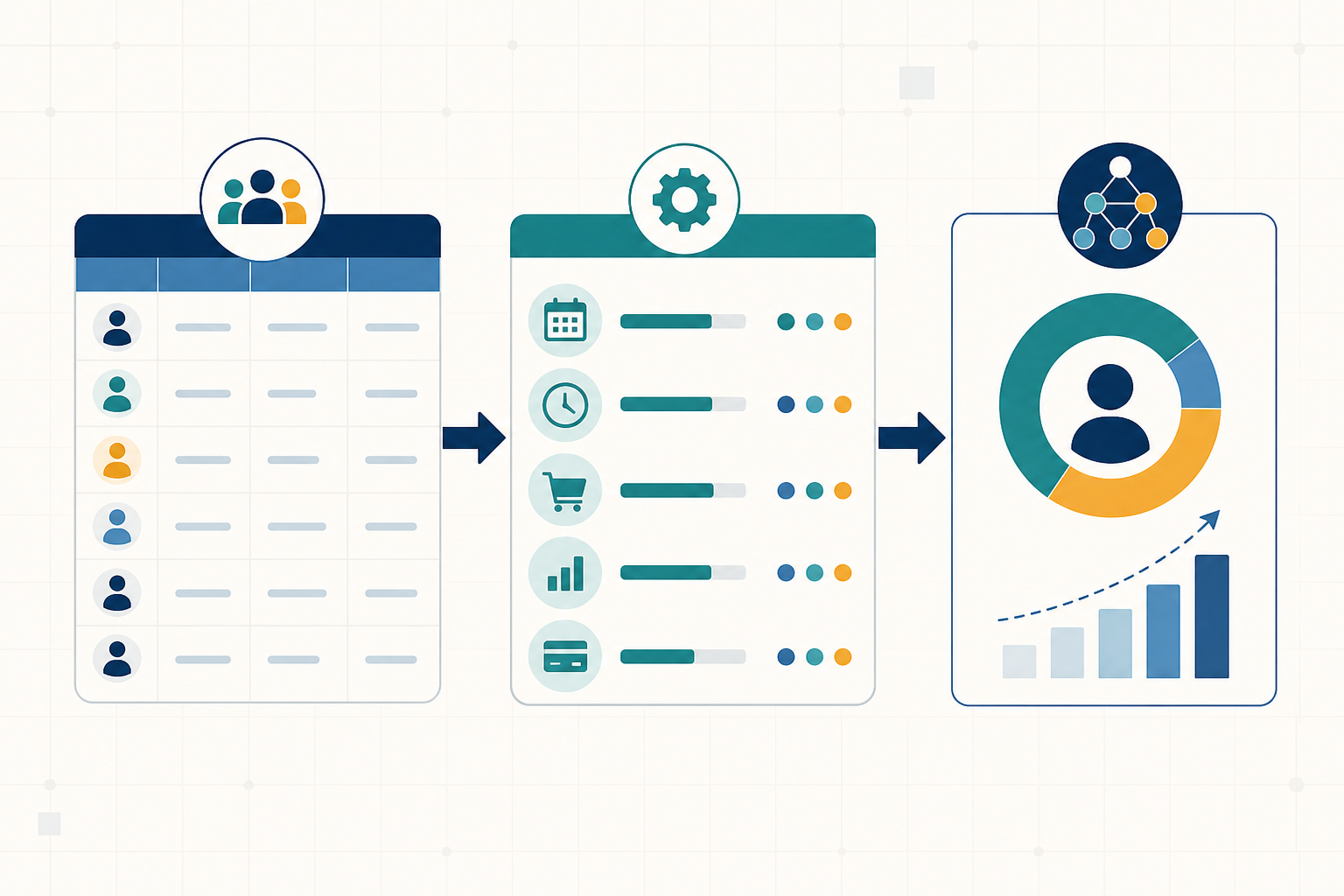
Feature engineering turns available or prepared data into useful inputs that help a machine learning model recognize patterns. It is the step where you decide what information the model should learn from—and how that information should be represented.
This lesson follows Data Preprocessing Explained. If you are new to training, validation, and test sets, review Training vs Testing Data first. Those boundaries are essential because feature engineering must not leak information from validation or test data into training.
What Is Feature Engineering?
A feature is an input variable or representation a model uses to learn patterns or perform a task, such as prediction or clustering. Feature engineering is the process of creating, transforming, or representing those inputs so they better describe the problem you want the model to solve.
Suppose an online service wants to predict whether a customer may cancel. Its raw records might contain a signup date, login timestamps, plan type, and support history. Useful engineered features could include:
- account age in days
- number of logins during the last 30 days
- days since the most recent login
- support requests during the last 90 days
- whether recent usage is increasing or decreasing
These features summarize behavior in a form the model can use. They are not automatically better, though. Each one must be available at prediction time, created without leakage, and tested against a baseline.
Preprocessing vs Feature Engineering
The two stages overlap, but they answer different questions:
| Stage | Main question | Examples |
|---|---|---|
| Data preprocessing | How do we make the data consistent and usable? | Correct types, handle missing values, remove invalid records |
| Feature engineering | How should the problem be represented for the model? | Create time windows, ratios, interaction terms, or domain-specific summaries |
| Feature selection | Which available features should the model keep? | Remove redundant, unstable, or unhelpful inputs |
| Feature extraction | Can existing information be represented in a smaller or different form? | PCA, embeddings, learned image representations |
Scaling and encoding are often described as preprocessing, feature engineering, or both. The label matters less than applying the transformation correctly and consistently.
A Leakage-Safe Feature Engineering Workflow
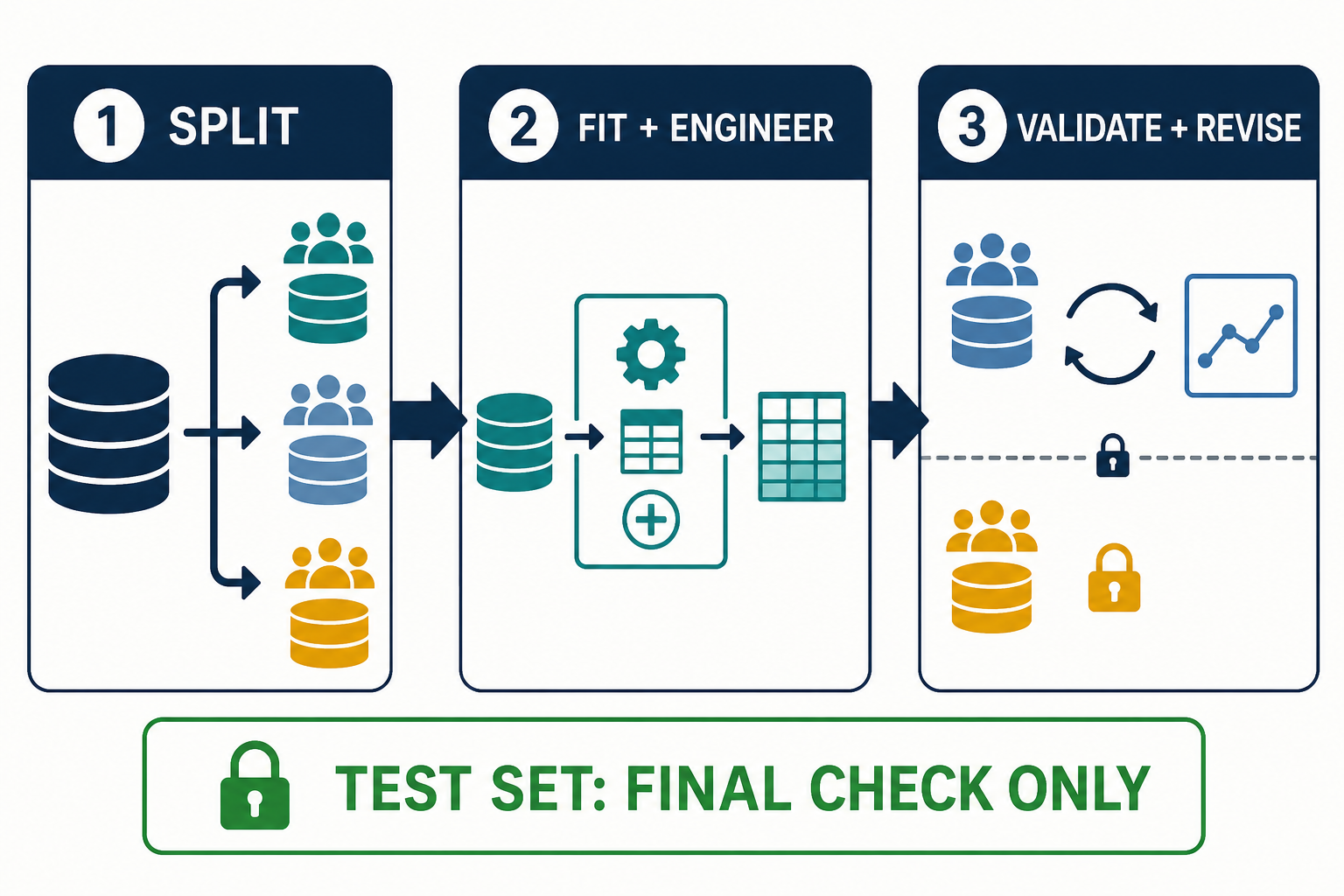
1. Define the prediction and prediction time
State exactly what the model will predict and when it will make that prediction. For a churn model, the question might be: “Using information available at the end of today, will this customer cancel within the next 30 days?” This prevents features from accidentally using future information.
2. Split the data before learning transformations
Create training, validation, and test sets before calculating statistics used by transformations. For time-dependent data, a chronological split is often more realistic than a random split.
3. Build a simple baseline
Train a reasonable model with a small set of defensible features. Record the validation metric that matches the real goal. A baseline gives you something concrete to improve instead of assuming every new feature helps.
4. Learn feature rules from training data only
Any transformation learned from the data—such as an imputation statistic, category vocabulary, scaling parameter, or feature-selection rule—must be fitted without using the held-out test set. Fit preprocessing steps on the training data, then apply those learned steps unchanged to validation data.
5. Compare on validation data
Add a candidate feature or a small, related group of features. Retrain the pipeline and compare validation performance with the baseline. Also check stability, interpretability, fairness, and whether the feature will be available reliably in production. Repeatedly choosing features based on the same validation results can overfit the development process, so larger projects may use cross-validation or a separate development holdout.
6. Keep the test set untouched
Use validation data for feature decisions. Use the test set only after the feature pipeline and model choices are settled, so it provides a more honest final estimate of performance on unseen data.
Common Feature Engineering Techniques
Dates and time windows
A timestamp can become day of week, hour of day, time since an event, or activity during a defined recent window. Time windows must end at the prediction time; otherwise they can reveal the future.
Counts, rates, and ratios
Raw events can become purchases per month, support requests per active week, or successful deliveries divided by total deliveries. Ratios need careful handling when the denominator can be zero or very small.
Categorical representations
Categories such as plan type or device class may be one-hot encoded, ordinally encoded when a true order exists, or represented with another method appropriate to the model. High-cardinality categories require special care because rare values and target-based encodings can overfit. Target-based encodings need extra care: create out-of-fold encodings for training rows, fit mappings within each training fold, and apply them to validation or test rows without using those rows’ labels.
Scaling and transformations
Standardization, normalization, and log transformations can help models that are sensitive to feature scale or highly skewed distributions. Scaling is important for methods such as k-nearest neighbors and many linear or gradient-based models, but tree-based models generally do not require it.
Interactions and domain knowledge
Sometimes two values become informative only when combined. Distance divided by travel time suggests speed, for example. Domain knowledge can reveal useful relationships, but it can also encode bias or assumptions that must be reviewed.
The Most Important Mistake: Data Leakage
Data leakage happens when a feature contains information that would not be available when the real prediction is made, or when information from validation or test data influences training.
For example, if you are predicting whether a customer will cancel next month, “final cancellation reason” cannot be a feature because it is recorded only after cancellation. Likewise, calculating an imputation mean across the full dataset allows validation and test records to influence the training process.
A practical safeguard is to keep preprocessing, feature creation, and modeling inside one reproducible pipeline. Scikit-learn’s documentation explains how pipelines help prevent leakage by ensuring transformations are fitted on the appropriate data: Common pitfalls and recommended practices.
How to Decide Whether a Feature Is Useful
A feature earns its place when it improves the system—not merely because it sounds clever. Ask:
- Is it available at prediction time?
- Can the same calculation run reliably in production?
- Does it improve the chosen validation metric?
- Is the improvement stable across appropriate validation splits?
- Does it introduce bias, privacy concerns, or a fragile dependency?
- Is the added complexity worth the benefit?
Feature importance scores can help investigate a trained model, but they do not prove that a feature causes the outcome. They also do not replace validation.
Feature Engineering and Deep Learning
Deep learning can learn useful representations directly from images, audio, and text, reducing some manual feature design. It does not eliminate the need to define targets, prevent leakage, choose time windows, represent context, and build reliable input pipelines. For structured business data, thoughtful feature engineering often remains valuable.
Key Takeaways
- Feature engineering creates or transforms the inputs a model learns from.
- Preprocessing makes data usable; feature engineering represents the modeling problem.
- Split the data before learning any transformation parameters.
- Fit feature rules on training data and compare choices on validation data.
- Keep the test set untouched until final evaluation.
- A feature should be available, reproducible, responsible, and demonstrably useful.
Frequently Asked Questions
What is feature engineering in simple terms?
It is the process of turning available data into useful model inputs. For example, a signup date can become account age at the moment a prediction is made.
What is the difference between preprocessing and feature engineering?
Preprocessing focuses on making data consistent and usable. Feature engineering focuses on representing the problem with informative inputs. Some transformations can reasonably belong to both stages.
Does every model need feature scaling?
No. Scale-sensitive methods often benefit from it, while decision trees and tree ensembles generally do not require scaling.
Can feature engineering reduce overfitting?
It can help when irrelevant or noisy inputs are replaced with stable, meaningful features, but it can also increase overfitting when too many highly tailored features are created. Validation determines which effect occurred.
What tools are commonly used?
Python libraries such as pandas and scikit-learn are common for structured data. The best tool depends on the data type, model, scale, and production environment.
Sources and Further Reading
- scikit-learn: Common pitfalls and data leakage — training-only transformations and pipelines.
- scikit-learn: TargetEncoder — target-based encoding and cross-fitting.
Continue the Learning Path
Prerequisite: Data Preprocessing Explained
Next lesson: Feature Selection vs Feature Extraction
After that, learn how to measure whether changes actually help in Model Evaluation Metrics Explained.