
Last reviewed: August 2026
AI in healthcare—also called medical AI or artificial intelligence in medicine—uses technologies such as machine learning, computer vision, natural language processing, and generative AI for defined clinical, administrative, and research tasks. Examples include analyzing medical images, drafting clinical notes, estimating risk, monitoring patients, and helping researchers prioritize drug candidates.
These systems do not all have the same purpose, evidence requirements, or risks. A scheduling tool, a note-drafting assistant, a research model, and an authorized medical device require different forms of validation and oversight. Model accuracy alone does not prove clinical benefit, and an AI output should not replace qualified medical judgment.
Educational information only: This guide explains healthcare technology, not individual medical care. It is not medical advice and should not be used to diagnose or treat a condition.
This beginner-friendly guide covers how AI is used in medicine, its potential benefits, its risks and limitations, and how evidence, regulation, privacy, bias, security, and human oversight shape responsible use.

What Is AI in Healthcare?
AI in healthcare refers to computer systems that use methods such as machine learning, computer vision, natural language processing, or generative models to perform a healthcare-related task.
Depending on the system, that task might involve:
- Analyzing an image.
- Estimating a risk.
- Organizing or retrieving information.
- Drafting or summarizing text.
- Supporting research.
- Automating an administrative workflow.
- Providing information for a clinical decision.
The output may be a label, score, alert, measurement, ranked list, generated summary, or recommendation. The meaning of that output depends on the system’s intended use and the evidence supporting it.
If you are new to the broader field, begin with What Is Artificial Intelligence? and Machine Learning Explained.
Where AI Is Used in Healthcare
Medical imaging
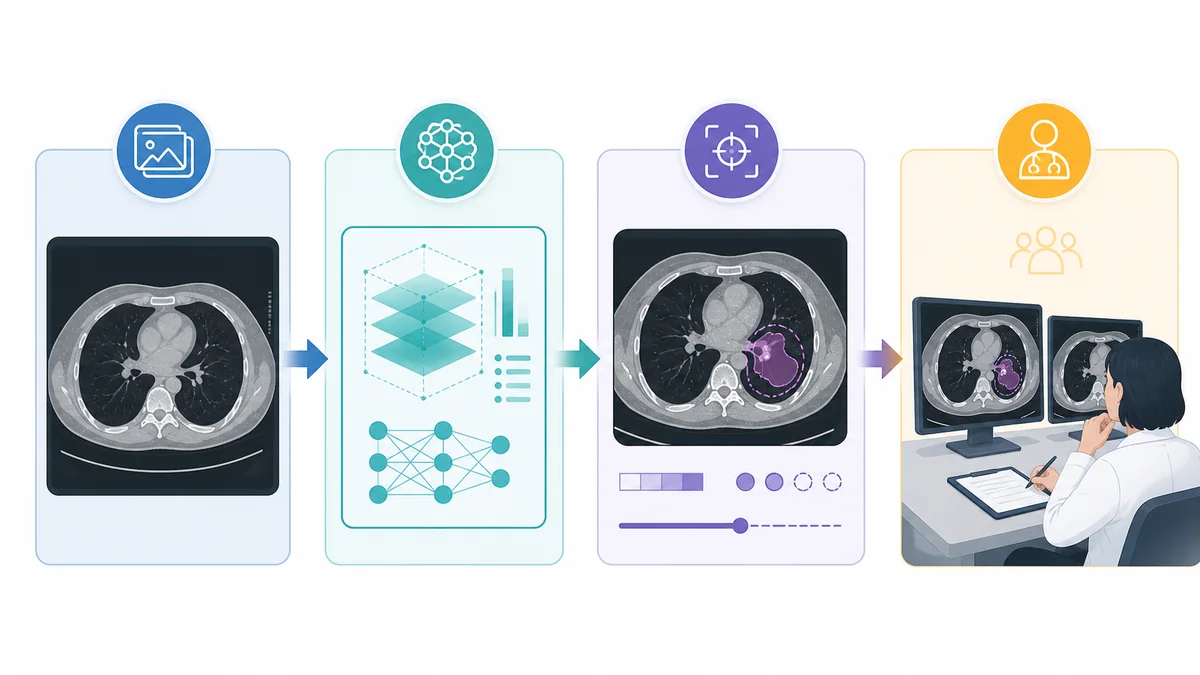
Computer-vision systems can help analyze X-rays, CT scans, MRIs, pathology slides, retinal images, and other medical imagery.
Depending on the authorized or validated use, a system may:
- Flag a case for review.
- Detect or measure a pattern.
- Segment an anatomical structure.
- Prioritize a worklist.
- Support a healthcare professional’s interpretation.
Performance on one imaging task does not establish that a system works equally well for another disease, population, device, or clinical setting.
The U.S. Food and Drug Administration maintains an AI-Enabled Medical Device List. FDA explains that listed devices met applicable premarket requirements for their authorized intended uses, while also noting that the list is not comprehensive and is updated periodically.
Learn the underlying visual concepts in Computer Vision Explained.
Clinical decision support
Clinical decision-support systems can analyze patient information and provide alerts, risk estimates, recommendations, or other information to healthcare professionals.
The phrase “human in the loop” is not enough by itself. Meaningful review requires appropriate information, time, expertise, authority, and a workflow in which the responsible person can act on concerns.
In the United States, FDA’s January 2026 Clinical Decision Support Software guidance explains that certain software functions can be excluded from the medical-device definition when statutory criteria are met, while other software functions remain subject to device oversight. The distinction depends on what the software is intended to do and whether a healthcare professional can independently review the basis for a recommendation—not merely on whether a clinician is nominally present.
Documentation and administrative work
Natural-language systems can support:
- Clinical note drafting and summarization.
- Coding assistance.
- Prior-authorization workflows.
- Patient-message drafting.
- Information retrieval.
- Scheduling and administrative processing.
These uses may reduce clerical work in some settings, but generated text can omit context or introduce errors. Scheduling and document routing are administrative tasks; generated clinical notes or patient messages can influence care even when presented as paperwork. Clinical content should receive safeguards and review proportionate to its consequence.
Learn more in What Is Natural Language Processing?.
Risk prediction and patient monitoring
Models can estimate risks such as deterioration, readmission, or other outcomes. Monitoring systems may combine clinical data, sensors, or wearable devices to identify changes that warrant review.
A risk score is not automatically a diagnosis. Its usefulness depends on factors such as:
- Validation in the relevant population.
- Calibration.
- Data quality.
- Workflow integration.
- Alert burden.
- How healthcare professionals respond.
- Whether performance changes after deployment.
Drug discovery and biomedical research
AI is used in molecular modeling, protein analysis, target identification, candidate prioritization, and other research activities.
These tools can help researchers explore possibilities, but a promising model output or laboratory result is not an approved treatment and does not demonstrate patient benefit. Research candidates still require appropriate laboratory, clinical, and regulatory evaluation.
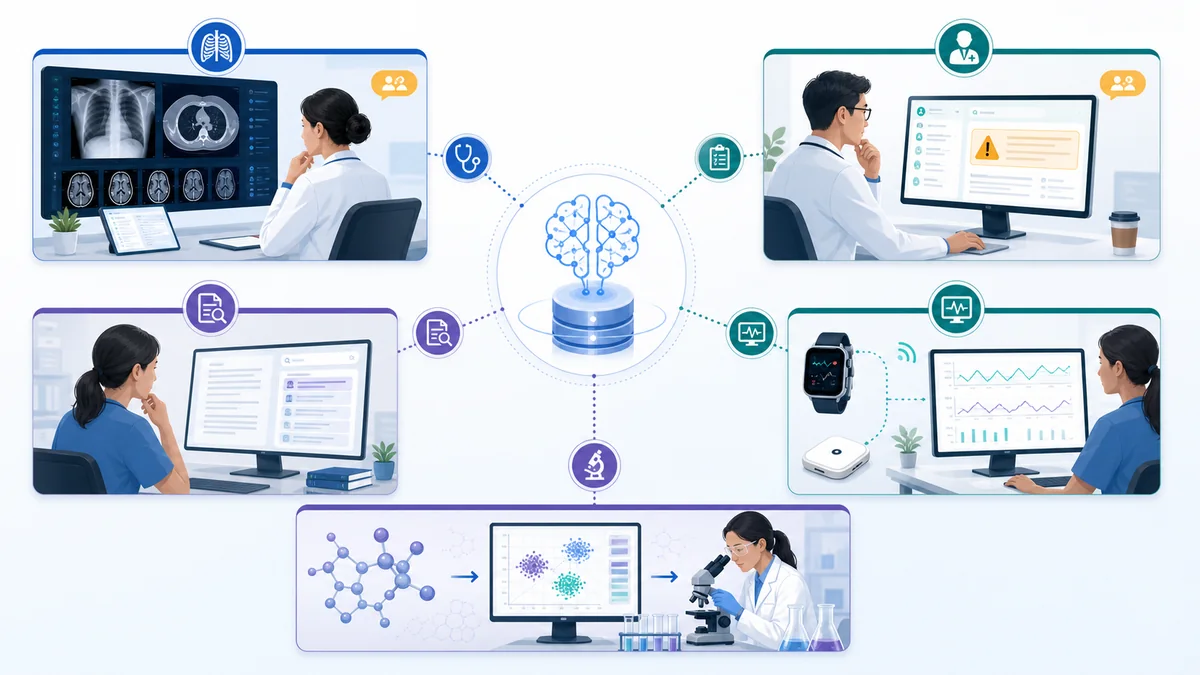
A map of healthcare-AI applications
Healthcare AI spans clinical, administrative, and research settings. Systems with different intended uses should not be evaluated or governed as though they present the same risks. For a related look at physical systems, see AI in Robotics, which distinguishes robotic hardware from AI capabilities.
Generative AI in Healthcare
Generative AI can draft notes, summarize records, answer questions, retrieve or synthesize information, and assist with administrative work.
It can also produce unsupported statements, omit clinically important details, expose sensitive data, or encourage overreliance when fluent wording is mistaken for validated evidence.
The World Health Organization’s guidance on large multimodal models for health emphasizes governance, transparency, safety, accountability, equity, and rigorous evaluation.
In the United States, the regulatory approach to generative-AI-enabled medical devices is still developing. On August 18, 2026, FDA opened a public discussion concerning generative-AI-enabled medical devices. The discussion includes risk assessment, premarket evaluation, foundation models, agentic systems, and postmarket monitoring. It should be understood as an active policy-development process rather than a settled universal framework.
A low-consequence drafting assistant and a system that influences treatment should not receive identical controls.
Read What Is Generative AI?.
Potential Benefits of AI in Healthcare
Depending on the technology and setting, potential benefits may include:
- Faster analysis of selected information.
- More consistent execution of a narrowly defined task.
- Support for documentation or information retrieval.
- Earlier identification of some patterns for review.
- Better organization of complex datasets.
- Research support and candidate prioritization.
- Expanded monitoring or remote-care workflows.
These are possibilities, not automatic outcomes. A healthcare organization still needs evidence that the system performs appropriately for its patients, staff, devices, data, and workflow.
Statements such as “AI improves accuracy,” “AI reduces burnout,” or “AI improves outcomes” are incomplete unless they identify the system, comparison, setting, and evidence.
Model Accuracy Is Not the Same as Clinical Benefit
A model can perform well on a benchmark and still fail to improve healthcare in practice.
Deployment problems can arise from:
- Differences between training data and local patients.
- Poor calibration.
- Missing or changing data.
- Workflow mismatch.
- Alert fatigue.
- Automation bias.
- Unequal subgroup performance.
- Data drift after deployment.
- Unclear responsibility when something goes wrong.
Healthcare-AI evaluation should therefore examine more than model-level accuracy. It should consider clinical usefulness, failure modes, workflow effects, subgroup performance, security, human factors, and monitoring after deployment. The American Heart Association’s science advisory recommends evaluation before deployment, during implementation and after deployment.
For measurement fundamentals, see Model Evaluation Metrics Explained.
Risks and Challenges
Bias and health equity
Performance can differ across populations when data, labels, measurement practices, access to care, or historical decisions reflect unequal conditions.
Teams should evaluate clinically relevant populations and examine who is harmed by false positives, false negatives, missing data, or unequal access. A single universal fairness score cannot answer every healthcare-equity question. WHO’s ethics and governance guidance emphasizes safety, accountability and equitable access across the design, deployment and use of health AI.
Privacy and security
Healthcare data may contain highly sensitive information. Organizations need to consider:
- Applicable health-data and privacy laws.
- Whether information is sent to external providers.
- Data retention and logging.
- Access controls.
- Re-identification risks.
- Security of models, interfaces, and connected tools.
- Secondary use of patient or clinical data.
Incorrect or unsupported output
Predictive and generative systems can produce incorrect results. Fluent wording, a confidence score, or an attractive visualization does not guarantee correctness.
Overreliance and automation bias
People may accept a system’s recommendation too readily, especially when workloads are high or the output appears authoritative. Effective oversight should account for real working conditions, not an idealized review process.
Transparency and accountability
Healthcare organizations need clear information about intended use, limitations, inputs, updates, performance, and responsibility. If professionals cannot meaningfully evaluate a consequential recommendation, nominal review may provide little protection.
Read AI and Ethical Considerations.
Regulation and Oversight
Healthcare-AI regulation depends on the function, jurisdiction, users, claims, and deployment context.
Regulatory authorization is connected to a defined intended use. It should not be interpreted as proof that a product is appropriate for every patient, institution, workflow, population, or off-label purpose.
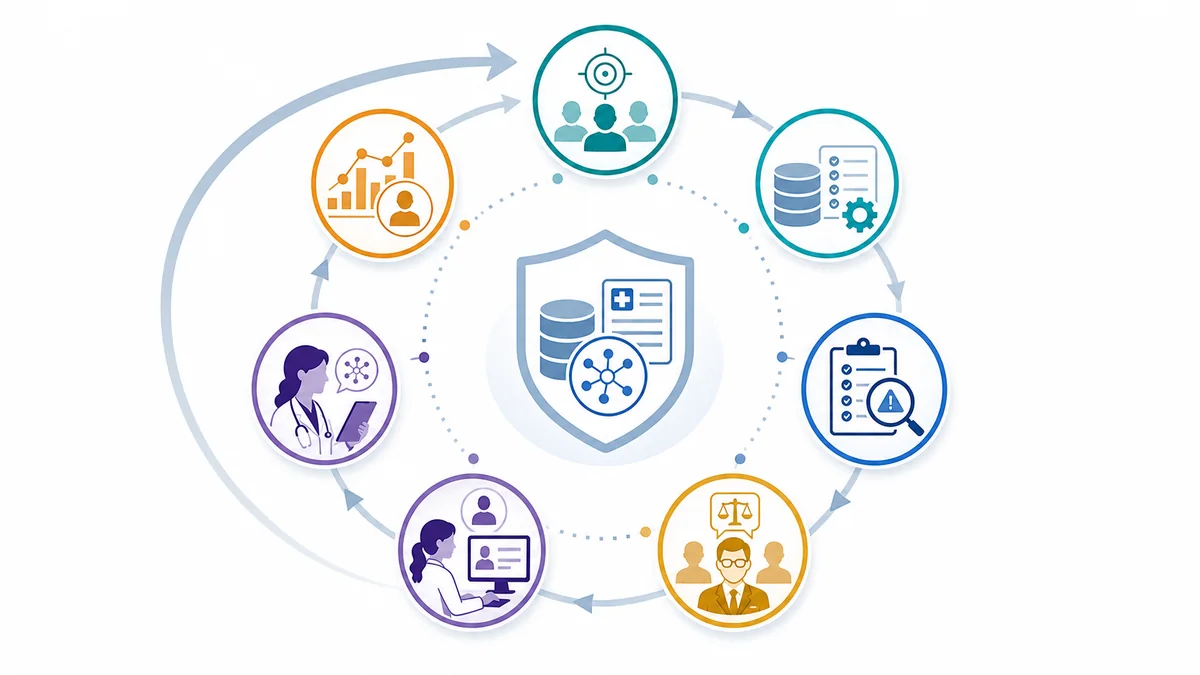
A responsible evidence-and-oversight lifecycle may include:
- Define the intended use and users.
- Document development data and assumptions.
- Validate performance and failure modes.
- Complete applicable regulatory and organizational review.
- Integrate the system into a real workflow.
- Provide meaningful professional oversight.
- Monitor performance, safety, equity, and change after deployment.
Will AI Replace Doctors and Nurses?
AI can automate or assist particular tasks, but healthcare involves responsibilities that extend beyond producing a model output. Clinical work includes judgment, communication, physical care, coordination, accountability, and understanding a patient’s circumstances.
The more useful question is not whether AI will replace an entire profession. It is which tasks may change, which evidence supports those changes, who remains responsible, and how patients and healthcare workers are affected.
What to Watch Next
Important areas to monitor include:
- Clinical and administrative generative-AI use.
- Multimodal systems combining text, images, and other data.
- AI-enabled medical-device policy.
- Agentic systems and connected clinical tools.
- Real-world post-deployment monitoring.
- Privacy, cybersecurity, bias, and health-equity safeguards.
- Evidence connecting AI use to patient and workforce outcomes.
These are evidence questions, not guaranteed predictions. See The Future of Artificial Intelligence for broader scenarios.
Frequently Asked Questions
What is AI in healthcare?
AI in healthcare is the use of artificial-intelligence methods for healthcare-related tasks such as image analysis, documentation, risk estimation, monitoring, decision support, and research.
Can AI diagnose patients?
Some authorized systems support detection or diagnostic workflows, but capabilities and intended uses vary. AI should not be described as universally diagnosing patients on its own.
Is generative AI safe for medical advice?
Generative models can produce incorrect or incomplete medical information. Safety depends on the system, use, evidence, controls, and oversight. Individual medical decisions should be made with qualified healthcare professionals rather than unverified model output.
Is healthcare AI regulated?
Many healthcare-AI functions are regulated, but treatment depends on the function, claims, users, jurisdiction, and relevant legal definitions.
Does FDA authorization mean an AI system is safe for every use?
No. Authorization is tied to a defined intended use and supporting evidence. It does not establish suitability for every patient, workflow, population, institution, or off-label purpose.
Will AI replace healthcare professionals?
AI may change or automate particular tasks, but healthcare still requires professional judgment, responsibility, communication, coordination, and physical care.
Where to Learn Next
Recommended next guide: Real-World Applications of AI. Compare how AI is used across different fields, then use the specialist guides below to go deeper.
- Computer Vision Explained — understand medical-image analysis foundations.
- What Is Natural Language Processing? — explore clinical text and documentation systems.
- Model Evaluation Metrics Explained — learn why different errors and metrics matter.
- What Is Generative AI? — understand generative-model fundamentals.
- AI and Ethical Considerations — go deeper into accountability, bias, privacy, and governance.
Want clear, evidence-conscious AI explanations by email? Join AllForTheAI for free beginner education without the hype.
About the Author and Review
Christos Adam Lee writes and edits AllForTheAI’s beginner-focused guides. This article’s regulatory and technical framing was reviewed in August 2026 against current FDA, WHO, and healthcare-AI evaluation resources. Read the Editorial Policy for sourcing, corrections, review, and AI-assistance standards.
How This Guide Was Reviewed
The review separated research, administrative use, clinical decision support, and regulated medical-device functions. General benefit claims were removed unless they could be framed as use- and evidence-dependent. Regulatory authorization was treated as specific to intended use, and model performance was separated from clinical utility and patient outcomes.
Sources and Further Reading
- FDA: Artificial Intelligence-Enabled Medical Devices
- FDA: Clinical Decision Support Software Guidance, January 2026
- FDA: Generative AI-Enabled Medical Devices Discussion, August 18, 2026
- WHO: Ethics and Governance of Artificial Intelligence for Health
- WHO: Guidance on Large Multimodal Models for Health
- WHO European Observatory: Demystifying Artificial Intelligence in Health, 2026
- American Heart Association: Pragmatic Evaluation and Monitoring of AI in Health Care