Deep Learning

Deep learning explained in simple terms—neural networks with multiple layers, how training works, and where deep learning is used in vision, language, generative AI, and other fields.

Start Here: What Is Deep Learning? A Beginner’s Guide →

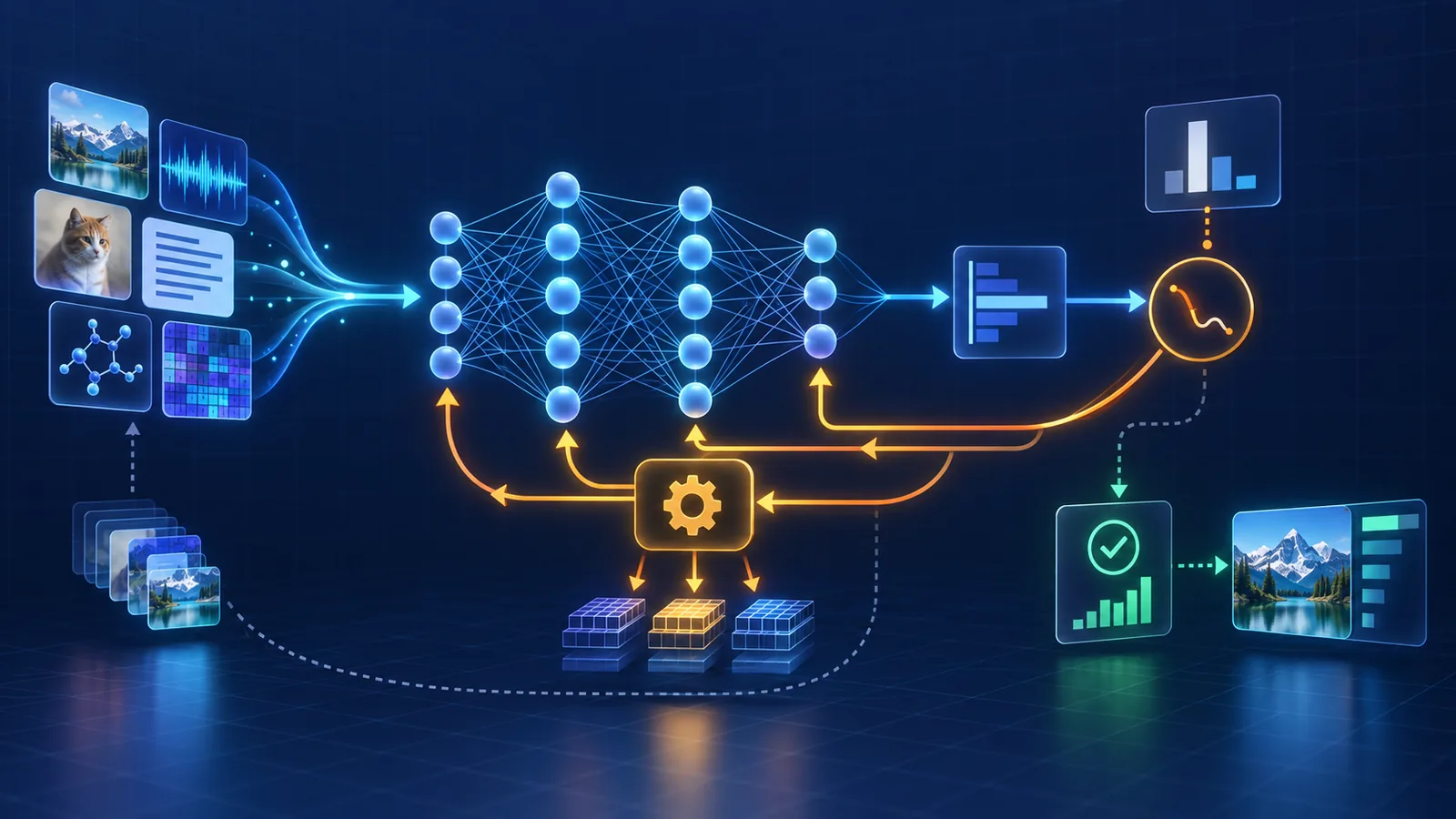
Training data moving through a neural network, loss calculation, gradient feedback, optimizer updates, validation, and inference

How Deep Learning Works (Beginner-Friendly Guide)

Deep learning models do not simply “get smarter” each time they see data. They are trained through a controlled loop: process a batch, measure a loss, compute gradients, update parameters, and repeat—then evaluate on data that was not used for those updates. This beginner-friendly Lesson 9 explains that complete workflow, from the first training batch

How Deep Learning Works (Beginner-Friendly Guide) Read More »

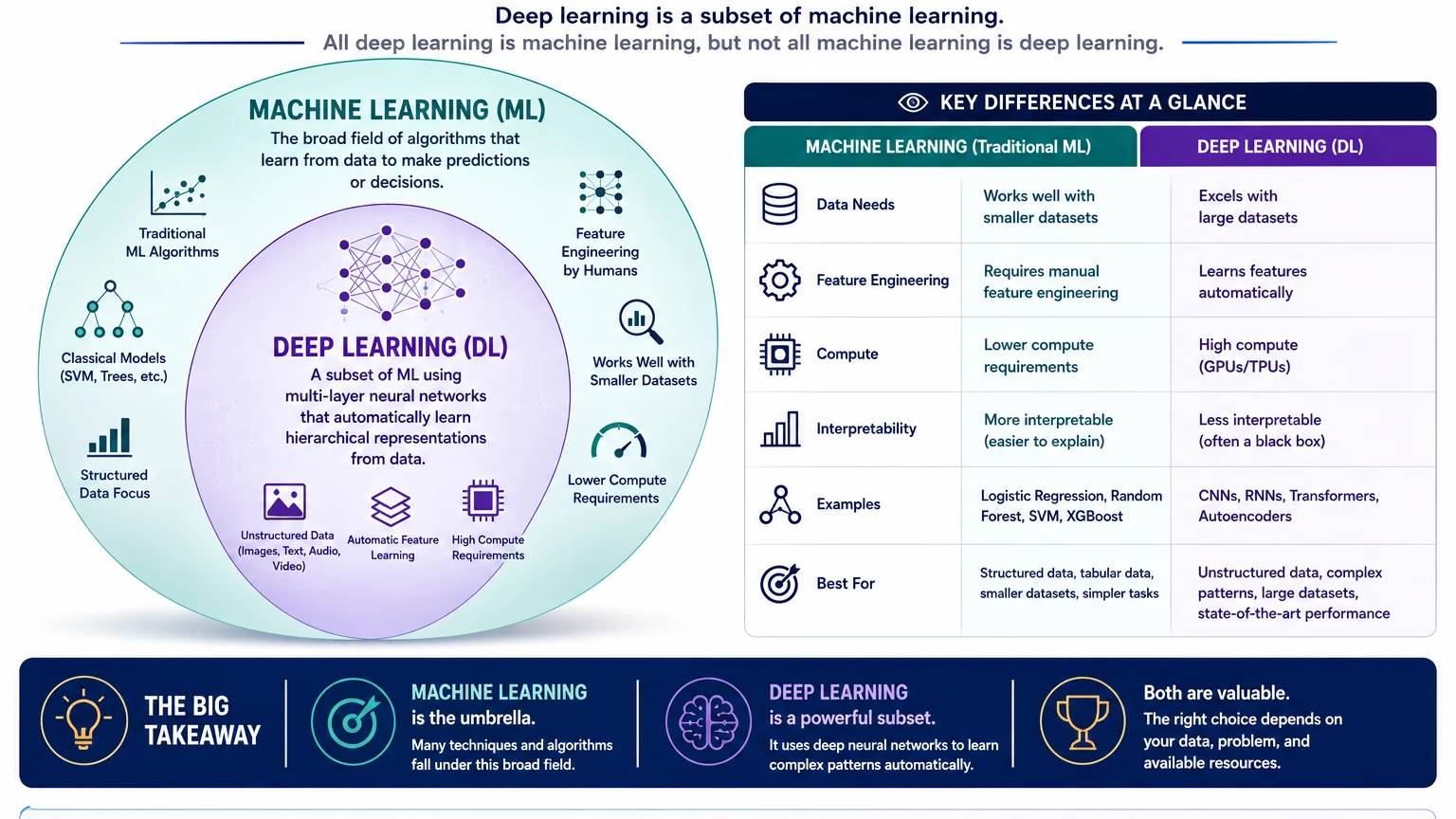
Comparison showing deep learning as a subset of machine learning, with traditional machine-learning methods alongside multilayer neural networks and their common data types and use cases.

Deep Learning vs Machine Learning: Key Differences Explained

Deep learning and machine learning are not separate competing fields. Deep learning is a subset of machine learning that uses multilayer neural networks. The practical question is therefore not usually “machine learning or deep learning?” It is whether a particular problem benefits from a deep neural-network approach or from another machine-learning method. Last reviewed and

Deep Learning vs Machine Learning: Key Differences Explained Read More »

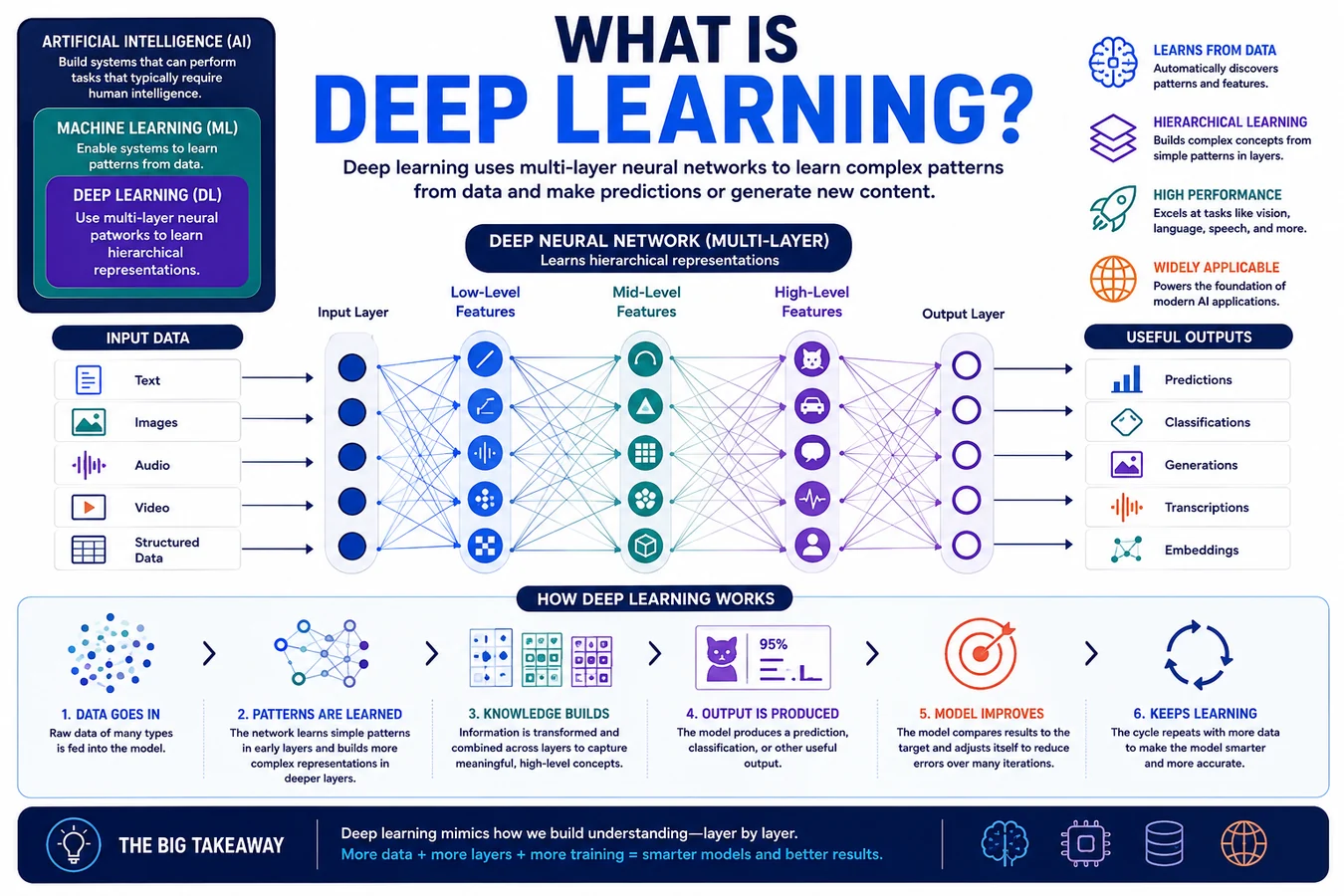
Deep learning illustration showing image, text, audio, and video inputs passing through multiple neural-network layers to produce predictions, generated outputs, and learned representations.

What Is Deep Learning? A Beginner’s Guide

Deep learning is a branch of machine learning built around neural networks with multiple layers of learned representations. It is responsible for many of the advances behind modern computer vision, speech recognition, language models, generative AI, and multimodal systems. The word deep refers to the use of multiple computational layers—not to a system having deeper

What Is Deep Learning? A Beginner’s Guide Read More »

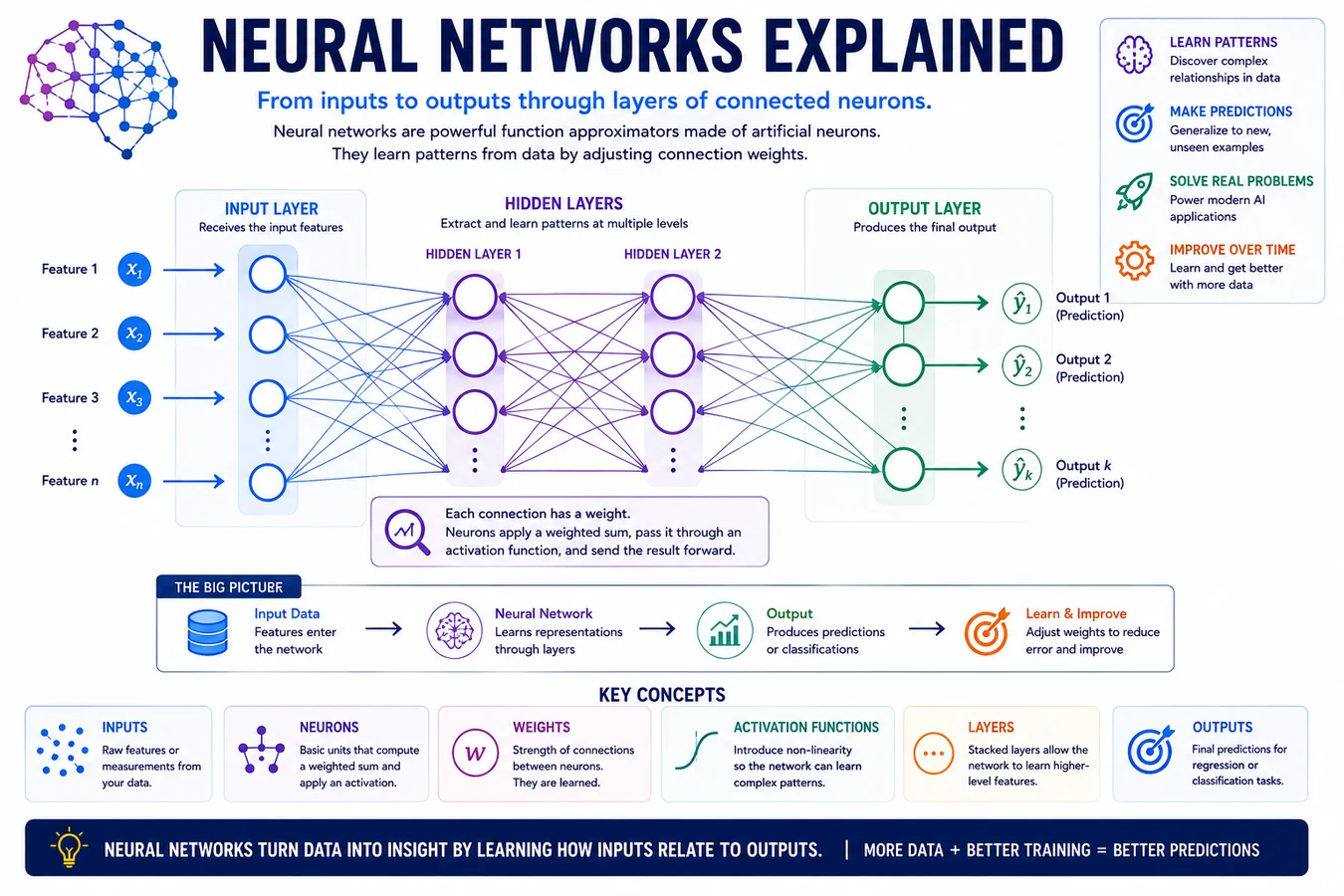
Neural network diagram showing input features passing through connected hidden layers with learned weights to produce an output prediction.

Neural Networks Explained: How They Work and Why They Matter

A neural network is a machine-learning model built from layers of connected computational units. These units transform numerical inputs using learned weights, biases, and nonlinear functions so the network can approximate useful relationships in data. Google’s current Machine Learning Glossary provides a useful technical reference for neural-network, neuron, activation-function, and backpropagation terminology. Neural networks power

Neural Networks Explained: How They Work and Why They Matter Read More »

Generative Pre-Trained Transformer (GPT)

Exploring the Impact of Generative Pre-trained Transformers (GPT)

Generative Pre-trained Transformers (GPT) have transformed the field of artificial intelligence (AI), especially in how computers handle human language. Created by OpenAI, GPT models can understand and generate text that sounds like it was written by a person. 1. What Are Generative Pre-trained Transformers (GPT)? Definition and Purpose Generative Pre-trained Transformers (GPT) are advanced AI

Exploring the Impact of Generative Pre-trained Transformers (GPT) Read More »

Scroll to Top