
Artificial intelligence is used across financial services to help analyze data, detect suspicious activity, support credit and risk decisions, process documents, assist customers, and automate parts of research and operations. But AI does not automatically make finance more accurate, profitable, fair, or safe. Its value depends on the problem, the data, the model, the controls around it, and how people use the output.
This beginner-friendly guide explains what AI in finance actually means, where it is used today, how machine learning and generative AI fit in, and why model risk, privacy, cybersecurity, regulation, and human oversight matter.
If you are new to the topic, start with What Is Artificial Intelligence? and Machine Learning Explained. For the wider industry map, see Real-World Applications of AI.
Published April 11, 2024 · Updated October 1, 2026
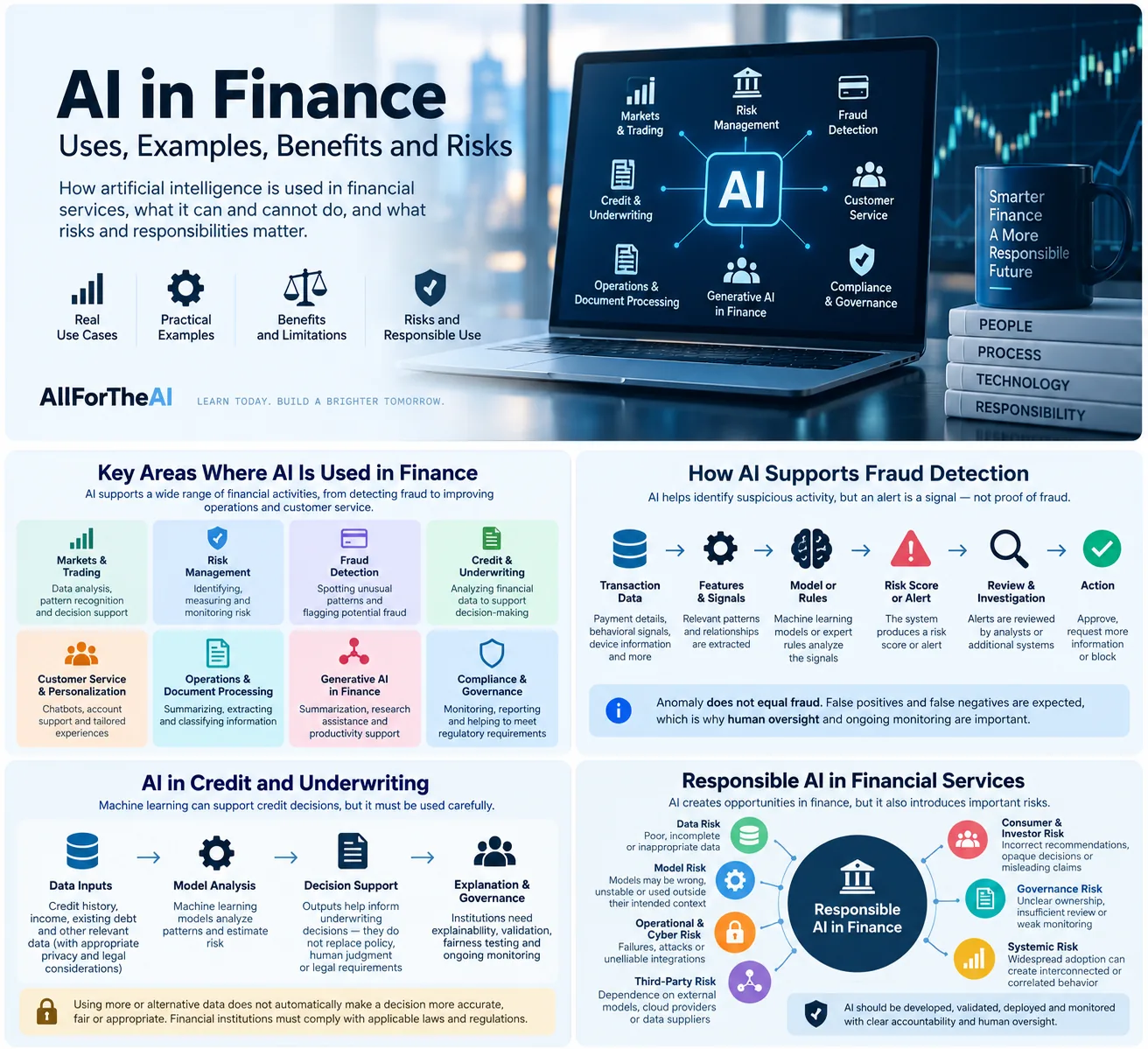
What does AI in finance mean?
AI in finance refers to the use of AI methods—such as machine learning, natural language processing, anomaly detection, and generative models—to support financial tasks. These systems can classify information, estimate risk, rank or score cases, extract data from documents, generate text, identify patterns, or help people make decisions.
Not every automated financial system is AI. A fixed rule that says “flag any transaction over a chosen threshold” is automation. A model that learns patterns from historical examples and produces a risk score is a machine-learning system. Likewise, algorithmic trading is not automatically AI: an algorithm can follow fixed rules without learning from data.
| Approach | What it does | Finance example |
|---|---|---|
| Rules / automation | Follows predefined logic | Route transactions that meet fixed criteria for review |
| Machine learning | Learns patterns from data to produce predictions, scores, or classifications | Fraud-risk scoring or credit-risk estimation |
| Natural language processing | Works with text and language | Extract clauses from contracts or summarize reports |
| Generative AI | Generates or transforms text, code, images, or other content | Draft internal summaries or assist with document review |
Where is AI used in finance?
Financial institutions use AI in many different workflows. Some systems directly support decisions; others help employees process information faster. The same financial product can combine rules, traditional statistics, machine learning, and human review.
Fraud detection and financial crime
Fraud detection is one of the clearest AI use cases in finance. Models can analyze transaction patterns, device or account signals, historical outcomes, and relationships between entities to estimate whether an event deserves extra scrutiny.
- Supervised models can learn from previously labeled legitimate and fraudulent cases.
- Anomaly-detection methods can flag behavior that differs from an expected pattern.
- Graph methods can help reveal relationships among accounts, payments, devices, or entities.
- Rules and AI can work together rather than one replacing the other.
An important distinction: an anomaly or high risk score is not proof of fraud. It is a signal. Real systems must manage false positives and false negatives and often route uncertain cases to additional verification or human investigation.
A simple workflow is: transaction or event → features and signals → rules/model → risk score → threshold or alert → review or additional verification → action.
False positives flag legitimate activity; false negatives miss activity that should have been flagged. Accuracy vs Precision vs Recall explains the trade-off, and Imbalanced Datasets explains why rare fraud cases can make headline accuracy misleading.
Compliance and Financial-Crime Monitoring
AI can support compliance teams by prioritizing alerts, extracting information from documents, identifying relationships among entities, searching policies and guidance, and helping reviewers examine large volumes of communications or records. These uses can make investigation and triage more manageable.
Outputs still need verification against reliable records and the relevant requirements. A flagged pattern or generated summary does not independently prove fraud or a rule violation. Consequential decisions need appropriate review, permissions and accountability.
Credit and underwriting
Machine-learning models can contribute to credit-risk assessment by estimating outcomes such as the probability of default from relevant financial information. They may be used alongside traditional scoring methods, policy rules, and human review.
Using more data does not automatically make lending decisions more accurate or fair. Credit systems need careful attention to data quality, representativeness, explainability, validation, monitoring, privacy, and applicable consumer-protection requirements. A model can be statistically strong and still be inappropriate for a particular decision or population.
In the United States, credit decisions remain subject to applicable law and regulation. The Consumer Financial Protection Bureau’s Regulation B resources are one authoritative place to understand requirements related to credit transactions.
Model Evaluation Metrics Explained introduces the measures used to compare predictions and errors; the appropriate measures and decision thresholds depend on the financial task.
Risk management
AI can support risk-management work by helping analysts classify information, identify patterns, estimate probabilities, monitor indicators, or prioritize cases. Examples include credit risk, market and liquidity analysis, operational risk, cybersecurity, and fraud-related monitoring.
AI is not a replacement for formal risk frameworks. A model can fail because the data changed, assumptions broke, the model was poorly validated, or the system was used outside the conditions it was designed for. Financial institutions therefore need governance, independent challenge where appropriate, ongoing monitoring, and clear ownership of model decisions.
U.S. banking regulators’ model-risk management guidance emphasizes development, validation, governance, and ongoing controls for models used in financial institutions.
Markets, trading, and investment analysis
Machine learning can be used in market research, signal generation, forecasting experiments, trade execution, portfolio analytics, and risk estimation. Natural language processing can also help analysts process filings, earnings transcripts, news, research, and other text.
These uses should not be described as systems that reliably predict markets, execute at “optimal” times, maximize returns, or outperform traditional strategies. Financial markets are noisy, adaptive, and affected by changing conditions. Backtests can also look much better than real-world performance if they contain leakage, unrealistic assumptions, or excessive tuning.
The U.S. Securities and Exchange Commission has taken action against misleading claims about purported AI capabilities. That is a useful reminder that “AI-powered” is not evidence of investment performance. See the SEC’s 2024 enforcement announcement concerning misleading AI claims.
Operations and document processing
Many valuable finance use cases are less dramatic than market prediction. AI can help classify documents, extract fields, summarize long reports, search internal knowledge, identify exceptions, assist with reconciliation, and route work to the right team.
It is also important to distinguish robotic process automation (RPA) from AI. RPA often follows predefined workflows. It becomes AI-enhanced when capabilities such as document classification, language processing, prediction, or adaptive decision support are added.
Customer service and personalization
Financial firms can use conversational systems to answer routine questions, retrieve account information, explain transactions, or help customers navigate services. Recommendation and segmentation models can also help tailor communications and product discovery.
Customer support is different from individualized financial advice. When a system recommends investments, credit products, or other consequential actions, additional questions arise around suitability, assumptions, accountability, supervision, and regulation. AI should not be treated as an infallible financial adviser.
Where generative AI fits in finance
Generative AI has expanded the range of finance workflows that can be assisted by language models. Common examples include summarization, information extraction, internal search, drafting, coding assistance, and customer-service support.
FINRA’s 2026 Regulatory Oversight Report highlights summarization and information extraction among observed generative-AI use cases. These systems can improve workflow efficiency, but they also introduce risks such as inaccurate outputs, confidential-data exposure, weak recordkeeping, inadequate supervision, and dependence on third-party models.
Generative AI should therefore be evaluated as part of a broader system: the model, the data supplied to it, retrieval tools, user permissions, review procedures, logging, and the human or automated action taken after an output is produced.
Potential Benefits of AI in Finance
AI may help financial organizations handle information and routine work more efficiently when a system is well matched to the task. Potential benefits include:
- processing large volumes of documents and extracting useful information more quickly;
- scaling transaction and risk monitoring, with alerts prioritized for investigation;
- helping employees find relevant policies, research and internal knowledge;
- supporting more responsive customer-service workflows;
- applying defined analytical processes more consistently; and
- improving detection or prediction in a specific setting when representative data, sound model design and validation support the result.
These are potential gains to measure against a suitable baseline. Include the costs of implementation, review, errors, monitoring and maintenance. Faster processing does not establish better investment returns, fairer lending, higher accuracy or stronger compliance.
What AI can and cannot guarantee in finance
| AI can help with | AI cannot guarantee |
|---|---|
| Processing large amounts of information | That the information or model is correct |
| Producing risk scores or forecasts | Future market performance or default outcomes |
| Finding patterns or anomalies | That every flagged case is fraud |
| Personalizing an interface or communication | That a recommendation is suitable for every person |
| Automating parts of a workflow | That the workflow is compliant, fair, or well governed |
| Generating summaries or drafts | That generated content is factual or complete |
Key risks of AI in finance
Finance is a high-consequence environment. A useful AI system needs more than good benchmark performance. The risks include the following.
- Data risk: incomplete, stale, biased, low-quality, or inappropriate data can produce unreliable results.
- Model risk: a model may be poorly specified, unstable, miscalibrated, insufficiently validated, or used outside its intended context.
- Privacy risk: financial and personal data may be exposed, reused, retained, or combined in ways that require controls and legal review.
- Cybersecurity and operational risk: attacks, outages, access failures, prompt injection, data poisoning, or integration errors can undermine an AI-enabled workflow.
- Third-party risk: external model, cloud, data, or software providers can create dependencies that financial institutions do not fully control.
- Consumer and investor risk: opaque or incorrect outputs can affect access to credit, financial choices, fraud decisions, or investment behavior.
- Governance risk: organizations may deploy systems without clear ownership, monitoring, escalation paths, or independent review.
- Systemic risk: institutions using similar models, vendors, data, or strategies can create correlated behavior and shared points of failure.
The Financial Stability Board has examined AI-related vulnerabilities in finance, including third-party dependencies, market correlations, governance, and cyber risk. See the FSB’s 2026 consultation on responsible AI adoption in finance.
Responsible AI in financial services
Responsible use means treating AI as part of a governed financial process rather than a standalone technical tool. A practical lifecycle includes:
- Define the decision and intended use. Be clear about what the system is allowed to influence.
- Assess data and legal constraints. Check provenance, relevance, privacy, representativeness, and applicable requirements.
- Develop and validate the model or workflow. Compare against appropriate baselines and evaluate failure modes.
- Document limitations. State where the system should not be trusted or used.
- Deploy with controls. Apply access rules, human review, thresholds, logging, and escalation where needed.
- Monitor after deployment. Watch for drift, performance changes, security issues, complaints, and unintended outcomes.
- Review vendors and dependencies. Understand what is outsourced and what happens when an external service changes or fails.
The U.S. Treasury has published financial-sector AI work focused on risk management, governance, cybersecurity, and responsible adoption. See Treasury’s Artificial Intelligence Innovation Series.
For the broader ethical principles behind these issues, continue to AI Ethics: Key Ethical Considerations for Artificial Intelligence. For security-specific risks, see AI in Cybersecurity.
What is changing now?
The most important developments are not simply “more AI.” Financial organizations are working out where AI creates measurable value, where generative AI can assist internal workflows, how third-party models should be governed, how cybersecurity changes, and how existing financial rules apply to new systems.
That makes governance and evaluation as important as model capability. The useful question is not “Will AI revolutionize finance?” but which financial task is being changed, what evidence shows the system works, what can go wrong, and who remains accountable?
Frequently asked questions
Is algorithmic trading the same as AI trading?
No. Algorithmic trading means that software follows an algorithm to make or execute trading decisions. Some systems use machine learning or other AI methods, while others rely on fixed rules.
Can AI predict financial markets accurately?
AI can be used to build forecasts and trading signals, but it cannot guarantee accurate market predictions or investment returns. Market conditions change, and historical performance may not generalize to the future.
How does AI detect financial fraud?
Fraud systems can combine rules and machine-learning models to evaluate transaction, account, device, behavioral, or network signals. The system may produce a score or alert that is then used for additional verification or investigation.
Is generative AI safe for financial work?
It can be useful, but safety depends on the use case and controls. Financial organizations need to consider confidential data, hallucinations, recordkeeping, supervision, cybersecurity, vendor risk, and the consequences of acting on an incorrect output.
Will AI replace financial professionals?
AI can automate or accelerate specific tasks, but its effect varies by role and workflow. High-consequence financial decisions still require governance, accountability, and often human judgment. It is more useful to ask which tasks are changing than to treat whole occupations as automatically replaced.
Continue learning
Next: Explore More Real-World AI Applications to see how these AI methods are used in other industries.
AI in finance makes more sense once you understand the methods behind the applications. Continue with Machine Learning Explained, explore Natural Language Processing, or learn how to judge model performance in Model Evaluation Metrics Explained.