
Unsupervised learning is a type of machine learning used to discover useful structure in data without task-specific target labels telling the model the correct answer for each example. Instead of learning a direct mapping from inputs to known labels, unsupervised methods may group similar observations, learn lower-dimensional representations, identify unusual patterns, or uncover statistical structure that can support later analysis. Common examples include clustering, dimensionality reduction, association discovery, and some forms of anomaly detection and representation learning. Unsupervised learning can be powerful when labeled data is unavailable or when the goal is exploration. But its results are not automatically meaningful just because an algorithm finds a pattern. The output still needs evaluation, interpretation, and validation against the real problem.
What Is Unsupervised Learning?
In supervised learning, each training example has a target such as “spam,” “not spam,” or a known numerical value. In unsupervised learning, those task labels are absent. For example, imagine a dataset containing customer behavior such as:
- Purchase frequency.
- Average order value.
- Product categories viewed.
- Time since last purchase.
- Website engagement.
A clustering algorithm could group customers with similar feature patterns even if nobody has provided predefined labels such as “high-value customer” or “occasional shopper.” The algorithm discovers groups according to its mathematical objective. Humans still have to interpret what those groups mean. A cluster is not automatically a real business segment simply because the model produced it.
How Unsupervised Learning Works
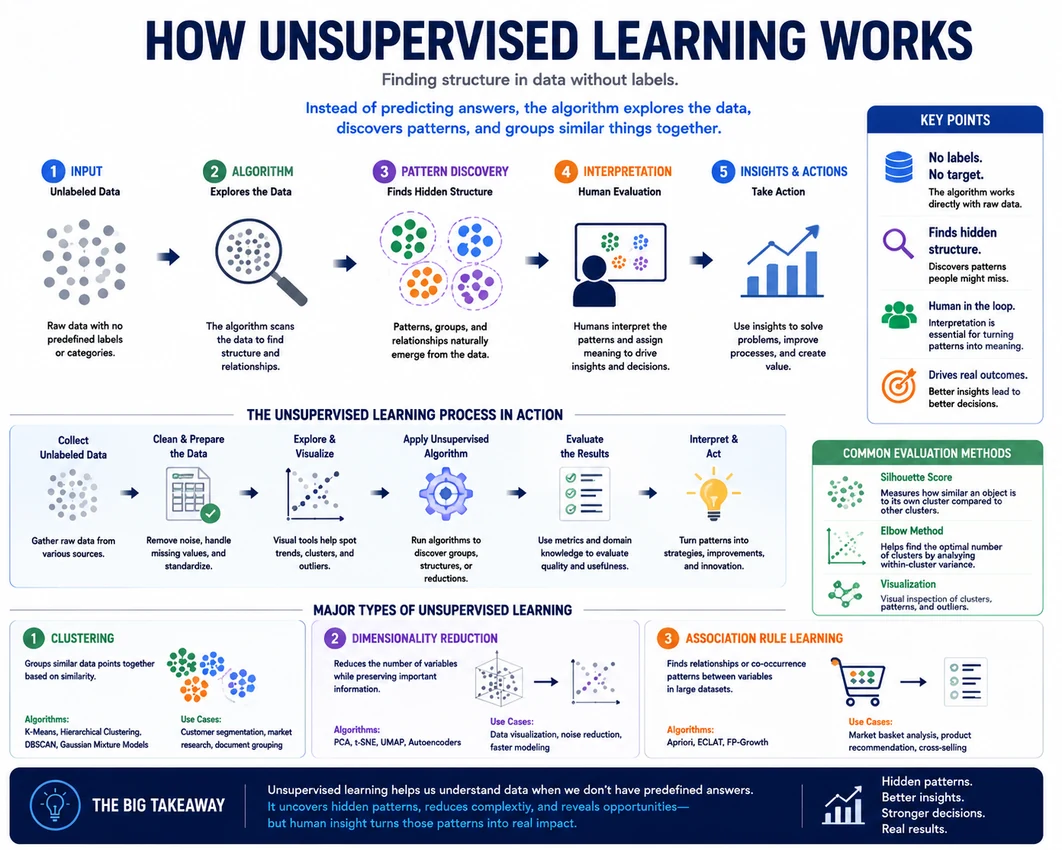
There is no single unsupervised-learning workflow, because clustering, dimensionality reduction, association discovery, anomaly detection, density estimation, and representation learning solve different problems. A typical process may include the following steps.
1. Define the exploratory objective
Even without target labels, you still need a reason for analyzing the data. Examples include:
- Identify potentially useful customer groupings.
- Compress high-dimensional data for visualization or modeling.
- Explore which items or variables tend to occur together.
- Explore whether observations contain unusual patterns.
- Learn compact representations that can support downstream tasks.
Without a clear objective, it is easy to find patterns that are mathematically interesting but operationally irrelevant.
2. Collect and understand the data
The dataset may contain numerical, categorical, textual, visual, behavioral, sensor, or other features. Data quality remains critical. Missing values, duplicates, measurement errors, irrelevant features, and inconsistent scales can distort unsupervised results. Read What Is a Dataset in Machine Learning?.
3. Preprocess the data
Many unsupervised algorithms are sensitive to feature representation. For example, distance-based clustering can be dominated by features with larger numerical scales unless the data is transformed appropriately. Preprocessing may include:
- Cleaning missing or invalid values.
- Scaling numerical features.
- Encoding categorical variables.
- Removing or handling extreme outliers.
- Selecting relevant features.
- Creating more informative representations.
See Data Preprocessing Explained, Feature Engineering Explained, and Feature Selection vs Feature Extraction.
4. Choose an unsupervised method
The algorithm should match the structure you want to explore. Examples include:
- K-Means for centroid-based clustering.
- Hierarchical clustering for nested grouping structures.
- DBSCAN for density-based clusters and noise identification.
- Principal component analysis for linear dimensionality reduction.
- Association-rule methods for finding items or events that frequently occur together.
- Autoencoders for learned representations.
Different methods make different assumptions, so they can produce very different results on the same dataset.
5. Fit the model or transformation
The algorithm uses the input data to optimize its own objective. For K-Means, that objective involves minimizing within-cluster squared distances to cluster centroids. PCA seeks directions that capture as much variance as possible under a linear projection. Other methods optimize different criteria. This is important: the algorithm is not discovering one objectively correct hidden answer. It is finding structure according to its assumptions and objective.
6. Evaluate and interpret the result
Google’s clustering guidance explains why unsupervised results may lack ground-truth labels for straightforward verification. More broadly, unsupervised learning usually does not have a single equivalent of classification accuracy because there may be no known correct labels. Evaluation can combine:
- Internal metrics such as silhouette score or cluster compactness.
- Stability across samples, seeds, or time periods.
- Comparison across plausible model settings.
- External labels when they exist for evaluation but were not used for training.
- Domain-expert review.
- Downstream task performance.
- Business usefulness or scientific validity.
A high internal clustering score does not guarantee that the clusters are useful in practice.
Major Types of Unsupervised Learning
Clustering
Clustering groups observations according to similarity or density under a chosen representation. Common clustering methods include:
- K-Means.
- Hierarchical clustering.
- DBSCAN.
- Gaussian mixture models.
Clustering can support exploratory segmentation, document grouping, biological analysis, image organization, and other tasks. Read K-Means Clustering Explained and Hierarchical clustering.
Dimensionality reduction
High-dimensional datasets can contain many correlated or redundant variables. Dimensionality-reduction methods create a smaller representation while preserving selected aspects of the original structure. Common techniques include:
- Principal component analysis (PCA).
- t-SNE for visualization.
- UMAP for nonlinear embedding and visualization.
- Autoencoders for learned representations.
Dimensionality reduction can help with visualization, compression, noise reduction, computational efficiency, and downstream modeling. Feature Selection vs Feature Extraction explains how this relates to transforming the original feature space. However, two-dimensional visualizations should be interpreted carefully. Apparent visual clusters can depend strongly on the method and parameter choices.
Association and pattern discovery
Association methods look for items, events, or variables that tend to occur together more often than expected. A familiar example is market-basket analysis: a retailer may explore which products frequently appear in the same transaction. These relationships are statistical associations, not proof that one item causes another.
Anomaly detection
Some anomaly-detection approaches work without labeled examples of every abnormal condition. They attempt to identify observations that differ substantially from typical patterns. Applications may include:
- Equipment monitoring.
- Network security.
- Quality control.
- Fraud investigation support.
Anomaly does not automatically mean fraud, failure, or malicious behavior. Unusual observations require contextual interpretation and often human review.
Representation learning
Unsupervised or self-supervised methods can learn useful representations of complex data such as images, text, or audio. These representations may later support supervised tasks with fewer labeled examples. Modern machine learning increasingly uses self-supervised learning, where the training signal is constructed from the data itself. Self-supervised learning is closely related to unsupervised learning but is often discussed as its own training paradigm because it creates explicit prediction objectives without manually supplied task labels. See Types of Machine Learning.
K-Means Clustering Example
Suppose a retailer has customer features such as purchase frequency and average order value. K-Means might divide those observations into several clusters by minimizing squared Euclidean distance between points and their assigned cluster centroids. The algorithm might return three groups, but it does not inherently know that they represent “loyal customers,” “budget shoppers,” or “at-risk customers.” Those labels would be interpretations added after examining the cluster characteristics. The number of clusters also is not always obvious. Methods such as the Elbow Method or silhouette analysis can provide evidence, but they are heuristics rather than guaranteed ways to discover a uniquely correct number of groups. Read K-Means Clustering Explained.
Real-World Uses of Unsupervised Learning
Customer exploration
Clustering can reveal groups with similar behavioral patterns. Teams can then investigate whether those groupings correspond to useful marketing, product, or service strategies. The clusters should be validated before being treated as stable customer segments.
Document and topic organization
Text embeddings and clustering can help organize documents, support exploratory topic discovery, or group similar support tickets and knowledge-base content.
Data visualization
Dimensionality reduction can project complex datasets into two or three dimensions for exploration. Visual patterns should not be treated as proof of true underlying categories without additional evidence.
Cybersecurity and fraud investigation
Anomaly-detection methods can surface unusual events for further investigation. In real systems, they are often combined with supervised models, rules, graph analysis, and analyst review.
Scientific research
Clustering and dimensionality reduction can support exploratory analysis in biology, astronomy, chemistry, and other fields where researchers want to understand complex structure before defining predictive targets.
Advantages of Unsupervised Learning
It does not require task-specific labels
This is valuable when labeling would be expensive, slow, subjective, or impossible.
It supports exploration
Unsupervised methods can help researchers and analysts generate hypotheses about structure in complex datasets.
It can improve downstream models
Representations or reduced feature spaces learned without labels can sometimes improve later supervised tasks.
It can help organize large datasets
Clustering and embeddings can make large collections of documents, images, products, or events easier to explore.
Limitations of Unsupervised Learning
Patterns are not automatically meaningful
An algorithm can find mathematically valid structure that has little practical value.
Evaluation can be difficult
Without ground-truth labels, there may be no single metric that tells you whether the result is “correct.”
Results depend on representation and assumptions
Feature scaling, distance metrics, algorithm choice, hyperparameters, random initialization, and preprocessing can substantially change the result.
Clusters can be unstable
A grouping discovered in one sample or time period may not remain stable in another.
Human interpretation can introduce bias
People may assign convenient stories to clusters after seeing them. Those interpretations should be tested rather than assumed.
High-dimensional data can be difficult
Distance and neighborhood relationships can behave unintuitively as dimensionality grows. Feature selection, dimensionality reduction, or learned representations may be necessary.
Unsupervised vs Supervised Learning
| Feature | Supervised learning | Unsupervised learning |
|---|---|---|
| Task labels | Available during training | Not supplied for the target task |
| Main goal | Predict a defined target | Explore or learn structure/representations |
| Common tasks | Classification, regression | Clustering, dimensionality reduction, association discovery, anomaly exploration |
| Evaluation | Often compares predictions with known targets | Often combines internal metrics, stability, domain validation and downstream usefulness |
Read Supervised Learning Explained for the labeled-data approach.
Unsupervised Learning vs Self-Supervised Learning
The terms are related but not identical. Traditional unsupervised learning often refers to discovering structure without an explicit target, as in clustering or dimensionality reduction. Self-supervised learning creates a prediction task from the data itself. For example, a model may learn to predict masked or missing parts of an input. The targets are generated automatically rather than manually labeled. Self-supervised learning has become especially important for pretraining large language, vision, and multimodal models.
Frequently Asked Questions
What is unsupervised learning in simple terms?
It is machine learning that looks for useful structure in data without being given task-specific correct labels for every example.
Is clustering the same as unsupervised learning?
No. Clustering is one major unsupervised-learning task. Dimensionality reduction, association discovery, representation learning, density estimation, and some anomaly-detection methods also fall within or overlap with unsupervised learning.
How do you know whether unsupervised learning worked?
There is rarely one universal metric. Evaluation may involve internal mathematical measures, stability tests, expert interpretation, external labels, downstream model performance, or evidence that the discovered structure is useful for the intended problem.
Does unsupervised learning discover hidden truth in data?
Not automatically. It discovers structure according to the data representation, algorithm, assumptions, and objective. Human validation is needed before treating the output as a meaningful real-world category or explanation.
Is K-Means always the best clustering algorithm?
No. K-Means works best under particular geometric assumptions and can struggle with irregular cluster shapes, outliers, different cluster densities, poorly scaled features, and some high-dimensional settings.
Is self-supervised learning unsupervised learning?
It is closely related and does not require manually supplied task labels, but modern ML often treats self-supervised learning as a distinct training paradigm because the system constructs explicit prediction targets from the data itself.
Where to Learn Next
Continue the foundational machine-learning curriculum with the next lesson.
Explore unsupervised methods
- K-Means Clustering Explained
- Hierarchical Clustering Explained
- Feature Selection vs Feature Extraction
← Previous Lesson: Supervised Learning | Lesson 5: Unsupervised Learning | Next Lesson: Reinforcement Learning →