Machine Learning

Learn machine learning fundamentals, how models learn from data, and the main ML types (supervised, unsupervised, reinforcement). Designed for beginners.


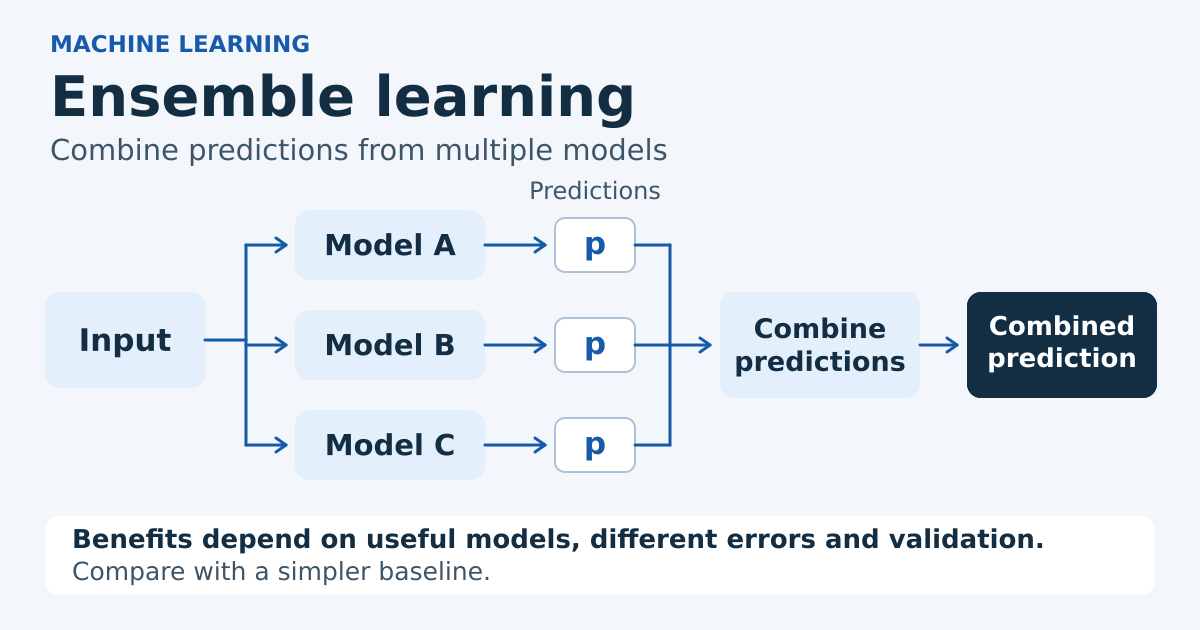
Educational infographic showing how multiple machine learning models combine together in ensemble learning to improve prediction accuracy

Ensemble Learning Explained: Beginner-Friendly Guide

What Is Ensemble Learning? Ensemble learning is a model-combination strategy, not a separate machine learning paradigm. Supervised, unsupervised, and reinforcement learning describe different learning settings. Ensemble methods describe how predictions from two or more models are combined within a suitable setting. The individual models are called base learners. They may be repeated versions of the […]

Ensemble Learning Explained: Beginner-Friendly Guide Read More »
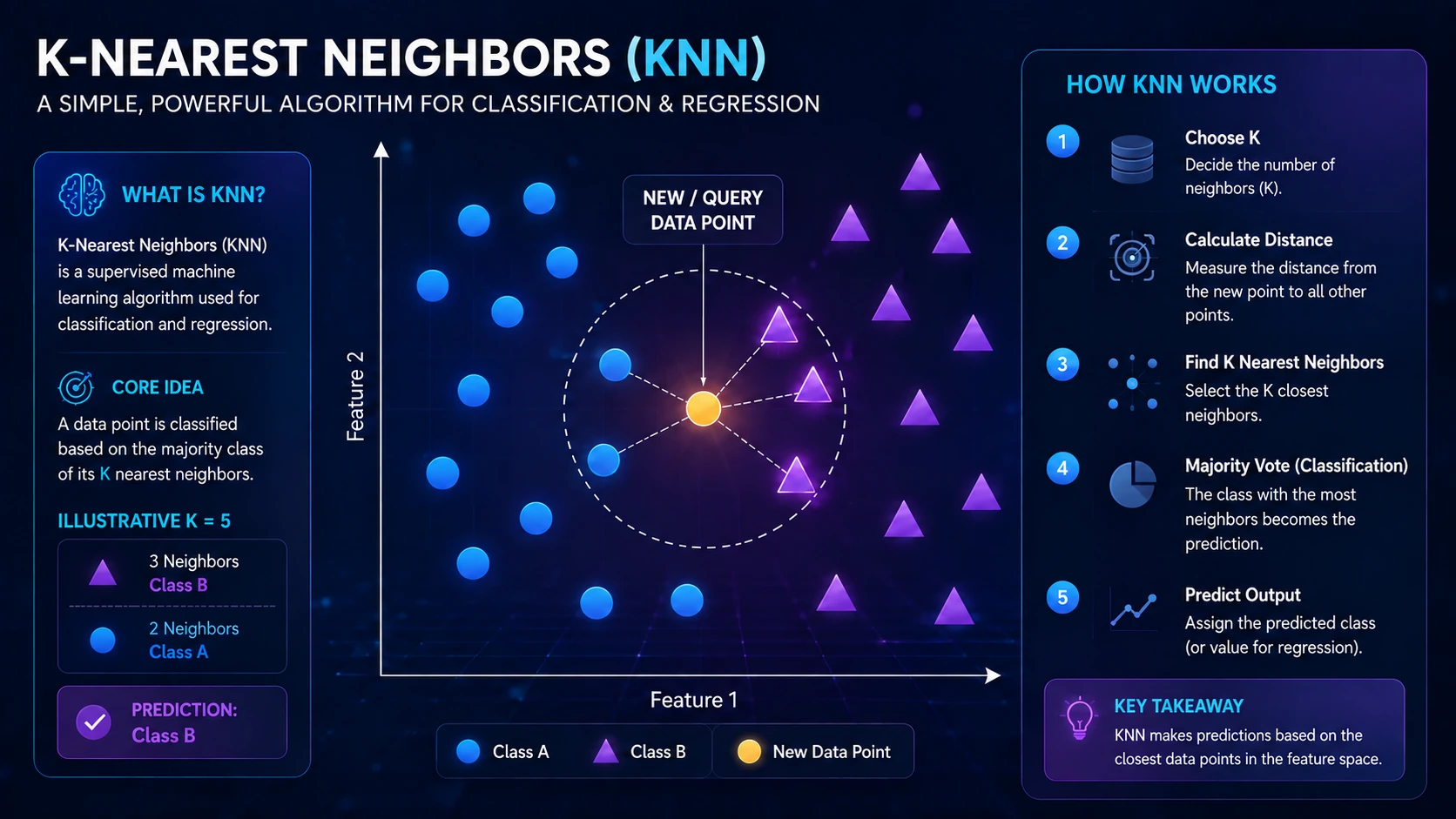
Educational infographic showing how K-Nearest Neighbors classifies data points based on nearby neighbors.

K-Nearest Neighbors Explained: A Beginner’s Guide

K-Nearest Neighbors (KNN) is a supervised machine-learning method that predicts an outcome from the labeled examples closest to a new data point. It can classify categories or estimate numerical values without fitting a conventional parametric model. The idea is intuitive: nearby examples get a vote. But useful KNN results depend on how “nearby” is defined,

K-Nearest Neighbors Explained: A Beginner’s Guide Read More »

Educational infographic explaining the Naive Bayes machine learning algorithm and probability-based classification.

Naive Bayes Explained: Beginner-Friendly Guide

Naive Bayes is a supervised classification method that combines a class’s prior probability with evidence from the features. Its simplifying assumption is conditional independence given the class—not that features are unrelated in the real world. This beginner guide explains Bayes’ theorem, the main variants, smoothing, text representations, evaluation, and when this fast probabilistic classifier is

Naive Bayes Explained: Beginner-Friendly Guide Read More »
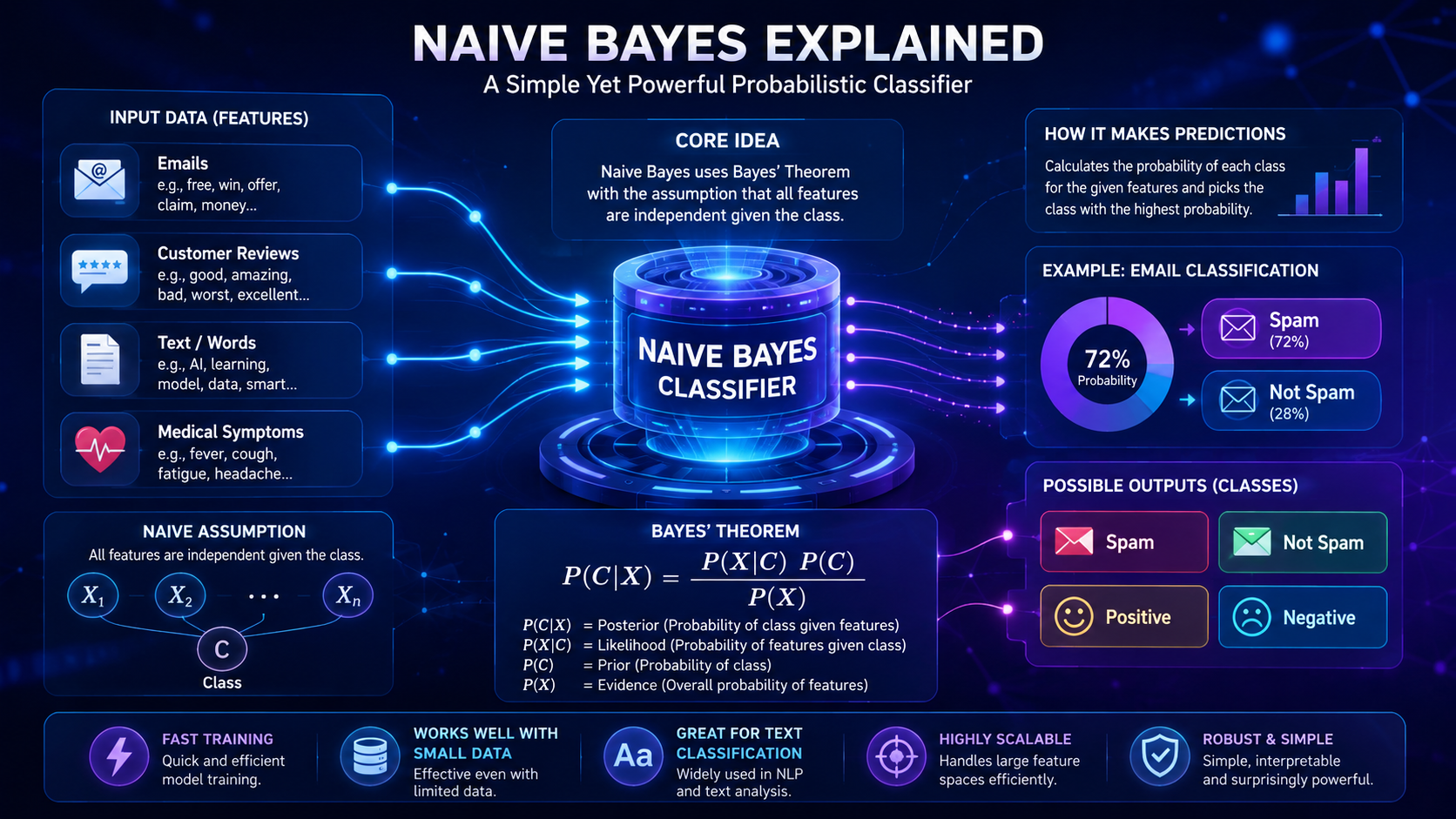
Educational infographic explaining hierarchical clustering with connected data groups and dendrogram structure in machine learning.

Hierarchical Clustering Explained: A Beginner’s Guide

Hierarchical clustering is an unsupervised method that organizes observations into a nested tree of groups. Instead of returning only one flat partition, it shows how individual observations and larger clusters join—or split—at different levels of dissimilarity. The tree is displayed as a dendrogram. It can help you explore possible groupings, but the result depends on

Hierarchical Clustering Explained: A Beginner’s Guide Read More »

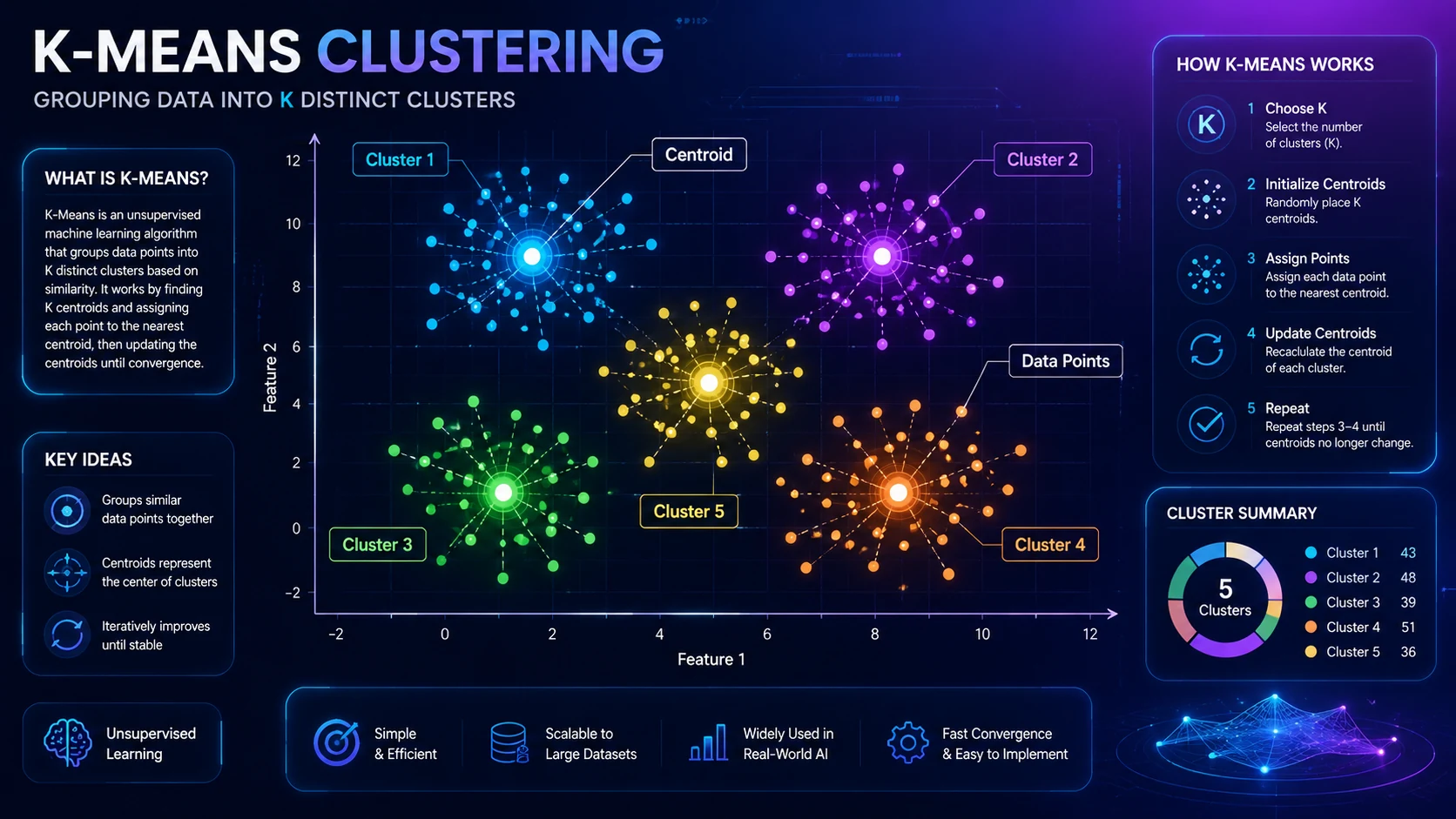
Educational infographic showing how K-Means clustering groups similar data points into clusters around centroids.

K-Means Clustering Explained for Beginners

K-Means is an unsupervised machine-learning algorithm that partitions numerical data into K clusters. It repeatedly assigns each point to a centroid and updates those centroids to reduce variation within the clusters. In standard K-Means, “closest” has a precise meaning: the algorithm minimizes the sum of squared Euclidean distances between data points and their assigned centroids.

K-Means Clustering Explained for Beginners Read More »

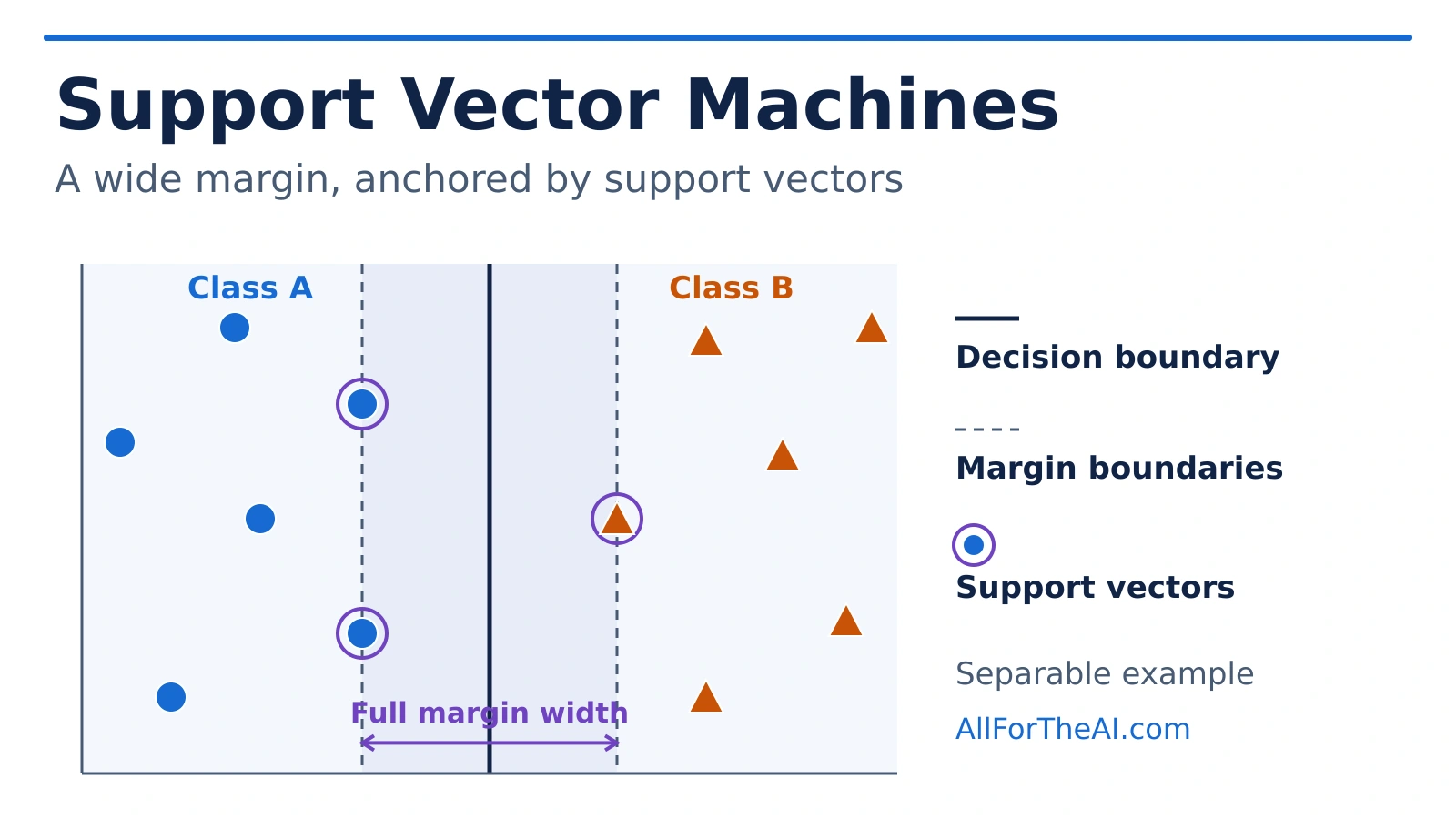
Support Vector Machine maximum-margin boundary with support vectors and kernel concepts

Support Vector Machines (SVM) Explained for Beginners

Support Vector Machines, usually shortened to SVMs, are supervised machine-learning methods used mainly for classification, although related methods can also perform regression and novelty detection. An SVM tries to find a decision boundary that separates classes while leaving a useful margin between that boundary and the closest training examples. Those influential training examples are called

Support Vector Machines (SVM) Explained for Beginners Read More »

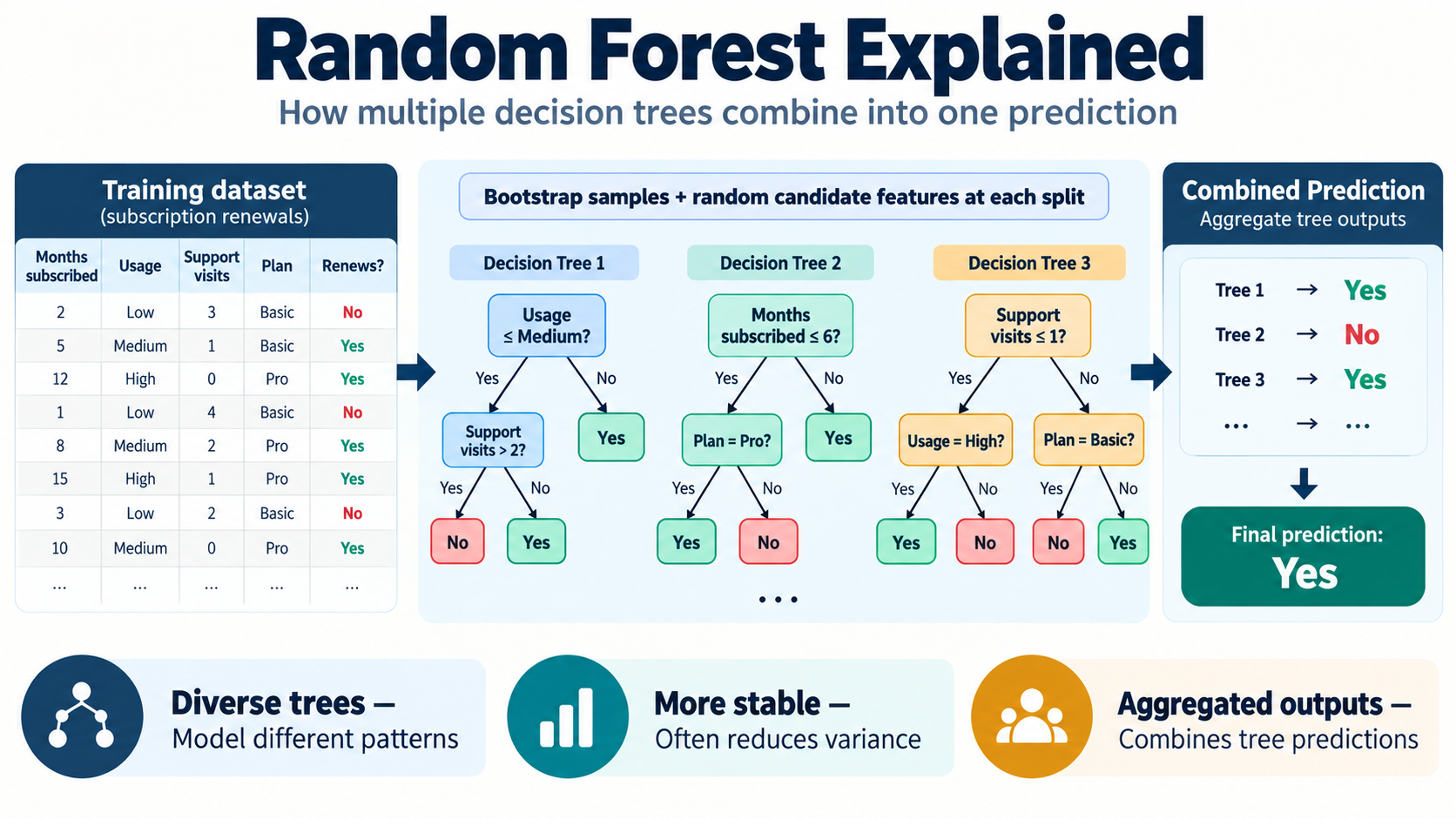
Diagram showing subscription-renewal training data feeding multiple diversified decision trees whose outputs are aggregated into one Random Forest prediction.

Random Forest Explained: Beginner-Friendly Guide

Random Forest is a supervised machine learning algorithm that combines many randomized decision trees. Its central idea is simple: build trees that make somewhat different errors, then combine their predictions so that tree-specific mistakes can cancel out. If you have not met a decision tree yet, start with Decision Trees Explained. Random Forest adds two

Random Forest Explained: Beginner-Friendly Guide Read More »
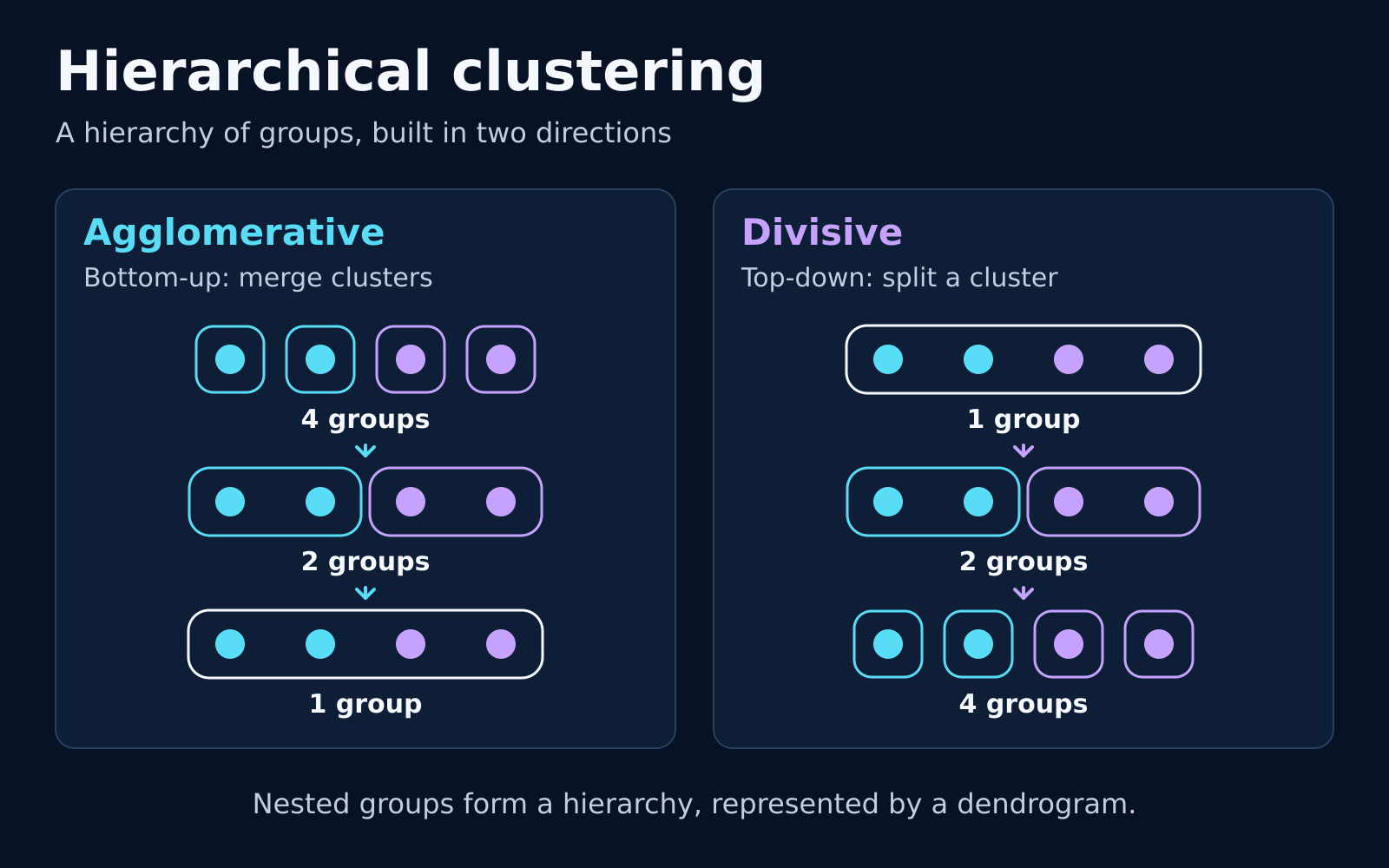
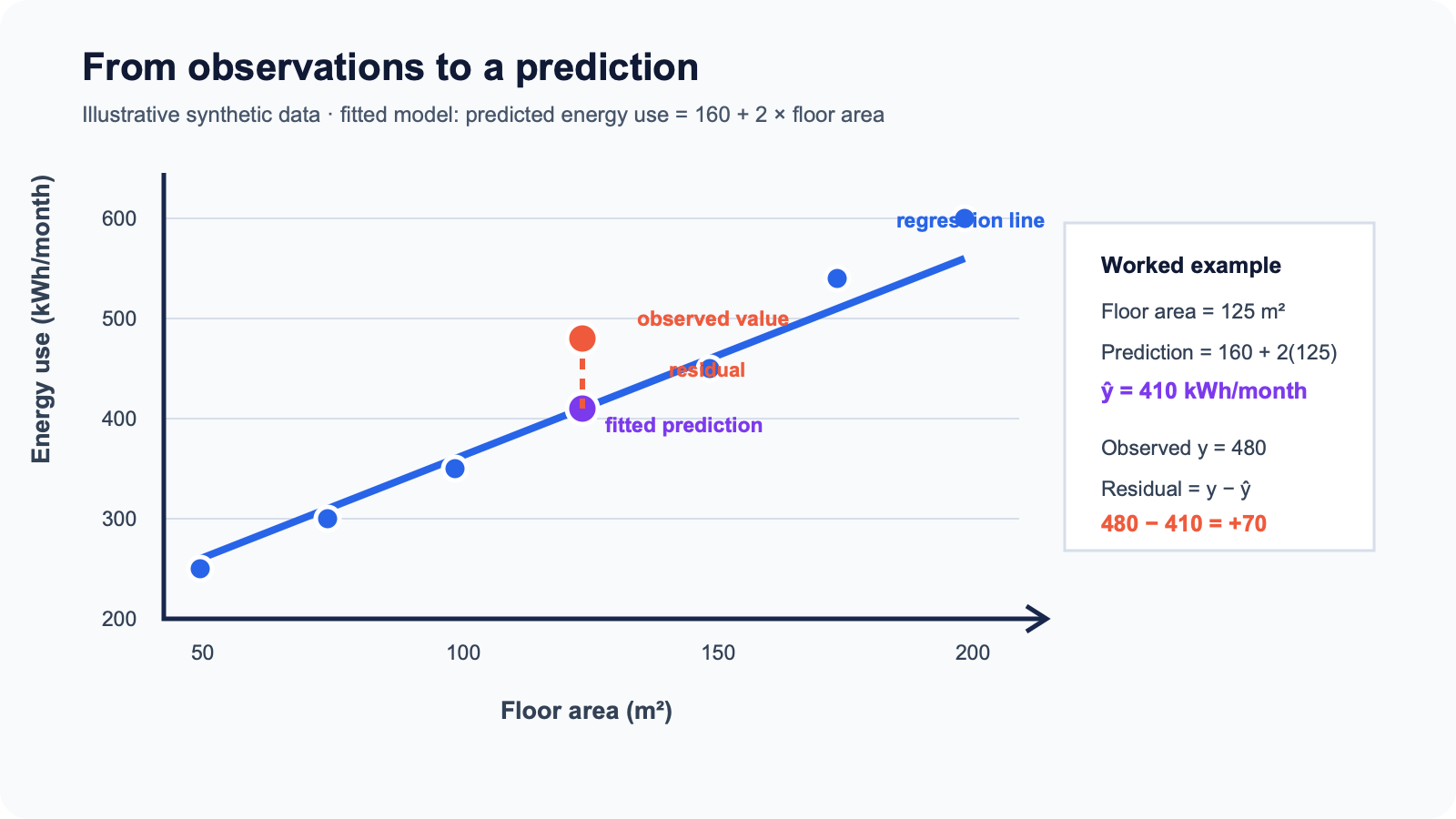
Educational infographic showing how linear regression uses a best fit line to predict trends from data points.

Linear Regression Explained for Beginners

Linear Regression is a supervised-learning method for predicting a numerical target from a linear combination of one or more input features. It is an excellent first algorithm to learn because every prediction can be traced to an equation, while its limitations introduce residuals, evaluation, diagnostics, and extrapolation. This is the first algorithm-specific lesson after the

Linear Regression Explained for Beginners Read More »

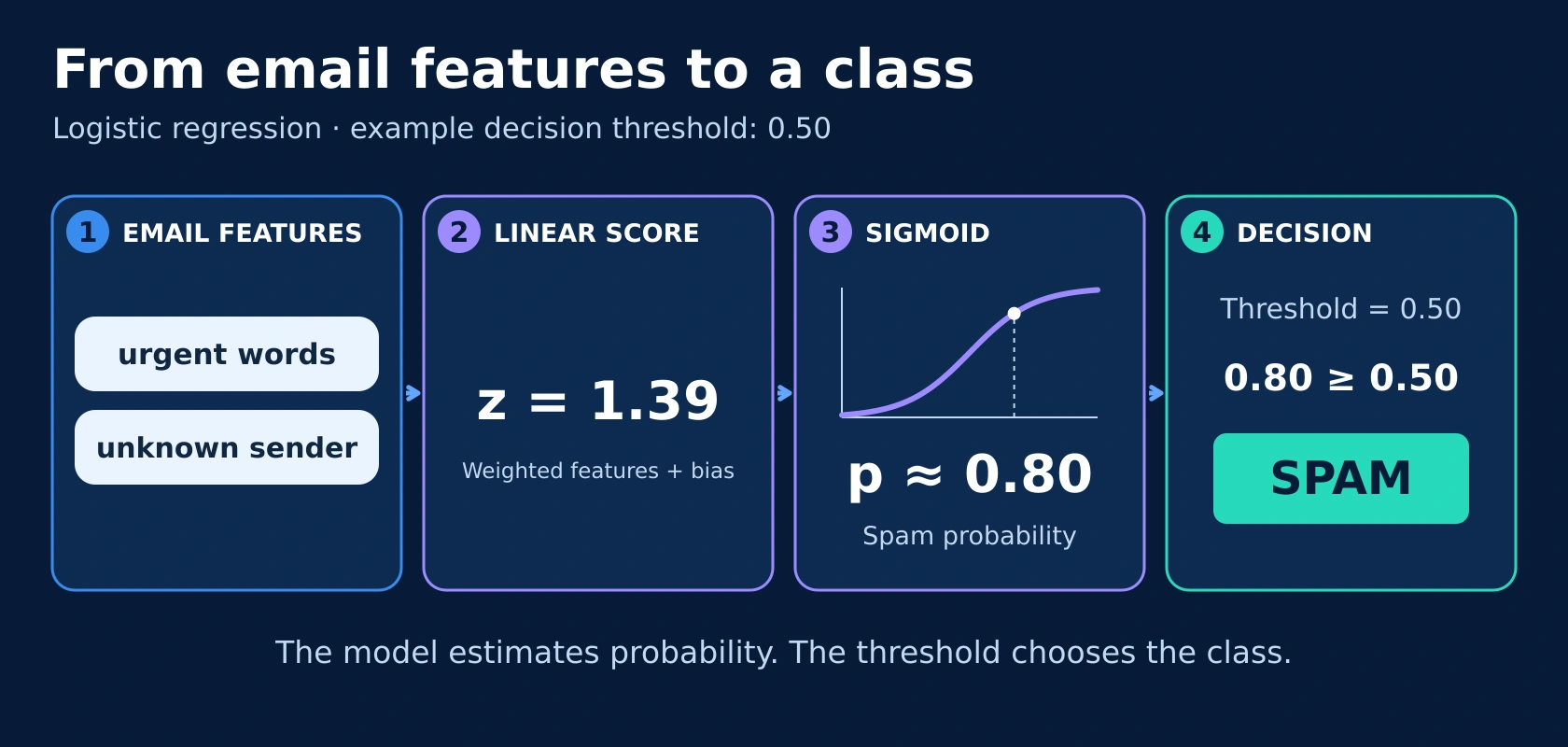
Four-step logistic regression flow from email features to a linear score, sigmoid probability, and spam classification

Logistic Regression Explained for Beginners

Logistic Regression is a supervised classification method that estimates the probability of a class. It starts with a linear score, passes that score through the sigmoid function, and—when a hard decision is needed—compares the probability with a chosen threshold. This guide uses spam detection as a running example. You will learn why the method has

Logistic Regression Explained for Beginners Read More »

Scroll to Top