
Last updated:
A dataset is a collection of examples used to develop, evaluate, or operate a machine-learning system. Depending on the task, each example may contain features, labels, text, images, audio, sensor readings, transactions, or other information. The Google Machine Learning Glossary provides useful reference definitions for examples, features, labels, training sets, validation sets, and test sets.
Datasets are central to machine learning because models learn patterns from the information they are given. But bigger is not automatically better. A useful dataset needs to be relevant, representative, appropriately labeled, well structured for the task, and evaluated for quality problems such as missing values, leakage, imbalance, or distribution shift.
What Is a Dataset?
A dataset is an organized collection of data points, often arranged so each row or example represents one observation. An example, sample, or observation is one recorded case; in a tabular dataset, it is typically stored as one row.
For a house-price model, one example (one table row) might include features such as square footage, location, number of bedrooms, and property age, with the final sale price as the target.
Illustrative house-price record
Features → model inputs
- Floor area: 1,400 square feet
- Location: Northside
- Bedrooms: 3
- Property age: 10 years
Target → sale price
$320,000
This recorded target value is the label stored with the example.
For an image-classification model, one example might be an image paired with a label such as “cat,” “dog,” or “car.”
For language models, datasets may contain very large collections of text, code, conversations, documents, or other sequences.
The structure depends on the machine-learning problem.
Features, Targets, and Labels
Features
Features are the inputs or measurable properties a model uses to learn patterns, produce outputs, or support decisions—not only to make predictions.
Examples include:
- Age, income, and account history.
- Pixel values in an image.
- Words or tokens in text.
- Sensor measurements.
- Product attributes.
Labels
In supervised learning, the target is the value a model is intended to estimate. A label is the recorded target value attached to a training example. The terms are often used interchangeably, but “target” emphasizes the modeling goal while “label” emphasizes the value stored with an example.
Examples include:
- Fraudulent vs legitimate.
- Customer churned vs did not churn.
- Sale price.
- Product category.
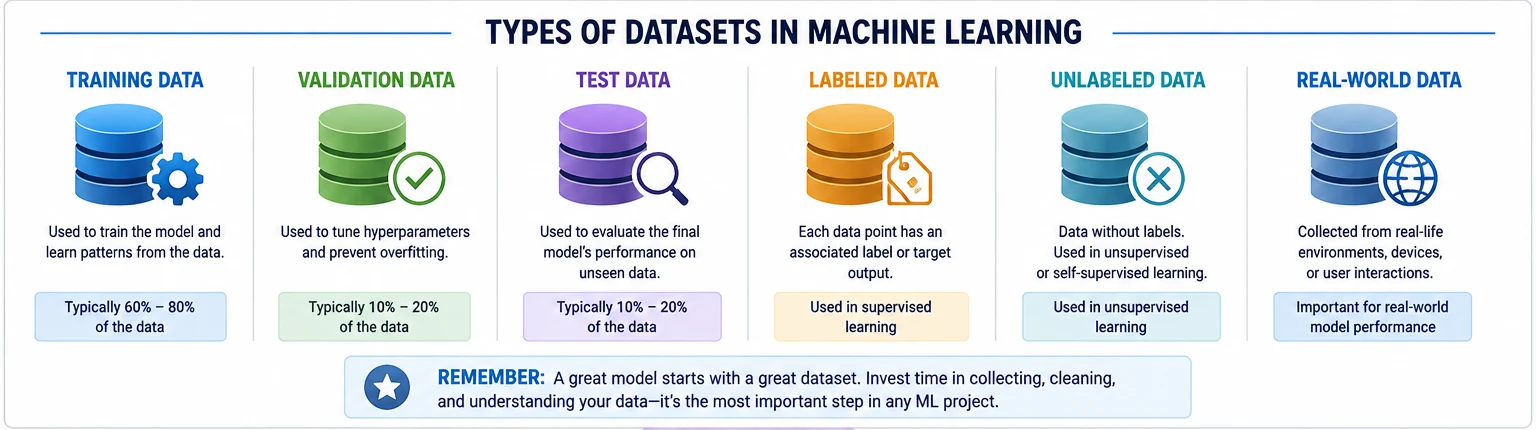
Not every dataset has labels. Unsupervised and self-supervised methods can learn from data without manually assigned task labels.
Read Supervised Learning Explained and Unsupervised Learning Explained.
Training, Validation, and Test Data
A machine-learning dataset is often divided into separate subsets.
Training set
The training set is used to fit model parameters.
Validation set
Validation data, or cross-validation folds, is used during development to compare models, tune hyperparameters, choose thresholds, and make other design decisions.
Test set
A final held-out test set is reserved for estimating how the selected system performs on unseen data after development decisions have been made.
Using the test set repeatedly during tuning weakens its value as an independent evaluation.
Learn more in Training vs Testing Data and its section on cross-validation.
Structured vs Unstructured Data
Structured data
Structured data follows a defined schema, such as rows and columns in a table.
Examples include:
- Financial transactions.
- Customer records.
- Inventory tables.
- Sensor measurements.
Semi-structured data
Semi-structured data does not use a rigid table schema, but it contains tags, keys, metadata, or other markers that organize its contents. JSON documents, XML files, emails with headers, and event logs are common examples.
Unstructured data
Unstructured data does not naturally fit into a fixed table format.
Examples include:
- Text documents.
- Images.
- Audio.
- Video.
Modern machine-learning systems often convert unstructured data into numerical representations before modeling.
For more examples and the preparation differences between these data types, see Structured vs Unstructured Data.
What Makes a Dataset High Quality?
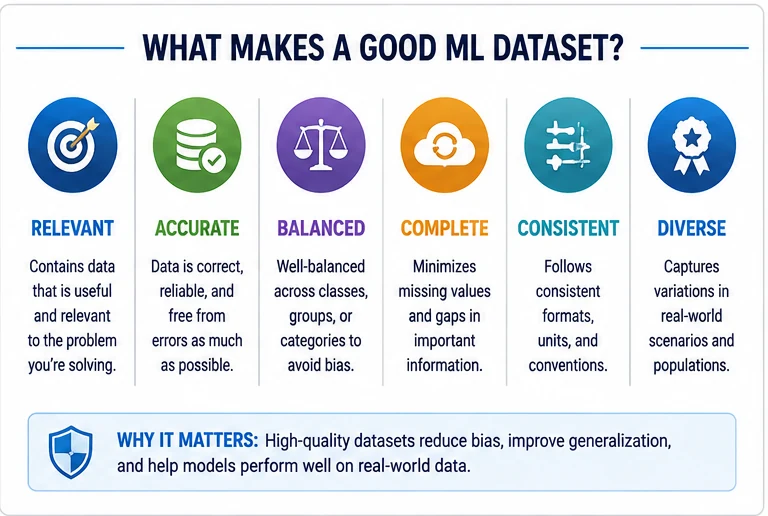
Dataset quality is multidimensional.
Relevance
The examples should reflect the actual task the model will perform.
Representativeness
The dataset should reasonably reflect the populations, conditions, environments, or operating scenarios where the model will be used.
Accuracy
Labels, measurements, and recorded values should be as correct as the application requires.
Coverage
Important cases should not be systematically missing.
Consistency
Definitions, units, labels, and collection procedures should be reasonably consistent.
Timeliness
Older data may become less useful if user behavior, markets, products, regulations, sensors, or other real-world conditions change.
Provenance and sourcing
Teams should document where data came from, how and when it was collected, who created or supplied labels, what permissions or licenses apply, and what transformations were performed. Clear provenance makes quality claims easier to check, exposes gaps or conflicts in sourcing, and supports responsible reuse.
Common Dataset Problems
Missing values
Some observations may lack fields or measurements. The right treatment depends on why data is missing and how important that field is.
Duplicate examples
Duplicates can distort training and evaluation, especially if nearly identical examples appear across training and test sets.
Label noise
Incorrect or inconsistent labels can reduce performance and make evaluation unreliable.
Outliers and noisy feature values
Unusual values may be genuine rare cases or errors, while noisy measurements can obscure useful patterns. Investigate their source and relevance before deciding whether to keep, correct, transform, or remove them.
Class imbalance
Some categories may be much rarer than others.
For example, fraud may represent only a small fraction of all transactions. In these cases, accuracy alone can be misleading.
Data leakage
Leakage occurs when information unavailable at real prediction time enters the training process or evaluation.
Examples include:
- Using future data to predict the past.
- Including a target-derived field as a feature.
- Splitting records from the same user across training and test sets when the real task requires generalization to new users.
Leakage can make a model appear much stronger than it really is.
Distribution shift
The data seen after deployment may differ from the data used for training.
Changes can occur in customer behavior, sensors, products, language, fraud tactics, medical populations, or other conditions.
A model can therefore degrade even if the original dataset was high quality.
Does More Data Always Improve a Model?
No.
More data can help when the additional examples are relevant, representative, accurately measured or labeled, and useful for the model.
More data may not help when it is:
- Duplicated.
- Biased.
- Outdated.
- Incorrectly labeled.
- Irrelevant to the target problem.
- Drawn from a different distribution than deployment data.
Data quality, task definition, model design, training procedure, and evaluation strategy all matter.
Data Preprocessing
Raw datasets usually require preparation before training. Fit learned preprocessing steps, such as imputation or scaling, on the training data only, then apply the fitted transformations consistently to validation and test data.
Common steps include:
- Cleaning missing or invalid values.
- Encoding categorical variables.
- Scaling numerical features when appropriate.
- Removing or investigating duplicates.
- Transforming raw fields into model-ready inputs; when this involves designing or selecting informative variables, it belongs more specifically to feature engineering.
- Splitting data safely.
- Preventing leakage.
Data Preprocessing Explained covers the broader workflow for cleaning, encoding, scaling, splitting, and preparing data. Feature Engineering Explained focuses on creating, transforming, or selecting inputs that help a model learn the relevant signal.
Dataset Bias and Fairness
A dataset can reflect historical, sampling, labeling, or measurement biases.
Bias can enter when:
- Some groups are underrepresented.
- Outcomes reflect historical inequalities.
- Labels encode subjective judgments.
- Collection methods favor certain users or environments.
Dataset review should therefore consider not only model accuracy but also who and what the data represents. The NIST AI Risk Management Framework Playbook specifically emphasizes evaluating dataset representativeness in the intended context of use and examining data quality and sourcing. Continue through the AI Ethics learning branch for broader coverage of fairness, accountability, and responsible AI use.
Dataset Size and Model Complexity
More complex models often require more data to estimate reliably, but there is no universal minimum dataset size.
The amount of data needed depends on:
- Task difficulty.
- Number and quality of features.
- Noise level.
- Model complexity.
- Availability of pretrained representations.
- Desired confidence in evaluation.
Transfer learning and pretrained models can sometimes reduce the amount of task-specific labeled data required.
Frequently Asked Questions
What is a dataset in simple terms?
It is a collection of examples used to train, validate, test, or operate a machine-learning system.
What is the difference between features and labels?
Features are model inputs. Labels are target values used in supervised learning.
Why split a dataset?
Separate subsets help fit the model, make development decisions, and evaluate generalization without reusing the same examples for every purpose.
Is a bigger dataset always better?
No. Relevance, quality, representativeness, labeling, and freshness also matter.
What is data leakage?
Leakage is information entering training or evaluation that would not legitimately be available when the model makes real predictions.
Where to Learn Next
The next lesson explains how separate data splits support training and honest evaluation.
After that, continue to Data Preprocessing Explained. Related guides: Feature Engineering Explained, Overfitting vs Underfitting, and Model Evaluation Metrics Explained.