
Last reviewed and updated: August 27, 2026
Data preprocessing is the process of checking, cleaning, transforming, and organizing raw data so it can be used reliably by a machine-learning system. The goal is not to make data look perfect. It is to create inputs that match the model, evaluation plan, and real-world prediction task.
Preprocessing can improve data quality and make some algorithms easier to train, but it does not guarantee better accuracy. Poor choices can discard useful information, introduce bias, or leak information from evaluation data into training.
Where Preprocessing Fits in Machine Learning
Before preprocessing, define what one row represents, what outcome is being predicted, and what information will be available at prediction time. Then create the appropriate training, validation, and test split.
Any preprocessing step that learns from data—such as calculating a mean, choosing categories, estimating scaling values, or selecting features—must be fitted using training data only. The learned transformation is then applied unchanged to validation, test, and future production data.
This order prevents evaluation information from influencing the model. Review Training vs Testing Data if you need the data-splitting foundation first.
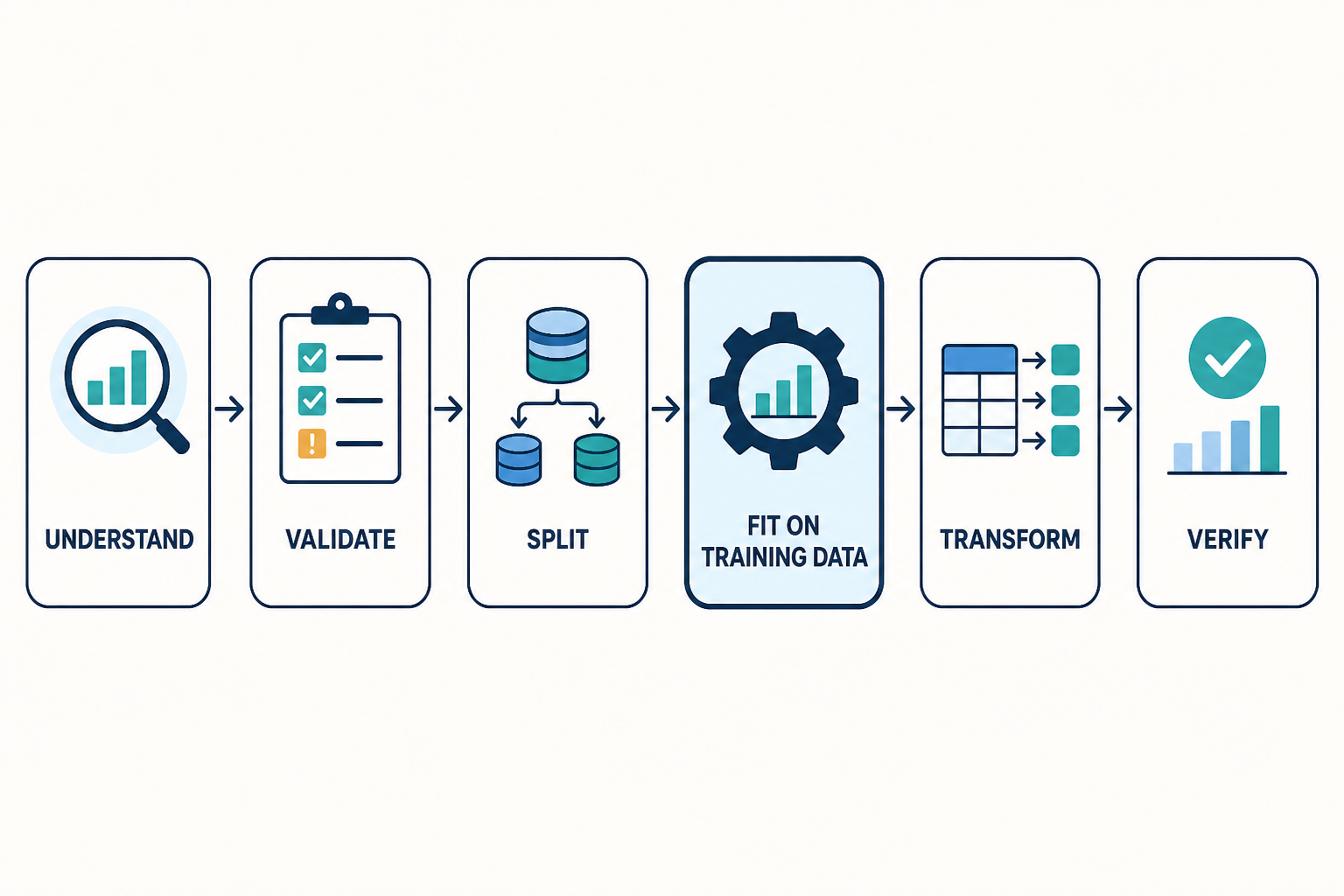
A Practical Preprocessing Workflow
| Stage | Main question | Typical work |
|---|---|---|
| 1. Understand | What does the data represent? | Define rows, features, labels, units, time boundaries, and intended use. |
| 2. Validate | Is the data plausible and consistent? | Check types, ranges, formats, duplicates, missingness, and impossible values. |
| 3. Split | How will real-world performance be estimated? | Create random, stratified, grouped, or time-based subsets as appropriate. |
| 4. Fit transformations | What must be learned from training data? | Fit imputers, encoders, scalers, and feature selectors on training data only. |
| 5. Transform | Can the same process handle new data? | Apply the fitted steps consistently to every subset and production input. |
| 6. Verify | Did preprocessing preserve meaning? | Check distributions, schema, class coverage, leakage, and downstream metrics. |
Core Data Preprocessing Techniques
Handling missing data
Missing values may represent unavailable measurements, skipped questions, system failures, or events that never occurred. The reason matters. Options include removing records, adding a missing-value indicator, or imputing a value such as a median, most-frequent category, or model-based estimate.
Simple mean imputation is not automatically neutral: it can reduce variation and distort relationships. The imputation method should be fitted on the training subset and evaluated for its effect on important groups.
Checking duplicates and inconsistent records
Exact duplicates, near-duplicates, inconsistent units, conflicting labels, and repeated records from the same entity can distort both training and evaluation. Removing duplicates requires judgment because repeated events may be legitimate observations rather than errors.
Reviewing outliers
An outlier is an observation that differs substantially from most others. It may be a data-entry mistake, a measurement failure, or a rare but valid case. Investigate the cause before removing it. Depending on the task, teams may correct errors, cap extreme values, use a robust transformation, choose a less-sensitive model, or preserve the observation.
Scaling numerical features
Scaling is especially important for methods that depend on distances, gradients, or regularization. It is less important for some tree-based models.
| Method | What it does | Useful consideration |
|---|---|---|
| Min-max scaling | Maps training values to a chosen range, commonly 0 to 1. | Can be strongly affected by extreme values. |
| Standardization | Centers a feature using its training mean and scales it using its training standard deviation. | Common for linear models, support vector machines, and neural networks. |
| Robust scaling | Uses statistics that are less sensitive to extreme values. | Can help when valid outliers are present. |
Encoding categorical data
Many algorithms require numerical inputs, so categories may need a representation such as one-hot, ordinal, frequency, or learned encoding. The choice depends on whether categories have a meaningful order, how many unique values exist, and how unseen categories will be handled.
Transforming text, images, and other data
Text may be tokenized or converted into vector representations. Images may be resized, normalized, or augmented. Audio and sensor streams may be resampled or divided into windows. These steps must match the model and should preserve information needed for the task.
Reducing or selecting features
Removing irrelevant or redundant variables can reduce complexity and computation. Feature selection may also reduce overfitting risk, but it does not prevent overfitting by itself. Any supervised selection method must be fitted inside the training process to avoid leakage.
Worked Example: Preparing Customer Data
Suppose a team is building a model that predicts whether a customer will cancel a subscription next month. The raw dataset contains account age, plan type, monthly usage, support contacts, and payment history.
- Define the prediction boundary: Remove information created after the cancellation decision, because it would not exist when the prediction is made.
- Create the split: Use an appropriate time-based or grouped split so the same customer does not appear across incompatible subsets.
- Fit on training data: Calculate missing-value replacements, category mappings, and scaling values using the training subset only.
- Apply consistently: Use the fitted transformations on validation and test records without recalculating them.
- Verify: Confirm that columns, units, category handling, and missing-value behavior remain consistent and that no target information leaked into the features.
A reusable pipeline helps keep these steps in the same order during training, evaluation, and deployment.
Common Preprocessing Mistakes
- Fitting a scaler or imputer on the complete dataset before splitting.
- Removing every outlier without checking whether it is valid.
- Using an average to fill missing values without examining the missingness pattern.
- Encoding categories in a way that invents an order that does not exist.
- Allowing duplicate people, devices, or events to appear across training and testing.
- Applying different transformations during development and production.
- Discarding columns without recording why the decision was made.
Data Preprocessing vs Feature Engineering
Preprocessing prepares existing data for reliable use. Feature engineering creates or reshapes variables so the model can use the underlying information more effectively. The boundary can overlap—for example, converting a timestamp into day of week could be treated as transformation or feature engineering.
The practical distinction is less important than documenting each step, fitting learned transformations correctly, and applying the same pipeline to new data.
Frequently Asked Questions
Is preprocessing required for every model?
Every project requires data validation, but the necessary transformations depend on the data and algorithm. Some models require scaled numerical inputs, while others can work directly with unscaled values.
Should data be split before preprocessing?
Split before fitting any transformation that learns from the data. Fixed corrections that do not use dataset-wide information can be defined earlier, but they should still be documented and applied consistently.
What is the difference between normalization and standardization?
Normalization often means mapping values to a defined range. Standardization commonly means subtracting the training mean and dividing by the training standard deviation.
Can preprocessing introduce bias?
Yes. Removing records, filling missing values, grouping categories, or excluding unusual observations can affect groups differently. Compare results across relevant populations and document important decisions.
Why use a preprocessing pipeline?
A pipeline makes the sequence repeatable, reduces training-serving inconsistencies, and helps ensure transformations are fitted within the correct training folds.
Sources and Further Reading
- scikit-learn User Guide: Preprocessing Data
- scikit-learn User Guide: Pipelines and Composite Estimators
- Google Machine Learning Crash Course: Numerical Data and Normalization
Continue Learning
Now that you understand how to prepare data safely, continue to Feature Engineering Explained to learn how useful model inputs are created and refined.