
Text Classification in Simple Terms
Text Classification is a Natural Language Processing (NLP) technique that automatically assigns categories or labels to written text. It enables AI systems to organize, understand, and process large amounts of text, powering applications such as spam filtering, customer support automation, sentiment analysis, and content moderation.
Simply put, text classification teaches computers how to determine what a piece of text is about and decide which category it belongs to.
Introduction
Every second, millions of pieces of text are created around the world.
People send emails, write customer reviews, publish news articles, post on social media, submit support requests, and chat with AI assistants. If humans had to read and organize all of this information manually, it would take an enormous amount of time and effort.
Fortunately, computers can help.
One of the most important technologies behind modern AI is Text Classification—the ability for a computer to automatically read text and decide what kind of information it contains.
Although you may never notice it happening, text classification works quietly behind the scenes every day.
When Gmail moves an email into your Spam folder…
When Netflix recommends movies…
When Amazon organizes product reviews…
When ChatGPT identifies the type of question you’re asking…
Text classification is often one of the first AI systems involved.
Without it, many of the intelligent features we use every day simply wouldn’t work.
In this guide, you’ll learn:
- What text classification is
- Why it is important in Natural Language Processing
- How AI classifies text step by step
- The different types of text classification
- Common machine learning algorithms
- Real-world applications across multiple industries
- Challenges and limitations
- How Large Language Models perform classification
- Future trends shaping modern AI
By the end of this article, you’ll not only understand what text classification is—you’ll understand how AI thinks when it classifies language.
Why This Matters
Before diving into the technical details, it’s worth asking a simple question:
Why should you care about text classification?
The answer is simple.
Almost every AI system that works with human language needs to organize information before it can do anything useful.
Imagine receiving 100,000 customer emails every day.
Some customers want refunds.
Some need technical support.
Others have billing questions.
Instead of hiring hundreds of employees to read every message, a business can use AI to instantly sort each email into the correct department.
The result?
- Faster customer service
- Lower operating costs
- Happier customers
- More efficient businesses
The exact same idea powers many of the AI applications we use every day.
Understanding text classification gives you insight into one of the core building blocks of modern Artificial Intelligence.
What Is Text Classification?
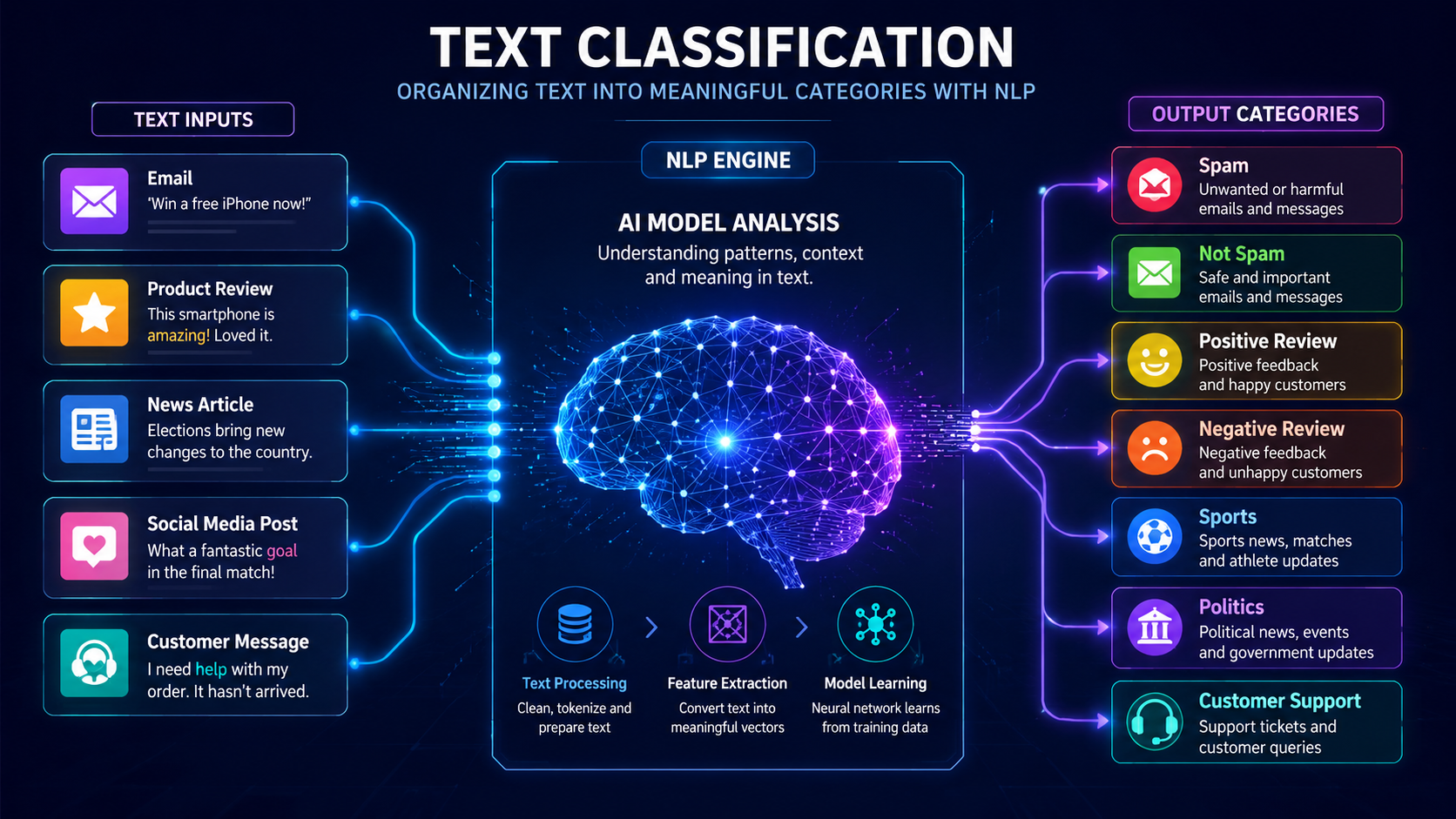
Text Classification is the process of automatically assigning one or more categories to a piece of written text.
The goal is to teach an AI system to recognize patterns in language so it can determine what a sentence, paragraph, email, or document is about.
Think of it like sorting physical mail.
A postal worker doesn’t need to read every letter from beginning to end.
Instead, they quickly identify important information—such as the address—and place the envelope into the correct delivery route.
Text classification works in much the same way.
Instead of sorting envelopes, an AI model sorts digital information.
For example:
| Text | Classification |
|---|---|
| “Congratulations! You won a prize.” | Spam |
| “I love this product.” | Positive Review |
| “The package arrived damaged.” | Customer Complaint |
| “Apple releases a new AI model.” | Technology News |
The AI analyzes the language, compares it with patterns it has learned previously, and predicts the most appropriate category.
Humans naturally perform this task every day without thinking about it.
Text classification enables computers to perform the same task automatically—and at an enormous scale.
Did You Know?

Every day, email providers classify billions of emails as spam or legitimate before those messages ever reach your inbox.

Without text classification, spam folders would barely function, and people would spend far more time sorting unwanted emails manually.
A Running Example We’ll Use Throughout This Guide
To make text classification easier to understand, we’ll follow the same customer support message throughout this article.
Imagine an online store receives this message:
“Hi, I received the wrong order and would like a refund.”
This simple sentence will help us explore how an AI system processes language.
As you continue reading, you’ll see exactly how the AI transforms this message into useful information.
By the end of the guide, you’ll understand every step of that process.
Why Is Text Classification Important in NLP?
Text classification is one of the foundational tasks in Natural Language Processing (NLP).
Many advanced NLP systems rely on classification before they perform more complex tasks.
For example:
- Spam filters classify emails before deciding whether to block them.
- Chatbots classify user intent before generating responses.
- Recommendation systems classify content before suggesting it.
- Social media platforms classify harmful content before moderation.
- Customer support systems classify support tickets before routing them.
Without text classification, AI systems would struggle to organize information efficiently.
Instead of immediately understanding the purpose of a message, they would need humans to interpret it first.
Text classification allows AI to:
Understand Meaning
It identifies what a piece of text is trying to communicate.
Automate Decisions
It allows computers to make decisions without requiring human review.
Improve User Experiences
Users receive faster responses, better recommendations, and more personalized services.
Process Massive Volumes of Information
Millions of documents can be categorized in seconds.
Because language is one of the most common ways humans communicate, text classification has become one of the most widely used technologies in AI.
A Simple Way to Think About Text Classification
Imagine you’re a librarian receiving 10,000 new books.
Reading every book cover to cover would be impossible.
Instead, you quickly examine:
- The title
- The summary
- The author’s description
- The table of contents
Within seconds, you know whether the book belongs in:
- Science
- History
- Business
- Technology
- Fiction
An AI system performs a very similar task.
It doesn’t “read” every document the way a human does.
Instead, it identifies important language patterns that help predict the correct category.
This allows the AI to organize enormous collections of information much faster than any human ever could.
Think Like the AI
Let’s return to our customer support example.
The customer writes:
“Hi, I received the wrong order and would like a refund.”
Now imagine you’re the AI.
Instead of seeing an entire sentence, you begin looking for meaningful clues.
You notice words like:
- received
- wrong
- order
- refund
You compare those words with millions of similar customer messages you’ve learned from before.
Many of those previous examples were labeled:
Refund Request
The AI then estimates the probability of each possible category.
| Possible Category | Confidence |
|---|---|
| Refund Request | 98% |
| Shipping Issue | 82% |
| Technical Support | 6% |
Since Refund Request has the highest confidence score, that’s the category the AI predicts.
The customer never sees this process.
It happens in just a fraction of a second.
Yet it’s one of the key reasons modern AI systems feel fast and intelligent.
The Evolution of Text Classification
Text classification has improved dramatically over the past several decades.
Understanding that evolution helps explain why today’s AI systems are so much more capable than earlier approaches.
Rule-Based Systems
Early systems relied entirely on manually written rules.
For example:
If an email contained phrases such as:
- “FREE MONEY”
- “WIN NOW”
- “LIMITED OFFER”
the system might classify it as spam.
Although simple, these systems required humans to continually write and update rules.
As language changed, the rules quickly became outdated.
Traditional Machine Learning
Machine learning introduced a major breakthrough.
Instead of relying on handwritten rules, algorithms learned patterns directly from data.
Popular approaches included:
These models adapted much better to new examples and significantly improved classification accuracy.
Deep Learning
Deep learning introduced neural networks capable of discovering far more complex language patterns.
Rather than depending heavily on manually engineered features, neural networks learned useful representations automatically from large datasets.
This led to another major leap in performance.
Transformer Models
Today, the most advanced NLP systems are powered by transformer architectures.
Models such as:
- BERT
- GPT
- Gemini
- Claude
can understand language in context rather than focusing only on individual words.
As a result, modern text classification systems are dramatically more accurate, flexible, and capable than ever before.
Now that you understand what text classification is, why it matters, and how the technology has evolved, let's see what actually happens inside an AI system when it classifies a piece of text.
In the next section, we'll follow our customer support message through every stage of the classification process—from raw text to a final prediction.
How Text Classification Works
Now that you understand what text classification is, let’s follow our customer support message through the entire AI workflow.
Remember our example:
“Hi, I received the wrong order and would like a refund.”
Although this looks like a simple sentence to us, an AI system doesn’t immediately understand its meaning.
Instead, it processes the text through several steps before deciding which category best describes it.
Let’s walk through each step.
Inside the AI’s Brain
Imagine you are the AI.
When the customer submits their message, here’s what happens behind the scenes.
Customer Message
↓
Read the text
↓
Break the sentence into smaller pieces
↓
Convert words into numbers
↓
Compare with millions of learned examples
↓
Calculate probabilities
↓
Choose the most likely category
↓
Send the ticket to the correct department
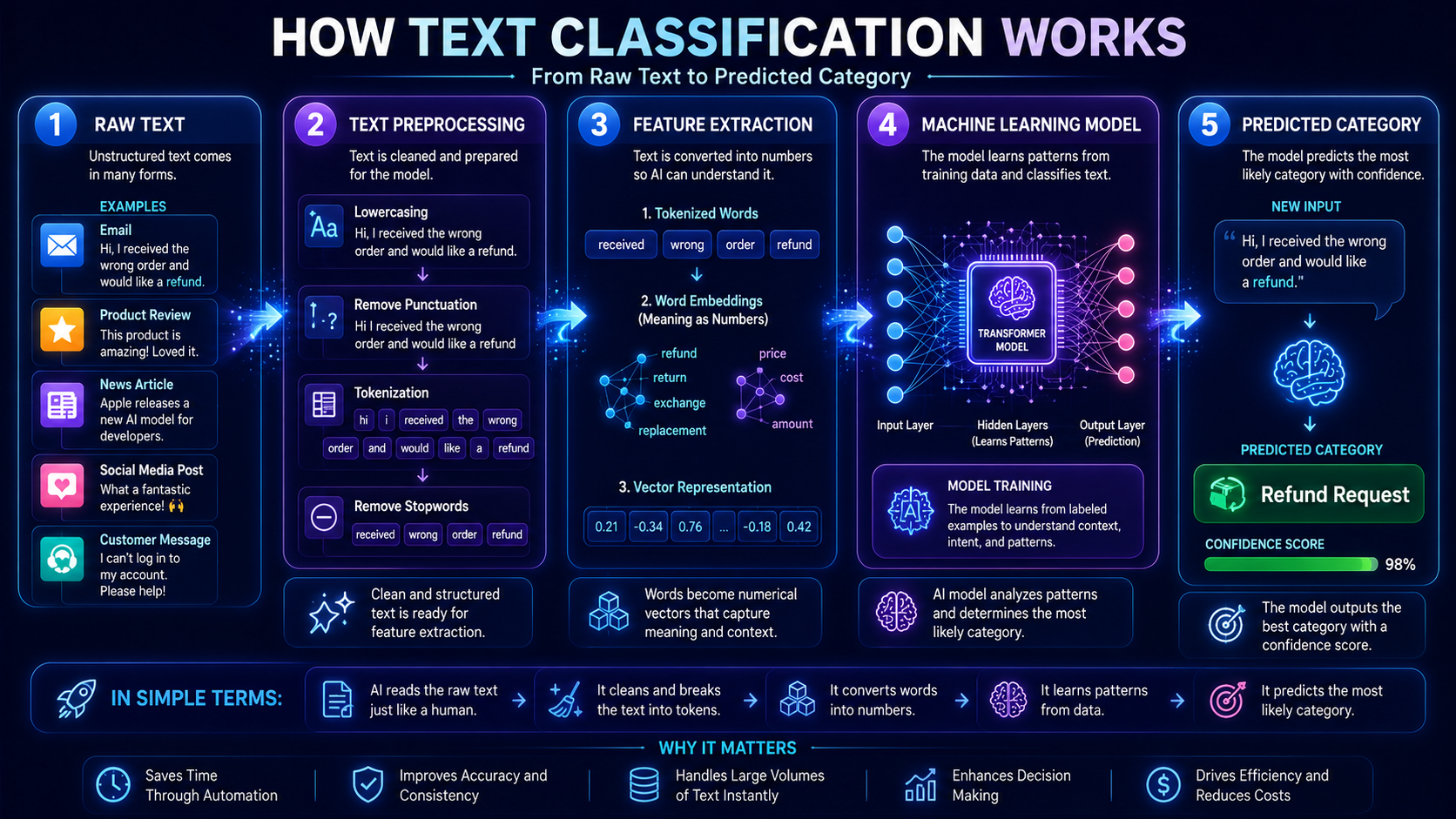
The entire process usually takes only a fraction of a second.
Although modern AI models perform incredibly complex mathematical calculations, this simple workflow captures the overall idea of how text classification works.
Did You Know?
Modern customer support systems can automatically classify millions of support requests every day, helping businesses respond faster while reducing manual work.
Step 1: Collect Text Data
Every AI model begins with data.
Before it can classify new messages, it needs thousands—or sometimes millions—of examples to learn from.
Depending on the application, this data might include:
- Emails
- Customer support tickets
- Product reviews
- News articles
- Social media posts
- Medical records
- Legal documents
The more diverse and accurate the training data is, the better the AI usually performs.
Our Running Example
“Hi, I received the wrong order and would like a refund.”
At this point, it simply sees text.
It has not yet assigned any meaning.
Step 2: Label the Data
If the model uses Supervised Learning every training example must already have the correct answer.
For example:
| Customer Message | Correct Label |
|---|---|
| “My package never arrived.” | Shipping Issue |
| “I can’t log into my account.” | Technical Support |
| “I’d like a refund.” | Refund Request |
| “I was charged twice.” | Billing Issue |
Over thousands of examples, the model begins recognizing which language patterns belong to each category.
Think of this as teaching a student with flashcards.
Eventually, the student begins recognizing the answers without needing help.
Step 3: Preprocess the Text
Raw text is often messy.
Before training begins, the AI cleans the text to make it easier to analyze.
Common preprocessing steps include:
- Removing unnecessary punctuation
- Converting text to lowercase
- Removing extra spaces
- Correcting formatting
- Tokenization
- Removing unimportant words when appropriate
For example:
Original message:
“Hi, I received the wrong order and would like a refund!”
After preprocessing:
received wrong order refund
Although simplified, the important meaning remains.
Think Like the AI
Humans understand complete sentences.
AI models often begin by looking for the most informative words.
Instead of focusing on:
Hi
or
would
the AI pays much closer attention to words such as:
- wrong
- order
- refund
These words provide much stronger clues about the customer’s intent.
Step 4: Convert Text into Numbers
Computers cannot understand words directly.
They only understand numbers.
This means every word must be converted into a mathematical representation.
Depending on the model, this might involve:
- Bag of Words
- TF-IDF
- Word Embeddings
- Transformer Embeddings
You can think of this as giving every word its own set of coordinates on a giant language map.
Words with similar meanings appear close together.
For example:
refund
exchange
return
would all appear relatively close together because they often occur in similar situations.
This helps the AI recognize relationships between words instead of treating every word as completely unrelated.
Step 5: Learn From Patterns
Now the real learning begins.
The model compares thousands—or even millions—of labeled examples.
Over time it discovers patterns such as:
Messages containing:
- refund
- return
- damaged
- wrong order
frequently belong to the category:
Refund Request
Unlike traditional rule-based systems, modern AI doesn’t memorize fixed rules.
Instead, it gradually learns statistical relationships that allow it to generalize to new examples it has never seen before.
This ability to recognize patterns is what makes machine learning so powerful.
Step 6: Evaluate Performance
Before an AI model is used in the real world, it must be tested.
Developers measure how accurately it classifies text it has never seen before.
Common evaluation metrics include:
- Accuracy
- Precision
- Recall
- F1 Score
If the results are poor, the model is improved and tested again.
This process continues until the system reaches an acceptable level of performance.
Step 7: Classify New Text
Now our trained AI is ready.
A customer submits the message:
“Hi, I received the wrong order and would like a refund.”
The AI quickly analyzes the message.
Possible predictions might be:
| Category | Confidence |
|---|---|
| Refund Request | 98% |
| Shipping Issue | 82% |
| Technical Support | 5% |
| General Inquiry | 2% |
The highest-confidence category becomes the prediction.
The support ticket is automatically sent to the refund team.
The customer receives faster service.
The business saves time.
Everyone benefits.
The Complete Text Classification Pipeline
Now let’s put everything together.
Customer writes:

"I received the wrong order."
↓
Collect Text
↓
Clean & Prepare Text
↓
Tokenization
↓
Convert Words into Numbers
↓
Machine Learning Model
↓
Calculate Probabilities
↓
Predict Category
↓
Refund Request
↓
Automatically Route Ticket
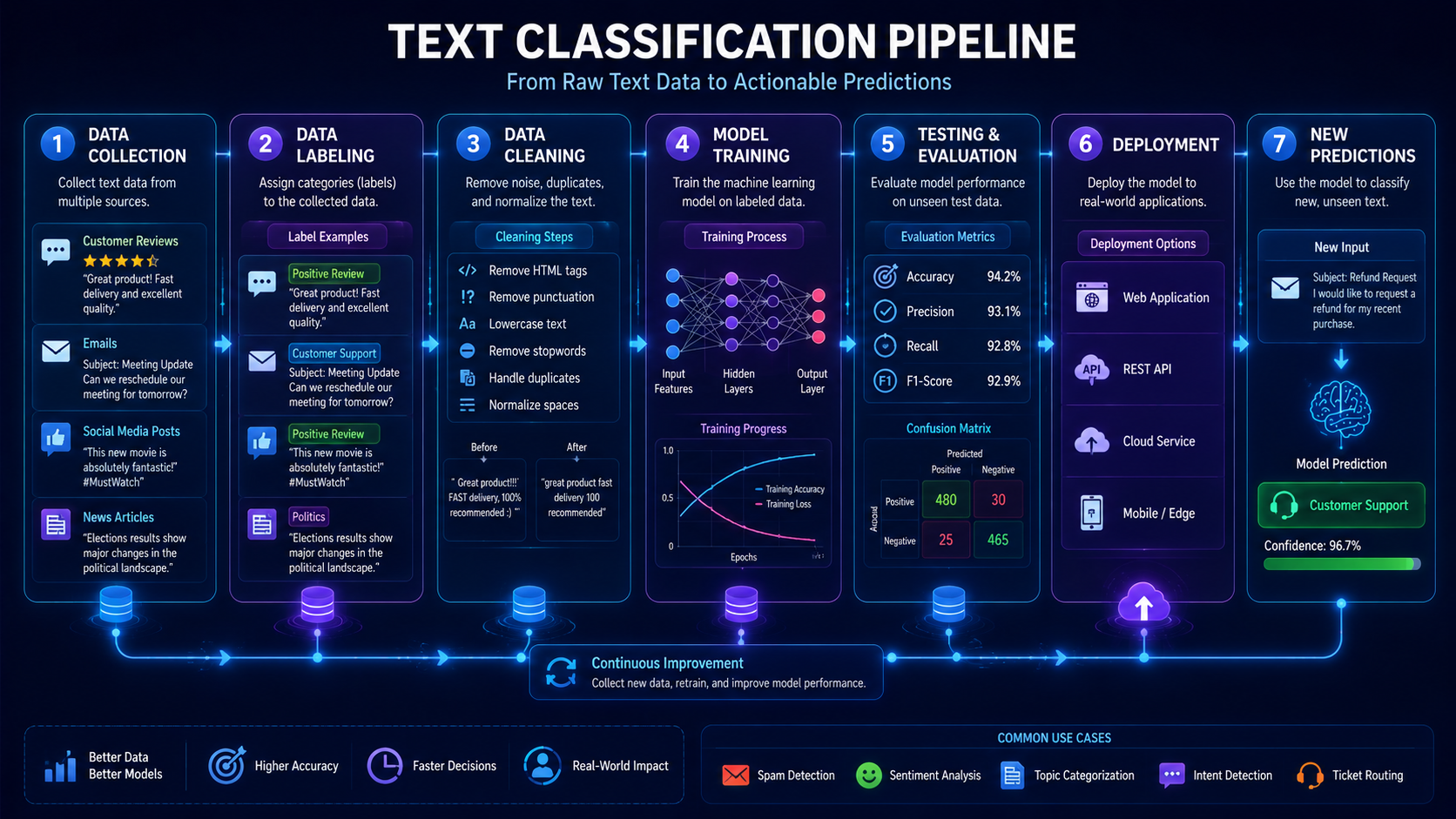
Although every AI system is different, most modern text classification models follow a workflow very similar to this one.
Key Concepts Beginners Should Understand
Before exploring different types of text classification, let’s review a few important concepts you’ll encounter frequently.
Labels
A label is simply the category assigned to a piece of text.
Examples include:
- Spam
- Refund Request
- Positive Review
- Sports
- Technology
The model’s primary goal is to predict the correct label.
Classes and Categories
The words class, category, and label are often used interchangeably.
For example:
Customer message:
“My package arrived damaged.”
Category:
Refund Request
Once predicted, that category becomes the label assigned to the text.
Features
Features are pieces of information that help the model make decisions.
Examples include:
- Individual words
- Word combinations
- Sentence structure
- Word frequency
- Context
Modern transformer models automatically learn many of these features without requiring humans to define them manually.
Training Data
Training data consists of examples that teach the model.
Just like students learn better from good teachers, AI models learn better from high-quality datasets.
Poor training data almost always produces poor predictions.
Confidence Scores
Modern AI models rarely make absolute decisions.
Instead, they estimate probabilities.
For example:
| Category | Confidence |
|---|---|
| Refund Request | 98% |
| Shipping Issue | 81% |
| Billing Issue | 7% |
The highest confidence score becomes the prediction.
This is why you may hear people say that AI is “predicting” rather than “knowing.”
Common Beginner Questions
Many people new to AI ask the same questions when learning about text classification.
Does AI actually understand language?
Not in the same way humans do.
Rather than understanding language consciously, AI recognizes statistical patterns that often correspond to meaning.
Can AI classify something incorrectly?
Absolutely.
If the wording is unusual or ambiguous, the model may predict the wrong category.
This is why human review is still important in many industries.
Can one document belong to multiple categories?
Yes.
Some classification systems allow multiple labels to be assigned to the same piece of text.
For example:
- Technology
- Artificial Intelligence
- Education
can all describe the same article.
Now that you've seen how AI learns to classify text, the next question becomes:

What kinds of classification problems can AI actually solve?

In the next section, we'll explore the different types of text classification before looking at the algorithms, real-world applications, and modern Large Language Models that power today's NLP systems.
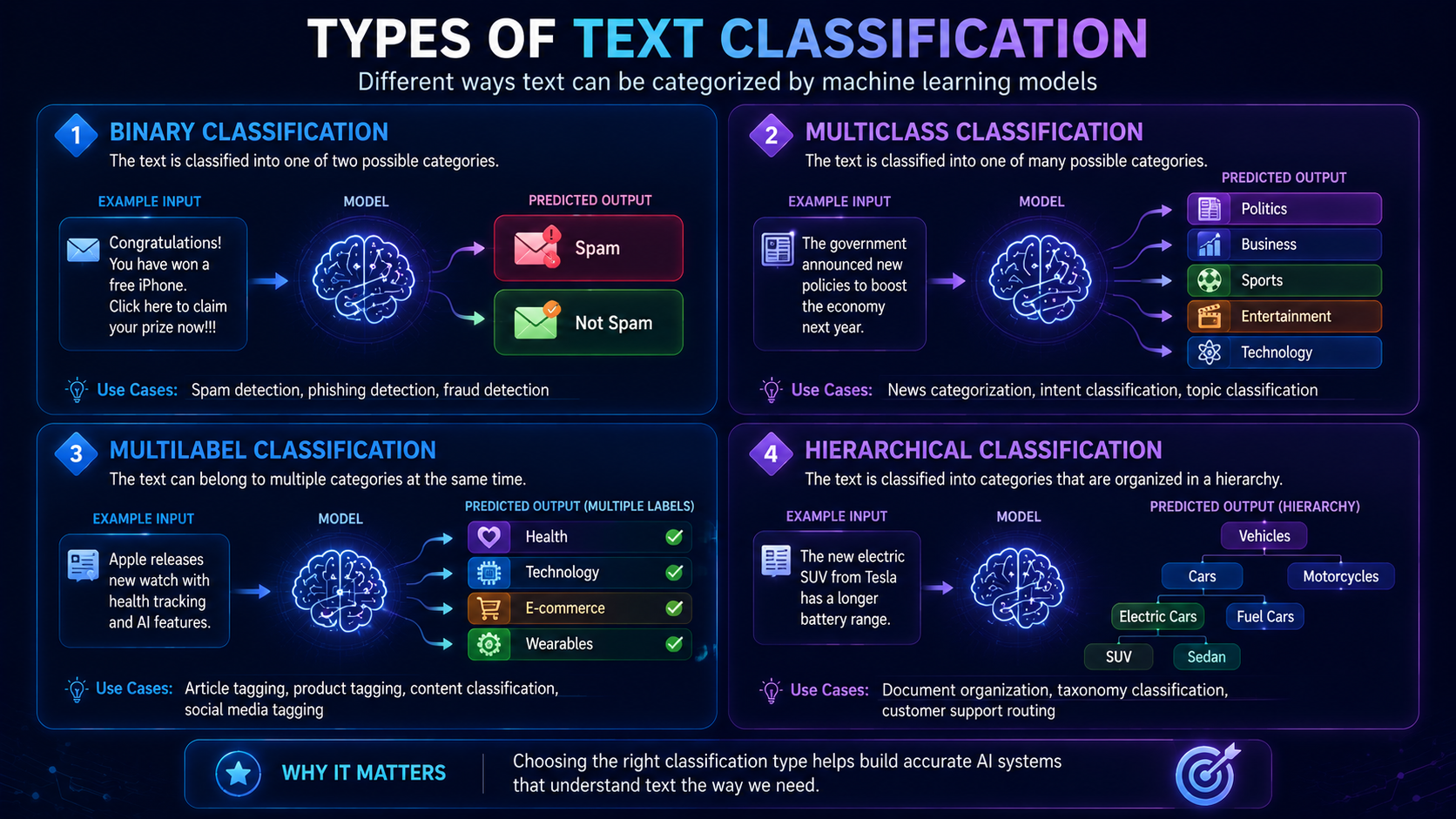
Types of Text Classification
Not every text classification problem is the same.
Some AI systems only need to choose between two categories, while others must select from dozens—or even hundreds—of possibilities.
Understanding the different types of classification helps explain why certain AI systems are designed differently depending on the task.
Binary Classification
Binary classification is the simplest form of text classification.
The model chooses between only two possible categories.
Examples include:
- Spam vs. Not Spam
- Positive vs. Negative
- Fraud vs. Legitimate
- Approved vs. Rejected
Think of binary classification like a simple Yes/No decision.
For example, when Gmail receives an email, one of its first decisions is often:
Spam?
- Yes → Move to Spam folder
- No → Deliver to Inbox
Although simple, binary classification powers many of the AI systems people use every day.
Multi-Class Classification
Sometimes AI must choose from many possible categories.
This is called multi-class classification.
For example, a news website may classify articles into:
- Politics
- Technology
- Business
- Sports
- Health
- Entertainment
Although there are many possible labels, each article receives only one final category.
Multi-Label Classification
Real life is often more complicated.
Sometimes one document belongs to several categories at the same time.
Imagine an article about AI being used in hospitals.
It could reasonably belong to:
- Artificial Intelligence
- Healthcare
- Technology
Instead of choosing only one category, a multi-label classifier assigns all relevant labels.
Many modern recommendation systems use this approach.
Hierarchical Classification
Some categories naturally fit inside larger categories.
For example:
Technology

↓

Artificial Intelligence

↓

Natural Language Processing

↓

Text Classification
This structure is called hierarchical classification.
Large websites, digital libraries, and enterprise knowledge bases often use hierarchical classification to organize enormous collections of information.
Common Algorithms Used for Text Classification
Over the years, researchers have developed many different machine learning algorithms capable of classifying text.
Although they all perform the same basic task, they use different approaches to reach their predictions.
Naive Bayes
Naive Bayes is one of the oldest and most widely taught text classification algorithms.
It predicts categories using probability.
Despite its simplicity, Naive Bayes remains surprisingly effective for many applications, especially spam filtering.
Logistic Regression
Despite the name, Logistic Regression is commonly used for classification problems.
It is often one of the first algorithms data scientists try because it is:
- Fast
- Reliable
- Easy to interpret
Many introductory machine learning projects begin with Logistic Regression before exploring more advanced models.
Support Vector Machines (SVM)
Support Vector Machines attempt to find the best boundary separating different categories.
Before deep learning became popular, SVMs were considered one of the strongest algorithms for many NLP tasks.
Even today, they remain useful for certain datasets.
Random Forest
Random Forest combines the predictions of many decision trees instead of relying on only one.
This often produces:
- Better accuracy
- Improved stability
- Reduced overfitting
Because multiple “opinions” are combined, Random Forest models are generally more reliable than a single decision tree.
Neural Networks
Neural Networks introduced a major leap forward.
Instead of relying heavily on manually designed features, neural networks automatically learn complex language patterns from data.
This makes them especially powerful for understanding human language.
Transformers
Today, transformer models dominate Natural Language Processing.
Models such as:
- BERT
- GPT
- Gemini
- Claude
understand context far better than previous algorithms.
Rather than focusing only on individual words, transformers analyze relationships across an entire sentence or document.
This is one reason modern AI feels dramatically more intelligent than earlier systems.
Common Algorithms at a Glance
| Algorithm | Best Known For |
|---|---|
| Naive Bayes | Fast probability-based classification |
| Logistic Regression | Reliable baseline classifier |
| Support Vector Machine | Strong decision boundaries |
| Random Forest | Combining many decision trees |
| Neural Networks | Learning complex language patterns |
| Transformers | Context-aware language understanding |
Real-World Applications of Text Classification
Although text classification may sound technical, you probably interact with it dozens of times every day.
Let’s look at some of its most common applications.
Email Spam Detection
Every incoming email is analyzed before reaching your inbox.
The AI decides whether the message belongs in:
- Primary
- Promotions
- Social
- Spam
Without text classification, your inbox would quickly become overwhelming.
Customer Support Automation
Businesses receive thousands of customer messages every day.
Instead of employees manually sorting every request, AI automatically routes messages such as:
- Refund Request
- Technical Support
- Billing Question
- Shipping Issue
This reduces waiting times and improves customer service.
Sentiment Analysis
Companies constantly analyze customer opinions.
Reviews can be classified as:
- Positive
- Neutral
- Negative
This allows businesses to measure customer satisfaction at scale.
Content Moderation
Social media platforms rely heavily on text classification.
AI helps identify:
- Spam
- Harassment
- Hate speech
- Harmful content
Human moderators can then focus on the most important cases.
News Categorization
Media organizations automatically classify thousands of new articles every day.
Readers can quickly browse topics such as:
- Business
- Technology
- Science
- Sports
- Politics
without editors manually organizing every article.
Healthcare
Hospitals and researchers use text classification to organize:
- Medical records
- Clinical notes
- Research papers
- Patient feedback
This helps healthcare professionals locate information more efficiently.
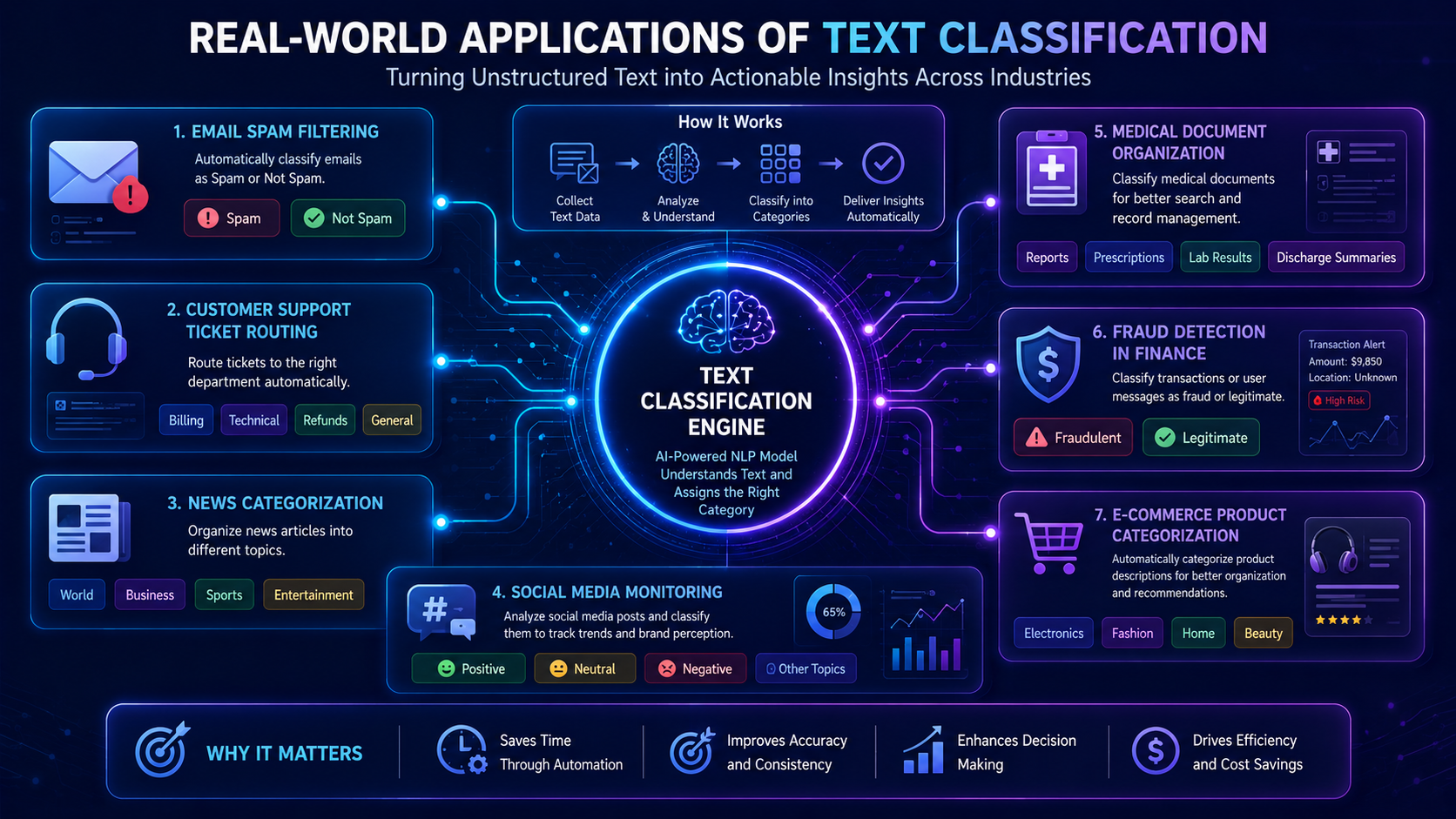
Financial Services
Banks and financial institutions classify:
- Fraud reports
- Customer inquiries
- Insurance claims
- Compliance documents
Automation improves both speed and accuracy.
Why Businesses Use Text Classification
Businesses adopt text classification because it saves both time and money.
Instead of manually reviewing every document, AI performs much of the repetitive work automatically.
Major benefits include:
- Faster customer service
- Lower operating costs
- Better customer insights
- Improved decision-making
- Increased productivity
- Scalable workflows
For organizations processing millions of documents every year, even small improvements can save thousands of hours of manual work.
 Did You Know?

Large companies may automatically classify millions of customer interactions every single day, allowing support teams to focus on solving problems instead of sorting messages.
Common Beginner Mistakes About Text Classification
Many newcomers misunderstand how text classification actually works.
Here are a few common misconceptions.
“AI understands language exactly like humans.”
Not quite.
AI recognizes statistical patterns in language rather than consciously understanding meaning the way people do.
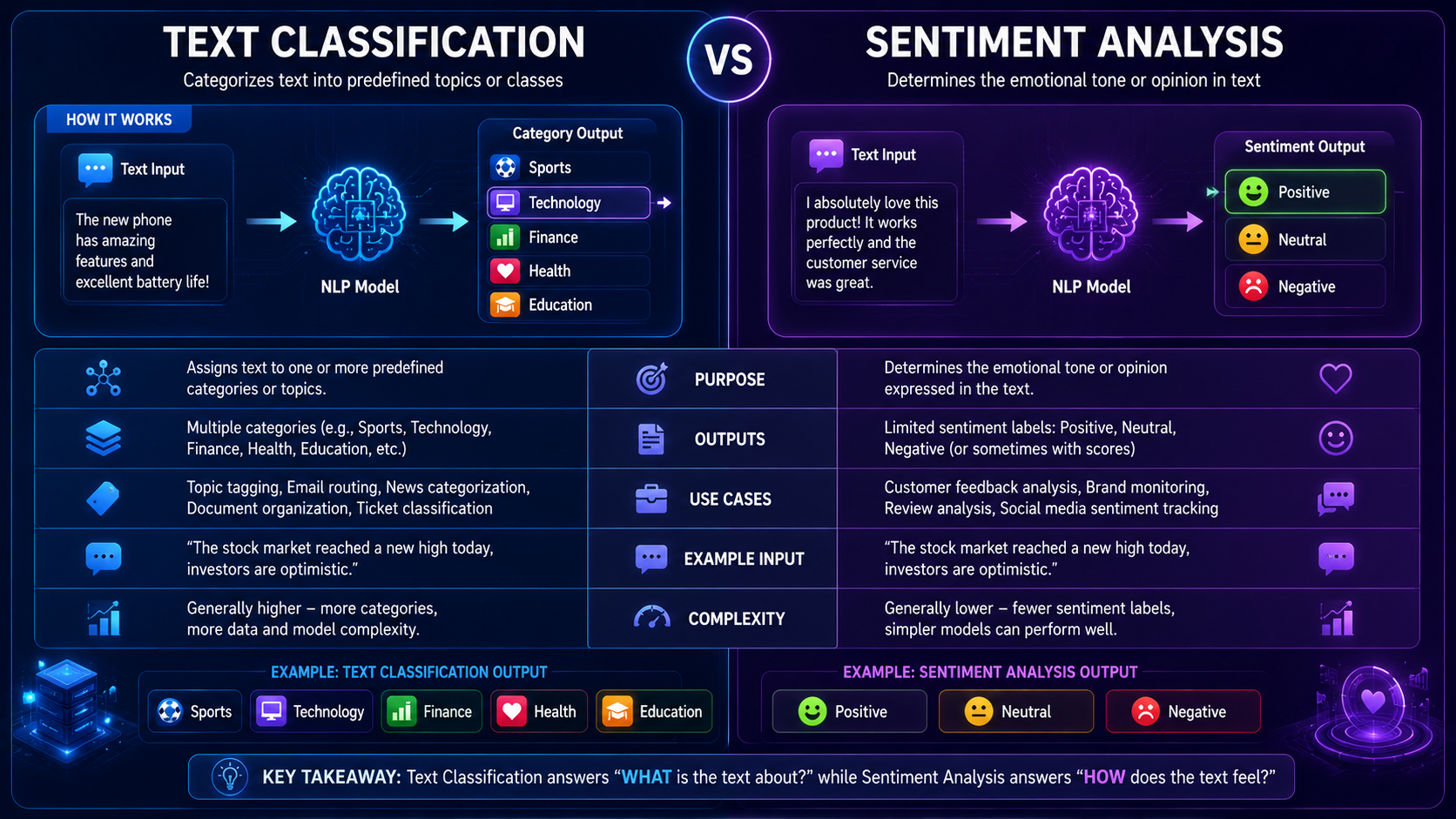
“Text classification and sentiment analysis are the same thing.”
Sentiment Analysis is actually **one specialized type** of text classification.
Text classification is the broader concept.
“Every document belongs to only one category.”
Many systems allow multiple labels.
For example:
An article might simultaneously belong to:
- Artificial Intelligence
- Healthcare
- Machine Learning
“AI never makes mistakes.”
Like humans, AI can make incorrect predictions.
Unusual wording, sarcasm, ambiguous language, or poor-quality training data can all reduce accuracy.
Advantages and Limitations
Like every AI technology, text classification has strengths and weaknesses.
| Advantages | Limitations |
|---|---|
| Automates repetitive work | Requires high-quality training data |
| Organizes massive datasets | May struggle with sarcasm and humor |
| Improves customer experiences | Language changes constantly |
| Enables real-time decision making | Context can still be challenging |
| Scales efficiently | Can inherit bias from training data |
Understanding both sides helps organizations build more reliable AI systems.
Where Text Classification Fits Into Artificial Intelligence
One of the easiest ways to understand text classification is to see how it fits into the broader AI landscape.
Artificial Intelligence

↓

Machine Learning

↓

Deep Learning

↓

Natural Language Processing

↓

Text Classification

↓

Real-World Applications
- Spam Detection
- Customer Support
- Search Engines
- Chatbots
- Recommendation Systems
- Content Moderation
Text classification is not an isolated technology.
Instead, it is one important building block within the larger field of AI.
Text Classification in the Age of Large Language Models
Today’s AI systems are increasingly powered by Large Language Models (LLMs).
Unlike traditional classification systems, LLMs can often perform classification with little—or even no—additional training.
Zero-Shot Classification
The AI receives only instructions.
Example:
“Classify this review as Positive, Neutral, or Negative.”
Without additional training, the model predicts the correct category.
Few-Shot Learning
The AI is given only a handful of examples before making predictions.
This allows it to quickly adapt to new tasks without requiring massive datasets.
Prompt-Based Classification
Instead of writing code, users simply describe the task using natural language.
For example:
“Determine whether this email is spam.”
This flexibility is one reason LLMs have transformed Natural Language Processing.
Future Outlook
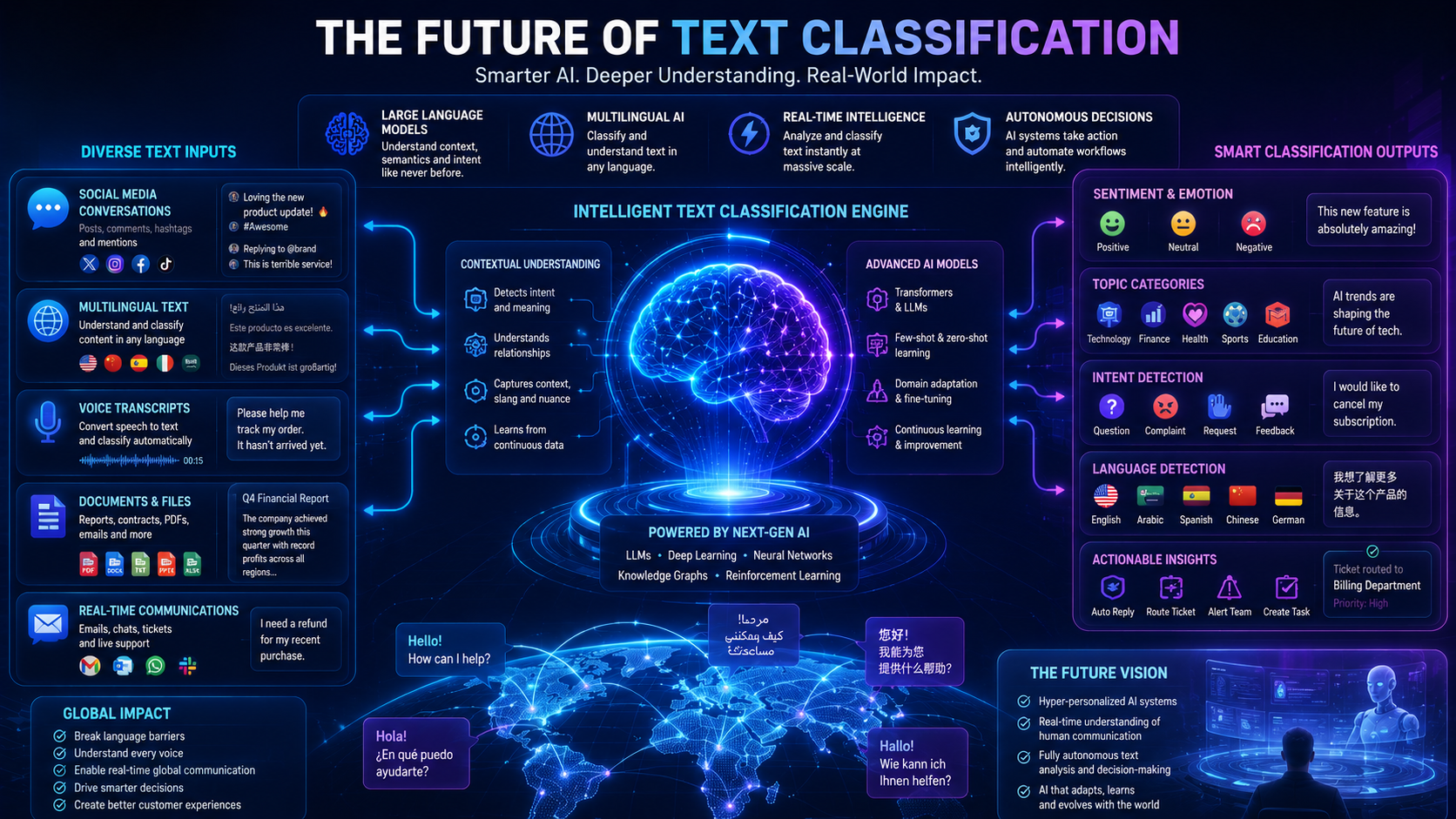
Text classification continues to improve rapidly.
Some of the biggest trends include:
- Better multilingual understanding
- Multimodal AI that analyzes text, images, audio, and video together
- Real-time classification at enormous scale
- More personalized AI assistants
- AI agents capable of making autonomous decisions
As AI becomes increasingly integrated into daily life, text classification will remain one of its most important foundational technologies.
Key Takeaways
Before moving on, here are the most important ideas to remember:
- Text Classification automatically assigns categories to written text.
- It is one of the core tasks in Natural Language Processing.
- Modern systems rely heavily on machine learning, deep learning, and transformer models.
- Businesses use text classification every day to automate workflows and improve customer experiences.
- Understanding text classification helps you understand many of the intelligent features behind modern AI.
Frequently Asked Questions (FAQ)
What is text classification in simple terms?
Text classification is the process of automatically assigning categories or labels to written text. AI systems analyze the content of a sentence, paragraph, or document and determine which predefined category it belongs to, such as spam, customer support, or positive review.
Why is text classification important?
Text classification helps computers organize and understand massive amounts of text quickly and accurately. It powers many everyday AI applications, including spam filtering, customer support automation, recommendation systems, and content moderation.
How does text classification work?
A text classification model learns patterns from labeled examples during training. When it receives new text, it compares the language with patterns it has learned and predicts the category with the highest probability.
What is an example of text classification?
One of the most common examples is email spam filtering. AI analyzes incoming emails and automatically classifies them as either Spam or Not Spam before they reach your inbox.
Is text classification part of Natural Language Processing (NLP)?
Yes. Text classification is one of the core tasks within Natural Language Processing (NLP). It helps AI systems understand, organize, and process written language so they can perform more advanced tasks.
What is the difference between text classification and sentiment analysis?
Text classification is a broad NLP task that assigns text to categories such as spam, news, or customer support. Sentiment analysis is a specialized type of text classification that focuses specifically on identifying emotional tone, such as positive, neutral, or negative.
Can a document belong to multiple categories?
Yes. In multi-label classification, a single document can receive multiple labels. For example, an article might be classified as Artificial Intelligence, Healthcare, and Technology at the same time.
What algorithms are commonly used for text classification?
Common algorithms include Naive Bayes, Logistic Regression, Support Vector Machines (SVM), Random Forest, Neural Networks, and modern Transformer models such as BERT and GPT.
Is text classification used in deep learning?
Yes. Deep learning has significantly improved text classification by allowing neural networks and transformer models to understand context, relationships between words, and complex language patterns more accurately than traditional machine learning methods.
How do Large Language Models (LLMs) perform text classification?
Large Language Models such as GPT, Claude, Gemini, and Llama can classify text using natural language prompts. They often perform zero-shot or few-shot classification, allowing them to categorize text accurately without requiring extensive task-specific training.
Conclusion
Every time you search Google…
Ask ChatGPT a question…
Receive a movie recommendation…
Open your email…
Or submit a customer support request…
There’s a good chance that text classification is working quietly behind the scenes.
Although most people never see it, this technology helps AI organize information, understand language, and make intelligent decisions in a fraction of a second.
Text classification isn’t just another NLP technique—it’s one of the fundamental building blocks that makes modern Artificial Intelligence possible.
Now that you understand how AI categorizes language, you’re ready to explore the next pieces of the NLP puzzle.
Continue Your AI Learning Journey
Natural Language Processing
- What Is Natural Language Processing (NLP)
- How NLP Works
- Tokenization Explained
- Word Embeddings Explained
- Sentiment Analysis Explained
- Named Entity Recognition (NER)
- Transformers in NLP
- Chatbots Explained
- Applications of NLP
Artificial Intelligence Foundations
- Artificial Intelligence Explained
- Machine Learning Explained
- Deep Learning Explained
- Neural Networks Explained
- Supervised Learning Explained
- Unsupervised Learning Explained
- Reinforcement Learning Explained
Each of these topics builds on the concepts you’ve learned here and will give you a deeper understanding of how modern AI systems process, interpret, and generate human language.
Learn More From Trusted Sources
f you’d like to explore text classification and Natural Language Processing in greater depth, these organizations provide reliable educational resources:
- IBM – Natural Language Processing (NLP)
- Google AI – Machine Learning and AI Research
- Stanford Human-Centered AI (HAI) – Artificial Intelligence Research and Education