

Updated: October 2026
Reinforcement learning, or RL, is a type of machine learning focused on sequential decision-making. An RL system learns a strategy for choosing actions by using feedback from an environment.
At its core, reinforcement learning asks: What should an agent do now to improve the outcome it can achieve over time? RL is widely known for game-playing systems and robotics research, but it also appears in control, optimization, recommendations, resource allocation, simulation, and other settings where actions influence future states.
Key takeaways
- Reinforcement learning is designed for decisions whose consequences unfold over time.
- An agent selects actions, receives feedback from an environment, and improves a policy.
- Rewards are useful but imperfect proxies for real objectives.
- Simulation, offline data, planning, demonstrations, and learned models can reduce the need for unsafe real-world exploration.
What is reinforcement learning?
In reinforcement learning, an agent interacts with an environment. At each step, the agent observes information about the current situation, chooses an action, and receives feedback that can include a reward and a new state.
The objective is usually not to maximize one immediate reward. It is to learn behavior that performs well across a sequence of decisions. This makes RL different from a direct prediction task where each example already has a known answer.
- The agent observes the current state or observation.
- It selects an action.
- The environment changes in response.
- The agent receives a reward and a new state or observation.
- The process repeats as the agent improves its policy.
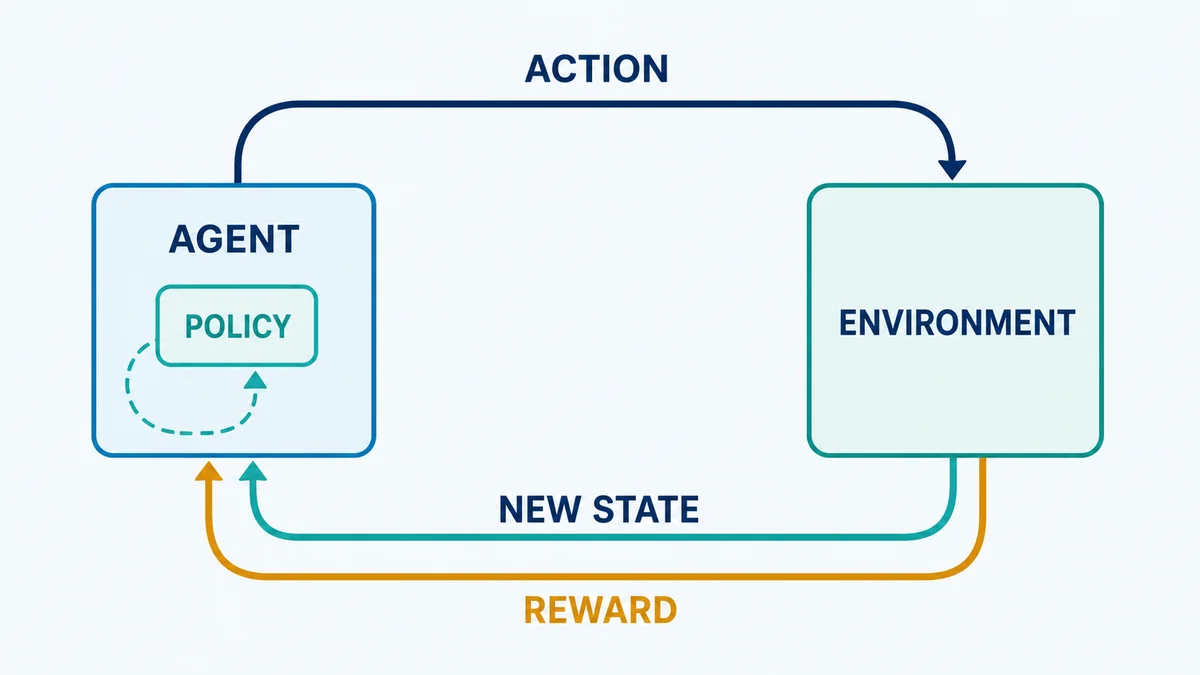
Core reinforcement learning concepts
Agent
The agent is the decision-making system. It chooses actions according to a learned or partially learned strategy.
Environment
The environment is the system the agent interacts with. It may be a game, simulator, robot, network, market model, software environment, or another process.
State and observation
A state represents the situation relevant to future decisions. In some problems, the agent observes the full state. In others, it receives only a partial or noisy observation.
Action
An action is a choice available to the agent, such as changing a control setting, allocating a resource, selecting an item, or choosing the next step in a plan.
Reward
A reward is a numerical feedback signal that helps define what the system is trying to achieve. Reward design matters enormously: if the reward does not represent the real objective well, an agent can score highly while producing an undesirable outcome.
Return
Return is the total reward accumulated over a sequence of decisions. It may be a simple sum over an episode, or a discounted sum that gives less weight to rewards further in the future. RL usually aims to learn a policy with a high expected return across possible runs, rather than chasing the largest reward at the next step.
Policy
A policy is the strategy the agent uses to select actions. It may be a table, a set of rules, a probability distribution, or a neural network.
Value
A value function estimates the expected future return from a state, or from taking an action in a state, while following a particular policy. It connects an immediate decision to its possible long-term consequences.
How reinforcement learning works
1. Define the environment and objective
The problem must specify what the agent can observe, which actions are allowed, how the environment changes, and how outcomes are scored.
2. Collect experience
The agent interacts with the environment or learns from previously collected trajectories containing sequences of states, actions, rewards, and next states.
3. Estimate useful behavior
An algorithm estimates better policies, action values, state values, or environment dynamics from experience.
4. Balance exploration and exploitation
The agent may explore unfamiliar actions to learn more while exploiting actions that already appear effective. Too little exploration can lock the agent into a weak strategy; too much can waste resources or create unsafe behavior.
5. Evaluate the learned policy
Evaluate a learned policy on repeated test episodes and relevant scenarios, separately from the experience used to improve it. An episode is one run of the task. Useful measures include:
- Average return: the mean return across test episodes estimates expected performance. Report variation as well as the average; one successful run is not enough.
- Task success rate: how often the agent achieves the intended goal, which may differ from merely earning a high reward.
- Robustness: how performance changes across starting conditions, disturbances and situations that differ from training.
- Sample efficiency: how much environment experience is needed to reach a useful level of performance.
- Safety and constraint violations: how often the policy breaks a safety rule or operating limit, even if its average return is high.
For research comparisons, use multiple training seeds and report the evaluation conditions. Real-world assessment may also need fairness, latency and human oversight checks. OpenAI’s RL benchmarking notes illustrate reporting average return and variation across runs.
Reinforcement learning is more than trial and error
RL is often described as learning through trial and error. That is useful as a first intuition, but it becomes misleading if it suggests uncontrolled experimentation in the real world.
Modern RL can use simulation, historical or offline datasets, human demonstrations, learned models of the environment, planning, value estimation, policy optimization, and preference or reward models. Not every RL system learns by blindly trying random actions.
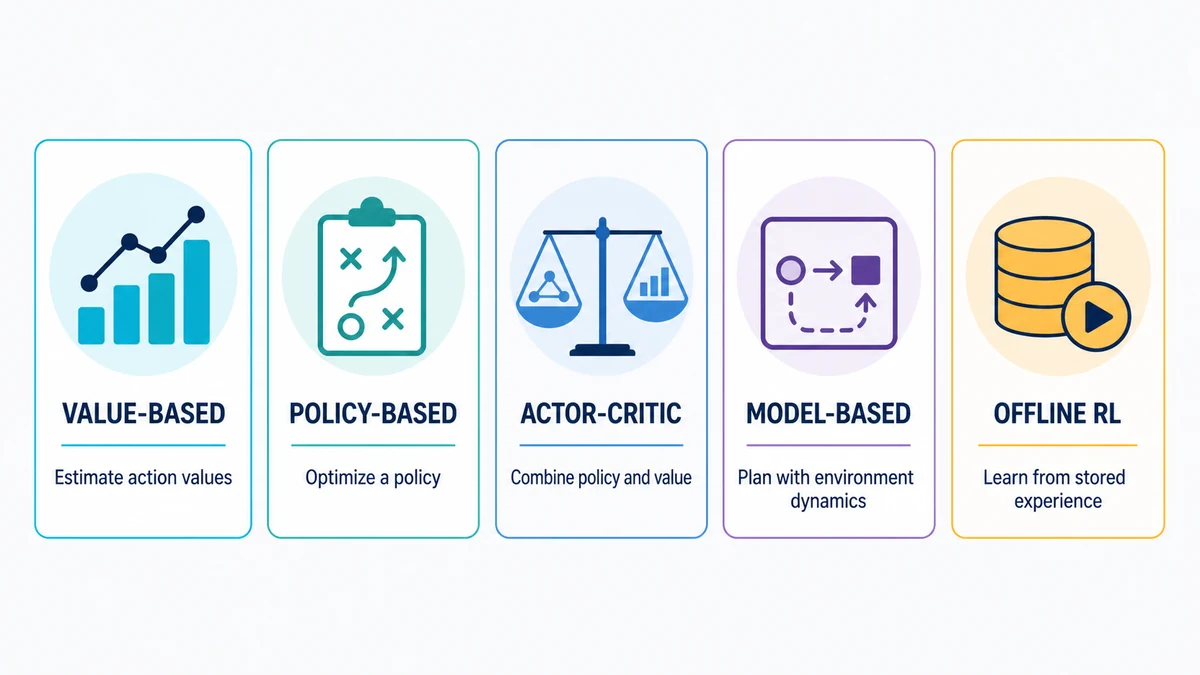
Main reinforcement learning approaches
Value-based methods
Value-based methods estimate how good states or actions are and use those estimates to choose behavior. Q-learning is a classic example.
Policy-based methods
Policy-based methods optimize the policy more directly. They can be useful when actions are continuous or a stochastic policy is desirable.
Actor-critic methods
Actor-critic methods combine a policy component, the actor, with a value-estimation component, the critic.
Model-based reinforcement learning
Model-based methods use or learn a model of how the environment behaves. The agent can use that model for planning or simulated rollouts.
Offline reinforcement learning
Offline RL learns from previously collected experience without unrestricted new interaction during training. This is attractive when exploration is expensive or unsafe, but performance is constrained by the quality and coverage of the historical dataset.
Reinforcement learning vs. supervised learning
| Feature | Supervised learning | Reinforcement learning |
|---|---|---|
| Primary signal | Labels or target values | Rewards and interaction feedback |
| Typical problem | Classification or regression | Sequential decision-making |
| Feedback timing | Usually attached directly to examples | Can be delayed |
| Data collection | Often fixed training datasets | Interactive, simulated, or offline trajectories |
Continue with Supervised Learning Explained, Unsupervised Learning Explained, and Types of Machine Learning.
Deep reinforcement learning
Deep reinforcement learning uses neural networks to represent a policy, value function, environment model, or learned observation representation. It made high-dimensional inputs such as images more practical, but it can also increase training cost, instability, and evaluation complexity.
For the model foundations, read Neural Networks Explained, What Is Deep Learning?, and How Deep Learning Works.
Real-world applications
- Games and simulation: rules, actions, rewards, and outcomes can often be simulated repeatedly at relatively low cost.
- Robotics: RL can support control research, especially when simulation or controlled environments allow safer training.
- Resource allocation: dynamic scheduling, networks, and energy systems can involve decisions that affect future conditions.
- Recommendations and ranking: RL or bandit ideas can account for longer-term response, alongside retrieval, supervised ranking, experimentation, and business rules.
- Autonomous systems: RL may contribute to specific components, but autonomous vehicles also require perception, mapping, planning, control, simulation, and safety engineering.
Challenges and limitations
- Sample efficiency: many methods require large amounts of experience.
- Reward design: poorly specified rewards can encourage unintended strategies.
- Safety during exploration: unfamiliar actions may be dangerous in high-stakes environments.
- Training instability: results can be sensitive to hyperparameters, random seeds, environment design, and implementation details.
- Distribution shift: a policy can fail when deployment conditions differ from training.
- Simulation gaps: simulated conditions may omit important aspects of the real world.
- Difficult evaluation: high training reward does not guarantee safe or robust deployment.
Reward hacking and specification problems
An agent optimizes the objective it is given, not necessarily the outcome a human intended. If a reward is only a rough proxy for the real goal, the agent may discover shortcuts that maximize reward while violating the spirit of the task. This is often called reward hacking or specification gaming.
The broader lesson applies across AI: objectives, constraints, monitoring, and evaluation must reflect the real outcome people care about.
Frequently asked questions
What is reinforcement learning in simple terms?
It is a machine-learning approach for learning how to choose actions over time using feedback from an environment.
Is reinforcement learning always trial and error?
No. RL can also use simulation, demonstrations, offline datasets, planning, learned models, and other techniques.
Is ChatGPT trained with reinforcement learning?
Some language-model training pipelines include reinforcement-learning or preference-optimization stages, but models are usually pretrained first with large-scale self-supervised learning. RL is only one part of some training processes.
Is reinforcement learning the main technology behind self-driving cars?
No. Autonomous vehicles combine perception, prediction, mapping, localization, planning, simulation, control systems, and safety engineering. RL may be used for specific research or optimization components.
Is reinforcement learning better than supervised learning?
Not generally. They solve different problems. Supervised learning is often appropriate for direct prediction from labeled examples, while RL is designed for sequential decisions with feedback over time.
Where to learn next
This lesson completes the introductory machine-learning paradigm sequence: Supervised Learning → Unsupervised Learning → Reinforcement Learning.
Next: Deep Learning Explained. Learn how multilayer neural networks represent patterns, and how deep learning can support different learning approaches, including RL.
For review, revisit Machine Learning Explained or Types of Machine Learning. For general evaluation concepts, see Model Evaluation Metrics Explained; the RL-specific measures above remain the guide for assessing a policy.