
Last reviewed: August 2026
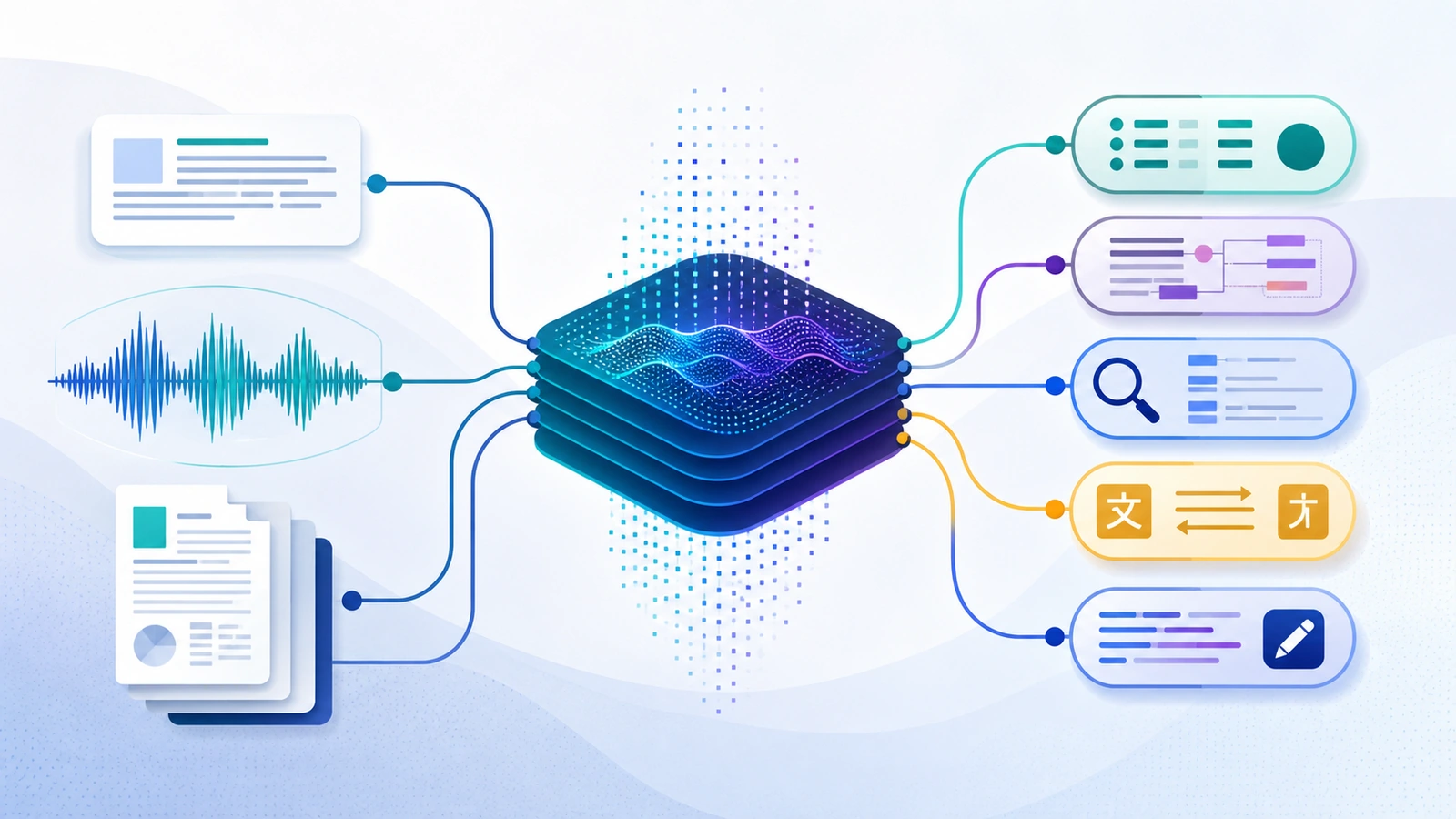
Natural language processing, or NLP, is the field of artificial intelligence concerned with helping computers process, analyze, retrieve, generate and interact with human language.
NLP includes much more than chatbots and large language models. It supports tasks such as spam filtering, search, sentiment analysis, information extraction, translation, summarization, speech-related language processing and text generation.
Different NLP systems solve different problems. Some use linguistic rules or statistical methods. Others use machine learning, neural networks, transformers, retrieval systems or combinations of these approaches.
In this guide, you will learn:
- What NLP does.
- Common NLP tasks and examples.
- How tokens and embeddings represent language.
- How NLP developed from rules to modern neural models.
- How NLP differs from LLMs, generative AI and transformers.
- How language systems are evaluated.
- Important limitations and risks.
What Does NLP Do?
NLP allows software to work with written or spoken language for a particular task.
Common NLP tasks include:
- Text classification: assigning labels such as spam, topic or intent.
- Sentiment analysis: estimating whether text expresses positive, negative or neutral sentiment.
- Named-entity recognition: finding people, organizations, locations, dates and other entities.
- Information extraction: turning facts in unstructured text into structured data.
- Search and retrieval: finding relevant information for a query.
- Machine translation: converting language from one language to another.
- Question answering: producing answers from documents, databases, model parameters or retrieved sources.
- Summarization: creating a shorter version of longer content.
- Text generation: producing new language based on an input or prompt.
- Topic modeling and clustering: grouping text by patterns or themes.
Google’s current Machine Learning Glossary defines NLP as the field of teaching computers to process what people say or type. Google Cloud’s NLP overview also highlights classification, entity extraction, sentiment analysis and document processing as practical NLP uses.
Different tasks require different data, system designs and evaluation methods. There is no single workflow or model that represents the entire field.
Simple example: A customer-support system might classify an incoming message, identify the product mentioned, retrieve a relevant help article and draft a response. Each step is a language task, but the steps may use different techniques.
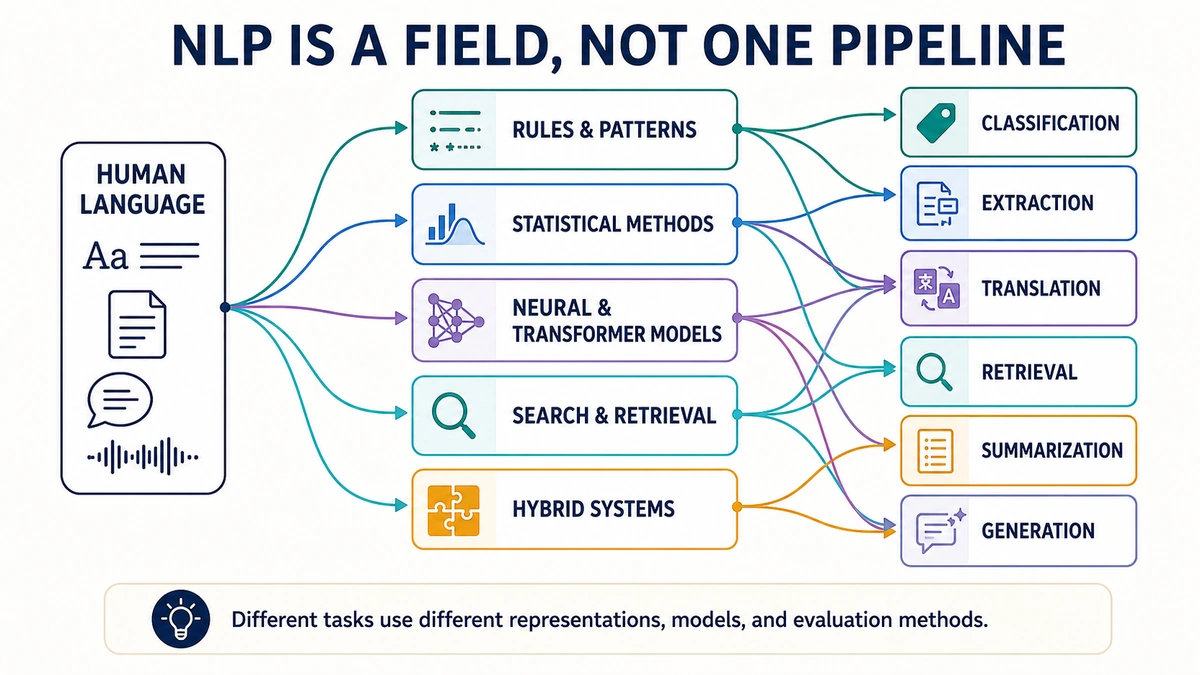
NLP Is a Field, Not One Pipeline
A useful beginner model is:
Language input → representation or rules → task-specific processing → output
The details vary substantially.
A rules-based system might match a phrase against a dictionary. A search system might retrieve documents containing related terms. A classifier might convert text into numerical features and predict a label. A transformer-based model might create contextual representations or generate text. A production application may combine all of these approaches.
This is why statements such as “all NLP begins with tokenization” or “all NLP systems train on massive text datasets” are too broad.
Tokenization and Subwords
Many modern language models divide input into smaller units called tokens.
A token might represent:
- A word.
- Part of a word.
- A character.
- A byte or other learned unit.
For example, one tokenizer might treat “unhelpful” as one token, while another might divide it into units similar to “un,” “help” and “ful.” The exact result depends on the tokenizer.
Subword tokenization helps models work with large vocabularies, rare terms and word variations without assigning a separate entry to every possible word. However, tokenization is model-specific and is not a universal first step for every language technology.
Learn more in Tokenization Explained.
Embeddings and Contextual Representations
An embedding is a numerical representation of a word, token, sentence, document or other input.
Older embedding methods often assigned a relatively fixed vector to each word. Modern transformer-based systems can create contextual representations, meaning that a word’s numerical representation can change with the surrounding text.
For example, “bank” appears in both of these phrases:
- River bank.
- Bank account.
A contextual model can represent the word differently in each phrase because the surrounding words differ. That does not prove human-like understanding; it shows that the model can use learned relationships in context.
Learn more in Word Embeddings Explained.
From Rules to Statistical NLP and Neural Models
NLP has developed through several overlapping approaches. Newer methods have not eliminated every earlier one.
Rule-based NLP
Rule-based systems use dictionaries, patterns, grammars or hand-written instructions.
They can be useful when requirements are explicit, outputs must be traceable or the problem is narrow and stable. Their main weakness is that maintaining enough rules for varied human language can become difficult.
Statistical NLP
Statistical NLP uses patterns learned from language data. Methods such as n-gram models, hidden Markov models, conditional random fields and probabilistic parsers became important for tasks including tagging, speech and parsing.
Neural NLP
Neural networks can learn language representations and task patterns from data. Recurrent networks, convolutional architectures and attention mechanisms expanded the range of problems these systems could address.
Transformers and pretrained models
A transformer is a neural-network architecture built around attention mechanisms. Transformers are widely used in current NLP, including language models, translation, classification, retrieval and generation.
Many modern systems begin with a pretrained model and adapt it using prompting, fine-tuning, retrieval or other methods. Pretraining can reduce the amount of task-specific training required, but it does not guarantee reliable performance in a new domain.
Stanford’s 2026 CS224N curriculum covers transformers alongside retrieval, agents, multilinguality, benchmarking and evaluation—illustrating that modern NLP is broader than any one model family.
Continue with Transformers Explained and Neural Networks Explained.
NLP vs LLMs, Generative AI and Transformers
These terms are related, but they are not interchangeable.
| Term | What it describes | Example |
|---|---|---|
| Natural language processing | The broader AI field concerned with language tasks | Classification, extraction, translation and generation |
| Large language model | A large model that estimates and generates token sequences | A model used for drafting or question answering |
| Generative AI | Systems that create or transform content | Text, image, audio or video generation |
| Transformer | A neural-network architecture based on attention | An encoder, decoder or encoder-decoder model |
NLP vs large language models
An LLM is one type of model used for language tasks. Many NLP systems do not require an LLM and instead use smaller models, rules, search, classical machine learning or hybrid designs.
For a specific language-model family, read What Is GPT? Generative Pre-trained Transformers Explained.
NLP vs generative AI
Generative AI creates or transforms content. NLP includes generative language tasks, but it also includes non-generative tasks such as classification, extraction, tagging and retrieval.
Read What Is Generative AI?.
NLP vs transformers
A transformer is an architecture. NLP is an application field. Transformers are important in modern NLP, but NLP existed before transformers and still includes non-transformer methods.
Common NLP Applications
Search and information retrieval
Search systems analyze queries and documents to find relevant information. Modern systems may combine keyword matching, embeddings, reranking and generative components.
Chatbots and virtual assistants
Conversational systems may classify intent, retrieve information, manage dialogue and generate responses. Speech-based assistants also depend on speech recognition and text-to-speech components.
Read Chatbots Explained.
Sentiment analysis
Sentiment analysis estimates the tone expressed in text. Businesses may use it to study reviews or customer feedback, but sarcasm, mixed sentiment and domain-specific language can reduce accuracy.
Read Sentiment Analysis Explained.
Named-entity recognition and information extraction
Named-entity recognition identifies items such as people, organizations, products, locations and dates. Information-extraction systems can also identify events, attributes and relationships.
Read Named Entity Recognition Explained.
Machine translation
Machine translation converts text between languages. Performance varies across language pairs, dialects, domains and context. High-resource languages generally have more training and evaluation data than many low-resource languages.
Summarization
Extractive summarization selects passages from the source. Abstractive summarization generates new wording. Abstractive systems can be flexible, but they may omit important context or introduce unsupported statements.
Document and text classification
Classification systems can detect spam, assign topics, route support requests or flag content for review. Their quality depends on labels, training data, thresholds and how well evaluation data represents real use.
For a broader tour, see Applications of NLP.
How NLP Systems Are Evaluated
Evaluation should match the task and deployment context.
Examples include:
- Accuracy, precision, recall and F1 for classification or extraction.
- Retrieval metrics for search.
- Task-specific sequence or overlap metrics for translation and summarization.
- Human evaluation for correctness, usefulness, fluency or safety.
- Robustness tests across languages, domains and input variations.
- Real-world task success, latency, cost and human-intervention requirements.
No single score captures every dimension of NLP quality. A system can perform well on a benchmark and still fail on unfamiliar language, specialized documents or real user inputs. NIST emphasizes that trustworthy AI depends on meaningful measurement and evaluation of both technology and use context in its AI measurement and evaluation guidance.
Read Model Evaluation Metrics Explained.
Limitations and Risks of NLP
Ambiguity and context
Words and sentences can have multiple meanings. Intent may also depend on conversation history, shared knowledge or circumstances outside the text.
Sarcasm, idioms and cultural differences
Literal wording may not reflect intended meaning. Humor, slang, dialects and social norms vary across communities and regions.
Unsupported or incorrect generation
Generative language models can produce fluent statements that are false, unsupported or inconsistent. NIST calls this risk confabulation in its Generative AI Profile.
This risk applies especially to generative systems; it should not be presented as an inherent behavior of every NLP method.
Bias
Language systems can reflect biases in data, labels, design choices, objectives and deployment processes.
Multilingual coverage
Performance can vary substantially across languages, dialects and regional varieties. Good results in one language do not establish equivalent performance in another.
Privacy and security
Prompts, documents, logs, training data and retrieved context can contain sensitive information. Language systems can also face prompt injection, data leakage and other security risks depending on how they are connected to tools and information.
Domain shift
A model evaluated on general text may perform poorly on specialized legal, medical, scientific or organizational language without suitable adaptation and testing.
Input sensitivity
Small changes in wording, context or formatting can sometimes change a model’s result. Testing should include realistic variations rather than only ideal examples.
Frequently Asked Questions
What is natural language processing in simple terms?
Natural language processing is the field of AI that helps computers work with written or spoken human language.
Is NLP the same as artificial intelligence?
No. AI is the broader field. NLP focuses specifically on language-related tasks.
Is NLP the same as an LLM?
No. An LLM is one type of model used for some NLP tasks. NLP also includes rules, search, statistical methods, smaller models and hybrid systems.
Does all NLP use deep learning?
No. NLP can use linguistic rules, statistical methods, classical machine learning, neural networks, transformers, retrieval or combinations of these approaches.
Is ChatGPT an NLP application?
ChatGPT is a generative language application built around large language models. It performs several NLP-related tasks, but it does not represent the entire NLP field.
Does NLP understand language like a person?
NLP systems can learn complex patterns and perform useful language tasks. Strong task performance should not automatically be equated with human understanding, consciousness or intent.
What programming language is commonly used for NLP?
Python is widely used because of its machine-learning and language-processing ecosystem, but NLP systems can be built with many programming languages.
Where to Learn Next
Next: How NLP Works. Explore processing and system design in greater depth, then continue with the supporting guides below.
- Tokenization Explained — understand how many language models divide input.
- Word Embeddings Explained — learn how text can be represented numerically.
- Transformers Explained — understand the architecture behind many modern language models.
- Applications of NLP — see more real-world use cases.
Want clear AI explanations and practical guidance by email? Join AllForTheAI for free, beginner-friendly education without the hype.
About the Author and Review
Christos Adam Lee writes and edits AllForTheAI’s beginner-friendly AI guides. This article’s technical framing and sources were reviewed in August 2026. Read the Editorial Policy for sourcing, corrections, review and AI-assistance standards.
How This Guide Was Reviewed
The article separates the broad field of NLP from particular models and architectures. Technical definitions and current curriculum scope were checked against Google, Stanford and NIST resources. Product examples are illustrative rather than endorsements. Generative-model risks are identified separately from limitations that affect NLP more broadly.