
Applications of NLP: Quick Definition
An application of natural language processing (NLP) is a practical use of language-processing capabilities to solve a problem. Examples include routing support messages, searching documents, translating text, summarizing reports and answering questions through a chatbot.
NLP is the broader field. Tasks such as classification or entity extraction are component capabilities; an application combines the capabilities it needs. A complete software system also includes interfaces, data sources, permissions and other tools.
Introduction
Natural language processing appears in many everyday digital experiences: searching documents, translating text, filtering messages, summarizing reports, extracting names and dates, analyzing customer feedback, and communicating with chatbots or AI assistants.
The important beginner idea is that these applications do not all work through one universal NLP pipeline. A search system, a text classifier, and a generative assistant may use very different combinations of rules, retrieval methods, statistical models, neural networks, transformers, databases, and external tools.
If you need the foundation first, start with What Is Natural Language Processing (NLP)?. This guide focuses on what NLP is used for in real systems.
What Counts as an NLP Application?
An NLP application uses language as an important input, output, or interface. The application may analyze text, retrieve information, generate text, or connect language input to another system that performs an action.
For example, a travel assistant may use NLP to identify a user’s intent and destination, but the actual flight inventory still has to come from a booking service, database, or API. NLP handles the language layer; other software components handle the real-world data or action.
- Task: extract “New York” as a destination.
- Application: help a traveler find suitable flights.
- Complete system: combine language processing with an interface, flight inventory, permission checks and booking tools.
A language prediction alone does not reserve a flight.
This distinction is useful because many modern products are mixed systems. A voice assistant can combine speech recognition, NLP, search or tool use, and text-to-speech. An email filter can combine language features with sender, URL, reputation, and behavioral signals. A recommendation system may use NLP for product descriptions or queries while relying on other machine-learning methods for ranking.
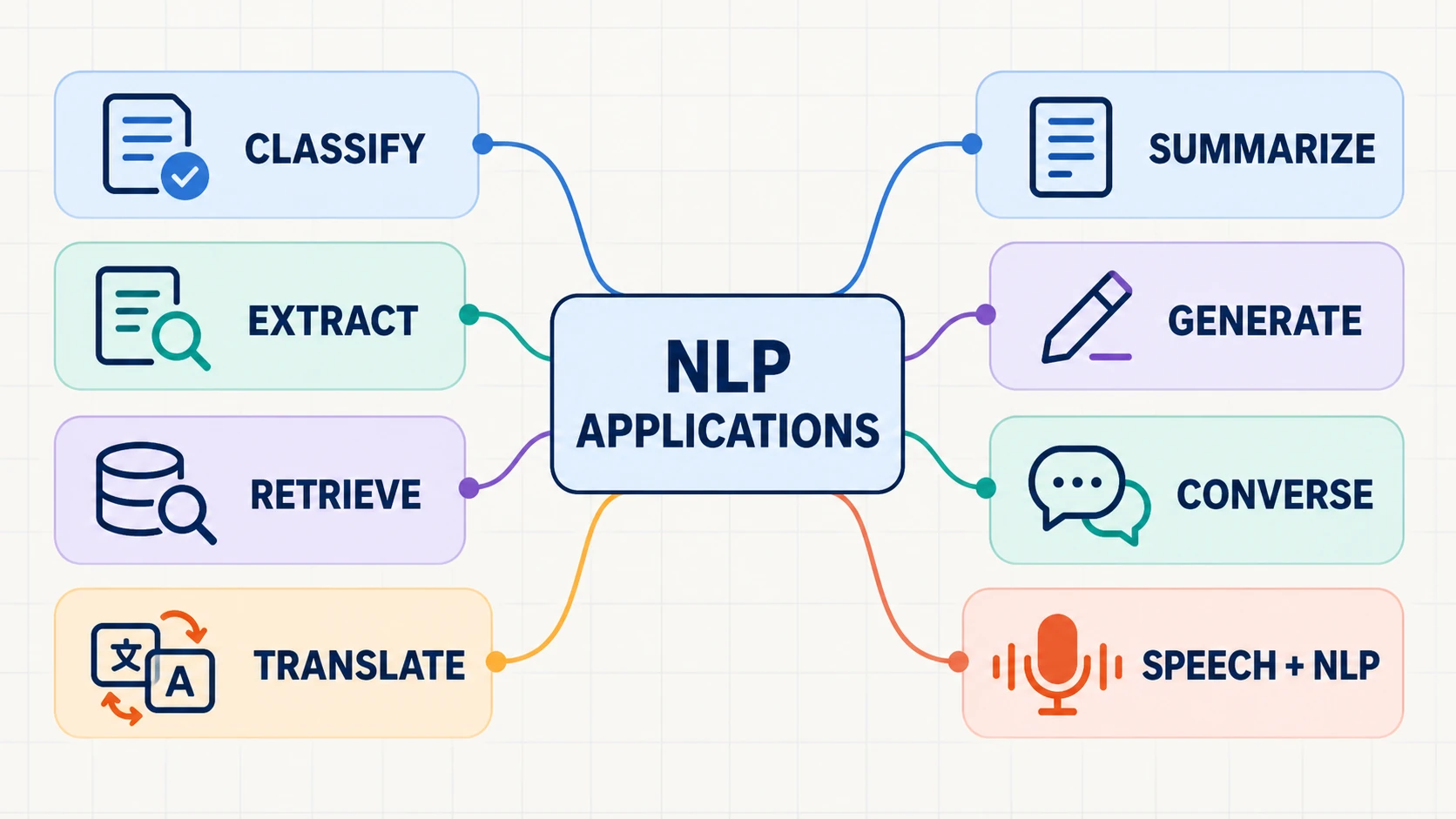
Major NLP Application Families
| Family | Purpose and examples |
|---|---|
| Text classification | What category does this text belong to? Spam detection, intent classification, topic labeling |
| Information extraction | What facts or entities are mentioned? Names, organizations, dates, products, relationships |
| Search and retrieval | Which information is most relevant? Web search, document search, knowledge-base retrieval |
| Machine translation | How can this content be expressed in another language? Text and document translation |
| Summarization | How can this content be shortened while preserving useful information? Meeting notes, reports, articles |
| Language generation | How can new language output be produced? Drafting and rewriting |
| Conversational systems | How can a user interact through language? Chatbots, support assistants, tool-using assistants |
| Speech + NLP systems | How can spoken input connect to language processing? Voice assistants, dictation plus language commands |
These categories overlap. A customer-support assistant, for example, may classify intent, extract an order number, retrieve account information, and generate a response in a single interaction.
Question answering cuts across these families. A system may retrieve relevant documents, extract an answer span, generate an answer, or combine these approaches. The Hugging Face question-answering guide distinguishes extractive and generative approaches.
How Different NLP Applications Work
There is no single step-by-step process that every NLP application follows. It is more accurate to look at a few common patterns.
Text Classification
Text input → representation/model → predicted category
A classifier may label a message as spam/not spam, assign a support ticket to a department, or identify the topic or intent of a sentence. Learn more in Text Classification Explained.
Search and Retrieval
User query + document collection → retrieval/ranking → relevant results
Search systems may use language representations to connect a query with useful documents. They can also combine NLP with indexing, ranking, metadata, personalization, and other retrieval signals.
Conversational or Tool-Using Assistant
User request → language processing/model → retrieval or external tool → response
The language model or NLP layer does not necessarily contain the real-world information itself. A system may need a search index, database, calculator, booking service, or another API to complete the task.
Some systems are periodically retrained or updated using new data or feedback. Others remain unchanged until developers deliberately update the model, rules, retrieval index, or configuration. Using an application does not automatically mean it learns from every interaction.
Example: A Flight-Booking Request
Suppose a user says:
“Book me a flight to New York.”
A simplified application could separate the language task from the action:
- Intent classification: identify the request as book flight.
- Entity extraction: identify New York as the destination location.
- Clarification if needed: ask for missing dates, origin, or passenger details.
- External tool or booking API: retrieve available flights.
- Response: present the retrieved options to the user.
The travel intent is not a named entity. The destination is. This is why real applications often combine several NLP tasks with software outside NLP.
Common Real-World Applications of NLP
Text Classification
Text classification assigns one or more categories to language input. Common tasks include spam detection, topic classification, support-ticket routing, content moderation assistance, and intent classification.
Named Entity Recognition and Information Extraction
Information-extraction systems identify structured information inside text, such as people, organizations, locations, dates, products, medical terms, or contract fields. Named Entity Recognition (NER) is one important extraction task.
Sentiment Analysis
Sentiment analysis estimates expressed sentiment or attitude in text, often using labels such as positive, negative, or neutral. It can help summarize large collections of reviews, surveys, or social posts, but it does not directly reveal a person’s internal emotional state.
Search and Information Retrieval
NLP can help search systems represent queries and documents, identify relevant concepts, and improve retrieval beyond exact keyword matching. Search quality also depends on indexing, ranking, freshness, authority, and other signals outside NLP.
Machine Translation
Machine-translation systems generate text in one language from content in another. Modern systems can produce strong results for many language pairs, but quality can vary with domain, language, terminology, context, and the stakes of the translation.
Summarization and Writing Assistance
NLP systems can condense documents, rewrite text, help draft content, extract action items, or answer questions about supplied material. See What Is Generative AI? for the broader generation concept. Generative systems can also produce unsupported or incorrect statements, so important outputs may require source checking and human review.
Chatbots and Conversational Assistants
Chatbots can use rules, retrieval, intent/entity pipelines, generative models, or combinations of these approaches. Some systems simply answer predefined questions; others retrieve company information or call external tools. Continue with Chatbots Explained for the application-specific deep dive.
Speech + NLP Systems
Voice assistants combine technologies. Speech recognition converts audio into text or another machine-readable representation; NLP then helps interpret or respond to the language; text-to-speech may convert a response back into audio. Speech recognition and speech synthesis are related to NLP applications but are not identical to NLP itself.
Applications of NLP Across Industries
The strongest industry examples are language-specific. A field such as healthcare or finance uses many forms of AI, so it is more accurate to identify the part of the workflow where language processing is involved.
| Industry | Language-focused NLP uses |
|---|---|
| Healthcare | Clinical-note extraction, transcription support, document summarization, literature search, coding/documentation assistance |
| Finance | Financial-news sentiment, document extraction, compliance-document review, customer-service conversations |
| Education | Language tutoring, feedback assistance, question answering over course materials, text classification |
| Legal | Contract-field extraction, document review, legal search, summarization and drafting assistance |
| Cybersecurity | Phishing-message analysis, threat-report extraction, alert/report summarization |
| Retail and e-commerce | Product search, review analysis, conversational shopping, product-text classification |
| Marketing | Review and survey analysis, sentiment estimation, topic classification, drafting assistance |
| Customer service and operations | Ticket routing, chatbot support, knowledge-base retrieval, document processing |
In higher-stakes settings such as healthcare, finance, legal work, and cybersecurity, language-processing assistance should not automatically be treated as authoritative professional judgment. Appropriate validation, privacy controls, security safeguards, and human review may be necessary depending on the use case. The NIST Generative AI Profile describes risks including unsupported generation, data privacy and information security; these require controls suited to the application.
How Do You Evaluate an NLP Application?
There is no single “NLP accuracy” metric that works for every application. Evaluation should match the task and the real-world consequences of errors.
| Application | What evaluation may focus on |
|---|---|
| Text classification | Precision, recall, F1, error costs, class-specific performance |
| Named entity recognition | Whether the correct entities and boundaries are extracted |
| Search and retrieval | Relevance, ranking quality, coverage, latency |
| Translation | Meaning preservation, fluency, terminology, human review for important content |
| Summarization | Coverage, faithfulness to the source, usefulness, concision |
| Generative assistants | Task success, factual support, safety, groundedness, tool success |
| Customer-support chatbot | Resolution rate, correct routing, escalation quality, user outcomes, latency |
Evaluation also needs representative data. A system that works on general web text may perform differently on medical notes, legal documents, internal company language, dialects, or languages that were less represented in development data.
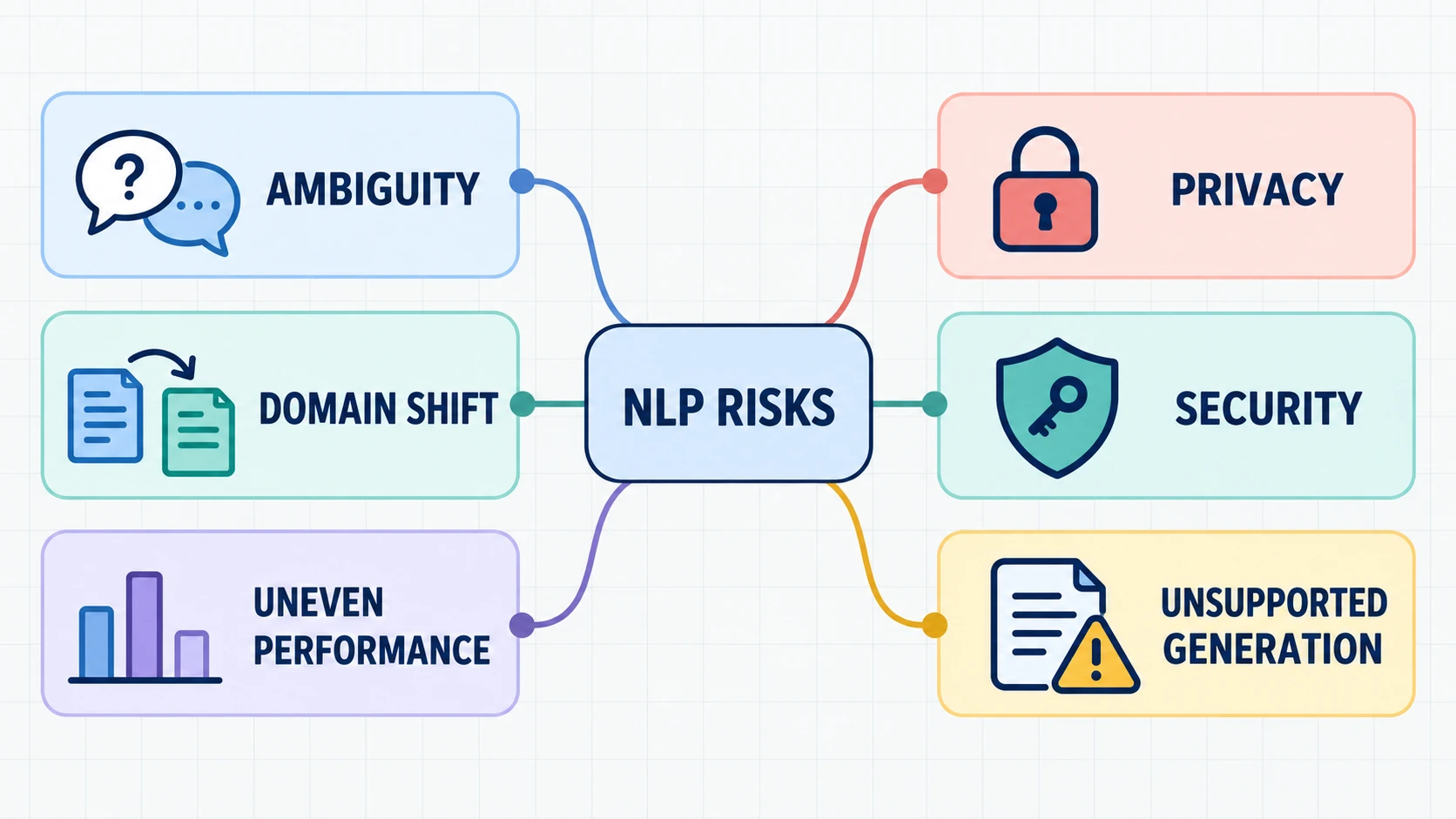
Challenges and Risks of NLP Applications
Ambiguity and Context
Words and sentences can have different meanings depending on context. Sarcasm, humor, idioms, implied meaning, and specialized terminology can make interpretation difficult.
Multilingual and Cultural Variation
Performance can vary across languages, dialects, domains, and cultural contexts. A system should be evaluated on the actual populations and language conditions where it will be used.
Domain Shift
A model that performs well on one kind of language may degrade on another. Legal contracts, clinical notes, support tickets, social posts, and academic papers have very different vocabulary and structure.
Bias and Uneven Performance
Training data, labels, objectives, and deployment choices can contribute to uneven performance. Important applications should be tested for the groups, languages, and scenarios that matter to the intended use.
Privacy and Sensitive Data
Emails, support tickets, legal documents, medical notes, and conversations may contain personal or confidential information. Collection, storage, retrieval, logging, and model use all need appropriate privacy controls.
Security
Language interfaces that can retrieve private information or call tools create additional security concerns. Systems should limit access, validate actions, and treat untrusted text as potentially adversarial input.
Unsupported Generated Information
This limitation applies especially to generative systems: fluent text is not proof that a statement is correct. Applications that generate answers or summaries may need grounding in reliable sources, citations, or human verification.
Data Requirements Vary
NLP does not always require a huge custom dataset. Training a large language model can require enormous corpora, while a rule-based system, retrieval application, or pretrained model may require far less task-specific training data.
Benefits of NLP Applications
- Scale: process or search large collections of language data.
- Automation: assist with repetitive classification, extraction, routing, and drafting tasks.
- Access: improve search, translation, summarization, and conversational access to information.
- Consistency: apply the same language-processing workflow across many inputs, subject to model and data limitations.
- Human-computer interaction: let people use ordinary language as an interface to software and information.
These benefits are not automatic. Value depends on whether the application is accurate enough for its task, integrated well with the surrounding workflow, and monitored for the kinds of errors that matter.
Where NLP Applications Are Heading
Current development is increasingly combining language models with retrieval, external tools, multimodal inputs, smaller on-device models, and domain-specific workflows. These directions may expand what language interfaces can do, but the practical value of any system will still depend on evaluation, data quality, security, privacy, and appropriate human oversight.
Frequently Asked Questions
What are applications of NLP?
They are practical tasks and software systems that use natural language processing to classify, extract, retrieve, translate, summarize, generate, or interact through human language.
What are common NLP applications?
Common examples include text classification, named entity recognition, sentiment analysis, search, machine translation, summarization, chatbots, writing assistants, and language interfaces connected to external tools.
Is a chatbot always based on a large language model?
No. Chatbots can use fixed rules, retrieval, intent and entity models, large language models, or combinations of these approaches.
Is speech recognition the same as NLP?
No. Speech recognition converts spoken audio into text or another machine-readable representation. NLP can then analyze or respond to the language. Voice applications often combine both technologies.
Do NLP systems learn from every user interaction?
Not necessarily. Some systems are periodically retrained or updated, while others remain fixed until developers intentionally change the model, rules, data, retrieval index, or configuration.
Can NLP applications make mistakes?
Yes. Errors can come from ambiguity, domain shift, insufficient or unrepresentative data, multilingual variation, model limitations, retrieval errors, or unsupported generated information. Evaluation should match the specific application.
Continue the NLP Learning Path
You now have the broad map of where NLP is used. The next step is to study one application family in depth.
Next lesson: Chatbots Explained
Related foundation guides:
- What Is Natural Language Processing (NLP)?
- How NLP Works
- Tokenization Explained
- Word Embeddings Explained
- Sentiment Analysis Explained
- Named Entity Recognition (NER)
- Text Classification Explained
- Transformers in NLP
Sources and Review Notes
Last reviewed: October 3, 2026.
This page was reviewed for beginner clarity, technical scope, application boundaries, evaluation concepts, and risk framing. Product examples were minimized where a task-focused example communicates the concept more accurately.
- Google Cloud Natural Language: Basics — examples of language-analysis tasks such as sentiment, entities, syntax, and content classification.
- Google Cloud Speech-to-Text documentation — useful for distinguishing speech recognition from downstream language processing.
- Stanford NLP Group — research and educational material on natural language processing.
- IBM Developer: A Beginner’s Guide to NLP — general NLP background and applications.
- NIST AI Risk Management Framework — general risk-management principles relevant to higher-stakes AI applications.