
Last reviewed and updated: September 22, 2026.
Machine learning is a branch of artificial intelligence that allows computer systems to learn patterns from data and use those patterns to make predictions, classify information, generate scores, recommend actions, or support decisions.
Instead of programming every possible rule by hand, developers define a problem, prepare data, choose a model and training approach, and optimize the model’s parameters so it performs the intended task.
Machine learning is one of the most important approaches used in modern AI, but it is not the same thing as artificial intelligence as a whole. AI also includes rule-based, symbolic, search, planning, optimization, and other methods that may not learn from data at all.
This guide explains how machine learning works, the major learning paradigms, how models are trained and evaluated, where machine learning is used, and what its main limitations are.
Machine learning is part of the broader AI field. Start with Artificial Intelligence Explained, then compare the terminology in AI vs Machine Learning vs Deep Learning.
What Is Machine Learning?
Machine learning is the practice of building models that learn useful statistical relationships from data. The NIST glossary defines machine learning as the development and use of computer systems that adapt and learn from data with the goal of improving accuracy.
A model may learn to:
- Predict a numerical value.
- Assign an example to a category.
- Rank or recommend items.
- Detect unusual patterns.
- Group similar examples.
- Estimate probabilities or risk.
- Learn representations that can support later tasks.
- Choose actions based on feedback.
The key idea is that the model’s behavior is shaped partly by data rather than being specified only through hand-written rules.
That does not mean machine-learning systems require no programming. People still define the objective, collect or select data, choose the modeling approach, design the training process, evaluate performance, set deployment rules, and monitor the system after release.
Machine Learning vs Traditional Programming
In traditional programming, developers usually write explicit rules that map inputs to outputs.
For example:
- If a customer’s age is below a threshold, apply one rule.
- If a transaction exceeds a fixed amount, trigger another rule.
- If a file extension matches a known type, process it in a predefined way.
Machine learning is useful when the relationship between inputs and outputs is too complex, variable, or large-scale to capture with simple hand-written rules.
Instead of specifying every decision rule directly, a model learns parameters from examples.
A simplified comparison looks like this:
| Traditional programming | Machine learning |
|---|---|
| Rules are explicitly written by developers. | Many decision patterns are learned from data. |
| Behavior changes when rules or code change. | Behavior may change when the model is retrained, fine-tuned, recalibrated, or replaced. |
| Best when logic is stable and explicit. | Useful when relationships are complex, statistical, or difficult to encode manually. |
In practice, real software often combines both approaches. A fraud system, for example, may use machine-learning predictions alongside business rules, thresholds, human review, and regulatory controls.
How Does Machine Learning Work?
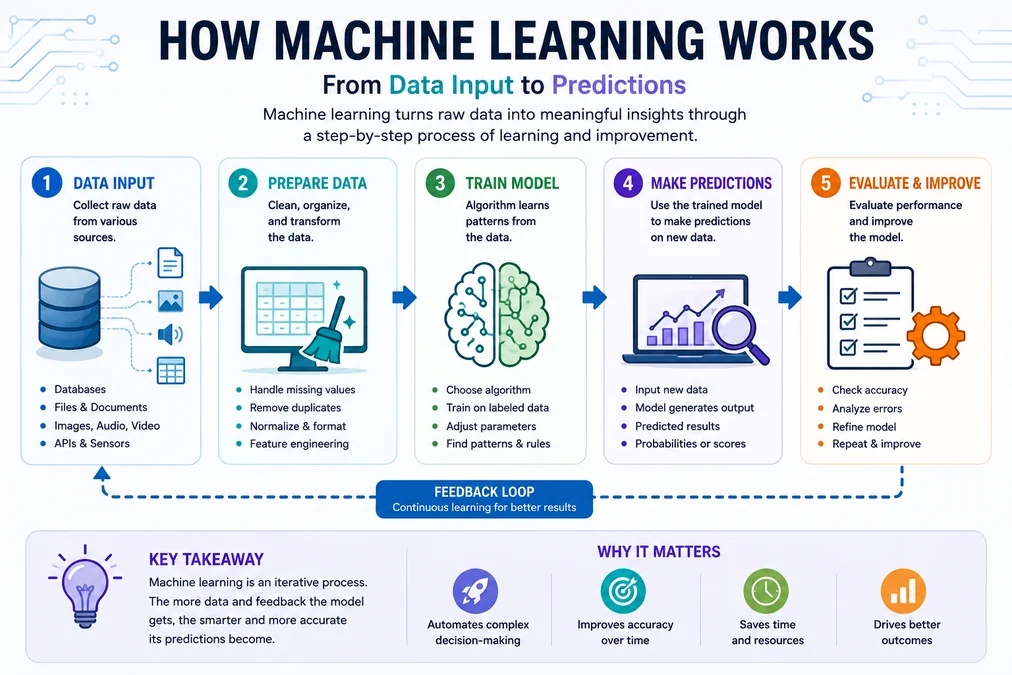
There is no single workflow for every machine-learning project, but many systems follow a general process. Google’s current Machine Learning Crash Course covers many of the same core building blocks, including problem framing, datasets, training, evaluation, overfitting, neural networks, production ML systems, and fairness.
1. Define the problem
The first step is deciding what the system should accomplish.
Examples include:
- Predicting house prices.
- Detecting fraudulent transactions.
- Classifying customer support messages.
- Grouping customers by behavior.
- Forecasting demand.
- Ranking search results.
A clear problem definition matters because it determines the data, model type, evaluation method, and acceptable error tradeoffs.
2. Collect and understand the data
Machine-learning models learn from data, so the quality and relevance of that data are critical.
A dataset may contain:
- Numerical measurements.
- Categories.
- Text.
- Images.
- Audio.
- Time-series observations.
- Behavioral events.
- Labels or target values.
More data is not automatically better. Additional data is useful when it is relevant, representative, sufficiently accurate, and appropriate for the real environment in which the model will operate.
Learn more in What Is a Dataset in Machine Learning?.
3. Prepare the data
Raw data often needs cleaning or transformation before training.
Common steps include:
- Handling missing values.
- Removing duplicates.
- Correcting inconsistent formats.
- Encoding categories.
- Scaling numerical features when needed.
- Splitting data into development and evaluation sets.
- Creating or selecting useful features.
To avoid data leakage, split the data before fitting preprocessing steps that learn from it. Scaling, imputation, PCA, and feature selection should be fitted on the training data only, then applied consistently to validation and test data using the learned training-data parameters.
See Data Preprocessing Explained and Feature Engineering Explained.
4. Choose a model and learning approach
The model should match the task, data, scale, constraints, and operational requirements.
Possible choices include:
- Linear or logistic regression.
- Decision trees.
- Random forests.
- Support vector machines.
- K-nearest neighbors.
- Clustering algorithms.
- Neural networks.
- Transformer-based models.
- Reinforcement-learning methods.
A more complex model is not always a better model. Simpler approaches can be more interpretable, cheaper, faster, and easier to maintain when they perform well enough for the task.
5. Train the model
Training is the process of adjusting a model’s parameters so its outputs better match the objective defined for the task.
For supervised learning, training usually involves examples paired with labels or target values. The model makes predictions, compares them with the expected output through a loss function, and adjusts its parameters to reduce error.
Other learning paradigms use different signals. Unsupervised methods may optimize structure or representation objectives without human-provided labels. Reinforcement learning uses feedback such as rewards. Self-supervised methods create training signals from the structure of the data itself.
Training does not mean a deployed model automatically keeps improving whenever it sees new data. Many models remain fixed after training unless they are deliberately retrained, fine-tuned, updated, or replaced.
6. Validate and tune the model
During development, practitioners typically use validation data or cross-validation to compare models, tune hyperparameters, choose thresholds, and make design decisions.
This stage helps answer questions such as:
- Which model performs better?
- Is the model overfitting?
- Which hyperparameters work best?
- Should a classification threshold change?
- Does performance remain consistent across subgroups or time periods?
Validation should be conceptually separated from final testing so the final test data remains a more independent estimate of generalization.
Read Training vs Testing Data for the broader evaluation-split foundation.
7. Test the final model
A held-out test set is commonly used to estimate how the selected model performs on data that was not used for iterative tuning.
Testing should reflect the real task. For example, a model may need evaluation across:
- Different classes.
- Time periods.
- Customer groups.
- Geographic regions.
- Rare events.
- Noisy or incomplete inputs.
A single overall score can hide important failure modes.
See Model Evaluation Metrics Explained.
8. Deploy and monitor the model
Deployment puts the model into a real application or workflow.
After deployment, teams may monitor:
- Prediction quality.
- Data drift.
- Distribution shift.
- Latency and cost.
- Error rates.
- Fairness or subgroup performance.
- Security issues.
- Human overrides or escalations.
If performance degrades or the business problem changes, the system may need retraining, recalibration, new data, new features, or a different model.
Interactive lesson
Teach a Machine to Predict
Illustrative data only. A learned relationship does not prove that one factor causes the other.
The Main Types of Machine Learning
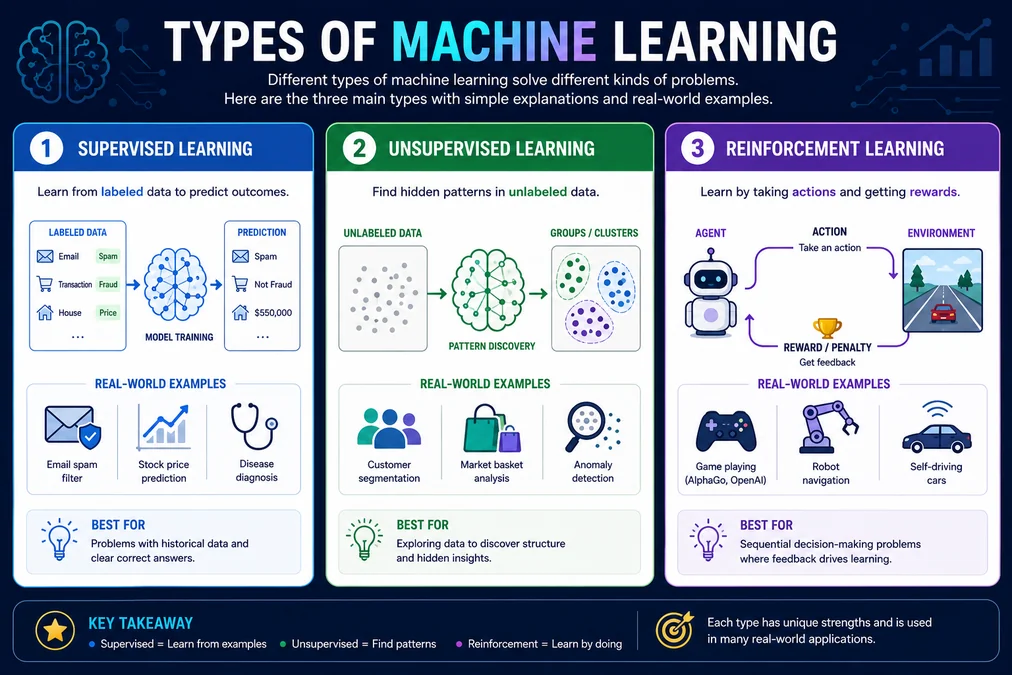
For beginners, machine learning is commonly introduced through three major paradigms: supervised learning, unsupervised learning, and reinforcement learning.
These are useful foundational categories, but they are not the only approaches used in modern machine learning. Semi-supervised and self-supervised learning are also important, and transfer learning is a common strategy for reusing learned representations or parameters.
For the full taxonomy, read Types of Machine Learning.
Supervised learning
Supervised learning uses examples paired with known labels or target values.
Two common task families are:
- Classification, which predicts categories.
- Regression, which predicts numerical values.
Examples include spam detection, customer-churn prediction, credit-risk estimation, image classification, and price prediction.
Read Supervised Learning Explained and Classification and Regression in Machine Learning.
Unsupervised learning
Unsupervised learning works with data that does not include the same kind of human-provided target labels used in standard supervised learning.
Common tasks include:
- Clustering.
- Dimensionality reduction.
- Representation learning.
- Some forms of anomaly or structure discovery.
Because there may be no single correct label for each example, evaluation can be less straightforward than in supervised learning.
Read Unsupervised Learning Explained and K-Means Clustering Explained.
Reinforcement learning
Reinforcement learning trains an agent to choose actions in an environment using feedback such as rewards or penalties.
Common concepts include:
- Agent.
- Environment.
- State or observation.
- Action.
- Reward.
- Policy.
Reinforcement learning is especially relevant in some control, simulation, robotics, optimization, and game-playing settings, but it is not the sole learning method behind every autonomous system.
Read Reinforcement Learning Explained.
Machine Learning vs Deep Learning
Deep learning is a subset of machine learning, not a separate field at the same level.
Deep learning uses multilayer neural networks to learn complex representations from data. These models are especially important in computer vision, speech, natural language processing, and generative AI.
A simplified comparison:
| Machine learning | Deep learning |
|---|---|
| Broad field containing many model families. | Subset of ML based on deep neural networks. |
| Can work well on small or medium structured datasets depending on the problem. | Often benefits from larger datasets, pretraining, or transfer learning, especially for complex unstructured tasks. |
| May rely more heavily on manually designed features in some workflows. | Can learn useful internal representations and reduce some manual feature engineering, while preprocessing and representation choices still matter. |
| Can be easier to interpret for some model families. | Often harder to interpret internally, though explanation methods can still be used. |
See Deep Learning Explained and Neural Networks Explained.
Compare Deep Learning vs Machine Learning in detail →
Common Machine Learning Algorithms
Machine learning includes many algorithm families.
Linear regression
Linear regression models relationships between input variables and a continuous target. It is widely used because it is simple, fast, and relatively interpretable.
Logistic regression
Despite its name, logistic regression is commonly used for classification. It estimates the probability of an outcome and is often a strong baseline model.
Decision trees
Decision trees split data through a sequence of conditions. They are easy to visualize and can model nonlinear relationships, but a single tree can overfit.
Random forests
Random forests combine many decision trees to improve stability and predictive performance.
Support vector machines
Support vector machines can perform classification or regression by finding boundaries that separate examples in a transformed feature space.
K-nearest neighbors
KNN predicts based on nearby examples. It is intuitive but can become computationally expensive and sensitive to feature scale in larger datasets.
K-Means clustering
K-Means is an unsupervised clustering method that groups examples around centroids. It works best when its geometric assumptions are reasonable for the data.
Neural networks
Neural networks learn layered representations and can model highly complex relationships. Deep neural networks underpin many modern language, vision, speech, and generative systems.
Real-World Uses of Machine Learning
Recommendations
Recommendation systems can use machine learning to estimate which products, videos, articles, or songs may be relevant to a user.
These systems often combine multiple models, retrieval systems, ranking models, business rules, and feedback loops.
Fraud detection
Financial and commerce systems may use machine learning to score transactions, accounts, devices, or behavior for fraud risk.
Predictions usually support a broader control process that can include rules, thresholds, manual review, and investigation.
Healthcare
Machine learning can support medical imaging, risk estimation, documentation, triage assistance, research, and operational planning.
Because healthcare is high stakes, models require careful validation, representative data, privacy controls, regulatory compliance, and appropriate human oversight.
Search and ranking
Search systems use machine-learning models to estimate relevance, rank results, understand queries, and personalize or contextualize responses.
Forecasting
Machine learning can support demand forecasting, inventory planning, energy forecasting, maintenance prediction, and financial modeling.
Forecasts are estimates, not guarantees. Performance can degrade when real-world conditions differ from the patterns present in historical data.
For example, a model may estimate crop yield from historical weather, soil and crop data. See AI in Agriculture for how these forecasts can support farm planning, why local validation matters, and why predicting yield does not guarantee a higher harvest.
Computer vision and language
Machine-learning models power tasks such as image classification, object detection, speech recognition, translation, sentiment analysis, summarization, and question answering.
How Machine Learning Models Are Evaluated
A model is useful only if it performs well on the actual task and remains reliable in realistic conditions.
Common evaluation considerations include:
- Classification evaluation: accuracy, precision, recall, F1 score, ROC-AUC or PR-AUC where appropriate, and calibration.
- Regression evaluation: mean absolute error, root mean squared error, and other task-appropriate error measures.
- System-level evaluation: ranking quality where relevant, latency, cost, fairness across relevant groups, and robustness to changing conditions.
The best metric depends on the problem. For example, a medical screening model and a product recommendation model may need very different evaluation criteria.
Read Accuracy vs Precision vs Recall and Model Evaluation Metrics Explained.
Overfitting and Underfitting
Machine-learning models must learn useful patterns without memorizing training-specific noise.
Overfitting occurs when a model fits the training data too closely and performs worse on new data.
Underfitting occurs when a model is too limited, poorly represented, or insufficiently optimized to capture useful structure.
Possible responses to overfitting include regularization, simpler models, more representative data, data augmentation where appropriate, early stopping, feature selection, and better validation practices.
Possible responses to underfitting include richer features, a more expressive model, reducing excessive regularization, or improving optimization.
No single technique always fixes either problem.
Read Overfitting vs Underfitting and Bias vs Variance.
Limitations of Machine Learning
Data dependence
Models reflect the data, labels, objectives, and environments used during development. Poor-quality or unrepresentative data can produce poor results.
Distribution shift
A model can perform well during testing but degrade when real-world conditions change.
Bias and fairness
Machine-learning systems can reproduce or amplify unfair patterns from historical data, labels, sampling decisions, objectives, or deployment feedback loops.
Interpretability
Some models are easier to understand than others. In high-stakes settings, teams may need explanations, audit trails, human review, or simpler models even if a more complex model has slightly better benchmark performance.
Security and robustness
Models can be affected by adversarial inputs, poisoned data, data leakage, insecure pipelines, and manipulation of surrounding applications.
Correlation is not causation
Machine-learning models often learn associations. A strong predictive relationship does not automatically establish a causal relationship.
Automation does not remove accountability
A model can assist or automate a task, but organizations remain responsible for how it is designed, deployed, monitored, and governed.
Does More Data Always Improve a Machine Learning Model?
No.
More data can improve performance when the additional examples are relevant, representative, correctly processed, and useful for the model and objective.
But more data may add little value—or even create problems—when it is:
- Noisy.
- Duplicated.
- Biased.
- Incorrectly labeled.
- Outdated.
- Irrelevant to the target population.
- Collected from a different environment than deployment data.
Model architecture, feature quality, training procedure, evaluation design, and problem definition can matter as much as data volume.
Does Machine Learning Automatically Improve Over Time?
Not necessarily.
Some systems are designed for periodic retraining, online learning, or continual adaptation. Others are deployed as fixed models and remain unchanged until a team intentionally updates them.
Simply processing more inputs does not mean a model is learning from those inputs.
To improve safely, a system usually needs a governed update process that controls new data, evaluates the new model, checks for regressions, and approves deployment.
Frequently Asked Questions
Is machine learning the same as artificial intelligence?
No. Machine learning is a subset of artificial intelligence. AI also includes approaches such as rule-based systems, symbolic reasoning, planning, search, and optimization.
Is deep learning the same as machine learning?
Deep learning is a subset of machine learning. It uses multilayer neural networks and is especially important for language, vision, speech, and generative tasks.
Does machine learning require labeled data?
Not always. Standard supervised learning relies on labeled examples, while unsupervised, self-supervised, reinforcement, and some semi-supervised approaches use different kinds of training signals.
Can machine learning work with small datasets?
Sometimes. The amount of data required depends on the task, feature quality, noise level, model complexity, prior knowledge, transfer learning options, and required accuracy.
Does more data always mean better accuracy?
No. More relevant and representative data can help, but quality, labeling, model design, and evaluation are also critical.
Can a machine-learning model be 100% accurate?
On some narrow or artificial datasets, a model may achieve perfect test accuracy, but real-world tasks often include noise, ambiguity, changing conditions, measurement error, and rare edge cases. A perfect score should be examined carefully for data leakage or an unrealistic evaluation setup.
What is the difference between training, validation, and testing data?
Training data is used to fit model parameters. Validation data or cross-validation is commonly used for model selection and tuning. A held-out test set is used after those choices to estimate final generalization more independently.
Where to Learn Next
Continue with the major learning paradigms and then deepen the supporting foundations.