
Chatbots are software systems that let people interact with a computer through conversation. Some follow scripts or decision trees. Others use machine learning, retrieval systems, or large language models to interpret requests, find information, generate replies, or perform actions.
Not every chatbot uses artificial intelligence, and AI chatbots do not all work the same way. The most useful way to understand chatbots is to look at the architecture behind the conversation.
Last reviewed:
What Is a Chatbot?
A chatbot is a software application designed to exchange messages with a person through text, voice, or another conversational interface. Depending on the system, it may answer questions, retrieve information, guide a user through a process, or connect to external tools to complete a task.
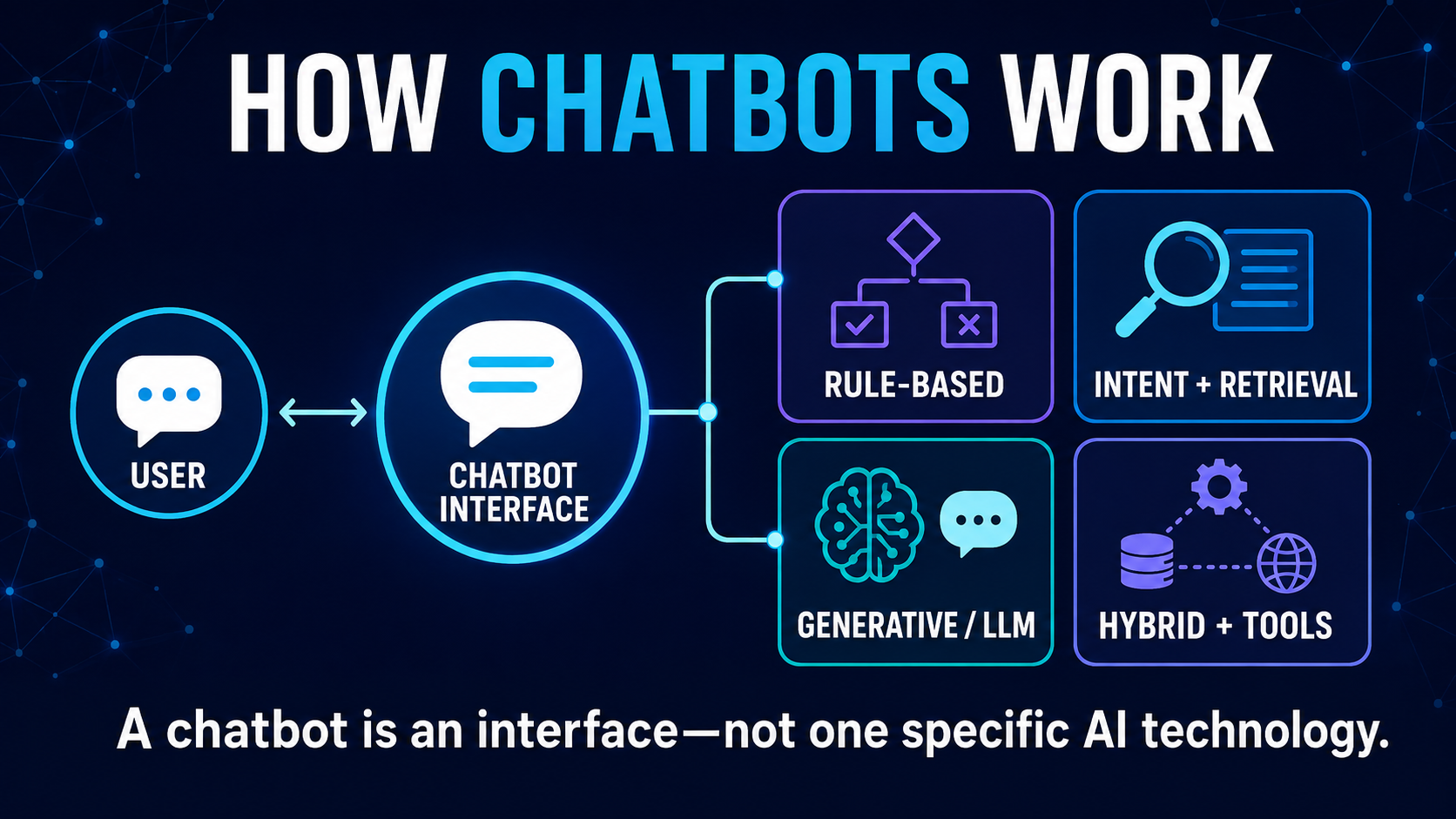
A chatbot is best thought of as an interface and application pattern, not as one specific AI technology. A simple FAQ bot can work without machine learning. A modern generative chatbot may use an LLM, retrieval, databases, APIs, safety rules, and other components together.
If you are new to language AI, start with What Is Natural Language Processing (NLP)?
Not Every Chatbot Uses AI
The word chatbot covers several different architectures. Calling all chatbots “AI chatbots” hides important differences in how they produce responses.
| Chatbot architecture | How it works | Best suited for |
|---|---|---|
| Rule-based or scripted | Uses predefined rules, menus, keywords, or decision trees. | Predictable, narrow workflows such as basic FAQs or guided support. |
| Intent and retrieval based | Classifies a request, may extract entities, then retrieves a response or calls a known workflow. | Customer service, account support, routing, and structured business tasks. |
| Generative or LLM based | Uses a generative language model to produce a response from the user message and supplied context. | Open-ended questions, drafting, summarization, conversational assistance, and flexible language tasks. |
| Hybrid or tool-connected | Combines rules, retrieval, generative models, databases, APIs, and other tools. | Systems that need both conversational flexibility and reliable access to business data or actions. |
These categories can overlap. A production chatbot might use a rules layer for authentication, retrieval for company policy, an LLM for response generation, and an API to check an order. See IBM’s overview of chatbot architectures and connected systems.
Text, voice, and multimodal are interaction modes
Voice is not a separate chatbot architecture. It is an interaction mode. A voice chatbot may still be rule-based, retrieval-based, generative, or hybrid. The same is increasingly true of multimodal systems that can accept combinations of text, images, audio, or other inputs.
How Chatbots Work
There is no single universal chatbot pipeline. The flow depends on the architecture.
1. Rule-based chatbot
User input → rule or menu match → predefined response or action
This type does not need to learn from data. It follows logic written in advance.
2. Intent and retrieval chatbot
User input → language processing → intent/entities → dialogue logic → knowledge base or API → response
For example, the message “Where is order 12345?” may be classified as an order-tracking request. The order number can be extracted and sent to an order system, which returns the actual shipping status.
3. LLM or generative chatbot
User message + conversation context → language model → optional retrieval/tools → generated response or action
A generative chatbot does not necessarily run a separate intent classifier, named-entity system, or traditional NLP pipeline for every message. Its behavior depends on the model, prompts, context, retrieval setup, tools, and surrounding application logic.
Depending on the architecture, a chatbot may use techniques covered elsewhere on AllForTheAI, including tokenization, embeddings, named entity recognition, text classification, and transformers.
Context, Memory, Retrieval, and Tools
These four ideas are easy to confuse, but they describe different parts of a conversational system.
| Concept | What it means |
|---|---|
| Conversation context | Information from the current interaction that is supplied to the system so later replies can refer to earlier messages. |
| Persistent memory | Information intentionally stored and retrieved across sessions or conversations. |
| Retrieval | Finding relevant information from documents, databases, search indexes, or other knowledge sources. |
| Tools and APIs | External systems the chatbot can call to look up data or perform actions. |
This distinction matters in practical systems. A language model can produce fluent text, but an order-tracking chatbot normally needs access to an authenticated order system to know whether a specific package has shipped. The conversational component handles language; the connected data source provides the authoritative order information.
Retrieval-augmented generation (RAG) is one common design pattern for grounding generative responses in external information. Grounding can reduce unsupported answers, but it does not guarantee correctness.
Do Chatbots Understand Language?
It is common to say that an AI chatbot “understands” a question. For beginners, a more precise explanation is that the system processes language patterns, uses available context, and produces an output according to its architecture and training.
A chatbot may classify intent accurately, retrieve the right document, or generate a useful answer without demonstrating human-like understanding. Good conversational performance should not be treated as proof that the system understands language in the way a person does.
Similarly, a deployed AI chatbot does not necessarily learn automatically from every conversation. Improvements may come from retraining, updated prompts, better retrieval data, system changes, evaluation results, or a newer model version.
Chatbots, Conversational AI, Assistants, and Agents
These terms overlap, and different companies use them differently. There is no single industry-wide boundary that applies everywhere.
| Term | Useful beginner definition |
|---|---|
| Chatbot | A conversational software application or interface. |
| Conversational AI | A broader category of AI technologies used to support language-based interaction. |
| AI or virtual assistant | A conversational product that may support a broader range of personal or work tasks. |
| AI agent | A system that can use tools and take one or more actions toward a goal; conversation may be only its user interface. |
For example, a support chatbot might answer policy questions only. A tool-connected assistant might also search account data and create a support ticket. An agentic system may plan several steps and use multiple tools to complete a larger task.
Where Chatbots Are Used
Chatbots can be useful when conversation is a convenient way to access information or start a workflow. Real systems often combine chatbots with other software rather than relying on the chatbot alone.
| Area | Example uses |
|---|---|
| Customer support | FAQs, account routing, order status, troubleshooting, and escalation. |
| Retail | Product questions, catalog search, order updates, and purchase assistance. |
| Education | Study support, explanation, practice, and course navigation with appropriate oversight. |
| Healthcare administration | Scheduling, navigation, reminders, and carefully governed information access. |
| Finance and banking | Authenticated account information, transaction support, and service routing. |
| Work and productivity | Drafting, summarization, information retrieval, and tool-assisted workflows. |
Higher-stakes uses require stronger controls. A chatbot should not be treated as an automatic substitute for qualified medical, financial, legal, or other professional judgment simply because it can produce confident conversational answers.
For the broader landscape of language applications, see Applications of NLP.
Potential Benefits and Limitations
Chatbots can create real value, but the benefits are not automatic. Outcomes depend on the task, system design, data access, evaluation, escalation process, and user expectations.
| Potential benefit | Important limitation |
|---|---|
| Fast, always-available first-line responses | A fast wrong answer can still harm the user experience. |
| Handles repetitive requests at scale | Complex or unusual cases may still need human review. |
| Consistent access to approved information | Generative systems may produce unsupported or inconsistent claims. |
| Can connect users to tools and workflows | Tool permissions and authentication introduce security risks. |
| Natural-language access can reduce friction | Conversation can hide uncertainty or make incorrect answers sound more convincing. |
Reliability, Privacy, and Security
Fluent answers can still be wrong
Generative chatbots can produce responses that are fluent, detailed, and false. NIST’s Generative AI Profile uses the term confabulation for confidently stated erroneous or false content from generative AI systems. Fluency is not evidence of correctness.
Grounding helps, but it is not a guarantee
Retrieval, citations, approved knowledge sources, validation rules, and tool constraints can make a chatbot more reliable. They do not eliminate every failure mode, so important outputs still need appropriate evaluation and, in consequential settings, human oversight.
Privacy and access control matter
Chatbots may process prompts, account information, documents, and conversation logs. Organizations need clear rules for data handling, retention, authentication, authorization, and which systems the chatbot is allowed to access.
Tool use creates new security risks
When a chatbot can retrieve external content or take actions, attacks such as prompt injection can try to manipulate the system through untrusted instructions. Safe designs limit permissions, separate trusted and untrusted data, validate actions, and require confirmation or human review where the consequences are significant. See OWASP’s prompt-injection guidance for attack patterns and mitigations.
Human handoff is part of good design
A chatbot should have a clear path to a human when it cannot resolve a request reliably, the user asks for escalation, or the situation is sensitive, ambiguous, or high stakes.
These issues connect directly to the broader AI Ethics learning branch.
How Do You Evaluate a Chatbot?
There is no single chatbot score that proves a system works well. Evaluation should match the purpose of the system.
| Evaluation dimension | Question to ask |
|---|---|
| Task success | Did the user accomplish the intended task? |
| Correctness and groundedness | Is the answer supported by the appropriate source or system of record? |
| Retrieval quality | Did the chatbot find the right information? |
| Handoff quality | Did it escalate when the request exceeded its safe or useful scope? |
| Safety and permissions | Did it avoid harmful, unauthorized, or privacy-violating behavior? |
| Robustness | Does the system still work when users phrase the same request differently? |
| Latency | Is the response fast enough for the intended experience? |
| Human evaluation | Are responses clear, useful, appropriate, and easy to act on? |
This is why chatbot evaluation belongs inside a broader model-and-system evaluation process rather than relying only on traditional metrics such as accuracy. Continue with Model Evaluation Metrics Explained for the wider evaluation foundation.
How Conversational Systems Are Evolving
Capabilities once described as purely future-facing are already appearing in current systems. Important directions now include multimodal interaction, retrieval-grounded generation, stronger tool use, persistent memory architectures, specialized models, and agent-like workflows.
These developments do not guarantee that every chatbot becomes more accurate, autonomous, or useful. Greater capability can also increase the importance of evaluation, permissions, privacy, security, and human oversight.
Generative AI is one of the most important technologies behind this shift. Read What Is Generative AI? to continue from conversational applications into the models that generate new text and other content.
Key Takeaways
- A chatbot is a conversational software application, not one specific AI technology.
- Some chatbots are rule-based; others use intent classification, retrieval, generative models, or hybrid architectures.
- Text, voice, and multimodal interaction describe the interface, not the underlying chatbot architecture.
- Conversation context, persistent memory, retrieval, and tool use are different concepts.
- AI chatbots do not necessarily learn automatically from each conversation.
- Retrieval and grounding can improve reliability but cannot guarantee correctness.
- Tool-connected chatbots need strong authentication, permissions, privacy protections, and defenses against manipulation such as prompt injection.
- Good chatbot evaluation includes task success, correctness, safety, handoff behavior, robustness, and human judgment.
Sources and Further Reading
- IBM — What are chatbots?
- Google Cloud — AI chatbot overview
- NIST — Artificial Intelligence Risk Management Framework: Generative AI Profile
FAQ About Chatbots
What is a chatbot in simple terms?
A chatbot is software that lets a person interact with a computer through conversation. It may use rules, machine learning, retrieval, generative AI, or a combination of these approaches.
Are all chatbots artificial intelligence?
No. Some chatbots follow predefined rules and do not use machine learning or generative AI.
How does an AI chatbot work?
It depends on the architecture. Some classify intents and retrieve predefined information. Others use large language models to generate replies. Many production systems combine models with search, documents, databases, APIs, rules, and safety controls.
Do chatbots learn from every conversation?
Not necessarily. Many deployed chatbots do not update their model parameters during ordinary conversations. They may instead be improved later through retraining, feedback processes, updated knowledge, prompts, or system changes.
What is the difference between a chatbot and conversational AI?
A chatbot is an application or conversational interface. Conversational AI is a broader category of AI technologies that can support language interaction. The terms overlap in everyday use.
What is the difference between a chatbot and an AI agent?
A chatbot is centered on conversation. An AI agent may use conversation as its interface but can also use tools and take multiple actions toward a goal. The boundary is not standardized across every product.
Can an AI chatbot give incorrect information?
Yes. Generative chatbots can produce fluent but unsupported or false answers. Retrieval, verification, constraints, and human review can reduce the risk but cannot guarantee perfect correctness.
Will chatbots replace human support teams?
Chatbots can automate or assist with some routine work, but the impact varies by task and organization. Human support remains important for sensitive, ambiguous, exceptional, or high-consequence situations.
Continue Learning
Next: What Is Generative AI? A Beginner’s Guide
For the broader language-learning path, return to Natural Language Processing or explore Applications of NLP.