
A transformer is a neural-network architecture that uses attention mechanisms to build context-dependent representations of elements in a sequence. In natural language processing (NLP), those elements are usually tokens.
Self-attention lets each token representation incorporate information from other relevant token representations. Transformer models can use the resulting representations for tasks such as classification, information extraction, translation, summarization and text generation.
This guide focuses on the architecture. For the clearest learning path, first review What Is NLP?, How NLP Works, Tokenization Explained and Word Embeddings Explained.
What Are Transformers in NLP?
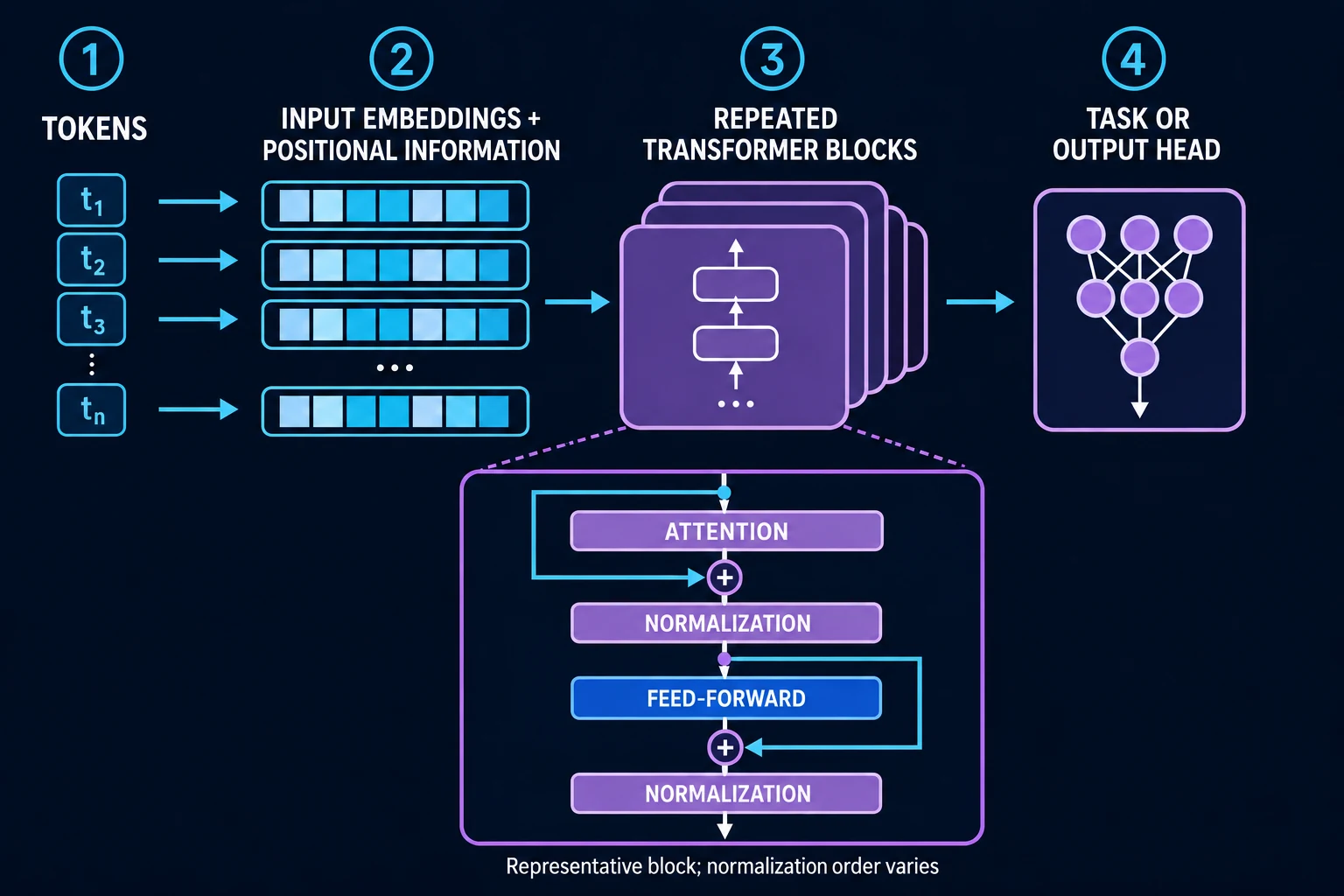
A transformer is a type of deep-learning architecture. It operates on sequences of representations and uses attention to model relationships among them. In NLP, the sequence usually consists of tokens. A token may be a complete word, part of a word, a character, a byte or another unit selected by the tokenizer.
Consider “bank” in these sentences:
“The bank approved the loan.”
“She walked along the bank of the river.”
The starting embedding associated with “bank” may be similar in both inputs. After transformer layers combine information from the surrounding tokens, the hidden representation can differ. One representation reflects a financial context; the other reflects a geographic context. This is a context-dependent representation—not evidence that the system comprehends language as a person does.
Why Transformers Became Dominant in Modern NLP
Before transformers, many neural NLP systems used recurrent neural networks (RNNs) or long short-term memory networks (LSTMs). Recurrent models pass information from one sequence step to the next. This sequential dependency limits training parallelism, and learning relationships across many steps can be difficult.
LSTMs improved recurrent networks with gates that help preserve and update information over longer spans. They did not remove recurrence, so the step-by-step computational path remained.
Transformer attention provides shorter computational paths between sequence positions and allows known positions to be processed more parallelly during training or encoding. These properties helped transformer models scale and achieve strong results across many language tasks. The 2017 paper “Attention Is All You Need” introduced the original encoder-decoder Transformer and emphasized both attention and parallelizability.
Parallel training is not the same as parallel generation. An autoregressive model normally generates one new token, adds it to the context and then predicts the next. Generation therefore remains sequential even though transformer computation over the tokens already available can be parallelized.
Transformers became dominant across much of modern NLP, but they did not eliminate linguistic rules, classical machine learning, recurrent models, retrieval systems or hybrid pipelines. The right approach still depends on the task, data, latency, cost and level of control required.
How Transformers Process Text
1. Text becomes tokens
A tokenizer divides input into units the model can process. “Transformers model context” might become word or subword tokens, depending on the tokenizer. Each token is mapped to an identifier. See Tokenization Explained for the complete process.
2. Tokens receive input embeddings
Each token identifier maps to an input embedding: a starting numerical vector. An input embedding is different from the contextual hidden representations produced later. Transformer layers repeatedly update the representation by incorporating information from the sequence.
3. The model incorporates positional information
Attention alone does not automatically represent sequence order. Transformer architectures therefore incorporate positional information so order and relative position can affect the computation. There is no single universal method. Different model families use fixed encodings, learned positional embeddings, relative-position methods or other approaches.
4. Self-attention combines relevant information
Self-attention lets each token representation draw information from other permitted positions in the sequence. Three learned projections provide a useful beginner model:
- Query: what information is this token representation looking for?
- Key: what information might another token representation match on?
- Value: what information can that token representation contribute?
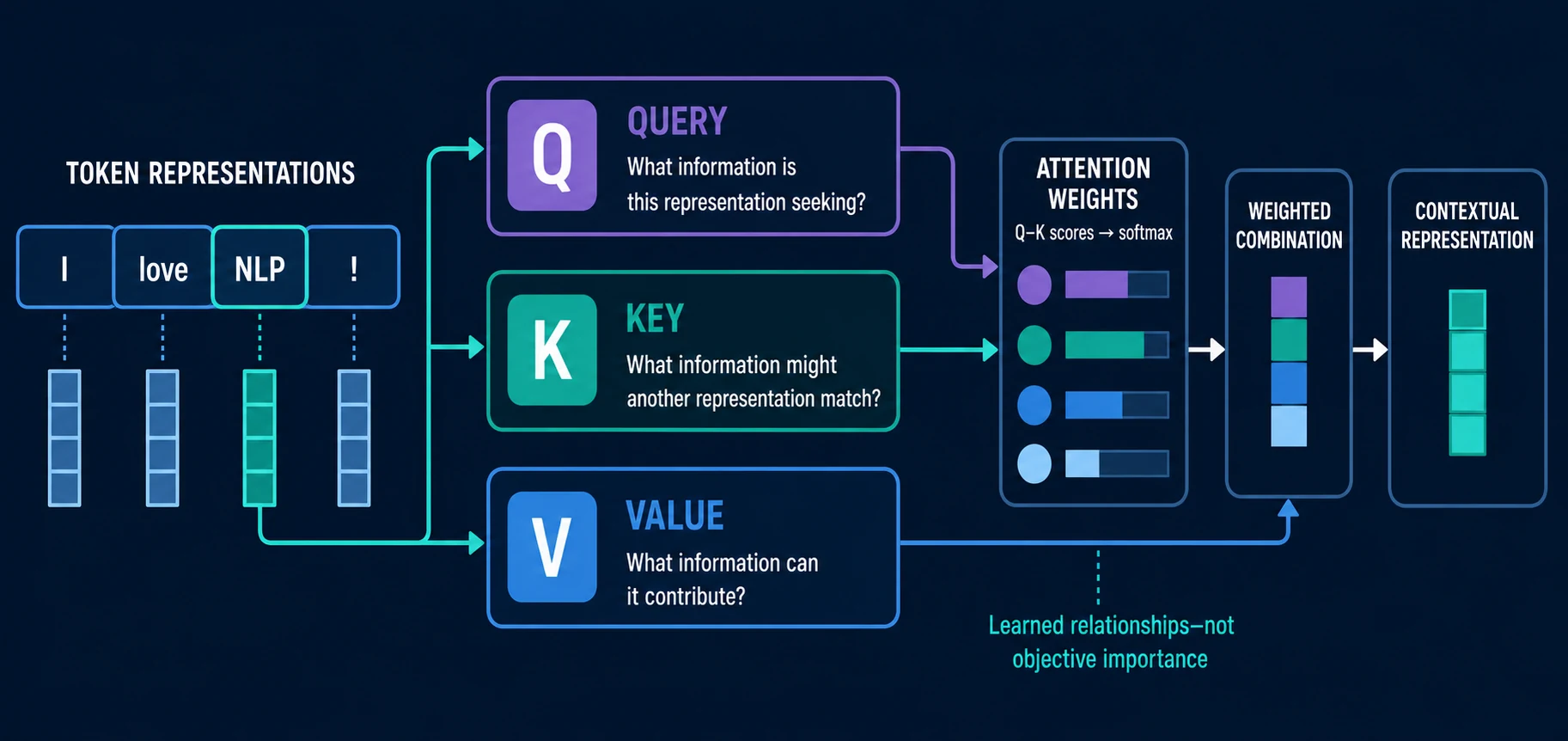
The mechanism compares queries with keys to calculate attention weights, then uses those weights when combining values. A weight reflects a learned relationship in a particular layer and head. It is not a universal judgment that a token is objectively important.
5. Multiple heads learn different patterns
Multi-head attention performs several attention operations in parallel. This allows a model to learn different relationship patterns. Some heads may become sensitive to particular linguistic or positional relationships, but individual heads do not necessarily correspond to tidy human-defined concepts such as “grammar” or “meaning.”
6. Transformer blocks refine the representations
A transformer stacks multiple blocks. A typical block combines attention, a feed-forward transformation, residual connections and normalization. Residual paths help information and gradients move through a deep network. Normalization helps stabilize internal activations. The exact order and normalization method vary by architecture.
tokens → input embeddings + positional information → repeated transformer blocks → task or output head
Input Embeddings vs Contextual Representations
An input embedding is the starting vector associated with a token before contextual processing. A contextual representation, sometimes called a hidden state, is the updated vector after transformer layers incorporate information from surrounding or otherwise permitted positions.
This distinction explains the “bank” example. The transformer does not simply look up one permanent meaning. Its layers produce a representation shaped by the particular sequence. The Word Embeddings guide explains static and contextual representations in greater depth.
Encoder, Decoder and Encoder–Decoder Patterns
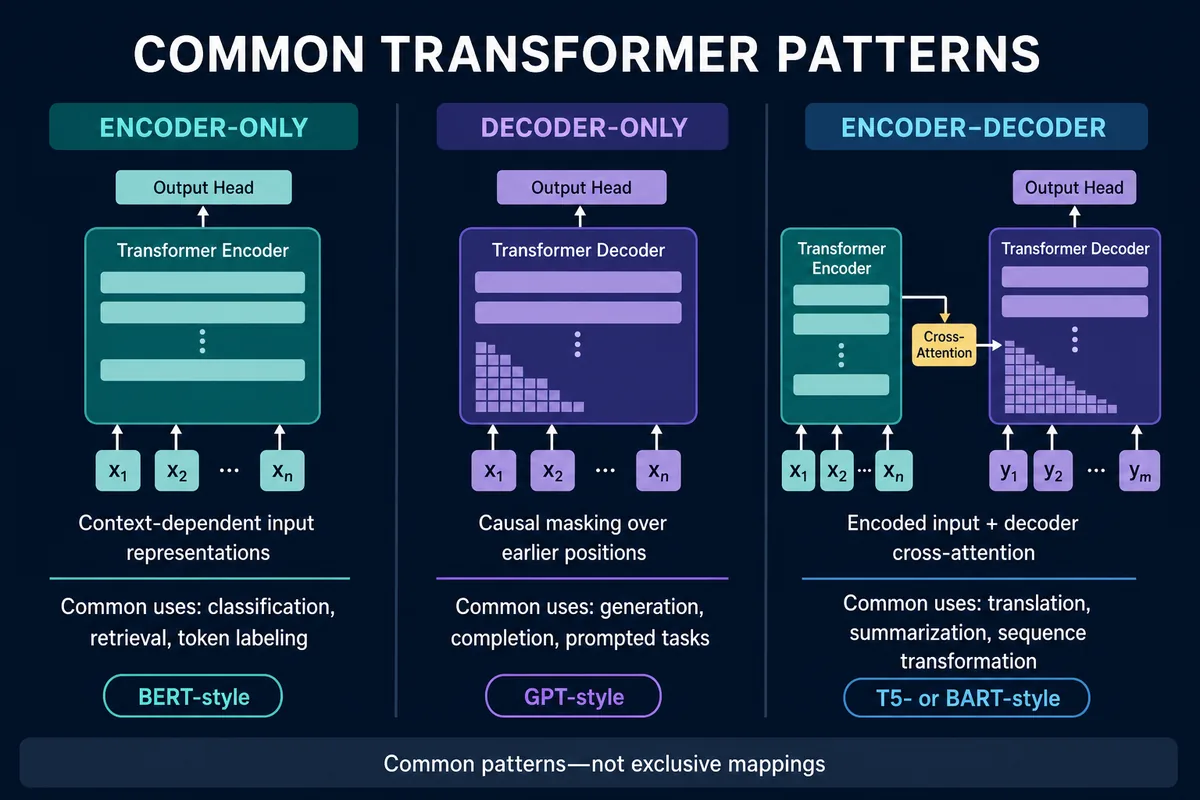
| Pattern | Core behavior | Common uses | Example family |
|---|---|---|---|
| Encoder-only | Produces context-dependent representations of an input sequence. | Classification, retrieval, token labeling and extractive tasks | BERT-style |
| Decoder-only | Uses causal masking so a position depends only on permitted earlier positions. | Autoregressive generation, completion and prompted tasks | GPT-style |
| Encoder–decoder | Encodes an input; the decoder can use cross-attention to encoder representations while producing an output. | Translation, summarization and other sequence-to-sequence transformations | T5- or BART-style |
These are common patterns, not exclusive mappings. Decoder-only models can perform classification and extraction through prompting or adaptation. Encoder models support more than basic classification. Encoder–decoder models can address many tasks that can be expressed as an input-to-output transformation.
Transformer vs Pretrained Model vs LLM
| Concept | Meaning |
|---|---|
| Transformer | A neural-network architecture built around attention and related block components. |
| Transformer model | A trained model whose architecture uses transformer blocks. |
| Pretrained language model | A model trained on a broad language objective before later adaptation or use. |
| Large language model | A large model trained to work with language. Most widely used modern LLMs are transformer-based, but “LLM” and “transformer” are not interchangeable terms. |
| NLP | The wider field of processing, analyzing, retrieving and generating human language. |
A transformer is the architectural blueprint. BERT-style, GPT-style and T5-style systems are trained model families built from transformer components. NLP is the broader field in which these models may be applied.
Transformers and Self-Supervised Pretraining
A transformer architecture begins with trainable parameters, not language knowledge. Self-supervised learning creates training signals from the data itself, allowing models to learn from large text collections without a person labeling every example.
- BERT-style pretraining historically included predicting masked tokens from surrounding context. The original BERT paper showed how a pretrained encoder could be fine-tuned for multiple NLP tasks.
- Autoregressive pretraining teaches a model to predict subsequent tokens from earlier context.
- Text-to-text pretraining can teach an encoder–decoder model to transform one token sequence into another. The peer-reviewed T5 study explored this unified transfer-learning approach.
After pretraining, a model may be adapted with fine-tuning, prompting, retrieval, a task-specific output head or other techniques. Using a pretrained transformer does not automatically require an organization to collect the enormous custom dataset needed to train a large model from scratch.
Where Transformers Are Used in NLP
| Capability | Example task | Deeper lesson |
|---|---|---|
| Sequence representation | Document or intent classification | Text Classification |
| Token-level representation | Finding people, organizations or locations | Named Entity Recognition |
| Context-sensitive classification | Estimating sentiment in reviews | Sentiment Analysis |
| Sequence transformation | Translation or summarization | Applications of NLP |
| Autoregressive generation | Producing conversational responses | Chatbots Explained |
These are examples, not guarantees. A deployed NLP system may combine a transformer with rules, search, retrieval, databases, moderation components and human review.
Advantages and Limitations
Advantages
- Context-dependent representations: each token representation can incorporate information from other positions.
- Training and encoding parallelism: known sequence positions can often be processed without a recurrent step-by-step chain.
- Long-range connections: attention provides direct computational routes between distant positions.
- Flexible patterns: encoder, decoder and encoder–decoder variants support many objectives and tasks.
- Transfer learning: pretrained models can be adapted instead of being rebuilt from scratch for every use case.
Limitations and risks
- Sequence-length cost: standard full self-attention compares many positions with one another, so compute and memory requirements grow quickly as a sequence becomes longer.
- Finite context: every deployed model has a limit on how much input it can process at once. Better long-range modeling does not mean unlimited document processing.
- Compute and memory: requirements vary widely, but training and serving large models can be expensive.
- Bias and representativeness: problems can arise from training data, objectives, annotations, fine-tuning choices and deployment context. These risks are not unique to transformers.
- Interpretability: attention weights and hidden representations do not provide a complete, simple explanation of a model’s output.
- Domain shift: performance can decline when real inputs differ from the data used for training and evaluation.
- Generative errors: generative transformer models can produce unsupported or incorrect text. This is a generative-model failure mode, not a behavior shared by every transformer classifier or embedding model.
- No human-like comprehension: strong contextual predictions do not establish consciousness, intent or human understanding.
Frequently Asked Questions
What is a transformer in NLP in simple terms?
A transformer is a neural-network architecture that uses attention to build context-dependent representations of tokens. Those representations support tasks such as classification, extraction, translation and generation.
Is attention just a measure of important words?
No. Attention calculates learned relationships among token representations for a particular layer and head. A high attention weight is not a universal judgment that a word is objectively important.
Do transformers process every token simultaneously?
During training or encoding, transformer layers can process known sequence positions in parallel. Autoregressive generation still normally produces new tokens sequentially because each prediction depends on the tokens generated so far.
Do transformers understand language like people?
No evidence from the architecture alone establishes human-like comprehension. Transformers learn statistical patterns and produce context-sensitive representations or predictions. Their outputs require evaluation appropriate to the task and its risks.
Where to Learn Next
Next lesson: Applications of NLP: Real-World Uses of Natural Language Processing. See how language capabilities become practical systems without repeating the architecture lesson.
Optional deeper path: Continue to What Is Generative AI? to see how transformer-based language models fit within the broader field of generative systems.
Last updated: August 31, 2026.
Visuals and links verified: October 3, 2026. Corrected the residual and query–key–value diagram paths, refreshed the preview image, and added full-size diagram access.