

Generative AI refers to models and systems that produce new outputs—such as text, images, audio, video, or code—from patterns learned during training. The result may be useful or novel-looking, but generation does not guarantee truth, originality, safety, or ownership.
Generative AI is part of the broader field of artificial intelligence. Modern generative AI is largely built with machine learning, especially deep learning, but generative modeling also includes other statistical approaches. Its defining goal is to model data well enough to create or transform examples, not to possess consciousness or human understanding.
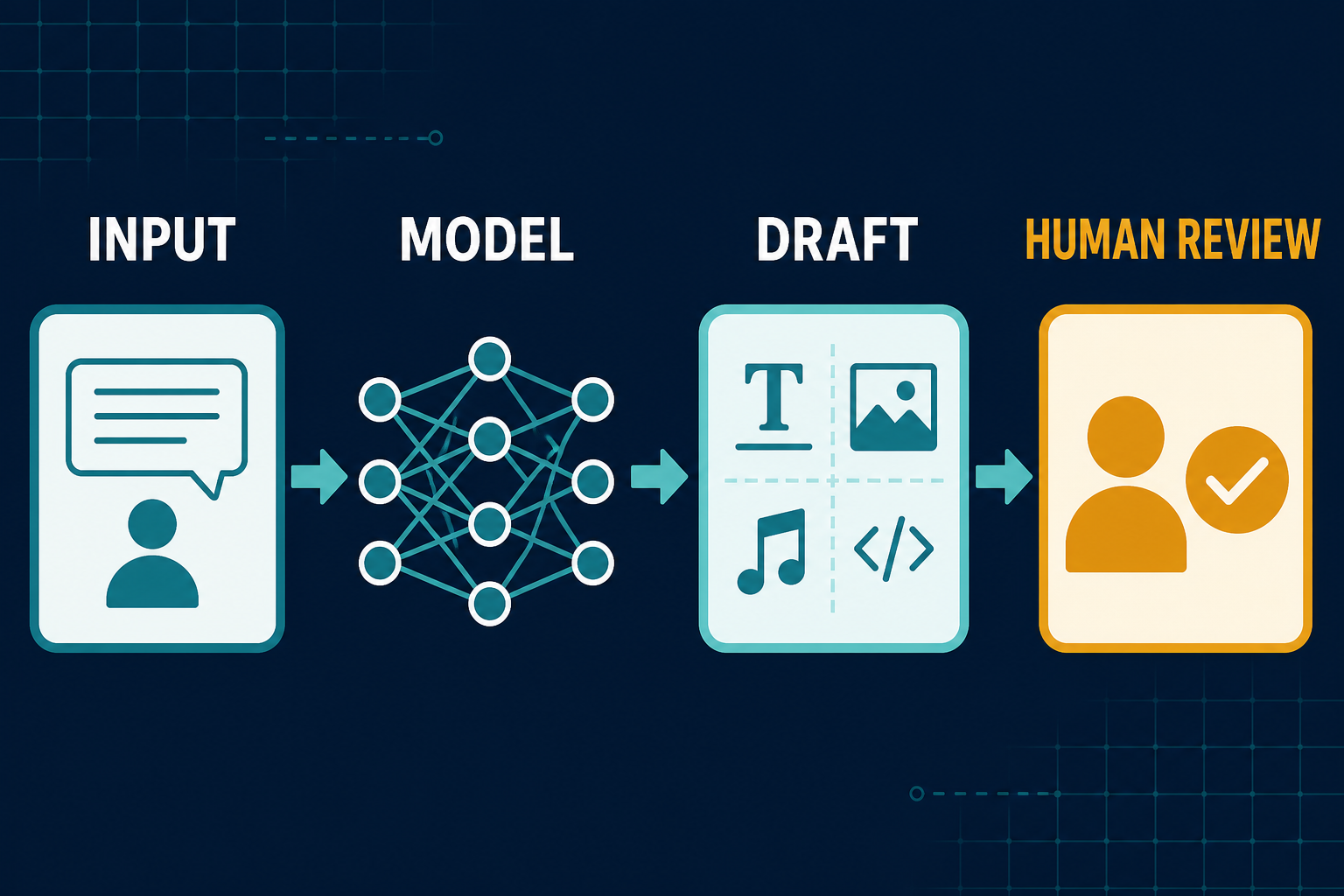
Generative vs discriminative models
A discriminative model predicts a label or value from input features, such as whether an email is spam. A generative model models a data distribution and can be used to produce examples, such as drafting an email.
This is not a strict “traditional AI versus modern AI” divide. Generative systems still make predictions internally, and one application may combine generation, classification, retrieval, rules, and human review.
How generative AI works
For an autoregressive language model, generation commonly means predicting one token after another. A diffusion image model instead learns a denoising process and generates by progressively transforming noise. Other model families use different objectives.
For a closer look at one autoregressive language-model family, read What Is GPT? Generative Pre-trained Transformers Explained.
Training generally produces distributed statistical representations rather than a searchable library of copied examples. However, models can memorize or reproduce training material in some circumstances. Generated does not automatically mean independent, original, or free of protected content.
Training vs inference
Training changes a model’s learned parameters. Inference uses a trained model with the current input and context to produce an output. Prompting a deployed model does not automatically retrain it or permanently update its parameters; a service may separately collect data for later training under its policies and settings.
Fine-tuning is additional training that changes parameters. Retrieval, including retrieval-augmented generation (RAG), supplies relevant information at inference time. Tool use connects a system to capabilities such as search, calculators, or applications. Retrieval and tool use do not by themselves retrain the model, and their results still need appropriate checks.
A simple generative AI example
Suppose a project team has rough meeting notes and wants a concise update. A useful prompt could be:
- Provide context. The user supplies the notes along with the audience, format, and constraints.
- Generate a draft. The model predicts a likely response from the prompt, notes, learned patterns, and current context.
- Compare it with the source. A person checks every bullet against the original notes, including names, dates, decisions, and responsibilities.
- Revise and approve. The person corrects unsupported wording and decides whether the update is ready to share.
For example, the draft might say, “The design review is scheduled for Friday,” when the notes only say, “Aim for Friday.” The polished sentence sounds plausible, but it changes a tentative goal into a confirmed date and must be corrected.
Lesson: generative AI can transform source material into a useful draft, but it does not independently verify that the draft is true. Unsupported names, dates, decisions, quotations, or citations should not be published.
How the main concepts fit together
These terms describe different, sometimes overlapping aspects of an AI system:
- Generative AI: the area of AI concerned with creating or transforming content.
- Generative model: a model of a data distribution that can support generation.
- Foundation model: a model trained on broad data that can be adapted to many tasks. Foundation models can support generative and non-generative uses.
- Large language model (LLM): a large model of language. Generative LLMs are one important part of generative AI; language tasks also belong to natural language processing.
- Transformer: a model architecture used by many LLMs and other systems. Generative AI also uses other architectures.
- Multimodal model: a model that handles more than one kind of data, such as text and images.
- Chatbot: a conversational application or interface. An AI chatbot may combine a model with retrieval, tools, and other components; some chatbots use rules instead.
One example: a chatbot is the application; a language foundation model can power it; a transformer can be that model’s architecture; and support for both text and images makes the model multimodal. These labels describe different parts or properties of the same system.
Major model families
Swipe horizontally to view the full comparison.
| Family | Simplified mechanism | Common outputs |
|---|---|---|
| Autoregressive models | Predict the next element from previous context. | Text, code, audio, images, or other sequences |
| Diffusion models | Learn to reverse a gradual noising process. | Images, audio, and video |
| Variational autoencoders | Learn a probabilistic latent representation and decode samples. | Images, structured variations, and representations |
| Generative adversarial networks | Train a generator against a discriminator. | Images, synthetic data, and transformations |
A transformer is an architecture used by many modern systems, not a synonym for generative AI. Models may also be multimodal, accepting and producing more than one media type.
What generative AI can do
- Text: draft, summarize, translate, classify, and restructure language.
- Images and design: create concepts, variations, edits, and mockups.
- Audio and video: synthesize narration, sounds, music drafts, clips, and edits.
- Code: draft functions, explain code, propose tests, and assist debugging.
- Structured work: produce tables, plans, schemas, and other formatted outputs.
A generative model can also classify an email, extract a date, or assign a score. Those are classification, extraction, or scoring tasks, even when a model trained for generation performs them.
These are capabilities, not quality guarantees. Generated code must be tested and reviewed for security, dependencies, licensing, and correctness. Generated facts, citations, calculations, and medical, legal, or financial statements require appropriate verification.
For film, music and game workflows, including rights and human review, see AI in Entertainment.
How generative AI is evaluated
Evaluate the whole system on examples that reflect its intended use. A fluent answer alone is not evidence of success.
- Factuality and grounding: check claims and citations against reliable sources or supplied material.
- Relevance and instruction following: check whether the response answers the question and follows the requested format and constraints.
- Task success: use task-specific checks, such as running generated code and tests or checking an extracted value against its source.
- Safety: test for harmful, biased, private, or insecure outputs and unsafe tool actions.
- Deployment fit: consider reliability, latency, cost, and the consequences of failure.
Combine automated checks with appropriate human review; neither replaces the other in every task. Use stronger verification for factual, externally published, consequential, or high-stakes outputs. See Model Evaluation Metrics Explained for broader evaluation principles.
A responsible beginner workflow
- Choose a low-risk task. Start with brainstorming, rewriting your own text, or creating a first draft.
- State the goal and constraints. Include the audience, format, required facts, sources, and boundaries.
- Protect sensitive information. Do not submit confidential, personal, regulated, or proprietary data unless the organization and service explicitly permit it.
- Inspect the result. Check facts, citations, calculations, code, bias, tone, and possible rights issues.
- Keep a human accountable. The person using the output remains responsible for consequential decisions and publication.
For example tools and reusable prompts to try this workflow, use the Beginner’s AI Starter Pack.
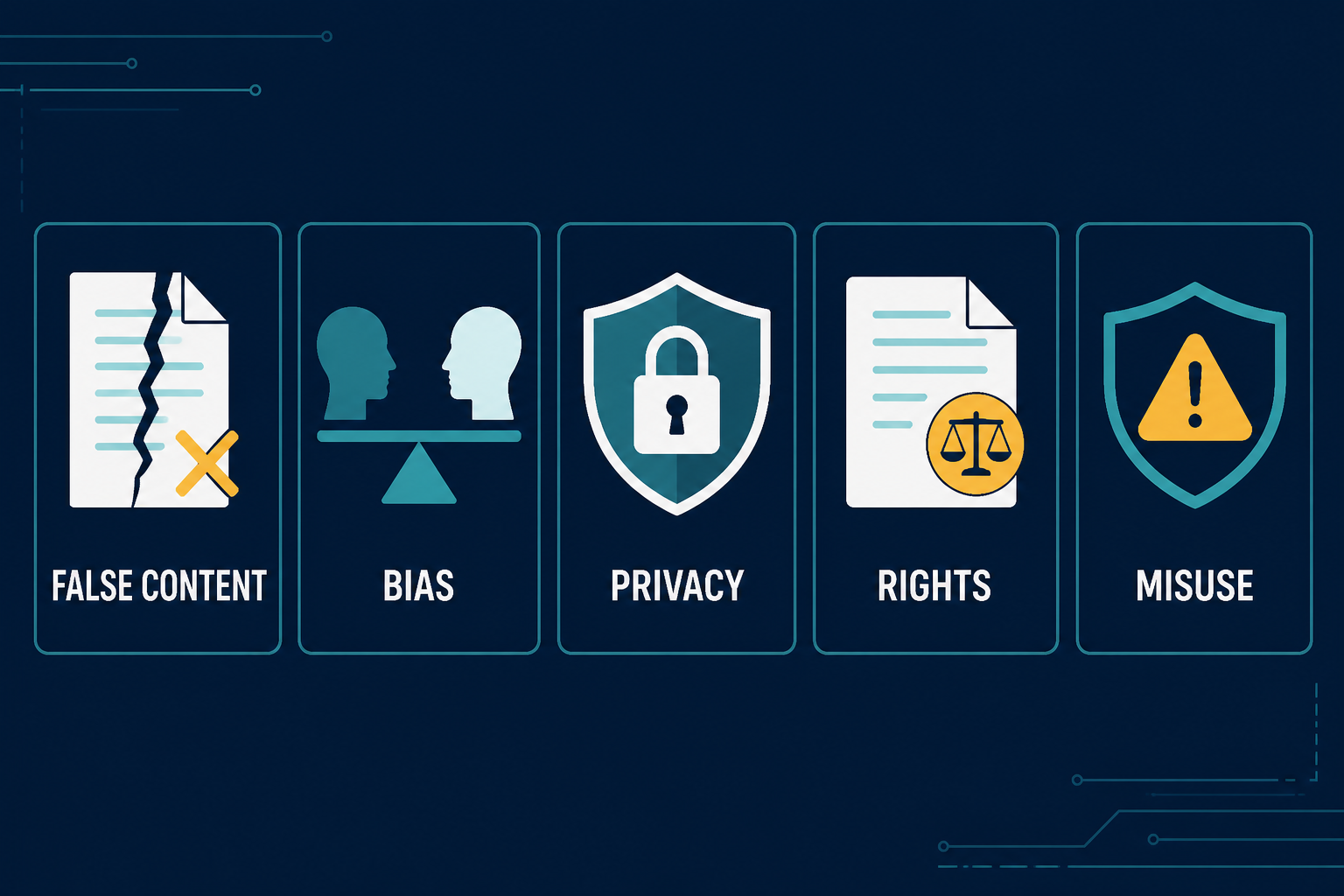
Limitations and risks
- False or fabricated content: fluent output can contain incorrect facts or invented citations.
- Bias and representation: training data and system choices can reproduce or amplify harmful patterns.
- Privacy and confidentiality: prompts, uploads, retention, and model-improvement settings vary by service.
- Copyright and other rights: questions can involve training data, output similarity, protectability, licenses, trademarks, and publicity rights. Rules vary by jurisdiction and continue to develop. Review the broader ethical considerations of artificial intelligence.
- Security and misuse: systems can assist scams, impersonation, malicious code, or misleading media.
- Automation bias: people may trust confident output without adequate evidence.
- Workforce effects: generative AI can change tasks and occupations, but the scale, distribution, and timing of those effects remain uncertain.
How to choose a tool
Product lists age quickly. Evaluate a tool according to the current task rather than assuming the most popular name is the best choice. Check:
- Supported input and output formats
- Data retention, training-use, and deletion controls
- Source citation or grounding features
- Enterprise, education, or regulated-data terms
- Accessibility, pricing, export, and ownership terms
- Human-review and logging requirements
Verify current capabilities and policies in the provider’s first-party documentation before relying on them.
Frequently asked questions
Is generative AI the same as machine learning?
No. Machine learning describes methods that learn from data. Generative AI describes models and systems used to create or transform content. Modern generative AI commonly uses machine learning, particularly deep learning, but the terms describe different things.
Is generative AI safe?
Safety depends on the model, task, data, deployment, and safeguards. Low-risk drafting is different from clinical, financial, legal, employment, or security use.
Does generative AI copy its training data?
Models usually generate from statistical representations, but memorization and reproduction can occur. Outputs should not be assumed original or rights-cleared.
How can I check an answer?
Trace important claims to authoritative sources, open cited material, recompute calculations, test code, and ask a qualified person to review high-stakes conclusions.
Sources and further reading
- Google Machine Learning Glossary: Generative AI — terminology for inference, fine-tuning, and generative models.
- On the Opportunities and Risks of Foundation Models — foundational research defining broad, adaptable models and their risks.
- NIST: Generative Artificial Intelligence Profile — risk-management guidance specific to generative AI.
- NIST: AI Risk Management Framework — a general framework for identifying and managing AI risks.
- Attention Is All You Need — the research paper that introduced the Transformer architecture.
- Denoising Diffusion Probabilistic Models — a foundational paper on diffusion-based generation.
Prerequisite context: if you need the foundations first, review Deep Learning Explained.
Where to learn next
Continue with the architecture behind many modern language models: