Machine Learning

Learn machine learning fundamentals, how models learn from data, and the main ML types (supervised, unsupervised, reinforcement). Designed for beginners.


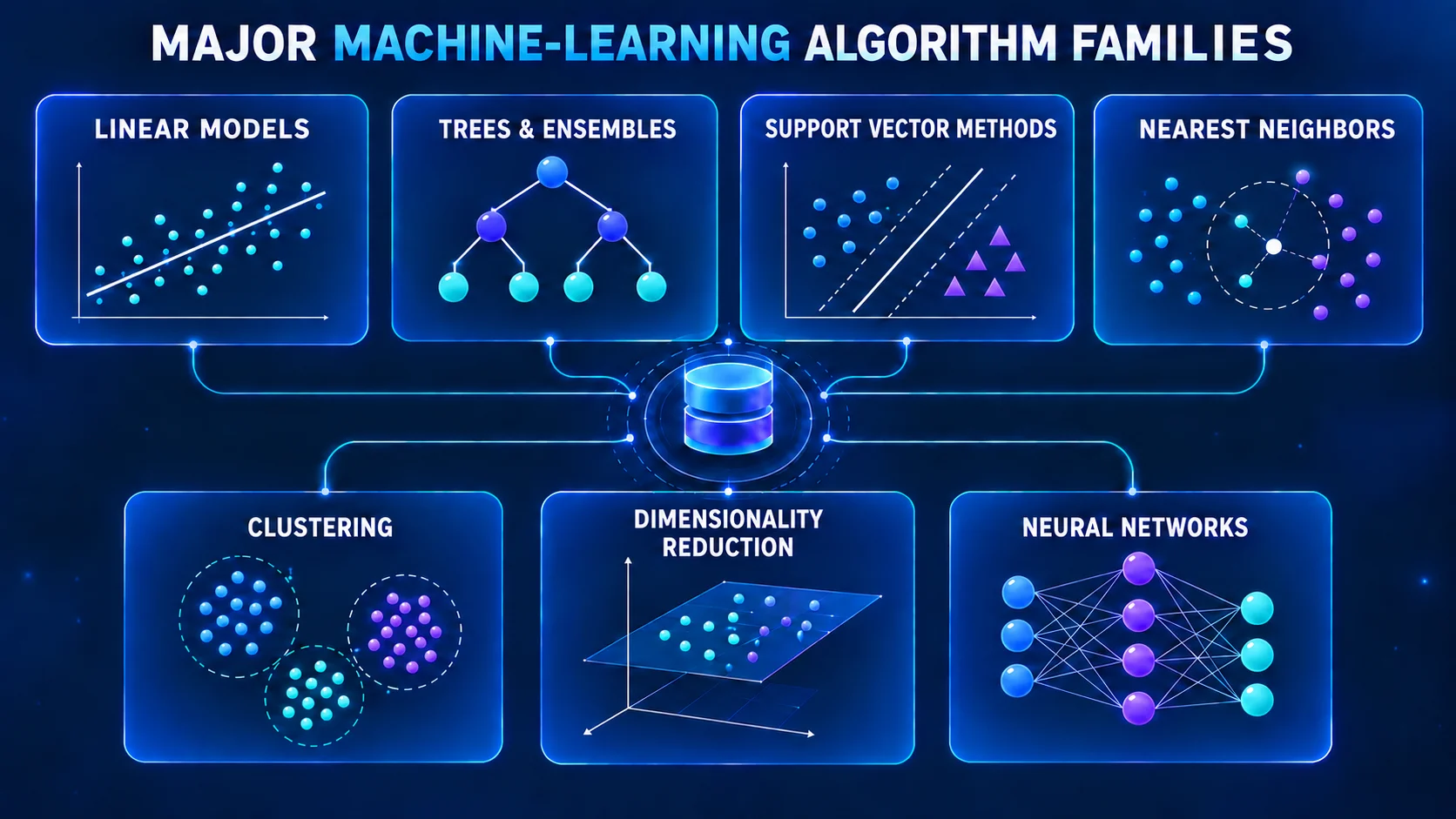
Map of major machine-learning algorithm families including linear models, trees, ensembles, support-vector methods, nearest neighbors, clustering, dimensionality reduction, and neural networks.

Machine Learning Algorithms: A Beginner’s Guide

Machine learning algorithms are methods used to fit models, make predictions, or discover useful structure from data. This beginner guide maps the major algorithm families, explains their trade-offs, and shows how to choose a sensible first method without pretending that one algorithm is best for every problem. If the foundations are new to you, start […]

Machine Learning Algorithms: A Beginner’s Guide Read More »
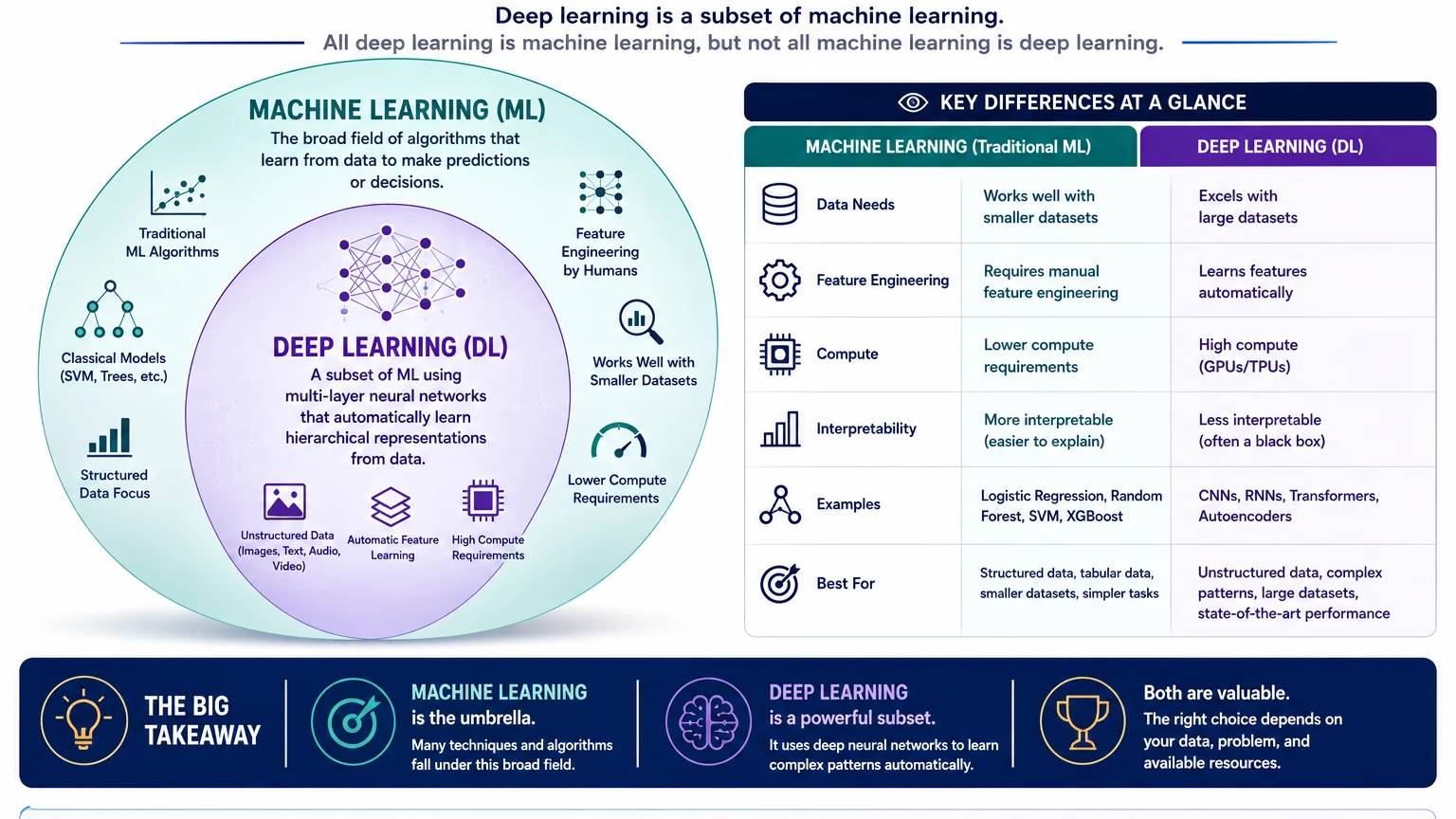
Comparison showing deep learning as a subset of machine learning, with traditional machine-learning methods alongside multilayer neural networks and their common data types and use cases.

Deep Learning vs Machine Learning: Key Differences Explained

Deep learning and machine learning are not separate competing fields. Deep learning is a subset of machine learning that uses multilayer neural networks. The practical question is therefore not usually “machine learning or deep learning?” It is whether a particular problem benefits from a deep neural-network approach or from another machine-learning method. Last reviewed and

Deep Learning vs Machine Learning: Key Differences Explained Read More »

Types of machine learning diagram showing supervised, unsupervised, and reinforcement learning as foundational approaches with additional modern methods such as semi-supervised and self-supervised learning.

Types of Machine Learning Explained: Supervised, Unsupervised, Reinforcement & More

Machine learning is not one single method. It includes several ways of training systems to recognize patterns, make predictions, discover structure, or choose actions. For beginners, three major introductory paradigms are especially useful: These are a strong starting point, not an exhaustive taxonomy. Semi-supervised and self-supervised learning are also important modern approaches. Transfer learning is

Types of Machine Learning Explained: Supervised, Unsupervised, Reinforcement & More Read More »

Unsupervised learning illustration showing unlabeled data being analyzed to reveal clusters, lower-dimensional structure, and unusual patterns.

Unsupervised Learning Explained: A Beginner’s Guide

Unsupervised learning is a type of machine learning used to discover useful structure in data without task-specific target labels telling the model the correct answer for each example. Instead of learning a direct mapping from inputs to known labels, unsupervised methods may group similar observations, learn lower-dimensional representations, identify unusual patterns, or uncover statistical structure

Unsupervised Learning Explained: A Beginner’s Guide Read More »
Supervised learning diagram showing labeled training examples used to train a model that predicts classes and numerical values for new data.

Supervised Learning Explained: A Beginner’s Guide

Supervised learning is a type of machine learning in which a model learns from examples that include both an input and a known target, or label. The goal is to learn a relationship between the inputs and targets so the model can make useful predictions on new data. Common supervised-learning tasks include classification, such as

Supervised Learning Explained: A Beginner’s Guide Read More »

Reinforcement learning agent choosing actions in an environment and receiving reward feedback over repeated interactions.

Reinforcement Learning Explained: A Beginner-Friendly Guide

Updated: August 2026 Reinforcement learning, or RL, is a type of machine learning focused on sequential decision-making. An RL system learns a strategy for choosing actions by using feedback from an environment. At its core, reinforcement learning asks: What should an agent do now to improve the outcome it can achieve over time? RL is

Reinforcement Learning Explained: A Beginner-Friendly Guide Read More »

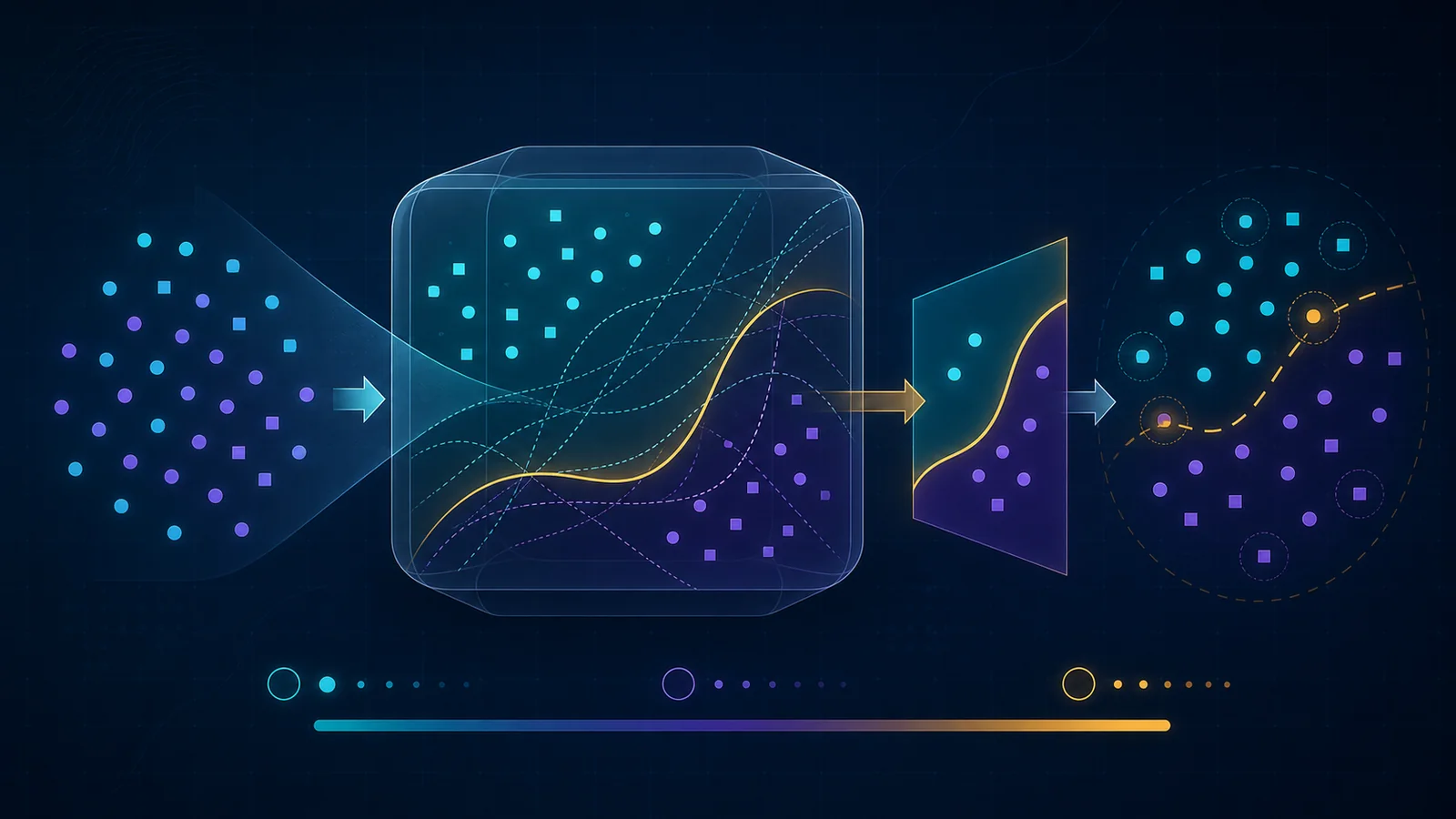
Machine learning process showing training data used to learn model patterns that produce predictions, classifications, rankings, and recommendations.

What Is Machine Learning? A Beginner-Friendly Guide

Last reviewed and updated: August 27, 2026. Machine learning is a branch of artificial intelligence that allows computer systems to learn patterns from data and use those patterns to make predictions, classify information, generate scores, recommend actions, or support decisions. Instead of programming every possible rule by hand, developers define a problem, prepare data, choose

What Is Machine Learning? A Beginner-Friendly Guide Read More »

Computational learning theory diagram connecting training examples, a hypothesis class, learned model, and generalization to unseen data.

Computational Learning Theory Explained

Updated: August 2026 Computational learning theory studies the mathematical conditions under which learning is possible. It asks how much data is needed, how complexity affects generalization, which assumptions are required, and whether a useful hypothesis can be found efficiently. This is an advanced supporting topic. Readers should first understand supervised learning, overfitting, model evaluation, and

Computational Learning Theory Explained Read More »

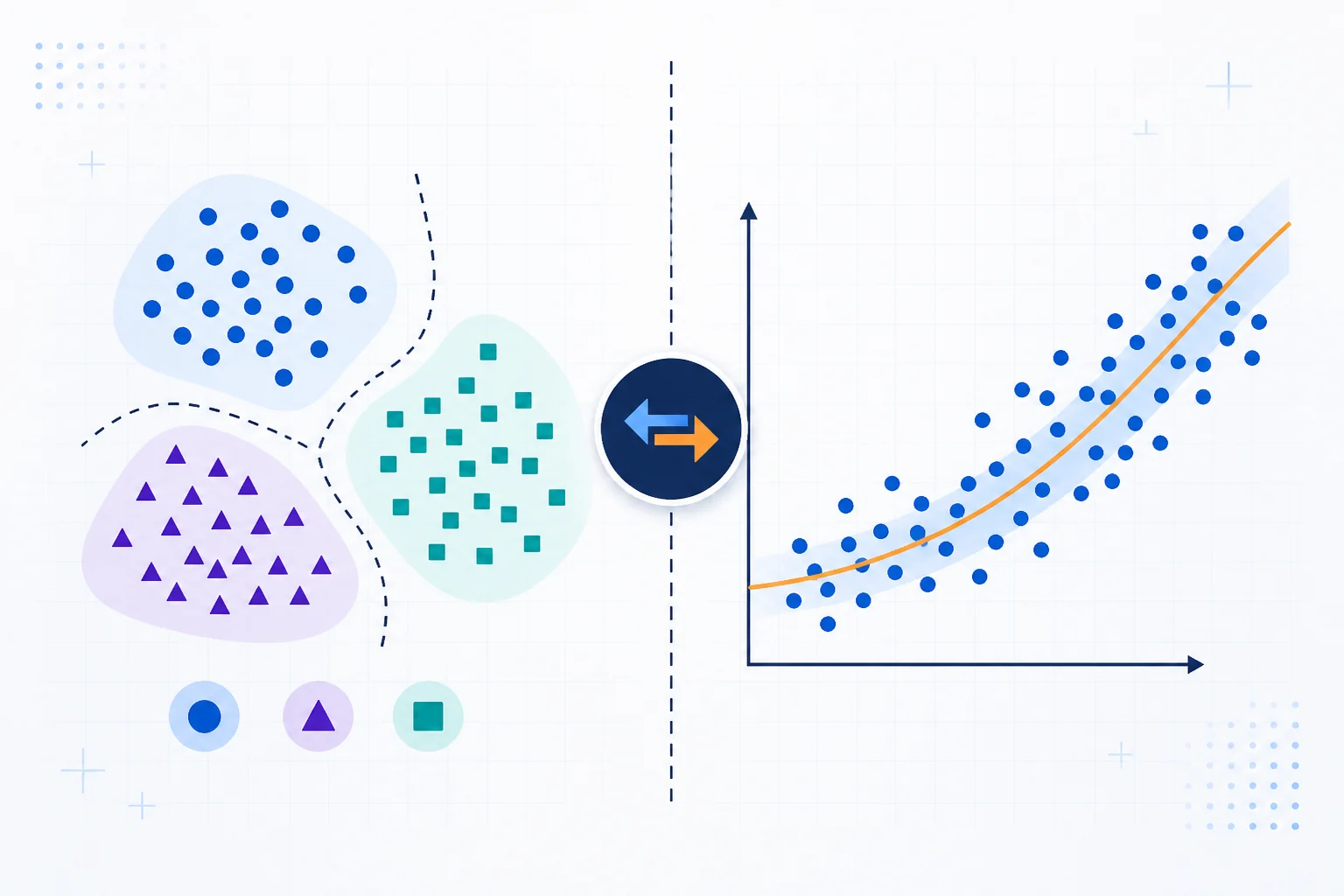
Classification clusters compared with a regression scatter plot and fitted trend line.

Classification and Regression in Machine Learning

Classification and regression are the two main prediction-task families in supervised learning. Both learn from labeled examples, but they answer different kinds of questions. The distinction matters because it affects how targets are represented, which models and loss functions are appropriate, how results are evaluated, and how predictions are used. Last reviewed and updated: August

Classification and Regression in Machine Learning Read More »

Scroll to Top