
Machine learning algorithms are methods used to fit models, make predictions, or discover useful structure from data. This beginner guide maps the major algorithm families, explains their trade-offs, and shows how to choose a sensible first method without pretending that one algorithm is best for every problem.
If the foundations are new to you, start with Machine Learning Explained. Next, read Types of Machine Learning to understand supervised, unsupervised, reinforcement, and related learning setups. Then use this algorithm hub to compare the method families used within those setups and continue into individual algorithm lessons.
Last reviewed and updated: September 7, 2026.
What Are Machine Learning Algorithms?
A machine learning algorithm is a defined procedure for fitting parameters, learning a decision rule, or finding useful structure in data. Different methods are designed around different objectives and assumptions. Some predict numbers, some classify categories, some group observations, and others support sequential decisions.
There is no universal algorithm leaderboard. The right method depends on the task, data, assumptions, evaluation design, and real-world constraints.
More useful, representative data can help, but more data does not automatically produce a better model. Data quality, feature representation, model choice, training procedure, distribution, and evaluation all matter.
Algorithm vs Trained Model
An algorithm or learning method is the procedure used during training. A trained model is the fitted result. The model contains learned parameters or structure used to produce predictions, scores, clusters, or decisions for new inputs.
For example, linear regression is a method. After it is fitted to house-price data, the learned coefficients form a trained model that can estimate prices. A deployed model does not automatically improve simply because people use it; it changes only when some update process, such as retraining or online learning, changes it.
The Three Learning Setups: A Short Recap
Supervised, unsupervised, and reinforcement learning describe broad learning setups. They are prerequisite context here, not three topics to re-teach in full.
| Learning setup | Core idea | Examples in this hub |
|---|---|---|
| Supervised learning | Fit a model against a known target or supervisory signal. | Linear and Logistic Regression, Trees, Random Forest, SVM, KNN, Naive Bayes |
| Unsupervised learning | Explore structure without a supplied prediction target. | K-Means, Hierarchical Clustering, PCA and related methods |
| Reinforcement learning | Learn sequential decisions using reward signals. | Value-based, policy-based, and actor-critic branches |
From Learning Paradigms to Algorithm Families
The learning setup describes how a system learns. The algorithm family describes the kind of method used inside that setup.
Supervised Learning
Learning signal: known targets or labels.
Common families: linear and logistic regression, decision trees, Random Forest, SVM, KNN, Naive Bayes, gradient boosting.
Typical tasks: classification and regression.
Unsupervised Learning
Learning signal: no supplied prediction target.
Common families: K-Means, hierarchical clustering, dimensionality reduction such as PCA, and other structure-discovery methods.
Typical tasks: clustering, representation, and pattern discovery.
Reinforcement Learning
Learning signal: rewards from sequential interaction.
Common families: value-based methods, policy-based methods, actor-critic methods, and deep reinforcement learning.
Typical tasks: sequential decision-making, control, and long-term reward optimization.
These paradigms are connected, not competing: they provide different ways to learn from data or interaction.
Deep Learning is a neural-network-based modeling branch, not a fourth peer learning setup. Ensemble Learning is a strategy for combining models, not a separate learning paradigm.
How to Read This Taxonomy
This guide covers the core beginner families taught on AllForTheAI; it is a practical learning map, not an exhaustive catalog of every machine-learning technique. Use these labels to understand what each item represents:
- Method: a specific procedure you can apply, such as linear regression, K-Means, or K-nearest neighbors.
- Family: a group of related methods that share a modeling idea, such as linear models, decision trees, or support-vector methods.
- Strategy: a way to organize or combine methods. Bagging, boosting, voting, and stacking are ensemble strategies rather than one algorithm.
- Learning branch: a broader field containing many methods, such as deep learning or reinforcement learning.
Machine Learning Algorithm Map
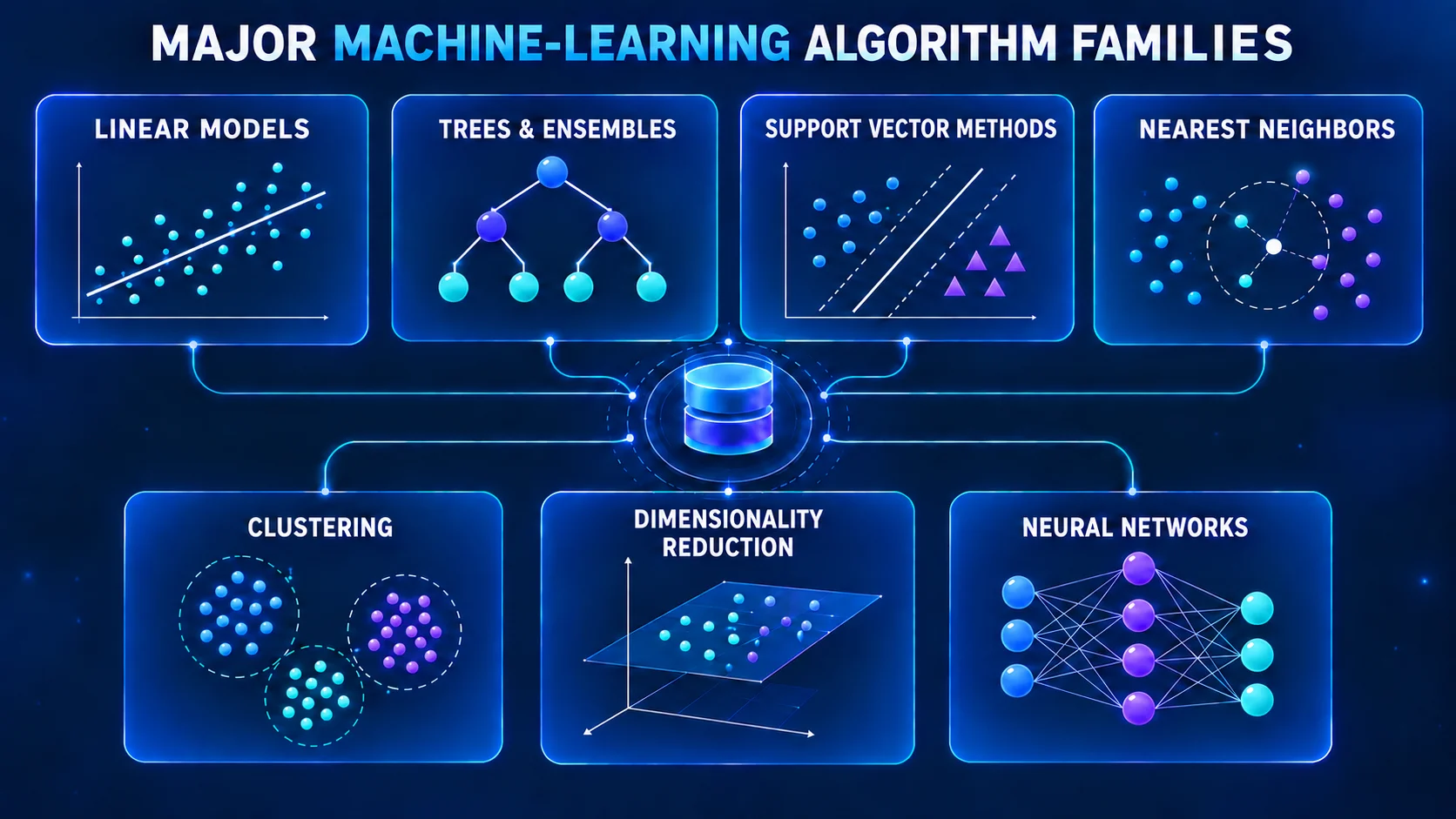
Some names below refer to individual methods, while others describe broader families, strategies, or learning branches. The goal is to show where the site’s lessons fit without forcing every technique into one rigid taxonomy.
- Regression: predict a numerical value. Start with Linear Regression; tree, nearest-neighbor, and support-vector methods can also perform regression.
- Classification: predict a category or estimate class probabilities. Explore Logistic Regression, Decision Trees, Random Forest, SVM, KNN, and Naive Bayes.
- Tree and ensemble methods: use recursive splits or combine multiple predictors. Random Forest is a tree-based ensemble; bagging, boosting, voting, and stacking are broader ensemble strategies.
- Gradient-boosted trees: build an ensemble sequentially, with later learners attempting to improve errors or residual structure left by earlier stages. They are widely used for structured/tabular problems; learn the core strategy in Ensemble Learning Explained.
- Nearest-neighbor methods: predict from nearby training examples. KNN can perform classification or regression but is sensitive to feature scale and the distance definition.
- Probabilistic methods: model outcomes using probability assumptions. Naive Bayes is a fast classification family often used for text and document classification.
- Clustering: find grouping structure without supplied targets. Begin with K-Means and Hierarchical Clustering. Different clustering methods can produce different structures because their assumptions about similarity, shape, density, and hierarchy differ.
- Dimensionality reduction and representation: transform data into smaller or more useful representations. PCA is a classical example covered in Feature Selection vs Feature Extraction. These methods often support later modeling rather than directly predicting the final target.
- Deep Learning branch: uses multilayer neural networks for learned representations, especially in complex image, text, audio, and multimodal problems. Continue through Neural Networks Explained.
- Reinforcement Learning branch: studies methods for sequential decisions and long-term reward through the Reinforcement Learning overview.
Beginner Algorithm Comparison Table
| Method | Common task | Beginner-friendly strength | Important trade-off |
|---|---|---|---|
| Linear Regression | Regression | Simple, transparent baseline | Assumes a suitable linear form |
| Logistic Regression | Classification | Interpretable probability baseline | May need better features for nonlinear boundaries |
| Decision Tree | Classification and regression | Rule-like and nonlinear | Deep trees can overfit and be unstable |
| Random Forest | Classification and regression | Often more stable than one tree | Less transparent and more computationally costly |
| Gradient Boosting | Classification and regression | Strong tabular-data baseline in many settings | Tuning and training complexity can increase |
| SVM / SVR | Classification and regression | Effective in many high-dimensional settings | Scaling, tuning, and dataset size matter |
| KNN | Classification and regression | Intuitive similarity-based method | Prediction cost and feature scale can become problems |
| Naive Bayes | Classification | Fast probabilistic baseline | Relies on simplifying independence assumptions |
| K-Means | Clustering | Simple and efficient partitioning | Requires a cluster count and favors certain shapes |
| Hierarchical Clustering | Clustering | Shows nested group structure | Distance/linkage choices strongly affect results |
| PCA | Dimensionality reduction | Compact lower-dimensional representation | Components can be harder to interpret and depend on scaling |
Comparison methodology: This table is an editorial learning aid, not a benchmark or universal ranking. Common tasks were cross-checked against scikit-learn’s supervised-learning guide and unsupervised-learning guide. The strengths and trade-offs summarize the linked AllForTheAI lessons; real candidates should be compared on the same data, preprocessing, validation design, and task-appropriate metrics.
How to Choose an Algorithm
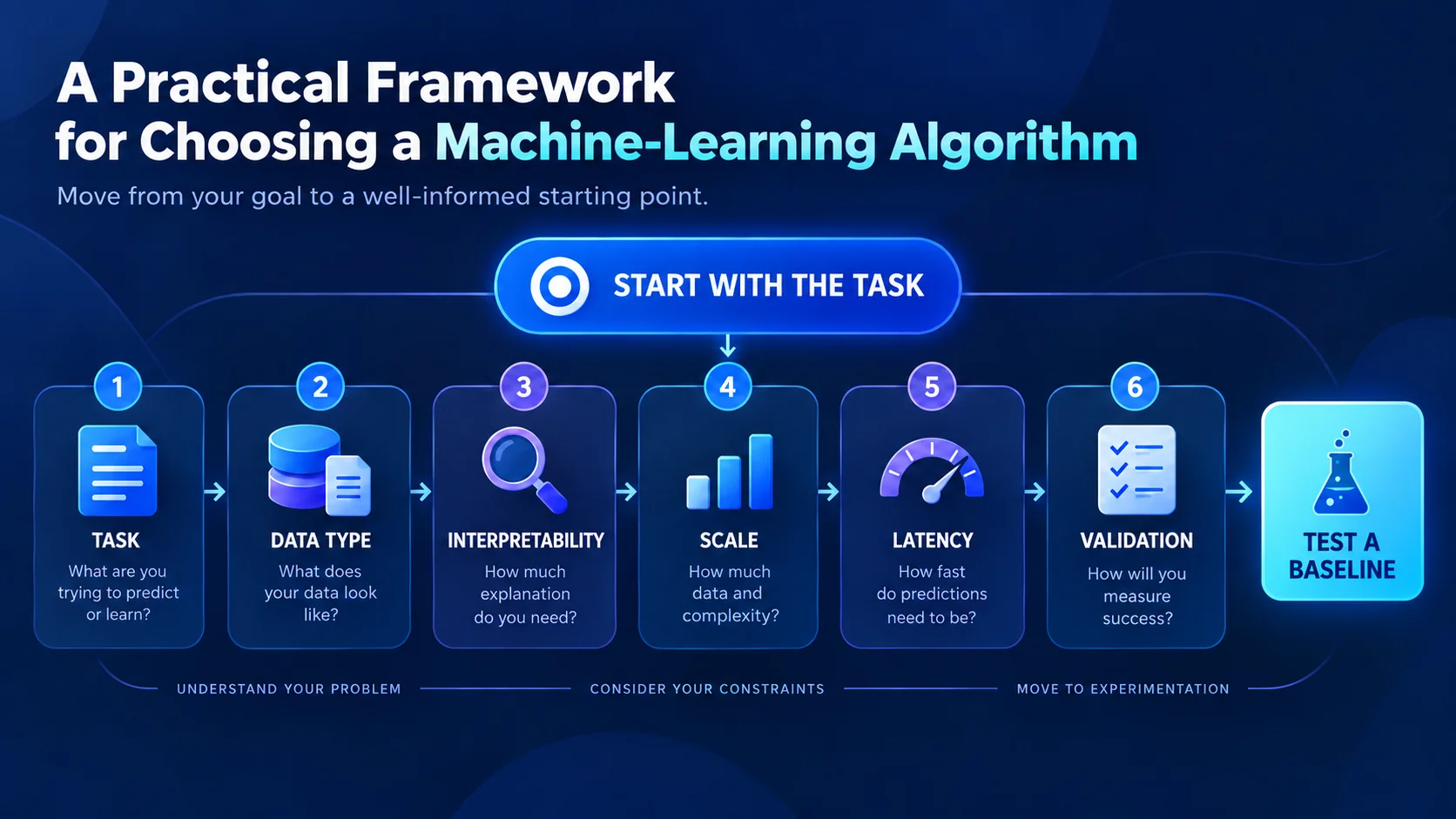
- Define the task. Are you predicting a number, predicting a category, finding groups, reducing dimensions, or learning sequential decisions?
- Identify the output and data. Consider target type, feature types, missingness, scale, dimensionality, sample size, and representation.
- Check assumptions. A convenient method may still be a poor match for the relationships in the data.
- Choose a simple baseline. Without a baseline, you cannot tell whether extra complexity produced a useful improvement.
- Decide what success means. Use a task-appropriate metric instead of treating accuracy as universal.
- Account for practical constraints. Interpretability, latency, memory, training time, serving cost, and maintainability can change the best practical choice.
- Compare candidates correctly. Use validation or cross-validation, then reserve untouched test data for the final evaluation.
For the supporting workflow, review Training, Validation, and Test Data, Data Preprocessing, Feature Engineering, and Model Evaluation Metrics.
Worked Example: Choosing a Model for Customer Churn
Suppose a subscription business wants to predict which customers are likely to cancel next month. The target is a category—churn or no churn—so this is a supervised classification problem.
- Start with a baseline: train logistic regression. It is fast, produces probabilities, and can make the influence of each feature easier to inspect.
- Compare suitable candidates: evaluate a decision tree, Random Forest, and a gradient-boosted tree model using the same data split and preprocessing.
- Choose metrics that match the decision: if churners are uncommon, accuracy alone can hide poor results. Compare precision and recall, F1, and a probability-ranking metric, then consider the cost of missed churners versus unnecessary retention offers.
- Validate consistently: tune and compare candidates with validation data or cross-validation. Use the untouched test set only after the final approach is selected.
- Apply operational constraints: prefer the simpler baseline if a more complex model adds only a small gain that does not justify slower predictions, higher maintenance, or reduced explainability.
The lesson is not that logistic regression always wins. It is that the practical choice comes from a fair comparison against a baseline, using metrics and constraints tied to the real decision.
Why There Is No Single Best Algorithm
The problem label alone rarely reveals the best method. Two classification datasets can differ in size, noise, imbalance, dimensionality, feature meaning, and the cost of mistakes. A model that leads on one metric may lose on another or be unsuitable for latency, interpretability, or maintenance requirements.
Treat algorithm choice as a testable hypothesis: select plausible families, build sensible baselines, compare them with an appropriate validation design, and judge the finalized approach on untouched test data. “Best” always means best under stated evidence, metrics, constraints, and uncertainty—not best in general.
Algorithm Trade-offs
- Interpretability vs flexibility: simpler models may be easier to explain; flexible models may capture more complex structure.
- Bias vs variance: restrictive methods can underfit, while highly flexible methods can become unstable or overfit.
- Training vs inference cost: some methods train slowly but predict quickly; KNN shifts much of the work to prediction time.
- Scale and dimensionality: distance- and margin-based methods often depend on preprocessing and feature representation.
- Data and assumptions: missing values, noisy labels, outliers, class imbalance, and distribution shifts affect methods differently.
- Operational constraints: memory, latency, retraining frequency, monitoring, and maintainability can outweigh a small metric gain.
Dedicated Algorithm and Strategy Guides
- Linear Regression Explained — numerical prediction and the clearest first fitted-model lesson.
- Logistic Regression Explained — classification probabilities and decision thresholds.
- Decision Trees Explained — recursive, rule-like splits for classification and regression.
- Random Forest Explained — a tree-based ensemble for classification and regression.
- Support Vector Machines — margin-based classification and support-vector regression.
- K-Nearest Neighbors — similarity-based classification and regression.
- Naive Bayes — fast probabilistic classification, including text examples.
- K-Means Clustering — partition data into a chosen number of groups.
- Hierarchical Clustering — explore nested grouping structure.
- Ensemble Learning Explained — bagging, boosting, voting, and stacking strategies.
Topics Covered in Broader Guides
The comparison table includes two important topics that do not yet have dedicated lessons. Use these broader guides in the meantime:
- Gradient boosting: continue to Ensemble Learning Explained for boosting’s place alongside bagging, voting, and stacking.
- Principal component analysis (PCA): continue to Feature Selection vs Feature Extraction for PCA’s role as a feature-extraction and dimensionality-reduction method.
Sources & Further Reading
- IBM: Machine Learning Algorithms
- Scikit-learn: Supervised Learning
- Scikit-learn: Unsupervised Learning
- Scikit-learn: Cross-validation
- Google Machine Learning Crash Course: Classification Metrics
About the Author
Christos Adam Lee researches, writes, and edits AllForTheAI’s beginner-friendly AI guides, with an emphasis on clear explanations, practical examples, and connected learning paths. Learn more about the author and how AllForTheAI researches and reviews its content.
Machine Learning Algorithms FAQ
What is the difference between an algorithm and a model?
An algorithm is the method used to fit or organize information from data. A trained model is the fitted result used for predictions, scores, clusters, or decisions.
Which algorithm should a beginner learn first?
Linear Regression is a strong first lesson because it makes the distinction between data, parameters, training, predictions, error, and evaluation easy to see.
How do classification and regression algorithms differ?
Regression predicts numerical values. Classification predicts categories or estimates class probabilities. Some families—including trees, KNN, and support-vector methods—support both tasks.
What is an ensemble method?
An ensemble method combines multiple fitted models or learners. Random Forest is a tree-based ensemble; bagging, boosting, voting, and stacking are other ensemble strategies.
Are neural networks machine learning algorithms?
Neural networks are a family of machine learning models and training methods. Deep Learning refers to approaches built with multilayer neural networks and can be used within supervised, self-supervised, or reinforcement-learning setups.
Why is there no universally best machine learning algorithm?
Methods make different assumptions and trade interpretability, flexibility, speed, memory, and robustness differently. The right choice depends on the data, task, metric, validation evidence, and real-world constraints.
Next Lesson — Linear Regression Explained
Start the algorithm sequence with a transparent numerical prediction method. You will see how a learning method becomes a fitted model, how prediction error is measured, and why a baseline matters.