
Deep learning is a branch of machine learning built around neural networks with multiple layers of learned representations. It is responsible for many of the advances behind modern computer vision, speech recognition, language models, generative AI, and multimodal systems. The word deep refers to the use of multiple computational layers—not to a system having deeper human understanding. Deep learning is powerful because networks can learn useful representations directly from complex data such as images, text, audio, and video. But it is not the best approach for every problem, and modern deep learning does not always require enormous manually labeled datasets.
Last reviewed and updated: September 1, 2026.
What Is Deep Learning?
Deep learning uses neural networks with multiple layers to transform input data into increasingly useful internal representations. The NIST AI glossary provides a standards-oriented reference for deep learning terminology, while NIST’s current AI terminology also defines architecture families such as convolutional neural networks. For example, an image model might learn representations related to edges, textures, shapes, objects, and broader scene relationships. A language model may learn representations of tokens, syntax, semantics, context, and patterns that help predict or generate language. These descriptions are useful intuitions. Individual learned features are not always cleanly separable or directly interpretable. Deep learning is a subset of machine learning, and machine learning is a subset of the broader field of artificial intelligence. Read AI vs Machine Learning vs Deep Learning.
Deep learning is not a fourth learning paradigm alongside supervised, unsupervised, and reinforcement learning. Deep neural networks can be trained using several different learning objectives and paradigms.
Deep Learning vs Neural Networks
The terms are related but not identical. A neural network is a model built from connected computational units and learnable parameters. Deep learning refers to the broader approach of using neural networks with multiple learned layers, often at substantial scale, to learn complex representations. A neural network can be shallow. Deep learning specifically emphasizes deeper architectures and representation learning. See Neural Networks Explained.
How Deep Learning Works
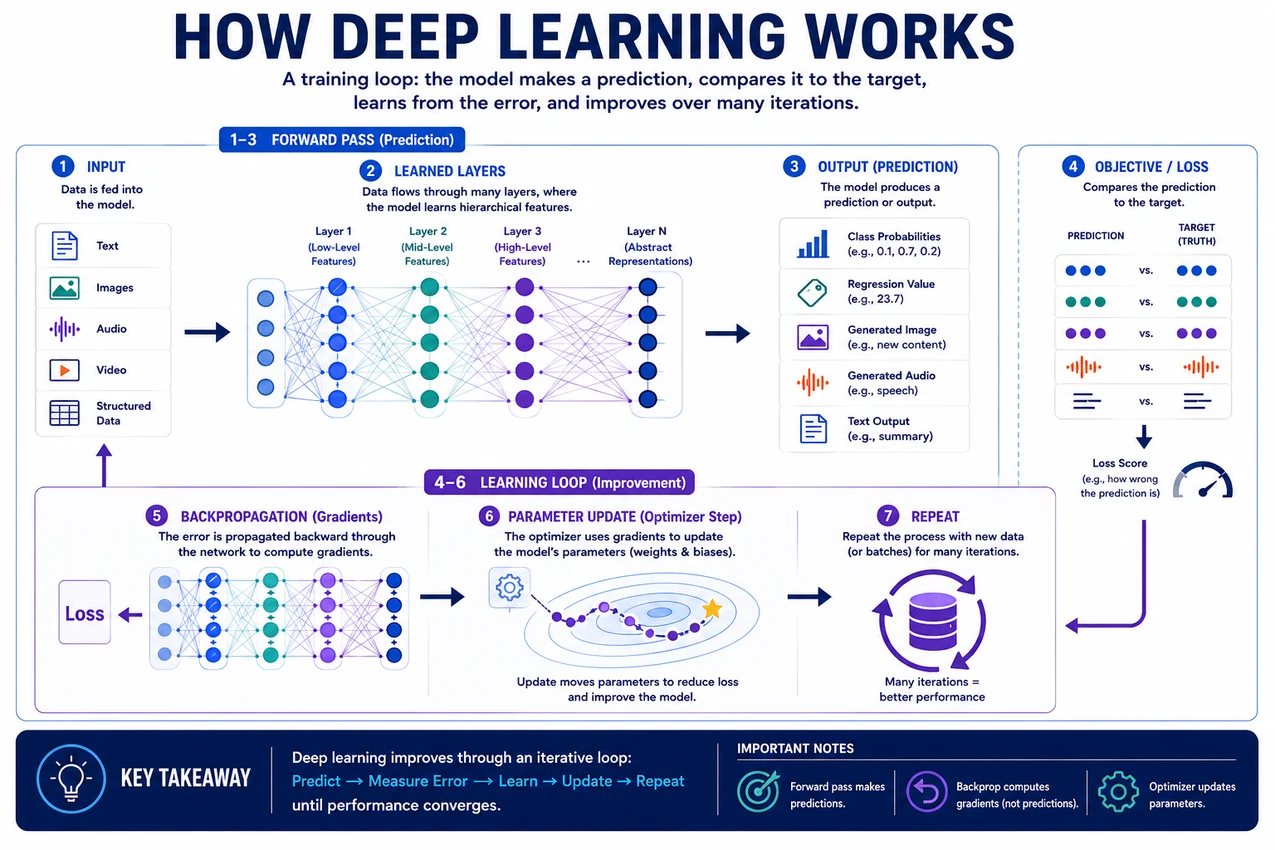
A deep-learning system typically includes several stages.
1. Represent the input
The system converts raw input into numerical representations. Depending on the domain, inputs might include:
- Image pixels or image patches.
- Text tokens.
- Audio samples or spectral features.
- Sensor readings.
- Video frames.
- Structured numerical features.
2. Pass data through multiple layers
Each layer applies learned transformations to the representations from the previous layer. The network’s architecture determines how information can flow and interact.
3. Produce an output
The output depends on the task. A model might produce:
- A class prediction.
- A probability distribution.
- A numerical value.
- An embedding.
- The next token in a sequence.
- A generated image or audio representation.
4. Measure the training objective
A loss or objective function measures how well the model is performing according to the training task.
5. Compute gradients
Backpropagation calculates gradients through the network.
6. Update parameters
An optimizer uses those gradients to adjust model parameters. This process repeats over many examples or batches during training.
Learn the full training loop → How Deep Learning Works
Modern Deep Learning Is Not Only Supervised Learning
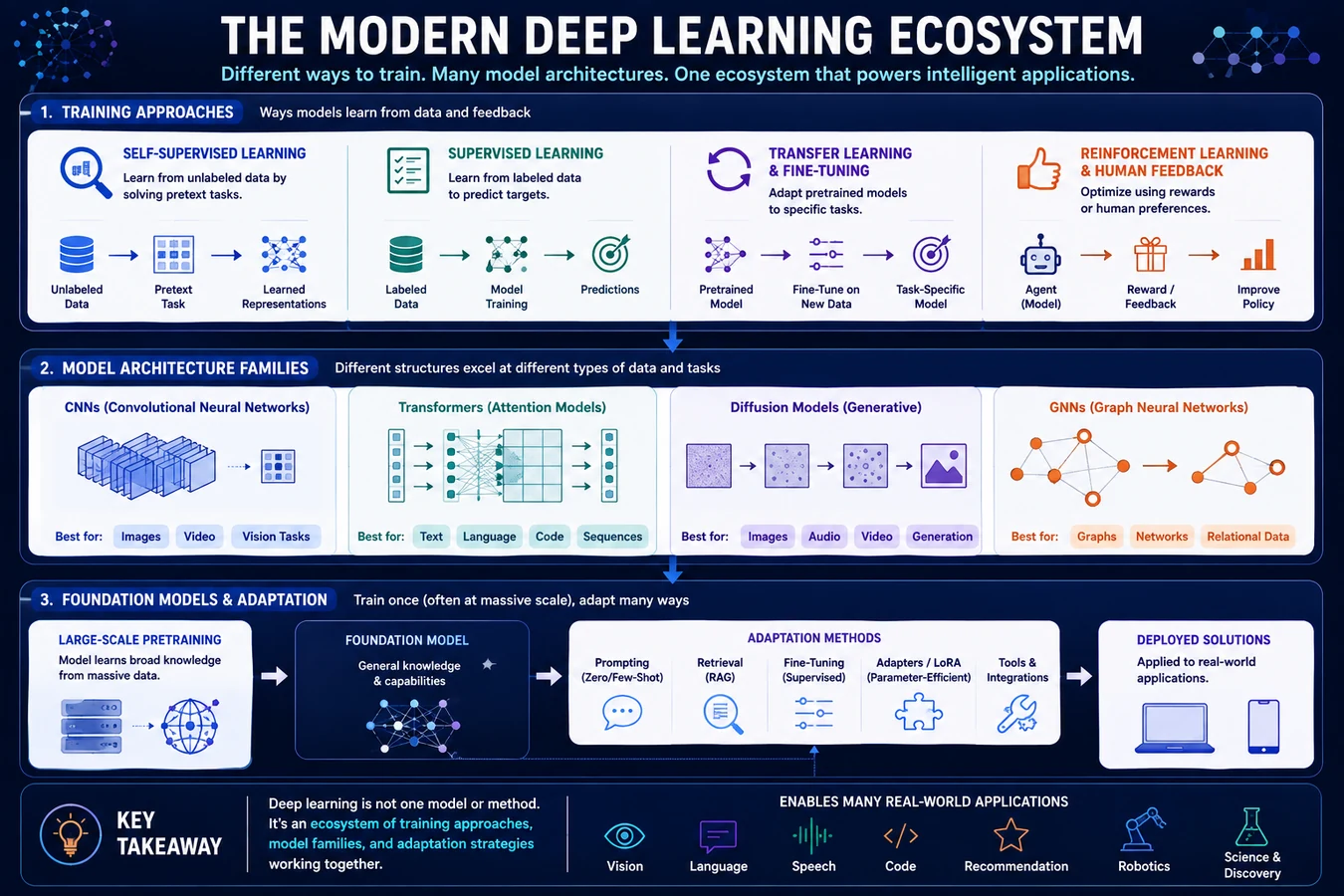
Early beginner explanations often present deep learning as training large neural networks on huge labeled datasets. That describes some systems, but it is incomplete today. Modern deep learning uses several training approaches.
Supervised learning
Models learn from inputs paired with target labels.
Self-supervised learning
Models create learning signals from the structure of the data itself. Large language models, for example, can learn by predicting tokens from surrounding context without requiring a human to manually label every sentence.
Transfer learning
A model trained on a broad dataset can be adapted to a narrower task.
Fine-tuning
Pretrained models can be further trained on task-specific examples or objectives.
Reinforcement and preference-based methods
Some systems use reinforcement-learning or preference-optimization stages after pretraining to adapt behavior. This combination of broad pretraining and targeted adaptation is central to many modern foundation-model systems. Read Types of Machine Learning and Supervised Learning Explained.
Major Deep Learning Architectures
Deep learning is not one architecture.
Convolutional neural networks
CNNs use convolutional operations that are well suited to local spatial patterns. They transformed computer vision and remain useful for many image tasks.
Recurrent neural networks
RNNs, LSTMs, and GRUs were designed to process sequential information. They remain useful in some settings, although transformers have become dominant for many large-scale language and sequence tasks.
Transformers
Transformers use attention mechanisms to model relationships among elements in a sequence or representation. They underpin most modern large language models and are increasingly used in vision, audio, biology, robotics, and multimodal systems. Read Transformers in NLP Explained.
Autoencoders
Autoencoders learn representations by encoding and reconstructing data. Variants are used in representation learning, anomaly detection, compression, and generative modeling.
Generative adversarial networks
GANs use competing neural networks—a generator and discriminator—to learn how to generate data resembling a training distribution. GANs played an important role in modern generative AI, especially image generation, although diffusion and transformer-based approaches now dominate many generative applications.
Diffusion models
Diffusion models learn to reverse a process that gradually adds noise to data. They have become important in image, audio, video, and other generative systems.
Graph neural networks
Graph neural networks operate on connected structures such as molecules, knowledge graphs, networks, and relationships among entities.
Deep Learning and Foundation Models
A major modern development is the rise of foundation models: large models pretrained on broad datasets and adaptable to many downstream tasks. Stanford’s Center for Research on Foundation Models defines foundation models as models trained on broad data—generally using self-supervision at scale—that can be adapted to a wide range of downstream tasks. See Stanford CRFM’s foundation model report. Large language models are one example. Vision-language and multimodal models extend the idea across multiple forms of data. Foundation models change the traditional workflow. Instead of training a separate model from scratch for every task, teams can start with a pretrained model and adapt it through prompting, retrieval, fine-tuning, tool use, or other methods. That can reduce task-specific training requirements, but it does not eliminate the need for evaluation, governance, security, or domain expertise.
Deep Learning vs Traditional Machine Learning
Traditional machine-learning methods such as linear regression, decision trees, random forests, support vector machines, and gradient-boosted trees remain extremely useful.
| Factor | Traditional ML | Deep Learning |
|---|---|---|
| Feature engineering | Often more manual | Can learn complex representations automatically |
| Data | Often strong on smaller structured datasets | Often benefits from larger or pretrained datasets |
| Compute | Often lower | Can be substantially higher |
| Interpretability | Some models are easier to inspect | Large networks can be difficult to interpret |
| Complex unstructured data | May require substantial feature design | Often excels on images, language, audio and video |
Deep learning should not automatically replace simpler methods. The best model depends on the dataset, task, latency, cost, interpretability requirements, deployment environment, and acceptable error profile.
See the full Deep Learning vs Machine Learning comparison →
Applications of Deep Learning
Computer vision
Deep networks power image classification, object detection, segmentation, visual search, medical imaging support, and many other vision tasks. Read Computer Vision Explained.
Natural language processing
Transformers and other deep networks are used for translation, classification, retrieval, summarization, question answering, and language generation. See What Is Natural Language Processing?.
Generative AI
Deep learning powers modern text, image, audio, video, and code generation. Read What Is Generative AI?.
Speech and audio
Deep networks support speech recognition, speech synthesis, music generation, audio classification, and speaker-related tasks.
Scientific applications
Deep learning is used in protein modeling, drug discovery, climate analysis, astronomy, materials research, and other scientific domains.
Robotics and control
Deep networks can support perception, prediction, policy learning, and planning components in robotics, often alongside classical control, simulation, and other techniques.
Does Deep Learning Need Huge Amounts of Data?
Not always. Training a large network from scratch can require substantial data. But modern workflows can reduce task-specific data requirements through:
- Pretrained models.
- Transfer learning.
- Self-supervised learning.
- Data augmentation.
- Synthetic data where appropriate.
- Fine-tuning.
- Parameter-efficient adaptation.
The relevant question is not simply “How much data?” It is whether the available data and pretrained representations are appropriate for the intended task.
Does More Compute Always Produce Better Models?
No. Scaling model size, data, and compute has produced major advances, but results depend on architecture, optimization, data quality, objective design, training stability, evaluation, and deployment constraints. Larger models can also create higher costs, latency, energy use, and operational complexity. A smaller model may be preferable when it meets the task requirements more efficiently.
Limitations and Risks of Deep Learning
Compute cost
Large models can require expensive hardware and significant energy for training and inference.
Data quality
Scaling low-quality, duplicated, biased, or inappropriate data does not guarantee better outcomes.
Interpretability
Deep networks can be difficult to explain, especially at large scale.
Overfitting and memorization
Models can fit training data too closely or memorize sensitive or irrelevant patterns. Read Overfitting vs Underfitting.
Distribution shift
Performance can decline when real-world inputs differ from training conditions.
Hallucination and generative errors
Generative deep-learning systems can produce fluent but incorrect or unsupported outputs.
Bias and fairness
Models can reproduce or amplify biases in data, labels, objectives, and deployment processes.
Security
Deep-learning systems can face adversarial inputs, data poisoning, model extraction, prompt injection, unsafe tool use, and other attack surfaces depending on the system design.
Operational complexity
Production systems require monitoring, evaluation, versioning, infrastructure, access controls, and governance beyond the model itself.
Frequently Asked Questions
What is deep learning in simple terms?
Deep learning is machine learning that uses neural networks with multiple layers to learn useful representations from data.
Is deep learning the same as AI?
No. Deep learning is one approach within machine learning, which is itself part of the broader AI field.
Is deep learning the same as a neural network?
Not exactly. Neural networks are the model family. Deep learning refers to approaches using neural networks with multiple learned layers and complex representation learning.
Does deep learning always need labeled data?
No. Modern systems often use self-supervised pretraining, transfer learning, reinforcement learning, synthetic data, or combinations of approaches.
Are large language models deep learning?
Yes. Modern large language models are deep neural networks, typically based on transformer architectures.
Are CNNs obsolete because transformers exist?
No. Transformers dominate many large-scale applications, but CNNs remain efficient and effective for many vision and signal-processing problems.
Is a bigger neural network always better?
No. Larger models can be more capable in some settings, but cost, latency, data quality, task fit, training method, and deployment requirements all matter.
Next Lesson
Learn how neural networks are structured, how their layers transform information, and how they form the model family behind deep learning.