
Artificial intelligence is already part of many entertainment workflows. It helps platforms recommend existing content, assists studios and creators with production tasks, supports behavior inside video games, and increasingly generates or transforms images, audio, text and video.
These uses should not be treated as one technology. A recommendation model that ranks movies is fundamentally different from a generative model that creates a voice or video clip. Understanding that distinction makes it easier to evaluate what AI can do—and where human judgment, rights and accountability still matter.
Key Takeaways
- Recommendation systems rank or select existing content; generative AI creates or transforms content.
- Film, music and game teams use AI for specific tasks rather than one fully automated creative process.
- Technical capability does not establish legal permission, production quality or audience value.
- Copyright, consent, likeness, privacy, bias and labor agreements shape responsible use.
- Human creators and organizations remain responsible for editorial, legal and production decisions.
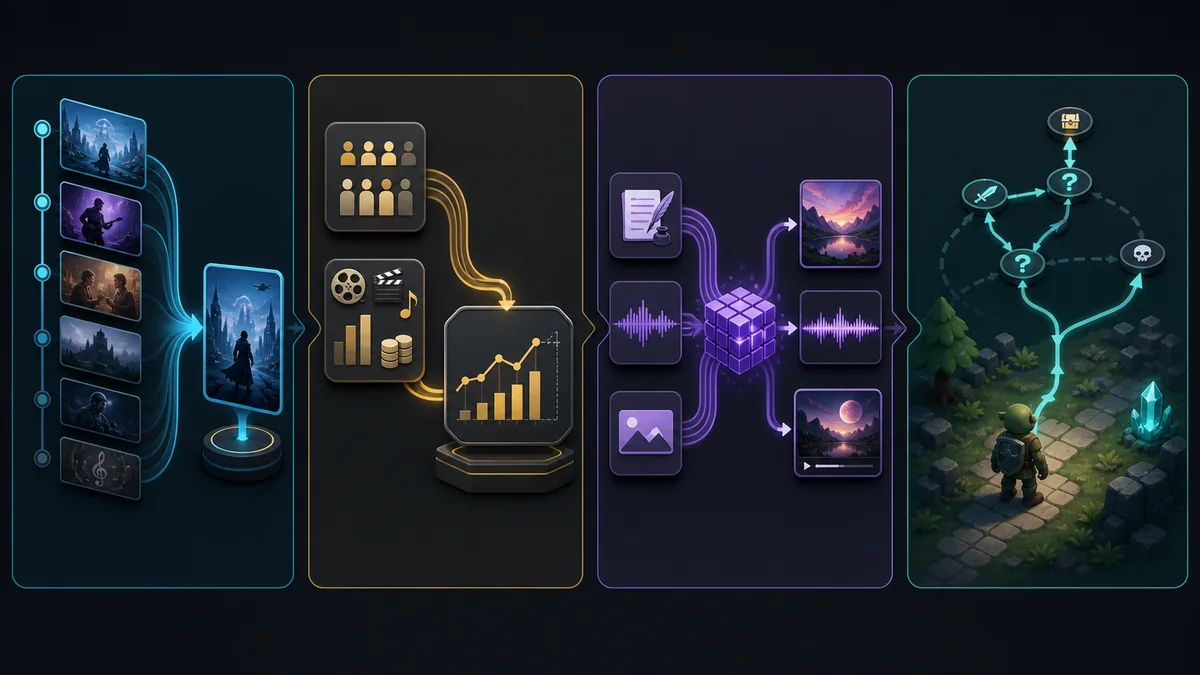
Four Types of AI Use in Entertainment
Recommendation: Ranks or selects existing content—for example, suggesting a film, song or game.
Prediction and analytics: Estimates audience or operational outcomes, such as demand or engagement.
Generative AI: Creates or transforms content, such as an image, voice, subtitle or video clip.
Game AI: Controls behavior, planning or interaction, such as a non-player character or pathfinding system.
Recommendation and Discovery
Streaming, music, video and gaming platforms use machine-learning systems to rank content using signals such as viewing or listening history, interactions, context, and similarities among users or items.
Recommendations can reduce search effort and help people discover unfamiliar work. They can also shape which creators receive visibility, encourage narrow feedback loops and require the collection or inference of behavioral data.
A recommendation is not an objective declaration of the “best” content. It is a ranked result produced for a particular goal, using particular data and product rules.
To understand the underlying technology, read Machine Learning Explained.
Generative AI in Entertainment
Generative AI creates or transforms content based on patterns learned from data. Entertainment uses can include:
- Concept exploration and storyboarding.
- Draft scripts, dialogue or marketing copy.
- Image and video generation.
- Voice synthesis, dubbing and localization.
- Music ideation and sound effects.
- Game assets and prototypes.
- Restoration or transformation of existing media.
Generated output still requires editorial, factual, legal and quality review. A compelling demonstration does not prove that a tool is reliable, licensed or appropriate for a production workflow.
Learn more in What Is Generative AI?
AI in Film and Television
AI tools can support pre-production, visual effects, restoration, localization, metadata, post-production and audience analysis. Predictive models can estimate audience demand, while computer vision can help analyze existing footage. Generative tools create or transform images, dialogue, or clips. Natural language processing supports language tasks such as transcription and subtitle processing; a single workflow may combine several approaches.
The most sensitive uses involve synthetic performances, digital replicas, voice cloning and manipulation of a performer’s likeness. The U.S. Copyright Office has identified unauthorized digital replicas as a serious legal and policy problem and has recommended federal protection. Current SAG-AFTRA agreements also include detailed consent and digital-replica protections for covered performers.
The practical question is not only whether a digital replica can be created. It is whether its creation and use are authorized, contractually permitted, secure and appropriately disclosed.
AI in Music and Audio
Recommendation and audio-analysis systems help people find or organize existing recordings. Generative AI systems can produce melodies, arrangements, synthetic vocals, sound effects, production ideas and localized audio. Analyzing or recommending a recording is different from generating a new one.
These uses raise questions about training data, stylistic imitation, attribution, licensing and recognizable voices. The U.S. Copyright Office distinguishes copyrightability of AI-generated outputs from broader questions about training data and digital replicas; those issues should not be collapsed into one claim about whether “AI art is legal.”
Human direction remains important because technical output quality, musical meaning and permission are separate questions.
AI in Video Games
Games have used AI techniques for decades for navigation, opponent behavior, procedural systems, planning and decision logic.
Modern machine learning and generative AI can additionally support dialogue prototypes, asset creation, player-behavior analysis, testing assistance and dynamic-content experiments.
Not every game system learns from players, and generative AI is not a substitute for game design, narrative direction, moderation, accessibility testing or performance engineering.
Rights, Likeness and Copyright
Entertainment AI intersects with intellectual-property, publicity, privacy and contractual rights. Useful questions include:
- Was source or training material used under an applicable license or legal basis?
- Does the output reproduce protected material?
- Was a performer’s voice, face or likeness used with valid consent?
- Who may own, distribute or commercially exploit the output?
- Do contracts or labor agreements impose additional conditions?
- Must AI-generated or manipulated content be disclosed?
Answers depend on jurisdiction, contracts and the specific workflow. The European Union’s AI Act includes transparency obligations for certain AI-generated or manipulated content, with phased application and supporting European Commission guidance.
For broader context, read AI Ethics.
Will AI Replace Entertainment Professionals?
Universal replacement predictions are not reliable.
AI can automate or accelerate particular tasks while creating new review, integration, rights-management and creative-direction work. Effects differ by occupation, organization, production budget, adoption choices, regulation and labor agreements.
A more useful question is: which tasks are changing, which decisions remain human-led, and what new controls are required?
Risks and Limitations
Rights and consent
Synthetic media can misuse protected work, voices, faces or identities.
Factual and quality errors
Generated scripts, research, subtitles and promotional materials can contain invented or misleading information.
Homogenization
Heavy reliance on similar models, prompts or training data can encourage repetitive aesthetics and ideas.
Bias and representation
Systems can reproduce stereotypes or uneven representation found in their data and evaluation choices.
Fraud and impersonation
Synthetic voice and video can be used for deception, scams or identity abuse.
Privacy and security
Prompts, uploaded media, biometric data, model outputs and production integrations may expose confidential or personal information.
A Responsible Production Checklist
- Define the task and responsible decision-maker.
- Confirm rights, licenses, consent and contractual requirements.
- Document which tools and source materials were used.
- Review output for quality, factual errors, bias and harmful representation.
- Protect confidential, personal and biometric information.
- Label or disclose generated and manipulated media when required.
- Preserve a human approval and escalation path.
- Monitor the published use and respond to complaints or incidents.
Frequently Asked Questions
Is recommendation AI the same as generative AI?
No. Recommendation systems primarily rank or select existing content; generative models create or transform content.
Can AI legally clone an actor’s or singer’s voice?
Technical ability does not establish legal permission. The answer depends on consent, contracts, applicable rights, labor agreements and jurisdiction.
Is AI already used in games?
Yes. Games have long used AI techniques for navigation, behavior and procedural systems. Modern machine learning and generative AI add newer capabilities.
Will AI replace artists and entertainers?
There is no reliable universal prediction. AI is changing particular tasks and workflows, but outcomes vary widely.
Where to Learn Next
Explore More Real-World Applications of AI. Compare entertainment with other industry uses, then choose a technology or responsible-use guide below.
- Start with What Is Artificial Intelligence? for the broad foundation.
- Read Machine Learning Explained for prediction and recommendation systems.
- Continue to What Is Generative AI? for content-generation fundamentals.
- Explore AI Ethics for governance, rights and accountability.
Last reviewed: August 28, 2026