
AI Foundations — Supporting Guide
Last reviewed and updated: September 4, 2026.
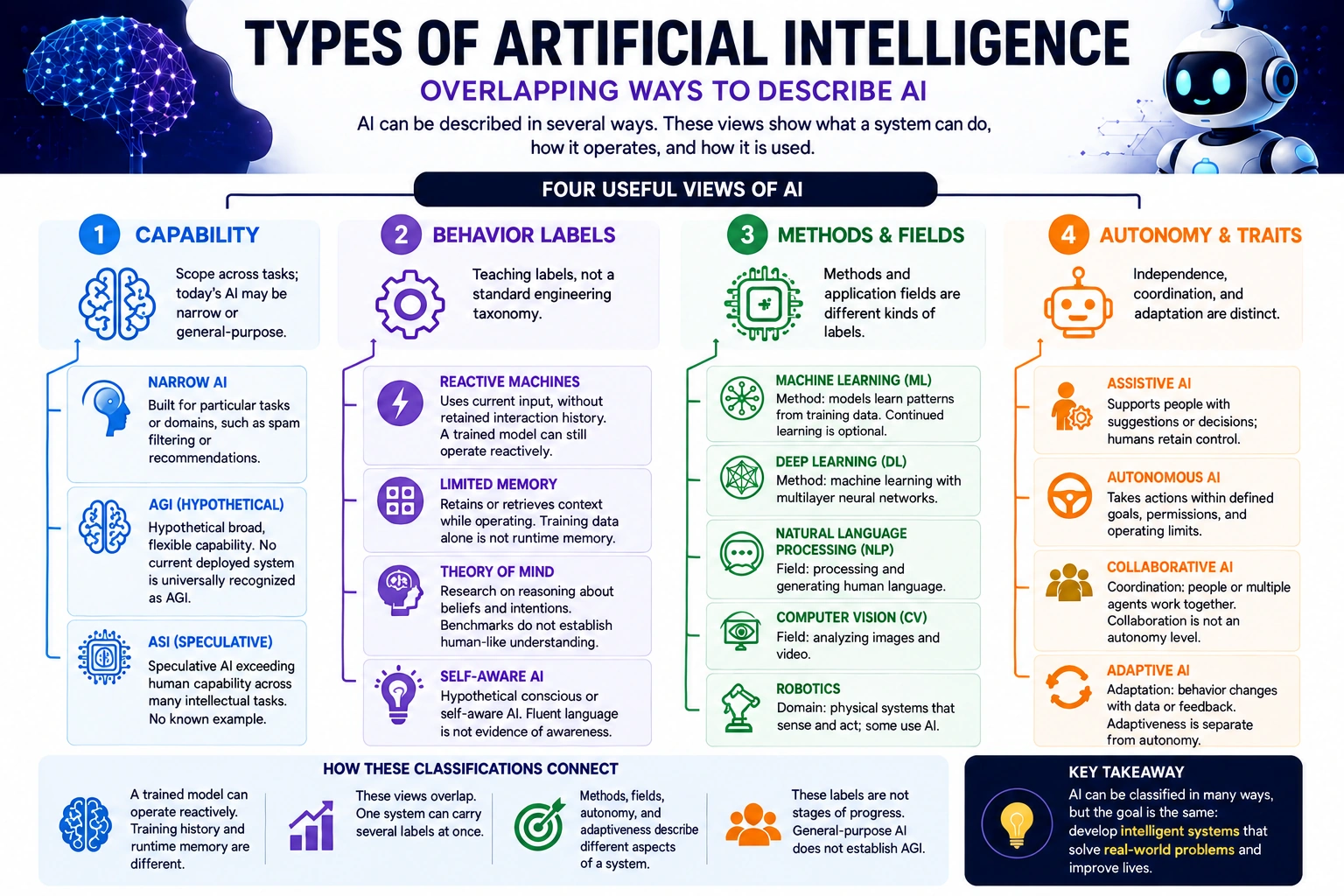
Artificial intelligence is often divided into “types,” but there is no single master taxonomy. Some labels describe a system’s scope of capability; others describe its runtime behavior, technical approach, task, modality, autonomy, or application domain. Keeping those dimensions separate prevents a misleading “ladder” of unrelated categories.
This AI Foundations supporting guide expands on Artificial Intelligence Explained. For the core learning path, continue to Machine Learning Explained. For a related supporting guide, explore How Artificial Intelligence Works.
For a standards-oriented baseline, the NIST AI glossary describes AI in terms of machine-based systems that produce outputs such as predictions, recommendations, or decisions for human-defined objectives.
Types of AI in One Minute
- Capability scope: How broadly can it perform tasks? Narrow and general-purpose AI describe scope; AGI and ASI remain hypothetical or speculative concepts.
- Runtime behavior: Does it respond to the current input, or retain or retrieve context while operating?
- Technical approach: Does it use symbolic rules, machine learning, deep learning, reinforcement learning, or a combination?
- Output or task: Does it predict, classify, rank, generate content, or control a process?
- Autonomy: Does it support a human decision, assist with a task, or take actions in an agentic workflow?
- Modality: Does it work with text, images, audio, video, or multiple kinds of input and output?
One system can carry several of these labels at once. They are different dimensions, not stages on one intelligence ladder.
Capability-Based Categories
Specialized or Narrow AI
Specialized AI, often called narrow AI or artificial narrow intelligence (ANI), is optimized primarily for particular tasks or domains. Examples include spam filters, recommendation systems, image classifiers, and speech-recognition systems. A narrow system may perform its assigned task extremely well without having flexible, human-level intelligence.
Current General-Purpose AI
Modern foundation models can support many tasks—such as writing, coding, analysis, translation, image understanding, and tool use—across multiple domains. It is useful to call these general-purpose AI models or systems, while recognizing that breadth alone does not establish AGI. General-purpose AI describes broad usefulness across tasks; it is not a formal fourth capability tier between narrow AI and AGI. Stanford HAI similarly distinguishes narrow AI from today’s more general-purpose models.
Artificial General Intelligence
Artificial general intelligence, or AGI, is a contested, hypothetical concept involving substantially broader and more flexible general capability. There is no universally accepted technical definition or test for AGI, and no current deployed system is universally recognized as AGI.
Researchers have proposed frameworks and benchmarks for discussing progress toward general capability, but none functions as an official AGI scale. The peer-reviewed Levels of AGI paper proposes one capability-oriented framework using performance and generality; it should not be mistaken for a universally adopted definition.
Artificial Superintelligence
Artificial superintelligence, or ASI, is a speculative concept describing AI that would substantially exceed human capability across a broad range of intellectual tasks. No such system is known to exist.
The Functionality-Based Teaching Framework
Another common educational framework, also presented in IBM’s overview of AI types, uses four labels: reactive machines, limited-memory AI, theory-of-mind AI, and self-aware AI. These terms can help introduce ideas about system behavior, but they are not a standard engineering classification for modern production systems.
Reactive machines
A reactive system bases its current decision primarily on the current input or state rather than persistent interaction history. “Reactive” describes runtime behavior, not how the system was built: a trained machine-learning model can still operate reactively at inference time when each input produces an output without retaining state from earlier interactions.
Limited-memory AI
“Limited-memory AI” is commonly used for systems that retain or retrieve some information while operating, but the label combines several different implementation patterns.
- Training history is information that influenced a model’s parameters during training. It does not mean the deployed system remembers a particular user or prior interaction.
- Operational or runtime memory is information retained or retrieved while the system is being used—for example, a context window, conversation history, database, retrieval layer, recurrent state, or external record.
A system can have one without the other, so “limited memory” should not be treated as a precise architecture category.
Theory-of-mind AI
Theory of mind is a psychology concept involving reasoning about other people’s beliefs, intentions, and mental states. Some AI research evaluates social reasoning, but benchmark performance is not evidence that a production system possesses a human-like theory of mind.
Self-aware AI
Self-aware AI is hypothetical. Fluent language or self-reference is not evidence that a current AI system is conscious or self-aware.
Capability and Functionality Answer Different Questions
ANI, AGI, and ASI describe scope of capability. Reactive, limited-memory, theory-of-mind, and self-aware labels form a teaching model about functional behavior. Because they answer different questions, they should not be presented as one seven-stage progression.
One System Can Have Several AI Labels
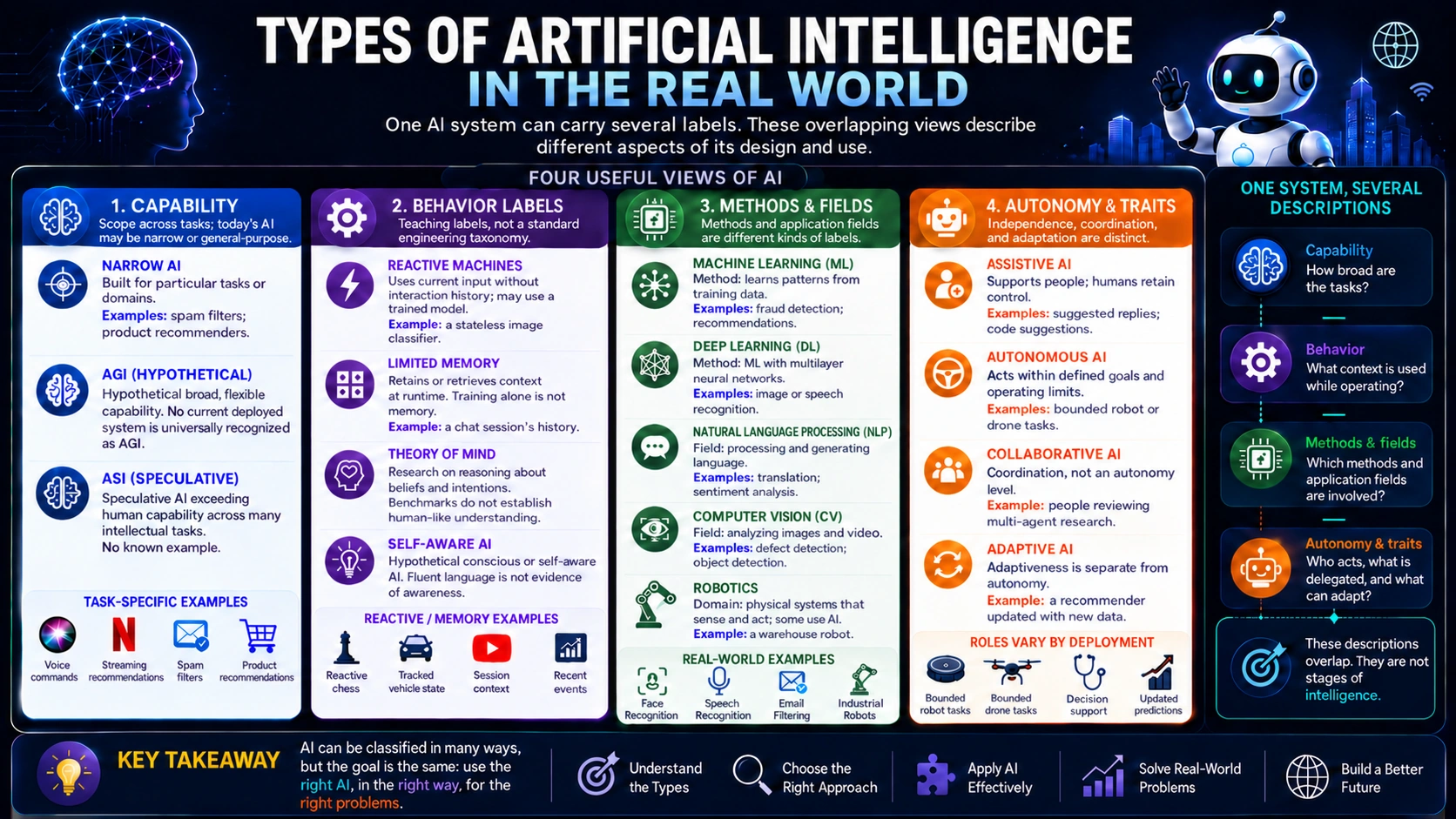
A real system is better understood as a combination of labels, not one item in a single list. For example, an AI research assistant could be described simultaneously as:
- Capability scope: general-purpose, but not established AGI.
- Technical approach: machine learning using deep neural networks, possibly combined with retrieval or symbolic rules.
- Modality: text and image, or multimodal.
- Task: generation, search, summarization, and ranking.
- Autonomy: an assistant, decision-support tool, or agentic workflow depending on how it is deployed.
- Domain: research, education, healthcare, finance, or another field.
Technical approaches an AI system may use
Technical approaches overlap and can be combined. Deep learning is part of machine learning; reinforcement learning is commonly treated as a machine-learning paradigm; deep neural networks can be used within reinforcement learning; and probabilistic or symbolic components can appear in hybrid systems.
- Rule-based or symbolic AI.
- Machine learning and deep learning.
- Probabilistic models.
- Reinforcement learning.
- Hybrid systems that combine multiple approaches.
Common AI fields and application labels
Practical labels often mix descriptive dimensions rather than forming a clean scientific taxonomy. Natural language processing and computer vision are fields or capability domains; robotics is an embodied-systems domain; recommendation systems are an application family; generative AI describes output behavior; and decision support describes a deployment role.
Where Generative AI Fits
Generative AI describes systems that generate content such as text, images, audio, video, or code. It is not a capability level above narrow AI, and a generative system may be specialized or general-purpose. Read What Is Generative AI?
Where Agentic AI Fits
Agentic AI is not a capability level like AGI. It describes systems designed to take actions toward goals, often by planning steps, using tools, responding to feedback, and carrying out multi-step work with some degree of autonomy. In short, generative AI primarily describes producing outputs, agentic AI describes organizing or taking actions toward an objective, and AGI remains a hypothetical broader-capability concept. See Stanford HAI’s definition of agentic AI.
Where Cognitive AI Fits
“Cognitive AI” is an industry and product term for systems combining capabilities such as perception, language processing, reasoning, knowledge representation, and decision support. It does not imply consciousness or human-like thought. See Cognitive AI Explained.
Frequently Asked Questions
How many types of AI are there?
There is no single universally accepted number. Different labels classify AI by capability scope, runtime behavior, technical approach, modality, task, autonomy, or application.
Is ChatGPT narrow AI or AGI?
Large language models can perform many tasks and are often described as general-purpose AI. That breadth does not establish AGI: the term has no universally accepted definition or test, and current deployed systems are not universally recognized as AGI.
Does self-aware AI exist?
There is no established evidence that current AI systems are conscious or self-aware.
Is generative AI a type of AI?
Yes, as a label for what a system produces. It is not a capability stage equivalent to ANI, AGI, or ASI.
Continue AI Foundations
Continue the core learning path: Learn how machine-learning systems use data to find patterns and make predictions.
Parent guide: Artificial Intelligence Explained
Related supporting guide: How Artificial Intelligence Works. Related reference: AI vs Machine Learning vs Deep Learning.