
Last reviewed and updated: September 4, 2026.
Artificial intelligence does not work through one universal process. Different AI systems use different combinations of rules, algorithms, learned models, search, retrieval, optimization, external tools, and human-designed controls.
A useful way to understand modern AI is to separate how a system is built or trained from what happens when it is used, a stage often called inference.
This AI Foundations supporting deep-dive expands on Artificial Intelligence Explained with a system-level walkthrough.
There Is No Single AI Pipeline
A rule-based expert system, a fraud-detection model, a recommendation engine, and a generative language model can all be called AI, but their internal operation is very different.
Two broad implementation traditions are useful for beginners:
- Explicitly specified AI uses human-designed rules, symbolic representations, search, planning, optimization, or other procedures.
- Learning-based AI learns patterns from data through machine learning. Deep-learning systems, foundation models, and most contemporary generative models belong within this tradition.
A modern AI application can add a system layer around either approach, combining models or procedures with retrieval, tools, business logic, databases, safety controls, and human oversight.
Rule-Based AI
Rule-based systems use explicit logic created by people.
A simplified rule might look like: IF condition A and condition B are true, THEN perform action C.
These systems do not necessarily learn from data. Their behavior comes primarily from explicit rules and knowledge representations designed by developers and domain experts.
Rule-based approaches can still be useful when requirements are clear, explainability is important, or behavior must follow strict constraints. Other explicitly specified approaches can use search, planning, or optimization without being rule-based systems.
How Machine-Learning AI Works
Machine-learning systems learn statistical relationships from data. A typical supervised-learning workflow may include:
- Define the prediction objective.
- Collect and prepare a machine-learning dataset.
- Split data for training, validation, and testing, using validation data during development and test data for final evaluation.
- Train a model.
- Evaluate it on unseen data.
- Deploy the model.
- Monitor its real-world behavior.
During training, an algorithm adjusts model parameters based on data and an objective function.
During inference, the trained model uses those learned parameters to produce a prediction for a new input. When that input comes from images, audio, or physical sensors, machine perception helps turn the sensory data into task-specific information. The Google Machine Learning Glossary provides additional definitions for these terms.
Read Machine Learning Explained.
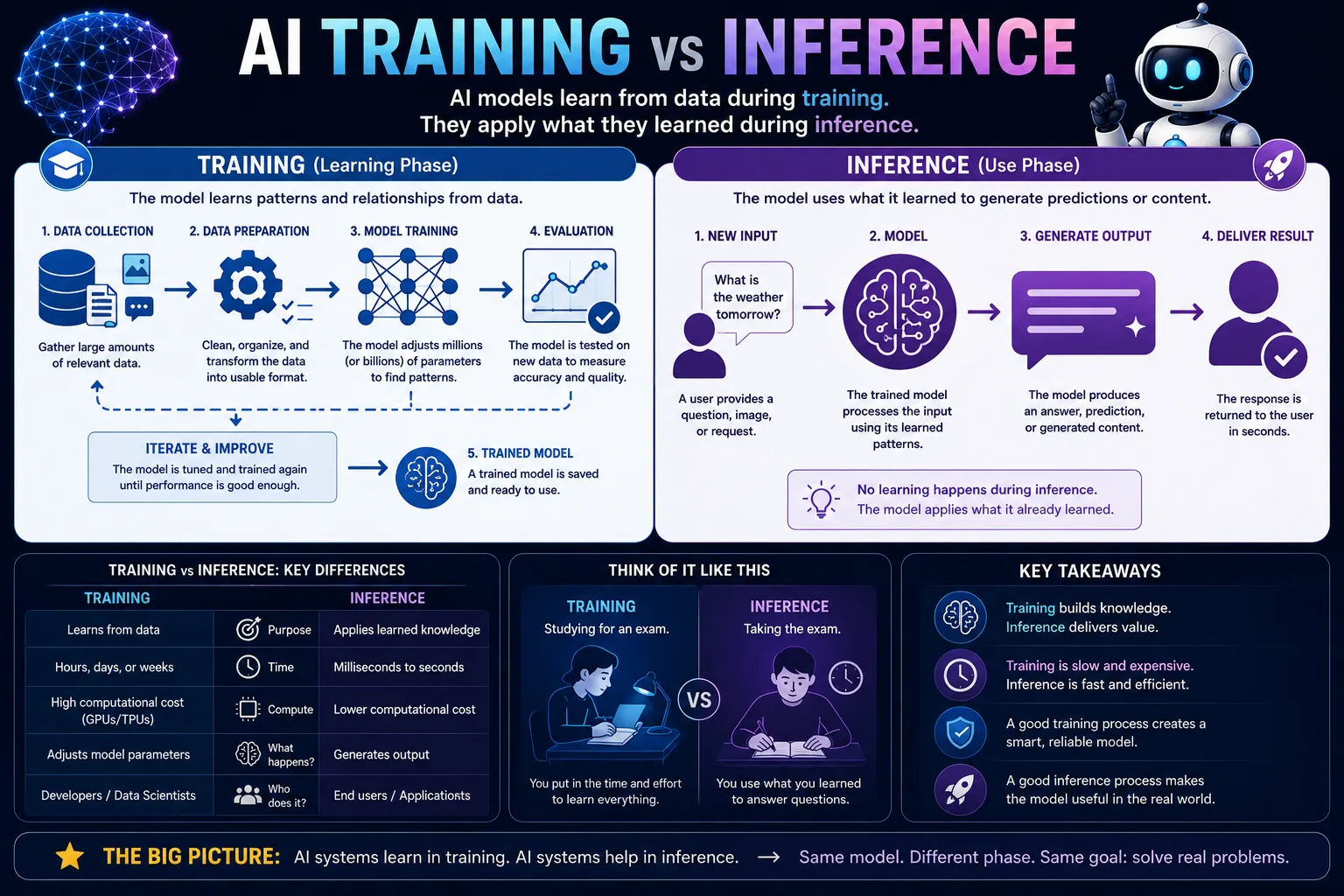
Training vs Inference
Training
Training is the process of fitting or adapting a model using data. Depending on the system, training may take seconds, hours, weeks, or longer and may require substantial computing resources.
Inference
Inference happens when the trained model is used to produce an output. Examples include:
- Classifying an image.
- Predicting fraud risk.
- Generating text.
- Translating a sentence.
- Ranking recommended products.
A deployed model does not necessarily retrain or learn from every user interaction. Many production systems keep model parameters fixed between scheduled training or update cycles.
How Deep-Learning Systems Work
Deep learning uses multilayer neural networks. During training, data moves through the network, a loss function measures prediction error or another training objective, and optimization algorithms adjust model parameters.
Repeated across many examples, this process can produce internal representations useful for language, vision, speech, and other complex tasks.
See Neural Networks Explained and What Is Deep Learning?.
How Foundation Models Work Within Machine Learning
Foundation models are large models pretrained on broad datasets and then reused or adapted for many downstream tasks.
Large language models, for example, are commonly pretrained using self-supervised objectives that teach the model statistical patterns in language. After pretraining, a model may undergo additional stages such as:
- Supervised fine-tuning.
- Preference optimization.
- Reinforcement-learning-based adaptation.
- Safety tuning.
- Domain-specific fine-tuning.
The exact pipeline varies by model and organization.
What Happens When You Prompt a Generative AI System?
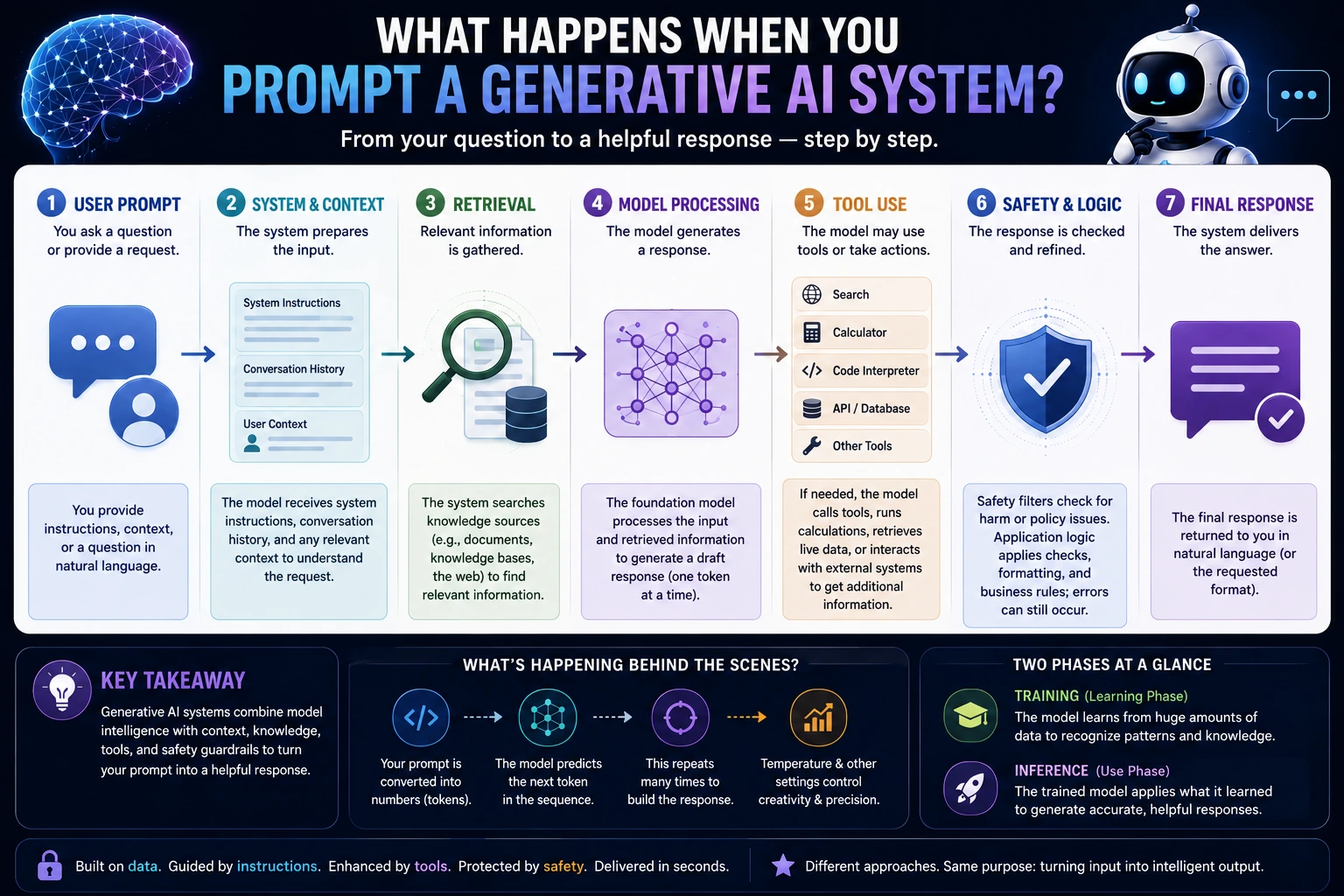
A modern generative-AI application may involve much more than sending text directly into one model. A simplified inference flow might include:
- Receive the user input.
- Apply system instructions and context.
- Retrieve relevant information if retrieval is enabled.
- Send an assembled context to a model, which generates or scores output tokens or other content.
- Potentially call tools or external systems.
- Apply safety, formatting, or application logic.
- Return the result.
This is an application architecture, not a universal description of every generative-AI product.
Read What Is Generative AI?.
Retrieval Is Not the Same as Training
Modern AI applications often retrieve information from databases, search indexes, documents, or APIs at inference time.
Retrieval can give a model access to current or private information without changing the model’s trained parameters. This is different from retraining or fine-tuning the model, and it does not guarantee that the resulting output will be correct.
Tool Use Is Not the Same as Information Represented in Model Parameters
An AI application may call calculators, search systems, databases, code execution environments, calendars, or business software. When that happens, the overall system can perform actions or obtain information that is not stored inside the model itself.
It is therefore useful to distinguish:
- Information represented through the model’s trained parameters.
- What context was supplied at inference time.
- What information was retrieved.
- What external tools performed.
The Same Principles Across AI Domains
Computer-vision systems process images or video, while natural language processing systems work with text or speech. Their architectures and training methods differ, but either domain can combine learned models with rules, retrieval, tools, and other system components. Continue with Computer Vision Explained or How NLP Works.
Does AI Learn Continuously?
Not necessarily.
Some systems support online or continual learning, but many deployed AI systems do not automatically update their model parameters from every interaction. Continuous uncontrolled learning can create safety, reliability, privacy, and evaluation problems.
Organizations often collect new data, review it, retrain or fine-tune models in controlled pipelines, validate the new version, and then deploy it deliberately.
Why AI Can Make Mistakes
Failures can occur at two different levels:
Model-Level Causes
- Poor or unrepresentative training data.
- Incorrect labels.
- Distribution shift.
- Weak objectives or reward design.
- Model limitations or ambiguous inputs.
- Hallucinated, or confabulated, generative output.
Application- and System-Level Causes
- Retrieval failures.
- Tool failures.
- Missing, misleading, or poorly assembled prompt context.
- Human design, configuration, or integration errors.
An AI application can fail even when the underlying model is behaving as designed. AI output should therefore be evaluated in the context of the task and consequences. See Model Evaluation Metrics Explained, and consider broader Responsible AI practices when systems affect people or consequential decisions.
Frequently Asked Questions
Does all AI use machine learning?
No. Rule-based, symbolic, search, planning, and optimization systems can be AI without machine learning.
Does AI learn every time I use it?
Not necessarily. Many deployed models perform inference with fixed parameters and are updated separately through controlled training processes.
Is retrieval the same as training an AI model?
No. Retrieval supplies information at inference time. Training changes model parameters.
Does a language model contain every piece of information used by its application?
No. The application may combine model parameters with prompts, retrieved documents, databases, tools, APIs, and other software components.
Continue the AI Foundations Curriculum
Revisit the parent guide or continue the core learning path:
Explore related supporting guides: