

Symbolic AI and neural networks represent two major traditions in AI, rather than an exhaustive division of the field. Symbolic approaches use explicit rules, logic, symbols, and structured knowledge. Neural networks learn distributed numerical representations from data.
The difference is not simply “old AI” versus “modern AI.” Both remain useful, and many practical systems combine them. This guide compares how they represent knowledge, learn, handle complex inputs, support constraints, and work together in hybrid or neuro-symbolic systems.
Updated October 1, 2026
Editorial responsibility: Christos Adam Lee reviewed and approved this guide for publication. Read the AllForTheAI editorial policy and author profile.
What Is Symbolic AI?
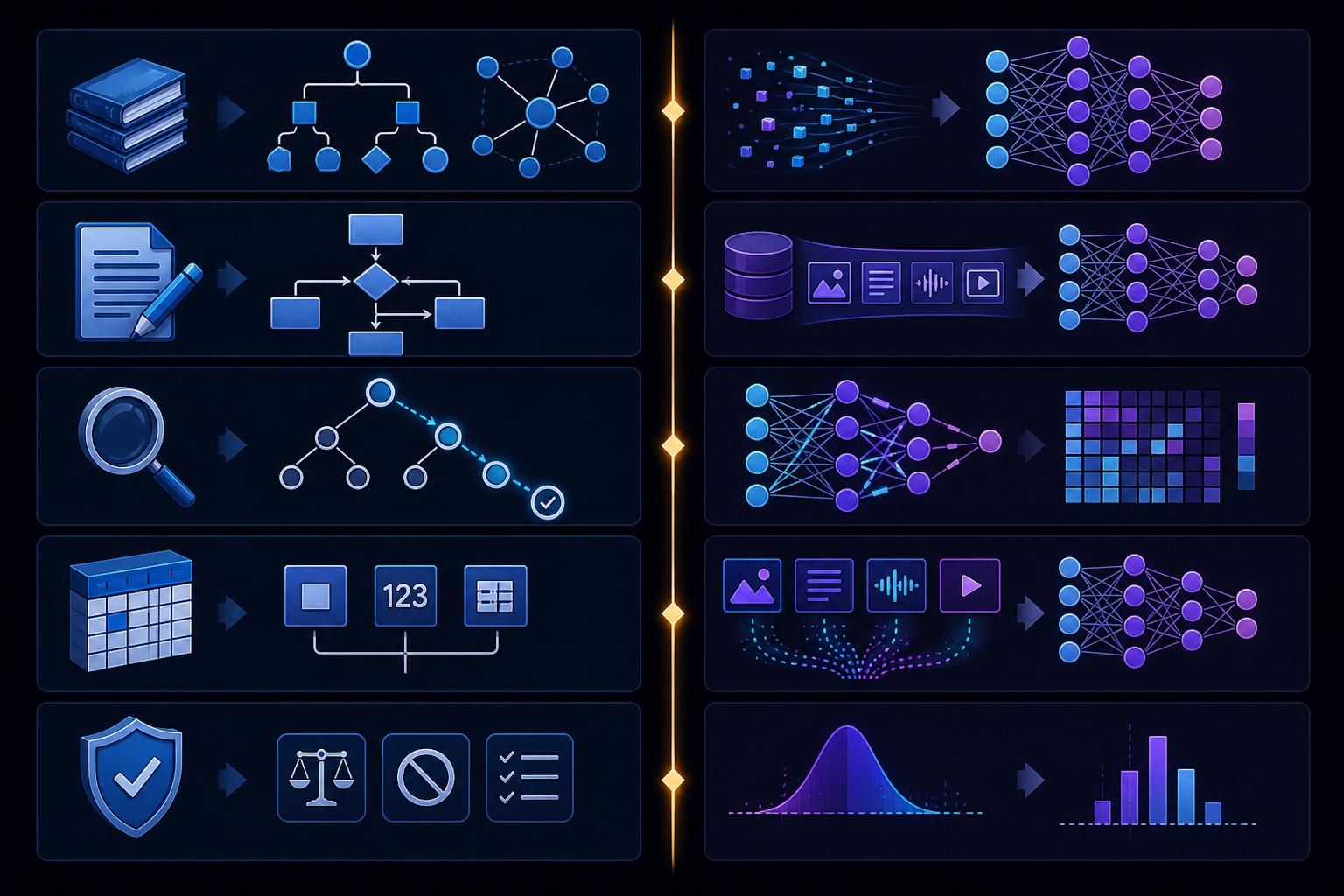
Symbolic AI represents knowledge explicitly through symbols, rules, logic, and structured relationships. Instead of storing all knowledge in learned weights, a symbolic system may use human-authored rules, formal constraints, a knowledge graph, or an inference engine.
Examples include rule-based expert systems, logic and inference engines, planning systems, constraint solvers, and business rules. Knowledge graphs provide structured representations that can support symbolic reasoning, but they can also be used with neural methods; a graph alone is not a complete symbolic AI system. A simplified rule might state: if condition A and condition B are true, then conclusion C follows.
Because the rules and structures are explicit, a symbolic system can provide a traceable reasoning path. That does not make every symbolic system automatically simple or interpretable: large rule bases may conflict, interact in complex ways, or become difficult to maintain.
What Are Neural Networks?
Neural networks learn numerical patterns and representations from data. During training, an optimization process adjusts model parameters to reduce a loss function. The resulting knowledge is distributed across learned weights rather than expressed as a short list of human-readable rules.
Neural networks are especially useful for high-dimensional or unstructured inputs such as images, audio, and language. Their performance depends on the task, architecture, training data, evaluation process, and deployment conditions—not merely on network size.
Some neural models require very large datasets, while others use transfer learning, pretraining, augmentation, simulation, or smaller task-specific datasets. Neural networks also vary widely in how interpretable their behavior is.
Symbolic AI vs Neural Networks: Key Differences
| Dimension | Symbolic AI | Neural networks |
|---|---|---|
| Knowledge | Explicit rules, symbols, and structures | Learned distributed representations |
| Learning | Often human-authored or logic-driven, though symbolic learning methods also exist | Usually trained from data by adjusting model parameters |
| Interpretability | Can be high when rules and reasoning paths remain manageable | Often harder to inspect directly, especially in large deep models |
| Unstructured data | Usually requires a structured representation or preprocessing | Often well suited to images, audio, language, and other complex inputs |
| Explicit constraints | Can enforce hard rules directly | Constraints require architecture, training, validation, or external controls |
| Adaptation | Rules or knowledge structures are updated explicitly | Training or fine-tuning updates model parameters. Prompting and connected tools can change outputs or application behavior without updating those parameters. |
Strengths and Limitations
When symbolic AI is useful
- Rules and constraints must be explicit.
- Domain knowledge is stable and well defined.
- Traceable reasoning paths are required.
- Deterministic validation or authorization is important.
- Limited training data is available but reliable expert knowledge exists.
The main challenge is knowledge engineering. Manually encoding and maintaining every relevant rule can become difficult in complex, ambiguous, or rapidly changing environments. Symbolic systems may also struggle with raw text, images, and audio until those inputs are converted into structured representations.
When neural networks are useful
- Patterns are difficult to specify manually.
- Inputs are high-dimensional or unstructured.
- Flexible representation learning matters.
- The system must generalize from examples.
- Training data and an appropriate evaluation process are available.
Limitations include dependence on data and evaluation quality, training and inference costs, sensitivity to distribution shifts, and difficulty explaining some individual outputs. Neural systems may produce confident errors, so explicit validation and human oversight remain important in consequential settings.
Hybrid and Neuro-Symbolic AI
Symbolic and neural approaches do not have to compete. A hybrid system might use a neural model to interpret language, images, or audio and then apply explicit rules, constraints, retrieval, planning, or knowledge-graph reasoning downstream.
Neuro-symbolic AI is a broad research area exploring tighter integration between learned neural representations and symbolic reasoning or structured knowledge. It is not one standardized architecture. Different systems combine these components in different ways. Combining them does not automatically guarantee reliability or explainability; the complete system still needs task-specific evaluation and validation.
Large language models are primarily neural, but applications built around them can include symbolic components such as structured retrieval, knowledge graphs, rule-based authorization, deterministic calculators, validators, planning systems, and workflow constraints. The model layer may be neural while the wider application depends heavily on explicit rules.
Which Approach Is Better?
Neither approach is universally better. Symbolic methods may be preferable when rules, constraints, or traceability dominate. Neural methods may be preferable when success depends on recognizing complex patterns in data. Hybrid systems are useful when an application needs both flexible perception and explicit control.
The practical decision should begin with the task: what inputs are available, which errors matter, what must be explained, which constraints are non-negotiable, and how performance will be evaluated. A system can use multiple approaches at different stages.
Frequently Asked Questions
Is symbolic AI obsolete?
No. Rule systems, knowledge graphs, planning, search, constraint methods, and deterministic business logic remain useful. Their role depends on the problem rather than on whether the technique is old or new.
Are neural networks always less interpretable?
No. Interpretability varies by model, task, explanation method, and audience. Large neural models are generally harder to inspect directly than small explicit rule systems, but symbolic systems can also become difficult to understand at scale.
Can a large language model use symbolic AI?
Yes. An LLM-based application can query a knowledge graph, call deterministic tools, apply explicit rules, use formal validators, or operate inside a constrained workflow.
What is a simple hybrid-AI example?
A neural vision model might detect objects in an image, while a rule engine checks whether the detected combination violates a safety constraint. The neural component handles perception; the symbolic component applies explicit logic.
Sources and Further Reading
- IBM Research — Imprecise Probabilistic Logic: background on combining formal reasoning with data-driven learning.
- IBM Research — Deep Learning Meets Symbolic AI: complementary strengths of learned and symbolic representations.
- IBM Research — Neuro-Vector-Symbolic Architecture: an example of active research combining neural learning and symbolic computation.
- Hogan and colleagues — Knowledge Graphs: graph-based representations and their use with deductive and inductive techniques.
- Brown and colleagues — Language Models are Few-Shot Learners: an example of adapting a model’s outputs through text context without gradient updates or fine-tuning.
Where to Learn Next
Next lesson: Continue to Neural Networks Explained to learn how neural architectures work. For related background, see Artificial Intelligence Explained for the broader field and Knowledge Representation and Engineering for symbolic structures. Cognitive AI Explained provides the wider cognitive-systems context.