
What Is Artificial Intelligence?
Artificial Intelligence (AI) refers to machines or software systems that can perform tasks that typically require human intelligence. These tasks include learning from data, understanding language, recognizing images, solving problems, and making decisions.
If you’re new to the topic, start with Artificial Intelligence Explained to understand the big picture before diving deeper.
At its core, AI is about teaching machines to think, learn, and adapt.
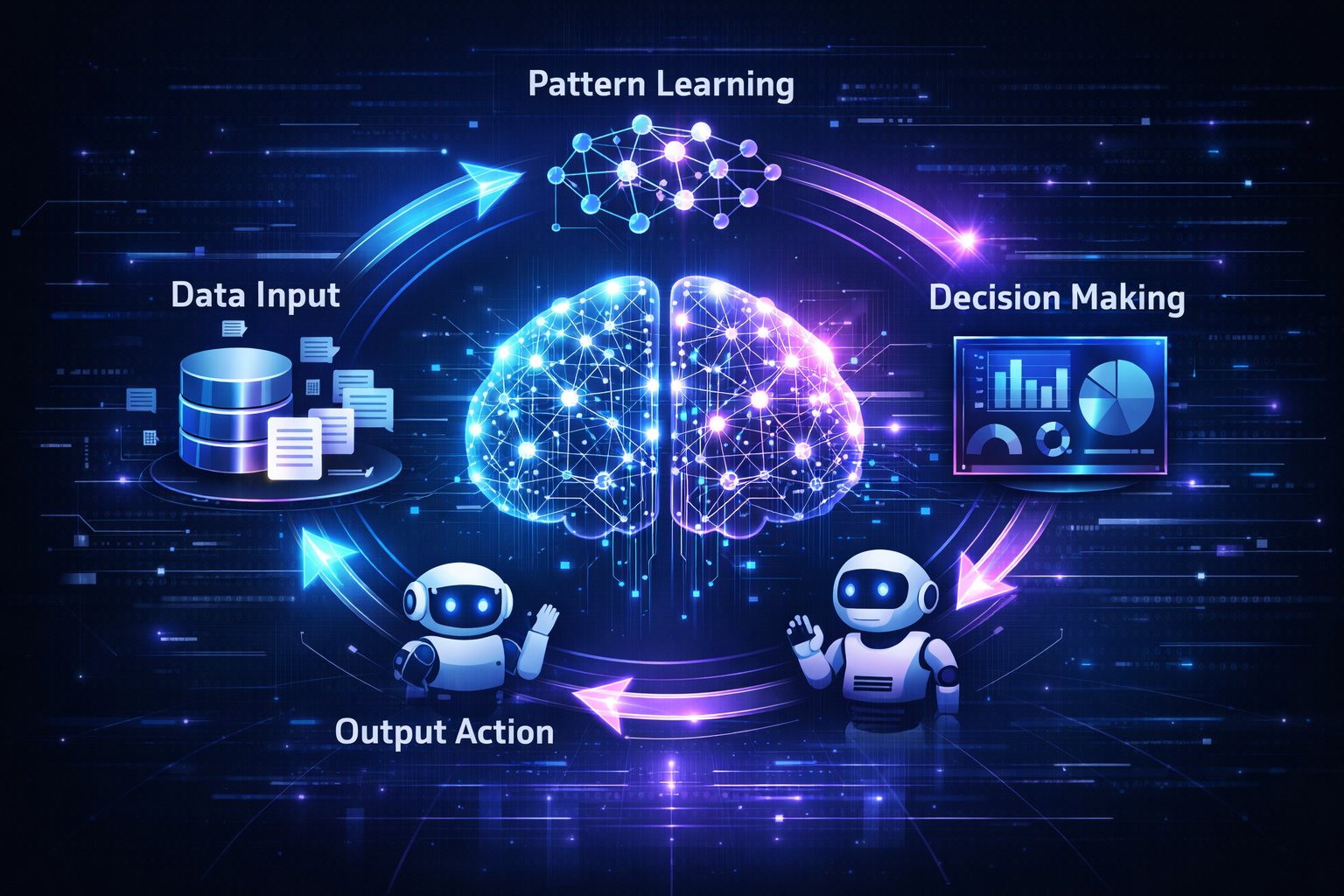
Artificial Intelligence (AI) works by using data, algorithms, and computational models to recognize patterns, learn from experience, and make decisions or predictions—similar to how humans learn, but at a much larger scale and speed.
Simple Example
Think about Netflix recommending movies:
- It observes what you watch
- It learns your preferences
- It predicts what you’ll like next
That entire process is AI in action.
How Artificial Intelligence Works (Step-by-Step)
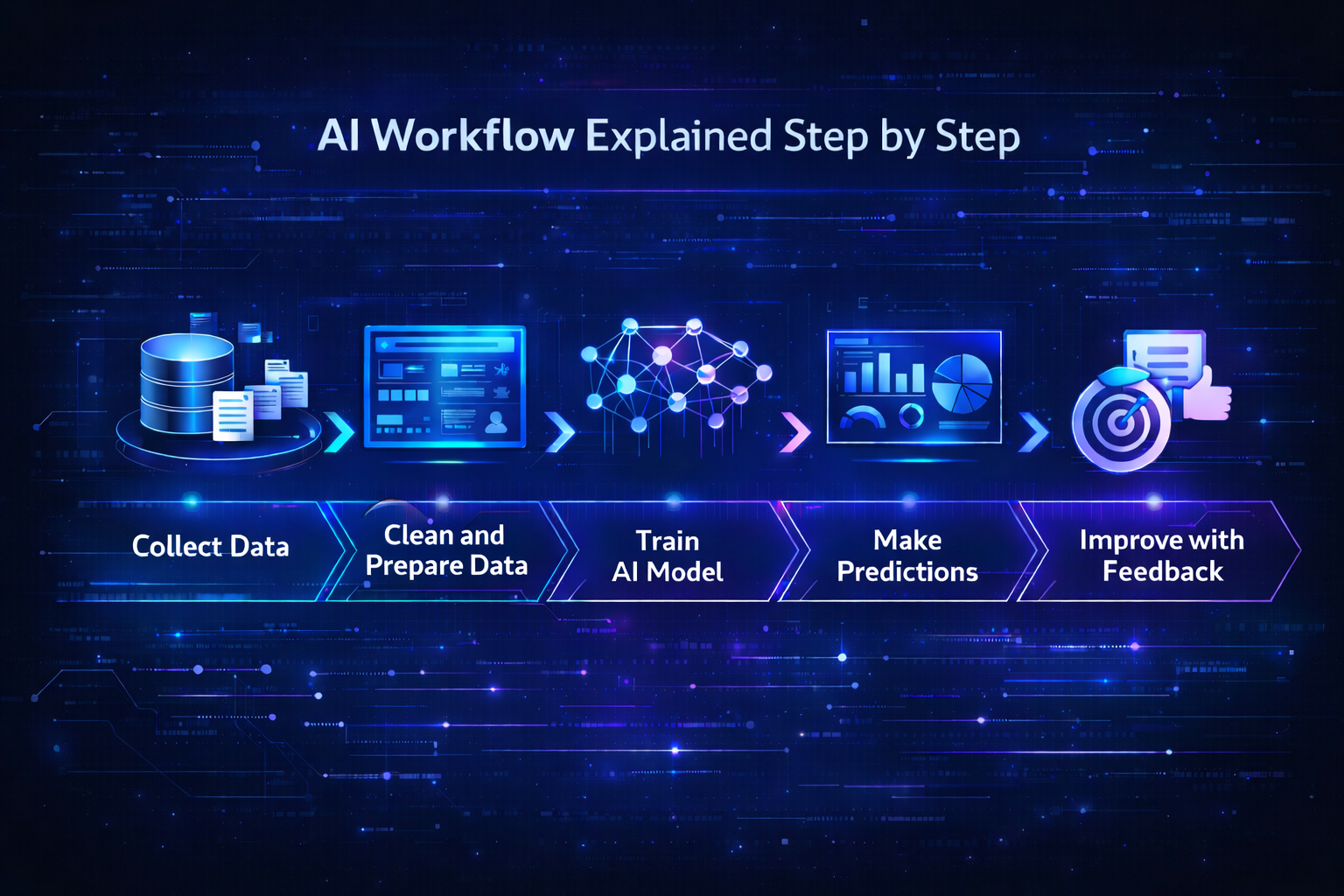
AI may sound complex, but it follows a clear and logical process. Let’s break it down into simple steps.
Step 1 – Data Collection
AI systems need data to learn.
This data can be:
- Images (for computer vision)
- Text (for chatbots and language models)
- Numbers (for predictions and analytics)
- Audio (for voice assistants)
Example:
A spam filter learns by analyzing thousands of emails labeled as “spam” or “not spam.”
Step 2 – Data Processing
Raw data is messy. AI systems must clean and organize it before learning.
This step includes:
- Removing errors or duplicates
- Formatting data into usable structures
- Converting text or images into numerical values
This process is often called data preprocessing.
Step 3 – Choosing an Algorithm
An algorithm is a set of instructions that tells the AI how to learn.
Common types include:
- Classification algorithms (yes/no decisions)
- Regression algorithms (predicting numbers)
- Clustering algorithms (grouping similar data)
You’ll explore these deeper in Machine Learning Explained.
Step 4 – Training the Model
This is where learning happens.
The AI model:
- Looks at the data
- Finds patterns
- Adjusts itself to improve accuracy
This process is called training.
Example:
A facial recognition system learns by analyzing thousands of labeled face images.
Step 5 – Testing and Evaluation
After training, the model is tested on new data to see how well it performs.
This helps answer:
- Is it accurate?
- Does it make mistakes?
- Can it generalize to new situations?
Step 6 – Making Predictions or Decisions
Once trained, the AI system can:
- Predict outcomes (e.g., weather forecasts)
- Classify data (e.g., spam detection)
- Recommend content (e.g., YouTube videos)
Step 7 – Continuous Learning
Many AI systems improve over time by learning from new data.
This is especially true in:
- Recommendation systems
- Self-driving cars
- Chatbots
Key Concepts Beginners Must Understand
To truly understand how AI works, you need to know a few core concepts.
1. Machine Learning (ML)
Machine learning is a subset of AI that enables systems to learn from data without being explicitly programmed.
👉 Read: Machine Learning Explained
2. Deep Learning
Deep learning uses neural networks to process large and complex datasets.
👉 Read: Deep Learning Explained
3. Neural Networks
Neural networks are systems inspired by the human brain that process information through layers.
👉 Read: Neural Networks Explained
4. Training Data vs Testing Data
- Training data teaches the model
- Testing data evaluates performance
5. Features and Labels
- Features = input data (e.g., size, color)
- Labels = correct output (e.g., cat, dog)
Types of AI Systems (How They Learn)
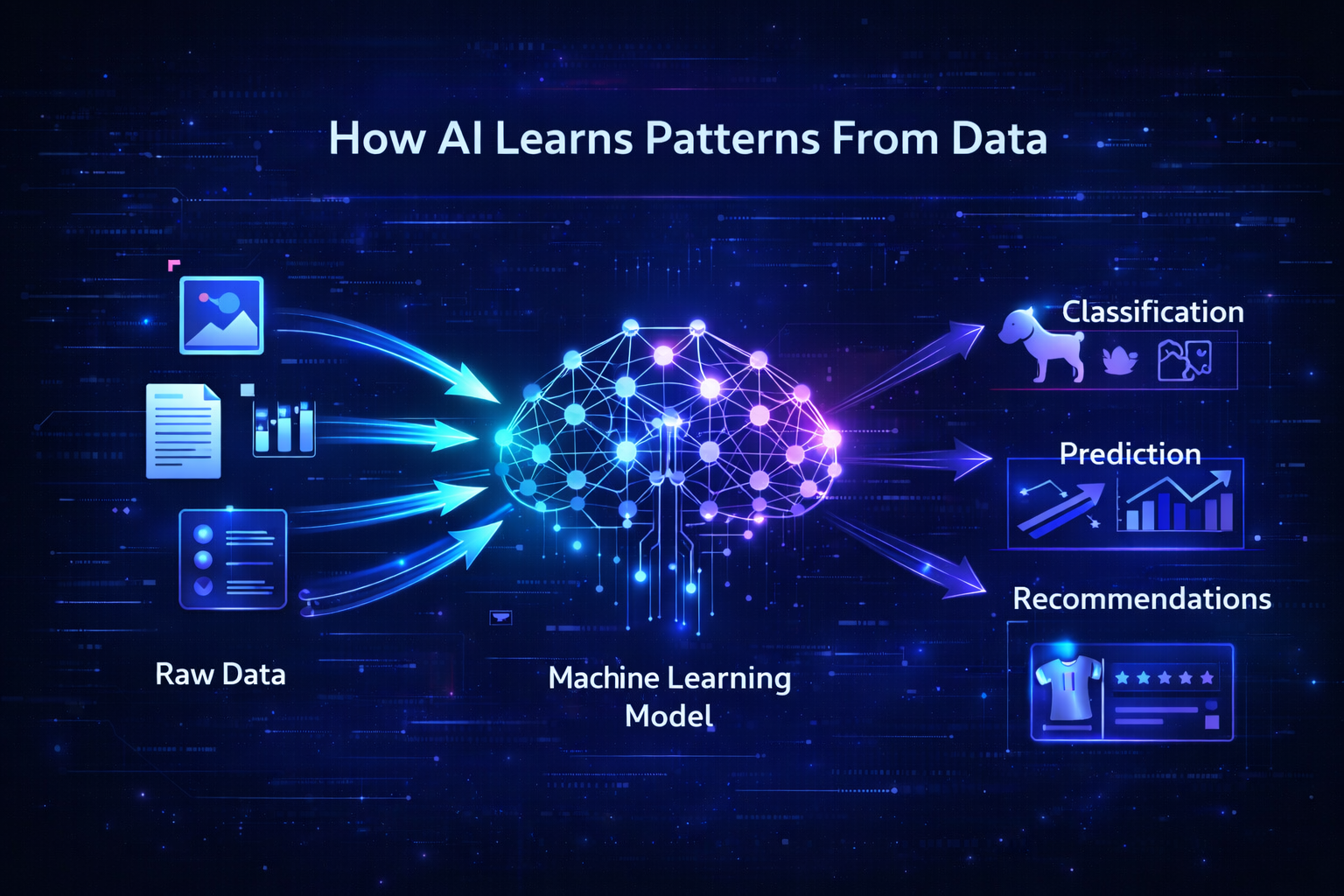
AI systems learn in different ways depending on the type of machine learning used.
Supervised Learning
- Learns from labeled data
- Example: Email spam detection
👉 Read: Supervised Learning Explained
Unsupervised Learning
- Finds patterns without labels
- Example: Customer segmentation
👉 Read: Unsupervised Learning Explained
Reinforcement Learning
- Learns through trial and error
- Example: AI playing video games
👉 Read: Reinforcement Learning Explained
Real-World Applications of AI
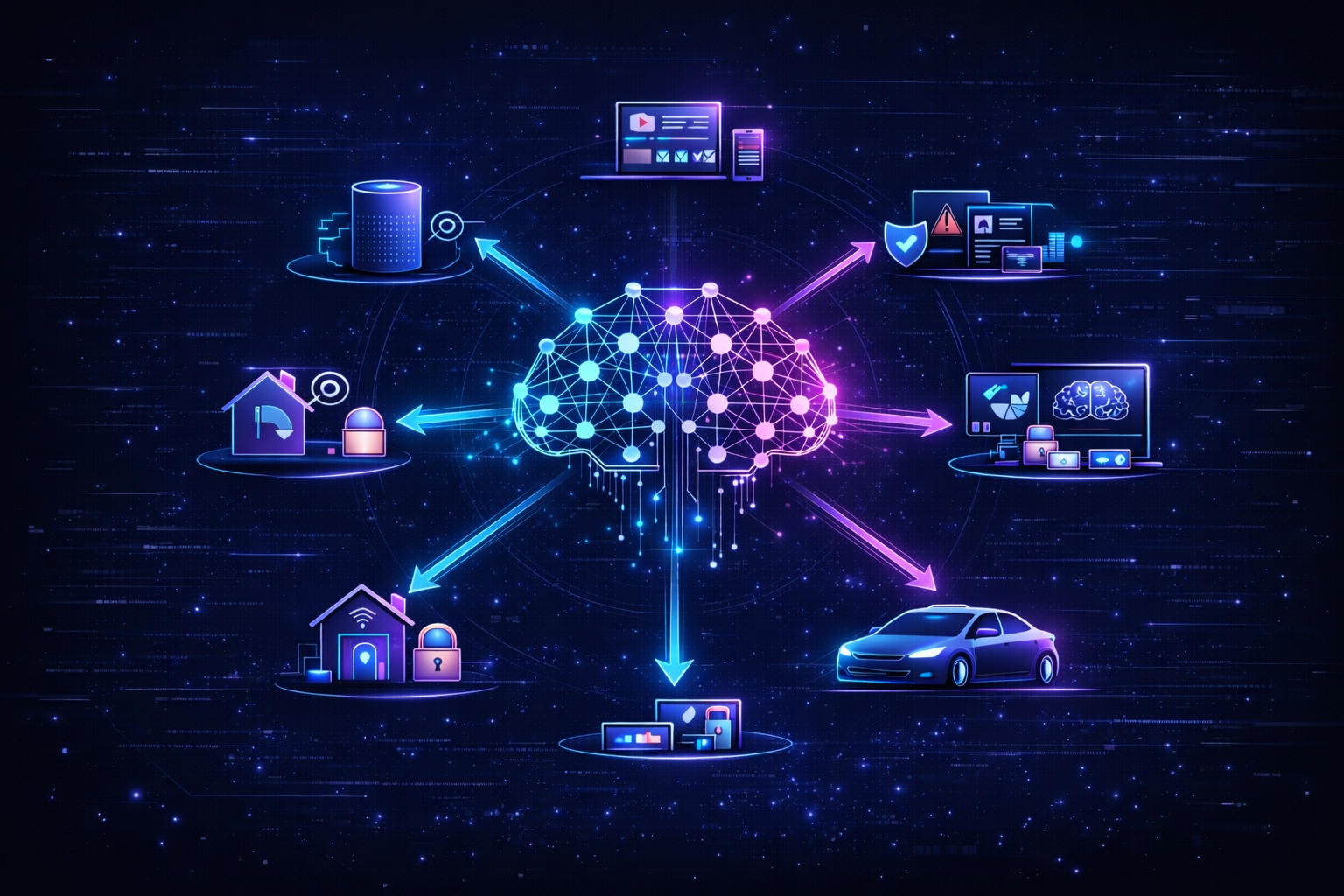
AI is everywhere in modern life. Here are some common examples:
1. Recommendation Systems
- Netflix, YouTube, Spotify
- Suggest content based on behavior
2. Voice Assistants
- Siri, Alexa, Google Assistant
- Understand and respond to speech
3. Self-Driving Cars
- Use sensors and AI models to navigate roads
4. Healthcare
- Diagnose diseases from medical images
- Predict patient outcomes
5. Finance
- Detect fraud
- Automate trading decisions
Advantages of Artificial Intelligence
1. Speed and Efficiency
AI can process massive amounts of data quickly.
2. Automation
Reduces the need for repetitive manual work.
3. Accuracy
AI can outperform humans in tasks like image recognition.
4. Personalization
Delivers customized recommendations and experiences.
Limitations of Artificial Intelligence
1. Data Dependency
AI needs large amounts of high-quality data
2. Lack of Human Understanding
AI does not truly “think” or understand context like humans.
3. Bias in Data
If training data is biased, AI results will be biased.
4. High Cost
Developing and training AI systems can be expensive.
AI vs Machine Learning vs Deep Learning
| Concept | Description | Example |
| Artificial Intelligence | Broad field of intelligent systems | Chatbots |
| Machine Learning | AI that learns from data | Recommendation systems |
| Deep Learning | Advanced ML using neural networks | Image recognition |
👉 For a deeper breakdown, see:
Future of How Artificial Intelligence Works
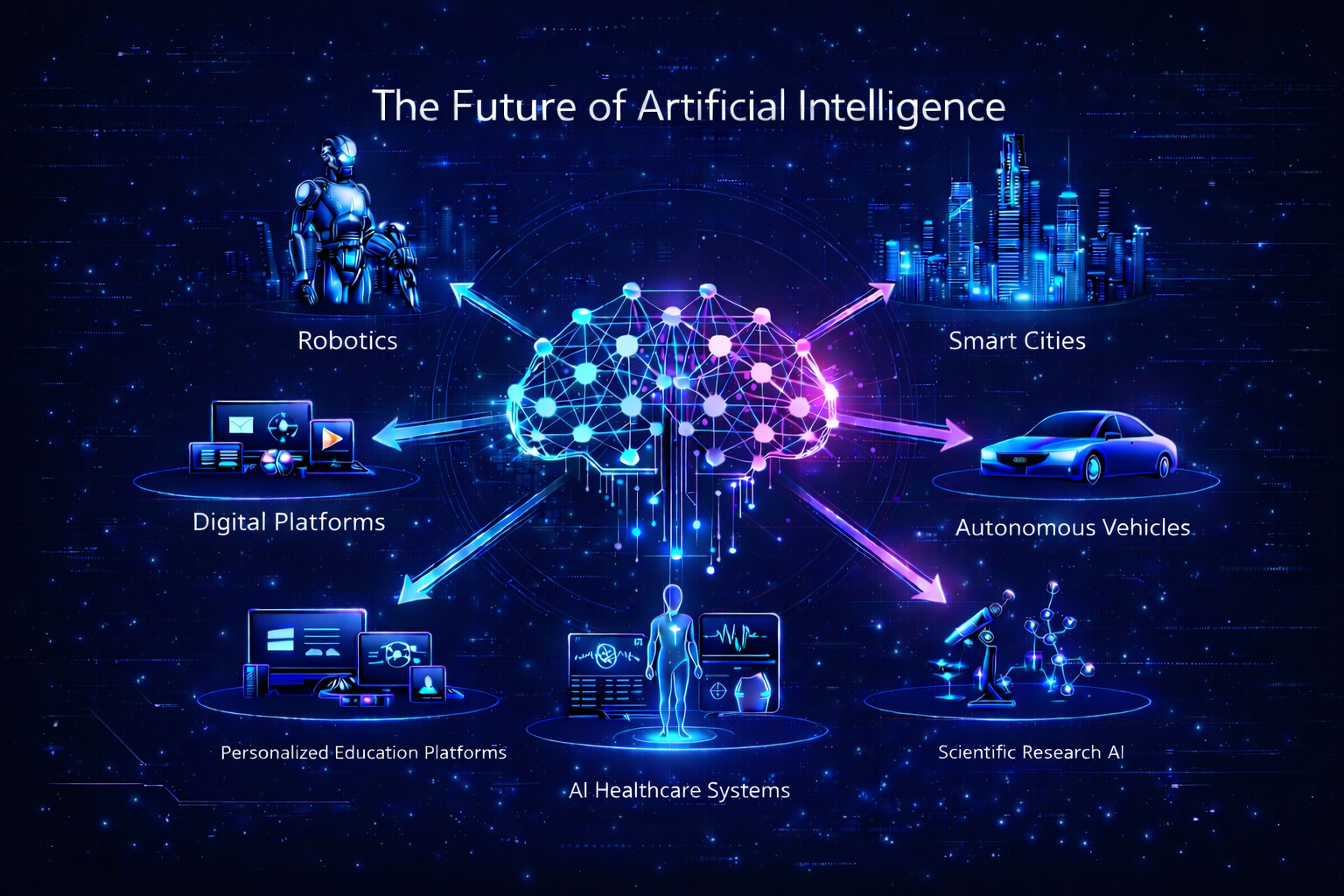
AI is evolving rapidly and becoming more powerful every year.
What’s Coming Next?
- More human-like AI assistants
- Fully autonomous vehicles
- AI-powered scientific discoveries
- Smarter personalization across industries
Future AI systems will likely:
- Learn faster
- Require less data
- Make more complex decisions
External Resources
For deeper learning, explore:
Frequently Asked Questions (FAQ)
1. How does AI actually learn?
AI learns by analyzing data, identifying patterns, and adjusting its model to improve accuracy over time.
2. Does AI think like humans?
No. AI simulates intelligence but does not have consciousness or true understanding.
3. What is the difference between AI and machine learning?
AI is the broad field, while machine learning is a method that allows AI to learn from data.
4. Why does AI need data?
Data is the foundation that allows AI to learn patterns and make predictions.
5. Can AI improve itself?
Yes, many systems improve through continuous learning and new data.
6. Is AI always accurate?
No. AI can make mistakes, especially if trained on poor or biased data.
7. What industries use AI the most?
Healthcare, finance, marketing, transportation, and technology.
8. Is AI hard to understand for beginners?
Not when broken down step-by-step like in this guide.
9. Do all AI systems use neural networks?
No. Some use simpler algorithms, while others use advanced neural networks.
10. What is the most important part of AI?
Data. Without data, AI cannot learn or function effectively.
Conclusion
Understanding how artificial intelligence works is the foundation for learning everything else in AI.
At a basic level, AI:
- Collects data
- Learns patterns
- Makes decisions
- Improves over time
Once you understand this process, the rest of AI becomes much easier to grasp.
Recommended Next Articles
To continue learning, explore: