
Artificial intelligence can help manufacturers inspect products, monitor equipment, forecast demand, support operators, and explore production decisions. But AI is not the same as factory automation, and it does not guarantee lower costs, fewer defects, safer work, or more sustainable operations.
This beginner-friendly guide explains where AI fits in manufacturing, what it can realistically do, and why industrial data, validation, cybersecurity, safety controls, and human judgment matter. Start with Artificial Intelligence Explained and Machine Learning Explained. This guide is part of the AI Applications learning path.
Last reviewed and updated: September 5, 2026.
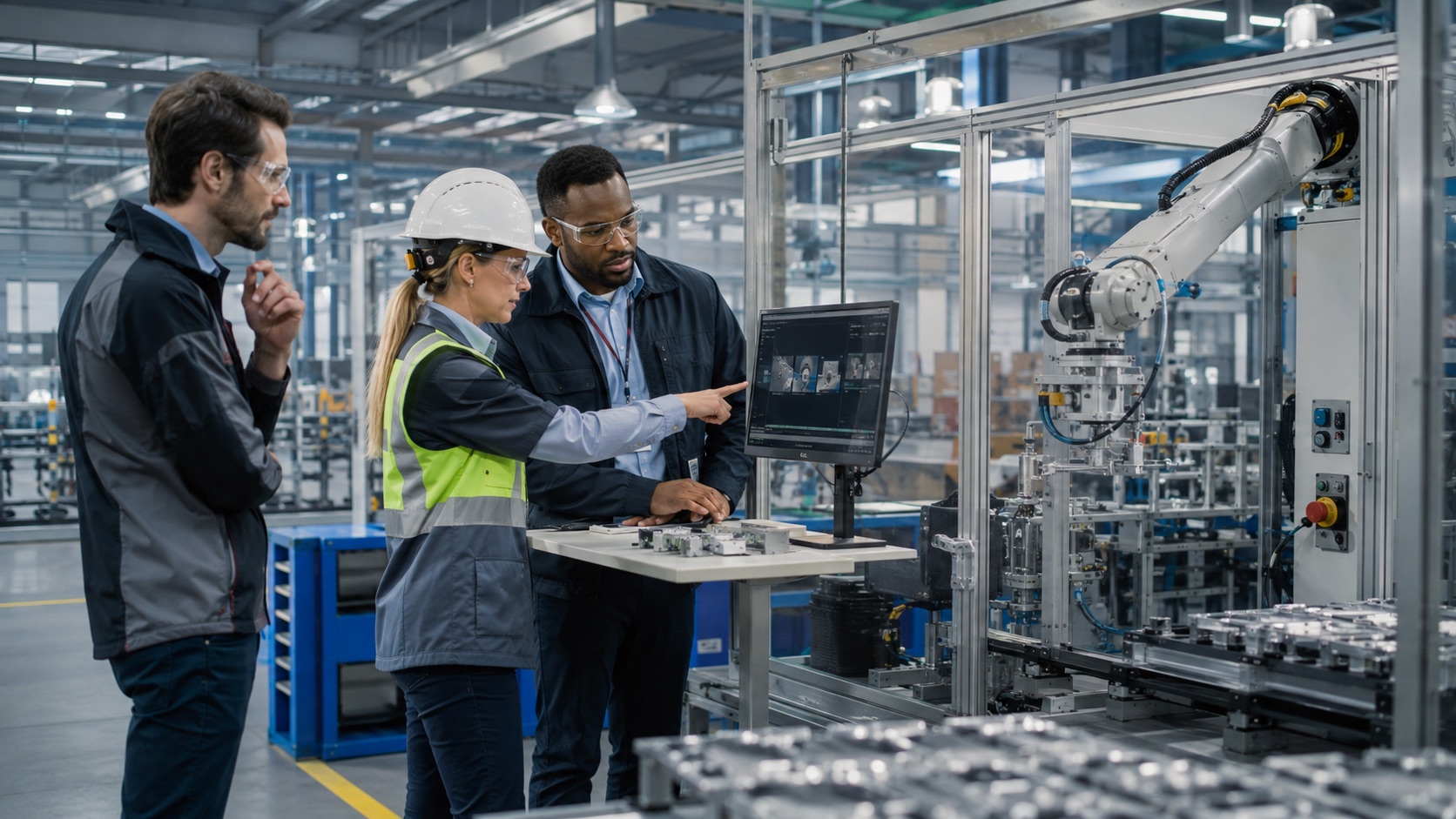
What Does AI in Manufacturing Mean?
AI in manufacturing means using computer systems for tasks such as perception, prediction, anomaly detection, language interaction, or decision support. A system might classify an image of a component, estimate whether a machine is degrading, retrieve a maintenance procedure, or recommend a production adjustment.
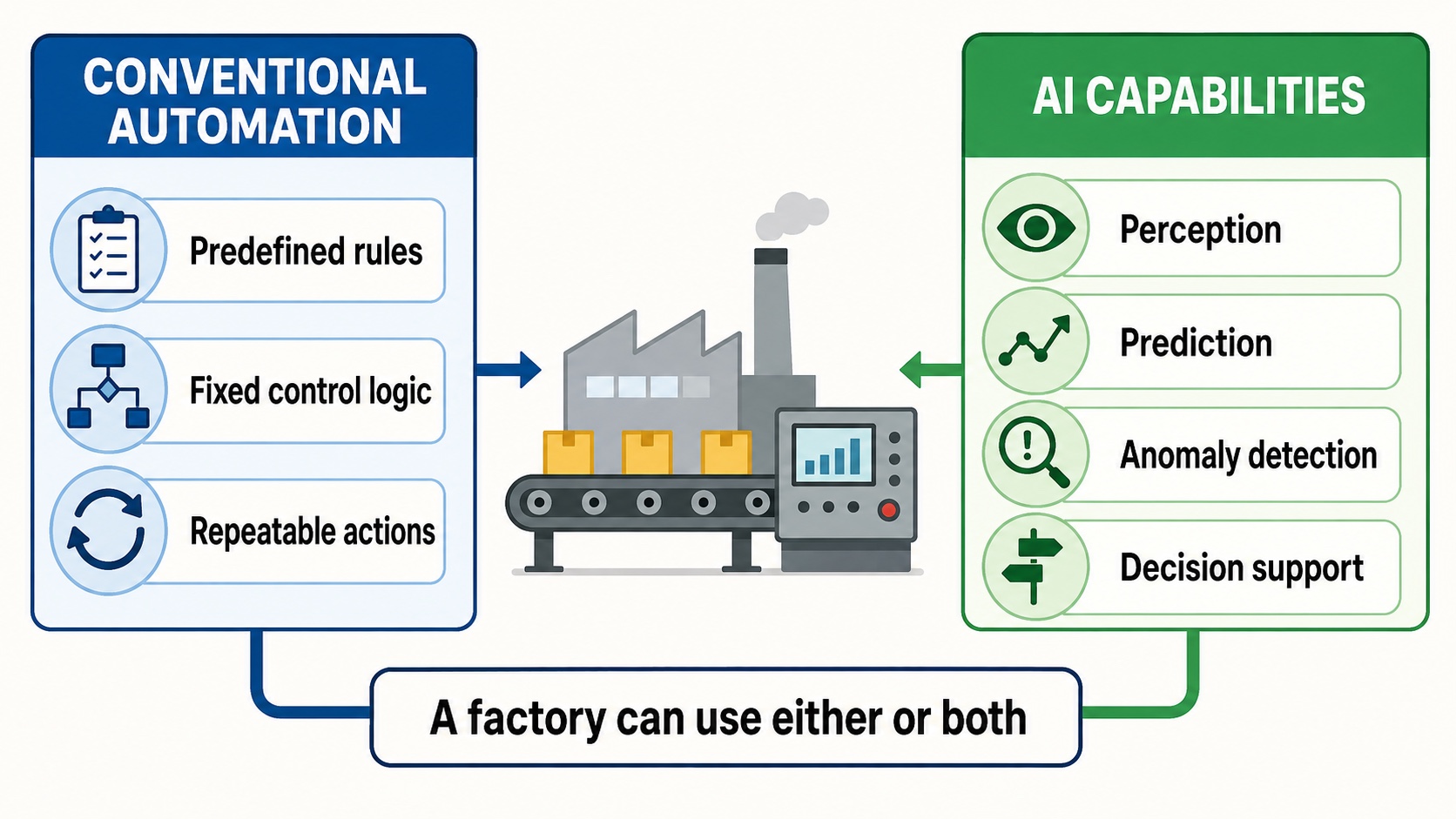
AI is not the same as automation
Factories have used automation for decades. Programmable logic controllers, fixed rules, statistical process control, mathematical optimization, simulation, and conventional robots can all operate without AI.
Automation follows predefined logic or procedures. AI can add perception, prediction, anomaly detection, language interaction, or adaptive decision support.
A manufacturing system may use automation without AI, AI without robotics, or both.
Potential Benefits of AI in Manufacturing
When a system is validated for its task and integrated into the workflow, potential benefits include:
- Inspection support: flagging possible defects or missing components for a defined review process.
- Maintenance planning: using condition information to help prioritize investigation and maintenance.
- Production decisions: improving demand estimates or helping people compare scheduling and material-flow options.
- Operator support: finding relevant manuals and records or reducing repetitive information-handling work.
Benefits are not guaranteed. Compare results with a baseline and include integration, errors, downtime, human review, maintenance, and computing costs when judging value.
Where AI Is Used in Manufacturing
Condition monitoring and predictive maintenance
Sensors can capture vibration, temperature, pressure, sound, and other indicators of equipment condition. Models may help find patterns that deserve investigation. Separate condition monitoring (what is happening now), diagnostics (what appears wrong), and prognostics (what failure or degradation might occur later).
A useful prediction depends on suitable sensors, representative operating data, examples of relevant failure modes, meaningful thresholds, and integration with maintenance decisions. Rare failures and changing conditions can weaken performance. The NIST program on prognostics and health management emphasizes verification and validation.
Computer-vision quality inspection
Manufacturers may use cameras and machine-learning models to detect surface defects, assembly errors, or missing components. Learn how the technology works in Computer Vision Explained.
Computer vision can automate or assist inspection when images, labels, equipment, and validation match the production environment. It can also produce false positives and false negatives, miss rare defects, or lose accuracy when lighting, cameras, materials, product variants, or processes change. A single accuracy percentage does not establish safety or usefulness.
Production planning and material flow
Scheduling involves machine availability, processing time, materials, worker skills, changeovers, commitments, and maintenance windows. AI may forecast inputs or detect changes; optimization, constraint programming, simulation, and conventional scheduling software may still determine the schedule. Models can also support estimates for supplier risk, inventory feeding a plant, and production demand. These are estimates, not guarantees.
Robotics and human-robot work
Some manufacturing robots use AI-based vision, perception, planning, or anomaly detection. Many rely mainly on conventional programming, estimation, optimization, and control. AI does not make every robot autonomous or adaptable.
Robots can reduce exposure to some hazardous, repetitive, or physically demanding tasks, but they also introduce hazards. OSHA notes that many robot accidents occur during programming, maintenance, testing, setup, or adjustment. Safe deployment requires application-specific risk assessment, engineered controls, protective measures, procedures, maintenance, training, and applicable standards. AI does not make a robot inherently safe.
A collaborative robot, or cobot, is not defined by AI; safety depends on the complete application and its controls. Continue to AI in Robotics, and consult OSHA’s robotics guidance.
Digital Twins in Manufacturing
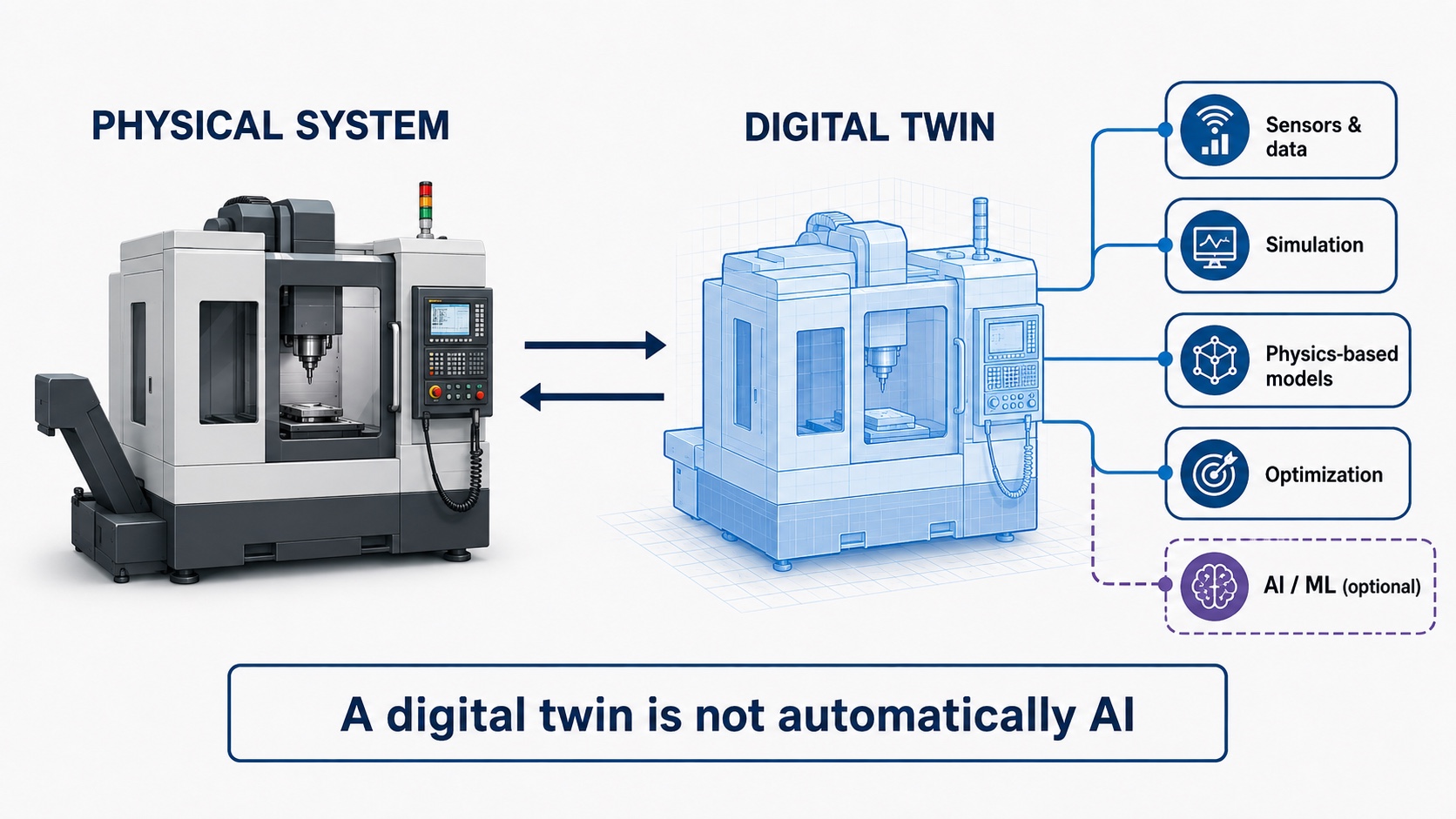
A manufacturing digital twin is a digital representation connected to a physical asset, process, or system for a defined purpose. It may support monitoring, diagnostics, prediction, optimization, maintenance planning, virtual commissioning, or production planning.
A digital twin is not automatically AI. It may combine sensor data, simulation, physics-based models, infrastructure, optimization, and AI. Its value depends on alignment with the real system and fitness for the intended decision. NIST’s digital-twin research for advanced manufacturing focuses on standards, interoperability, validation, and trustworthy use.
Generative AI and Foundation Models
Generative AI and large language models may help workers search manuals, retrieve maintenance history, summarize records, draft documentation, explore engineering information, or interact with scheduling and simulation tools. They can also produce fluent but incorrect answers, omit constraints, expose proprietary information, or lack a reliable source trail. Industrial copilots should retrieve from approved material, show sources, respect access controls, and keep trained people responsible for consequential decisions.
Key Risks and Limitations
- Data and changing conditions: rare failures, weak labels, new products, or different sensors can produce missed defects or false alarms.
- Integration and workflow fit: legacy equipment, latency, and poor escalation paths can make an otherwise useful model unsuitable.
- Safety and oversight: incorrect recommendations or actions can affect equipment and people; validation, safeguards, fallback, and trained review remain necessary.
- Security and confidentiality: connected OT, vendor access, and generative-AI tools can expose systems or proprietary information.
- Workforce and sustainability: task changes, worker surveillance, computing costs, and resource use need evaluation; benefits should not be assumed.
The sections below explain how these risks affect industrial data, reliability, cybersecurity, human-AI teaming, and responsible operation.
Industrial Data and Integration Challenges
- Sensors can be missing, noisy, poorly calibrated, or recorded in different formats.
- Important failures may be rare, leaving few representative examples.
- Legacy machines, controls, databases, and vendor tools may be difficult to connect safely.
- Operational technology directly controls physical processes where availability and safety are critical.
- Real-time outputs must arrive within the time available for action.
- Products, materials, tools, sensors, or conditions can cause model drift.
- A model creates little value if it does not fit the real workflow.
- Operators need usable evidence, escalation paths, and clear accountability.
NIST’s 2026 smart-manufacturing AI roadmap identifies industrial data, integration, explainability, reliability, and safety as central challenges.
Reliability, Validation, and Safe Operation
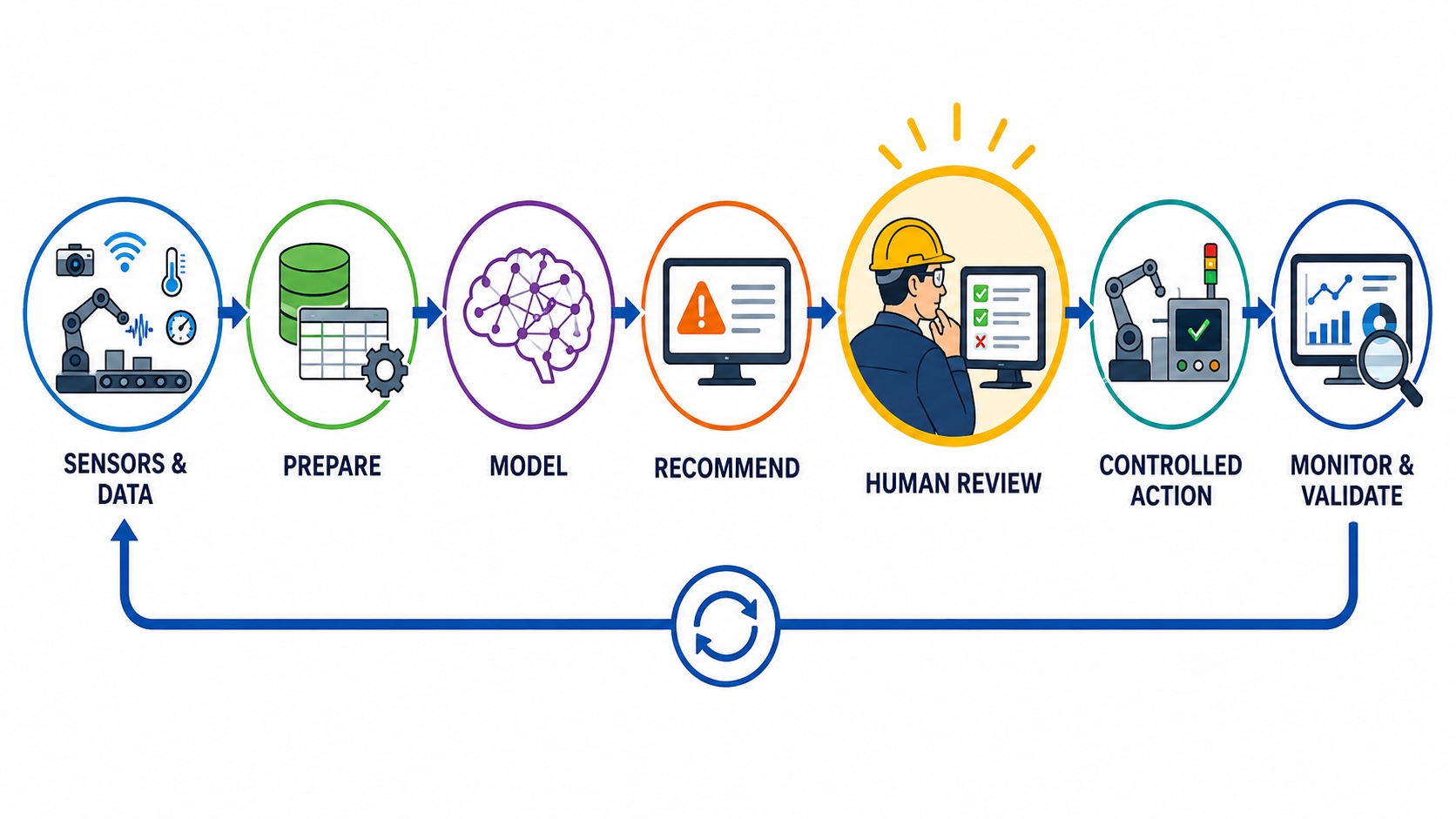
Test a manufacturing AI system for its intended task, equipment, products, users, and operating conditions—not only a laboratory benchmark. Define the consequences of wrong outputs; measure false positives and false negatives separately; include rare and changing conditions; establish when the system may act or must defer; monitor data and performance after deployment; and plan fallback, override, rollback, incident review, and retirement.
Reliability belongs to the whole system: sensors, models, software, controls, interfaces, procedures, operators, maintenance, and governance. A highly accurate model can still be unsuitable if its errors are hard to detect or its output arrives too late.
OT and Industrial-Control-System Cybersecurity
Information risks include exposure of designs, process knowledge, employee data, prompts, model outputs, or training data. Operational risks involve systems that monitor or control physical processes; compromise can affect production integrity, availability, equipment, recovery, and safety.
Connecting OT with IT, cloud services, remote access, AI platforms, or vendors can expand the attack surface. Manufacturers need asset visibility, appropriate network architecture, access controls, monitoring, secure updates, tested backups, incident response, and recovery plans. See NIST’s Cybersecurity Practice Guide for manufacturing control systems and AllForTheAI’s AI in Cybersecurity.
Human-AI Teaming and Workforce Effects
AI can change tasks, automate some activities, add monitoring or engineering responsibilities, and alter skill requirements. Effects vary by process, organization, role, and deployment strategy. It is too simplistic to assume AI removes every manual role or that every affected worker must become a machine-learning engineer.
Useful human-AI teaming gives people enough information and authority to check recommendations, handle exceptions, report unsafe behavior, and override the system. Training should match each job.
Ethics, Oversight, and Sustainability
Responsible manufacturing AI needs a defined purpose, fit-for-purpose evidence, clear accountability, human oversight, and monitoring. Concerns include inspection performance across product variants, worker surveillance, workload effects from scheduling, reliance outside a validated range, and incorrect generative-AI instructions.
AI may help identify energy patterns, reduce some scrap, or support optimization. These are possible outcomes, not automatic environmental benefits. Computing, sensors, equipment, and rebound effects consume resources too. Sustainability claims need a baseline, system boundary, time period, and measured outcome. Read AI Ethics.
Emerging Directions and Open Problems
Research directions include physics-informed AI, advanced digital twins, generative and semantic AI, explainable systems, industrial foundation models, and methods for reliability, availability, maintainability, and safety. These are directions under development—not promises of fully autonomous factories.
Open problems include combining physics and data-driven models, transferring systems between plants, validating rare safety-critical conditions, integrating heterogeneous equipment, measuring human-AI team performance, and keeping models reliable as production changes. Quantum computing remains experimental and is not a practical requirement for most manufacturing AI projects today.
A Practical Evaluation Checklist
- Name the exact problem.
- Check whether a rule, control change, statistical method, or optimization model is simpler.
- Define success and the consequences of errors.
- Inspect whether data is relevant, representative, permitted, and secure.
- Test realistic variation, rare events, conditions, and users.
- Define human review, exceptions, stop authority, and fallback.
- Plan security, monitoring, maintenance, incident response, and retirement.
Scenario-Based Self-Check
Scenario: A factory wants cameras to flag surface defects. A vendor reports high accuracy from a demonstration using different products and lighting. Should the factory deploy immediately, remove human review, or test representative products, defects, cameras, lighting, and production conditions while measuring both error types and defining review and fallback?
Best answer: test in the intended environment. This is a plausible use of computer vision, but evidence from another environment does not establish fitness for this production line.
Frequently Asked Questions
What is the difference between AI and automation?
Automation follows predefined procedures or control logic. AI can add perception, prediction, anomaly detection, language processing, or adaptive decision support.
Can AI guarantee fewer defects or less downtime?
No. Results depend on the problem, data, equipment, integration, validation, workflow, and monitoring.
Are digital twins always AI systems?
No. A digital twin may use sensors, simulation, physics-based models, infrastructure, optimization, AI, or a combination.
Does AI make industrial robots safe?
No. Safety depends on the complete application, risk assessment, engineered controls, procedures, training, maintenance, and applicable standards.
The Bottom Line
AI can be useful in manufacturing when it solves a defined problem and is supported by representative data, sound integration, realistic validation, cybersecurity, safe procedures, and accountable people. Its role is usually to strengthen a larger manufacturing system—not replace every rule, control method, robot, engineer, operator, or safety process.
Authoritative Sources
- NIST: 2026 Roadmap on AI and Machine Learning for Smart Manufacturing
- NIST: Prognostics and Health Management
- NIST: Digital Twins for Advanced Manufacturing
- NIST SP 1800-10: Cybersecurity for Manufacturing
- OSHA: Robotics
- OSHA Technical Manual: Industrial Robot Safety
Continue Learning
Return to the Real-World Applications of AI parent hub to compare manufacturing with other industries. For related topics, explore:
- AI in Robotics for perception, planning, control, and human-robot work.
- Computer Vision Explained for the technology behind visual inspection.
- AI in Cybersecurity for security uses and limitations.
- AI Ethics for accountability, oversight, and responsible use.