
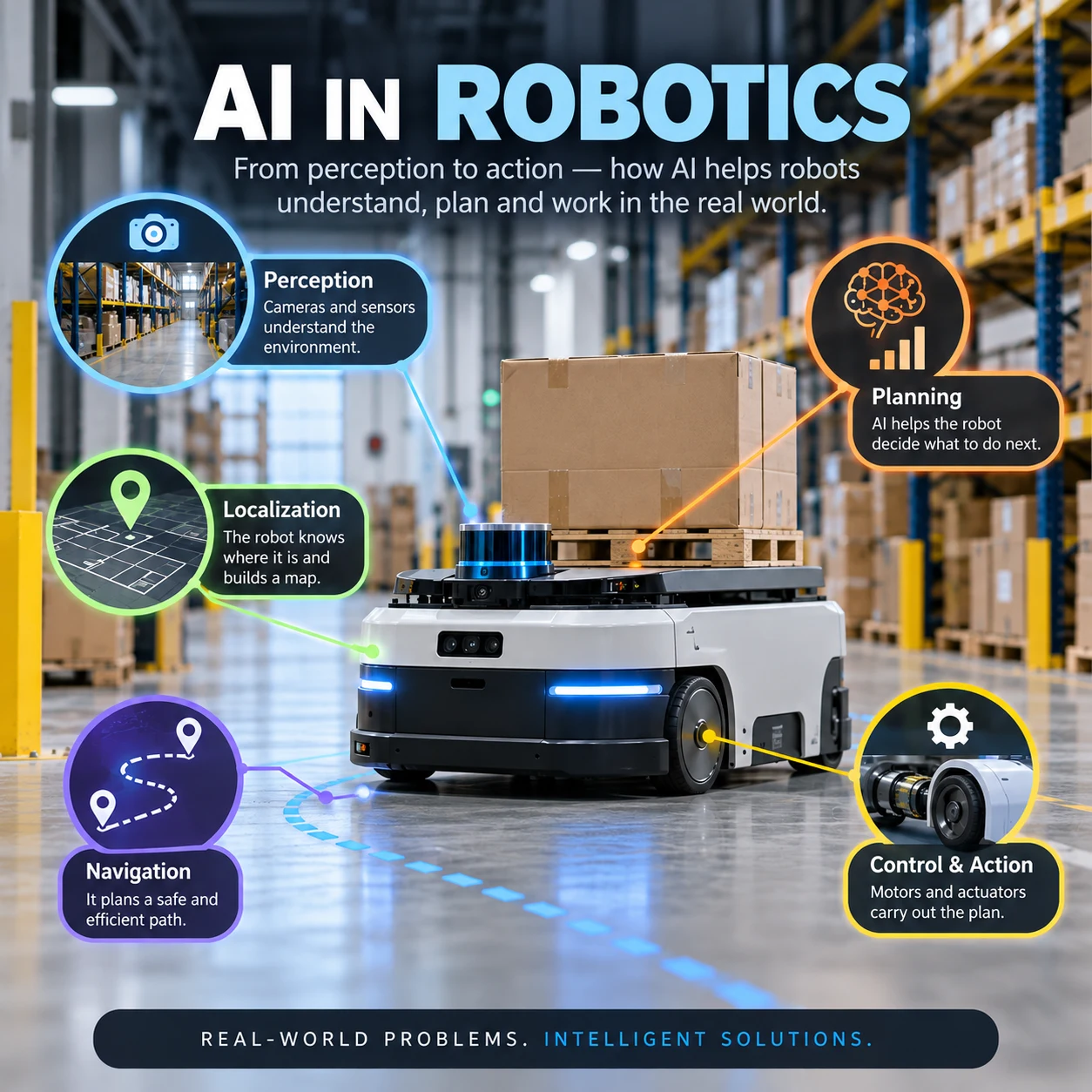
Robotics and artificial intelligence overlap, but they are not the same field. Robotics focuses on machines that sense and act in the physical world. Simulation is often used to design, train, test, and evaluate robotic systems before or alongside real-world deployment. AI can give some robots more flexible perception, planning, learning, or decision-making capabilities, but many robots operate mainly through conventional programming, estimation, optimization, and control. Understanding that distinction makes it easier to evaluate what an “AI-powered robot” can actually do—and what still depends on people, predefined rules, safety systems, and operating constraints.
Last reviewed: September 9, 2026.
What Is AI in Robotics?
AI in robotics means using artificial-intelligence techniques for particular parts of a robotic system. A warehouse robot might use computer vision to identify packages, a mobile robot might use learned perception alongside a conventional planner, and a research robot might use reinforcement learning for a carefully defined task. The phrase does not automatically mean a robot is intelligent in a human-like way, learns continuously, or can operate anywhere without supervision. Capability depends on the complete system: sensors, software, models, mechanical design, actuators, power, controls, interfaces, and the environment in which it was tested.
Where AI Fits in a Robotics Stack
A useful way to understand AI in robotics is to separate several layers. NIST describes robots as systems of systems that must perceive the world and their own state, plan and adapt actions, and execute those plans through actuation; AI algorithms and data can support any of those components rather than constituting the entire robot. See the NIST Measurement Science for Robotics and Autonomous Systems program.
Perception
Robots use cameras, lidar, radar, microphones, force sensors, encoders, and other inputs to estimate what is happening around them. AI can support perception tasks such as:
- Object detection and image classification.
- Pose and depth estimation.
- Speech recognition.
- Defect detection.
- Learned approaches to sensor fusion.
Sensor fusion combines measurements from multiple sensors. It does not inherently require AI: many systems use conventional or probabilistic estimation, such as Kalman filters. Learned components are one option within the wider sensing and estimation pipeline.
Perception models can fail when lighting, weather, objects, viewpoints, or environments differ from their training data. Safety-critical systems therefore need testing, uncertainty handling, redundancy, and fallback behavior. Read Computer Vision Explained and Machine Perception: A Beginner’s Guide.
Localization and state estimation
A robot needs to estimate where it is, how it is moving, and how its environment is changing. This may involve maps, GPS, inertial sensors, wheel odometry, visual odometry, probabilistic filters, or simultaneous localization and mapping. Some systems use learned components, but localization and state estimation do not inherently require machine learning.
Planning
Planning determines which sequence of actions can achieve a goal while respecting obstacles, time, energy, kinematics, and safety constraints. AI may contribute through search, learned policies, trajectory prediction, or model-based planning. Planning is different from control: deciding where to move is not the same as producing safe motor commands.
Control
Control converts a desired position, velocity, force, or trajectory into commands for motors and actuators. Classical feedback control remains central to robotics, including systems that also use computer vision, deep learning, or reinforcement learning. A reliable robot often combines learned components with conventional control and explicit safety limits.
Learning
Robots can use several learning methods:
- Supervised learning for tasks such as object classification or defect detection.
- Imitation learning to learn behavior from demonstrations.
- Reinforcement learning to optimize actions using rewards in simulation or controlled environments.
- Self-supervised learning to learn representations from unlabeled sensor data.
Learning is not automatically continuous or safe. Many deployed models are trained and validated before use, then updated through controlled engineering processes. Read Reinforcement Learning Explained.
AI Does Not Equal Autonomy
A robot can use AI without being fully autonomous, and an automated robot can operate without modern AI. Autonomy is not one simple property: it varies with the task, the difficulty of the environment, and the amount and type of human interaction required. A robot can therefore be highly autonomous for one narrow job in a structured environment while depending heavily on people in another setting. NIST’s work on autonomy measures likewise treats task complexity, environmental difficulty, and human interaction as separate dimensions. See NIST’s Autonomy Measures for Robots.
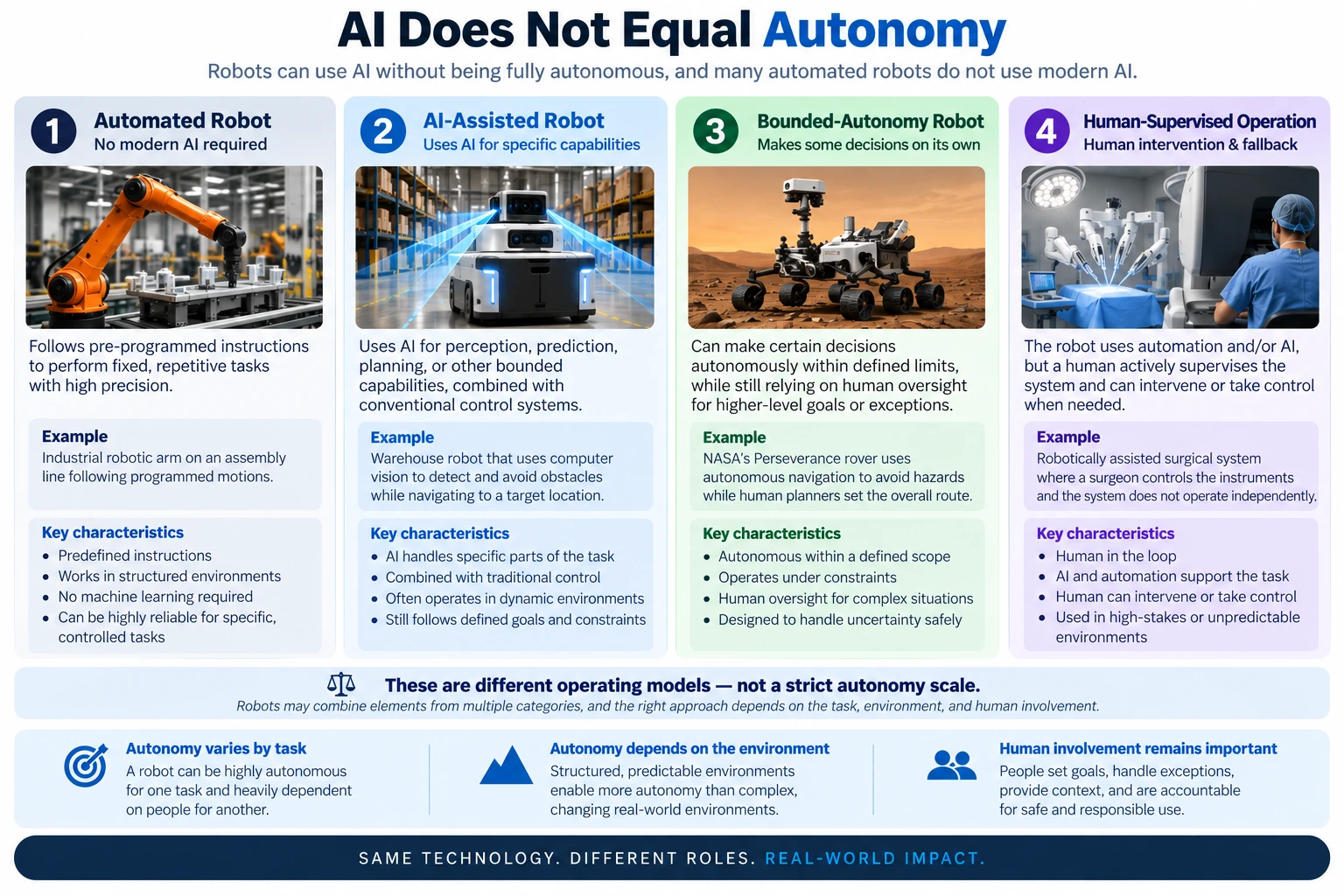
The four operating models in the graphic, in text:
- Automated robot: repeats a predefined task using programmed logic and control; it need not use AI.
- AI-assisted robot: uses AI for a particular capability, such as visual inspection, while the wider process remains constrained.
- Bounded-autonomy robot: makes some local decisions within a defined task and environment, with limits and fallback procedures.
- Human-supervised operation: people direct, monitor, approve, or intervene in the robot’s work. The amount of human control depends on the application.
These models can overlap. They are not a strict scale from less to more autonomous: an AI-assisted robot may also operate with bounded autonomy and human supervision.
A system may:
- Repeat a predefined task inside a guarded cell.
- Navigate a structured environment while being remotely monitored.
- Make local decisions but rely on people for goals and exceptions.
- Request human intervention when confidence is low.
- Operate independently only inside a specific operating domain.
Labels such as “AI-powered,” “autonomous,” and “intelligent” are not enough. The useful questions are what task the robot performs, where it can operate, what it can change, when people intervene, and how failures are handled.
Common Applications of AI in Robotics
Industrial and warehouse robots
AI can assist visual inspection, adaptive picking, grasp selection, anomaly detection, routing, and flexible task execution. These systems usually work within defined processes, physical layouts, safety zones, and performance limits. For the broader production context, see AI in Manufacturing.
Mobile robots and vehicles
Mobile robots can combine perception, localization, planning, and control to move through warehouses, hospitals, farms, mines, or public spaces. Performance depends heavily on the operating environment; success in a mapped warehouse does not imply reliable operation in every setting.
Healthcare and assistive robotics
Robotic systems can support rehabilitation, mobility, hospital logistics, surgical assistance, and other clinical tasks. High-stakes uses require appropriate evidence, training, oversight, maintenance, and regulation. Robotically assisted surgical devices do not independently perform surgery. The US Food and Drug Administration explains that these devices allow a surgeon to control instruments through computer and software technology and cannot perform surgery without direct human control. See the FDA guidance on computer-assisted surgical systems. For the broader field, read AI in Healthcare.
Agriculture and environmental work
Robots may help with crop scouting, targeted spraying, weeding, harvesting, ecosystem monitoring, or work in hazardous conditions. Their usefulness depends on terrain, weather, crop variation, sensing quality, and safe interaction with people and animals. See AI in Agriculture and AI in Environmental Science for the wider application context.
Space and remote exploration
Robotic systems are valuable where communication delays or dangerous conditions limit direct human control. NASA’s Perseverance rover uses AutoNav to handle local navigation and hazard avoidance, while human planners still choose general routes and scientific priorities. NASA describes this bounded-autonomy relationship in its overview of Perseverance’s autonomous systems. This is a useful example of bounded autonomy: the robot makes some local decisions inside a mission designed and supervised by people. For more examples, read AI in Space Exploration.
Research and embodied AI
Embodied-AI research studies how agents perceive, learn, reason, and act in physical or simulated environments. Current work includes multimodal perception, language-conditioned control, imitation learning, simulation-to-real transfer, and more general robot policies.
A robot policy maps observations to actions. A vision-language-action model can combine camera information and a language instruction to generate robot actions; Google DeepMind’s RT-2 research is one example. Learning this mapping does not remove the need for suitable sensors, conventional controllers, operating limits, or whole-system safety testing.
The International Federation of Robotics’ 2026 AI in Robotics overview discusses industry adoption and the growing use of simulation for physical AI. It provides an industry perspective rather than proof that a particular robot is safe or reliable. These systems remain an active research area. Impressive demonstrations do not necessarily establish reliability across new objects, environments, tasks, or safety conditions.
What Is ROS?
The Robot Operating System, or ROS, is not an AI model and is not a conventional operating system in the same sense as Linux or Windows. Official ROS documentation describes it as a set of software libraries and tools for building robotic applications. See the official ROS documentation. ROS can help developers connect sensors, algorithms, planning components, controllers, visualizations, and hardware interfaces. A ROS-based robot may use AI, but ROS itself does not make a robot intelligent or autonomous.
Safety and Reliability Challenges
A software error in a chatbot may produce bad text; a robotic failure can also create physical harm. Important robotics risks include:
- Collision and unsafe motion.
- Sensor failure or occlusion.
- Incorrect localization.
- Unpredictable environments.
- Mechanical wear and power loss.
- Cybersecurity compromise.
- Human misunderstanding of robot capability.
- Failure to reach a safe state.
Responsible deployment requires hazard analysis, testing in representative conditions, constrained authority, monitoring, maintenance, emergency stops or safe fallback behavior, and clear human responsibility. OSHA notes that industrial robot hazards can be especially serious during non-routine activities such as programming, maintenance, testing, setup, or adjustment, when people may enter a robot’s working envelope. See OSHA’s robotics hazard guidance. Cybersecurity is also part of physical-system safety because compromised software or communications can affect real-world behavior; see AI in Cybersecurity for the wider security context.
How to Evaluate an AI Robot
Before accepting a product claim or demonstration, ask:
- What exact task is automated? A narrow inspection task is different from general-purpose manipulation.
- Where was it tested? Structured factories, mapped warehouses, clinics, homes, and public spaces create different challenges.
- What does the AI component do? Identify whether it handles perception, prediction, planning, control, learning, or only the user interface.
- How is performance measured? Look for error rates, failure cases, safety metrics, and tests that match the intended environment.
- What happens when confidence is low? A reliable system needs fallback behavior and escalation paths.
- How much authority does it have? Understand what the robot can move, change, or access without approval.
- Who remains accountable? Deployment, supervision, maintenance, and incident response require named human responsibility.
Evaluate the whole robot, not only the AI model. A perception model can perform well on an object-detection benchmark while the complete robot still struggles because of latency, localization error, grasping failures, control limits, mechanical problems, or unexpected environmental conditions. AI-component metrics might include detection precision, recall, or prediction error; robot-level evaluation may also need task-success rate, intervention frequency, cycle time, recovery behavior, reliability across realistic conditions, and safety outcomes. NIST emphasizes that robotic-system performance is a composite of individual component performance and how well those components work together as an integrated system. See the NIST robotics measurement program.
Human-Robot Collaboration
Many useful robotic systems are designed to augment people rather than replace them. Robots may handle repetitive, hazardous, precise, or physically demanding work while people provide goals, context, exception handling, communication, and accountability. Good collaboration depends on predictable behavior, understandable signals, appropriate speed and force limits, accessible controls, training, and realistic expectations. Anthropomorphic appearance or fluent language should not be mistaken for broad competence.
Frequently Asked Questions
Do all robots use AI?
No. Many robots rely primarily on programmed logic, optimization, state estimation, and classical control.
Is AI the same as robotics?
No. AI includes computational methods for capabilities such as perception, prediction, planning, language, learning, and decision-making. Robotics focuses on machines that sense and act in the physical world. The fields overlap when AI techniques are used as components of robotic systems.
Is reinforcement learning required for robotics?
No. Robotics uses control theory, search, planning, optimization, supervised learning, imitation learning, reinforcement learning, and many other methods.
Are humanoid robots examples of artificial general intelligence?
No. A humanoid body does not imply general intelligence. Capability depends on the robot’s software, models, sensors, mechanics, controls, data, and operating constraints.
Can surgical robots operate independently?
Robotically assisted surgical systems in current clinical use are controlled by trained surgeons. They can assist with precise instrument movement but should not be described as independently performing surgery. See the FDA guidance on computer-assisted surgical systems.
The Bottom Line
AI can improve specific robotic capabilities, including perception, prediction, planning, and learning. It does not replace the broader robotics stack, guarantee autonomy, or remove the need for human oversight. The most useful question is not whether a robot “has AI.” It is what the system can reliably do, under which conditions, with what safeguards, and who remains responsible when reality differs from the plan.
Continue Learning
- Computer Vision Explained
- Machine Perception: A Beginner’s Guide
- Reinforcement Learning Explained
- AI Ethics: Key Ethical Considerations
- Real-World Applications of AI
Next: Continue with Computer Vision Explained to see how robots turn camera data into useful signals for perception and action.