
Artificial intelligence is increasingly used in sports to help turn video, tracking data, statistics and other information into estimates, classifications, summaries and decision-support tools. But not every piece of sports technology is AI, and an AI output is not automatically an objective or correct answer.
This guide explains where AI is genuinely used in sports today, how the technology fits into wider sports systems, what current evidence supports, and where important limits remain.
Last reviewed and updated: October 1, 2026.
What Is AI in Sports?
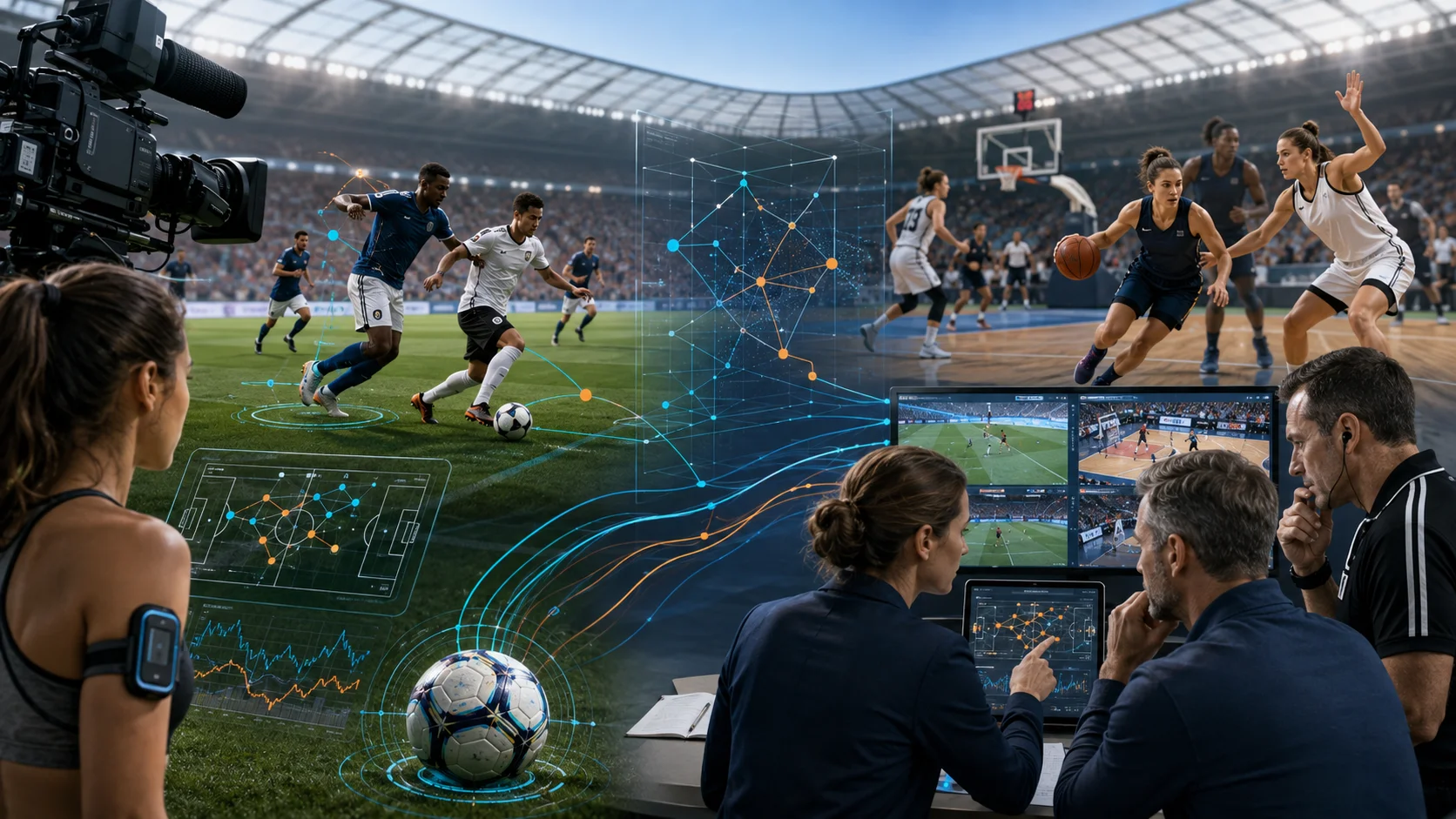
AI in sports means using artificial-intelligence methods—such as machine learning, computer vision and generative AI—inside sports workflows.
These systems may help analyze player movement, classify plays, estimate probabilities, summarize matches, support officiating technology or personalize digital content. The important word is support: in most high-stakes sports settings, people still decide how an AI output should be interpreted and used.
If you are new to the field, start with Artificial Intelligence Explained before going deeper into the sports examples below.
What Counts as AI—and What Does Not?
Sports technology often combines several components. A sensor, camera or virtual-reality headset is not automatically an AI system simply because it is digital or advanced.
| Technology | Typical role in sports | Is it automatically AI? |
|---|---|---|
| Sensors and wearables | Collect location, movement or physiological measurements | No |
| Optical or RFID tracking | Capture player, ball or object position over time | No; AI may be used later to interpret the data |
| Computer vision | Detect or track players, objects and actions in images or video | Yes, when AI/ML methods perform the visual analysis |
| Machine learning | Classify patterns, estimate probabilities or make predictions from data | Yes |
| Generative AI | Create or summarize text, images, audio or other content | Yes |
| VR and AR | Provide simulated or augmented experiences | No; they can include AI but do not have to |
This distinction matters because many sports systems are pipelines: one technology collects data, another processes it, an AI model estimates something from it, and a person decides what to do next.
How Sports AI Works
A simplified sports-AI workflow looks like this:
- Collect data. Cameras, tracking systems, event logs, statistics or wearables generate observations.
- Prepare and represent the data. The data may need cleaning, synchronization, labeling or transformation.
- Apply an AI model. A model might classify a route, detect a player, estimate a probability, rank content or generate a summary.
- Evaluate the output. Teams and developers need to test whether the model works reliably for the intended setting.
- Use human judgment. Coaches, analysts, clinicians, officials or editors decide how much weight the output deserves.
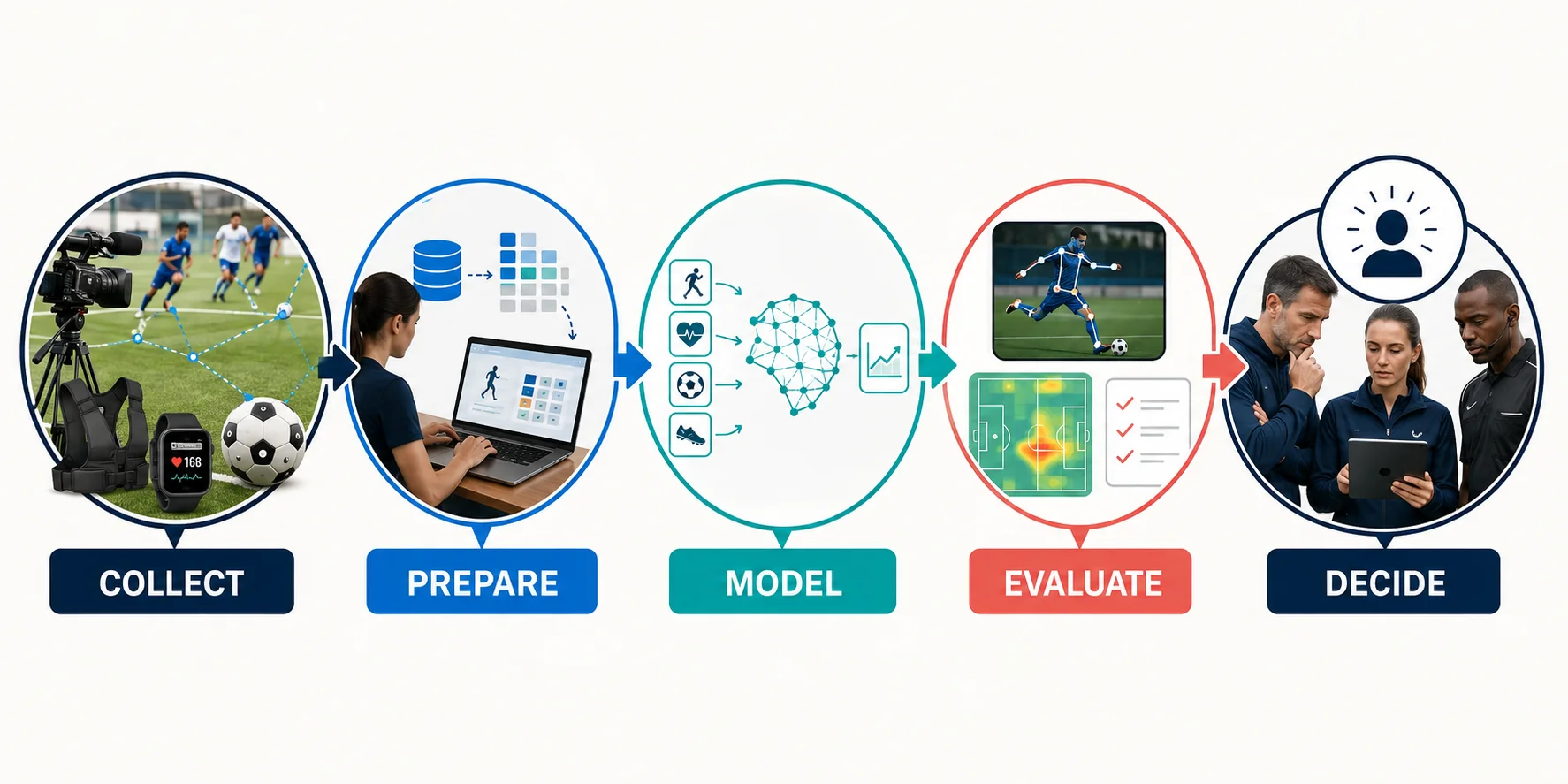
The same general idea appears across many real-world AI applications. See Real-World Applications of AI for the broader picture.
Performance Analysis and Player Tracking
Player and ball tracking is one of the clearest examples of modern sports data feeding AI systems. Tracking technology can record position, speed, direction and other measurements. Machine-learning systems can then derive higher-level classifications or estimates from those raw measurements.
The NFL’s Next Gen Stats system captures real-time player and ball tracking data using RFID technology. The NFL says the data is used to calculate performance metrics and derive advanced statistics with machine learning, including route detection, completion probability, expected rushing yards and win probability.
Basketball provides another example. The NBA has used Second Spectrum as its official optical-tracking provider. In an official NBA announcement about the technology, the league described Second Spectrum as using machine learning and computer vision to capture player and ball tracking data and derive statistics such as shot probabilities and defensive metrics.
These systems can reveal patterns that would be difficult to calculate manually, but they do not produce an objective definition of who is the “best” athlete. Metrics are designed measurements, and their usefulness depends on what is being measured, how accurately it is captured, and what decision the user is trying to make.
Coaching, Scouting and Strategy
AI can help teams search large amounts of match and tracking data for recurring patterns. Possible uses include opponent analysis, formation recognition, play classification, scouting support and pre-match preparation.
That does not mean every sport allows an AI assistant to direct coaches during live competition. Rules, available technology and competition policies vary.
FIFA AI Pro, introduced as Football AI Pro, provides a documented example. In its July 2026 post-tournament report, technology partner Lenovo reported that all 48 World Cup teams used the platform to query tournament data and match footage. Access to analysis does not establish that a team made better tactical decisions or gained a competitive advantage. FIFA states that the tool can be used for pre- and post-match analysis, not during live play. See FIFA’s 2026 Football AI announcement.
This is a better way to think about AI strategy tools: they can expand what analysts can inspect and compare, but the tactical decision still depends on rules, context and human judgment.
Injury-Risk and Athlete-Support Systems
Machine learning is being studied as a way to estimate sports-injury risk from variables such as training load, injury history, biomechanics and physiological measures. This is a promising research area, but the evidence does not support treating an AI score as a guaranteed injury forecast or medical diagnosis.
A 2026 systematic review and meta-analysis of machine-learning sports-injury prediction models found encouraging predictive performance overall, but also substantial methodological differences among studies and called for further validation. A separate 2026 systematic review of ACL-injury prediction models highlighted limited external validation, small samples in some studies, overfitting concerns and questions about generalizability.
You can review the evidence directly in PubMed: sports-injury prediction systematic review and meta-analysis and ACL injury-risk systematic review.
For beginners, the safest mental model is:
AI may help estimate risk from available data. It does not know whether a specific athlete will be injured, and it should not replace qualified medical judgment.
Because injury assessment crosses into health decisions, this topic also connects to AI in Healthcare.
AI-Assisted Officiating
Officiating is another area where AI can contribute measurements or reconstructions that support officials rather than simply replacing them.
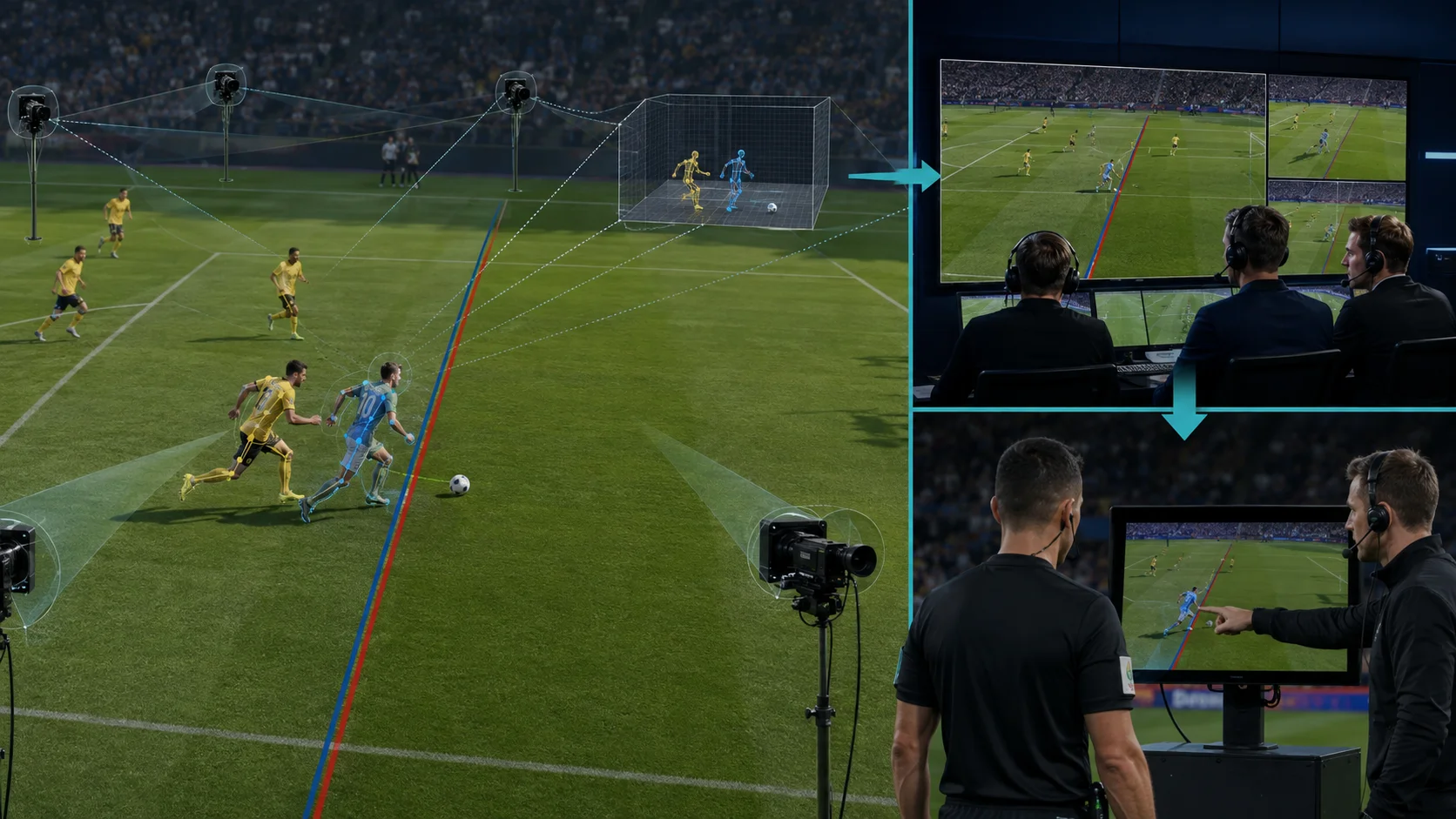
At the 2026 FIFA World Cup, AI-enabled 3D player avatars were used in semi-automated offside replays, according to Lenovo’s post-tournament report. FIFA’s technical explanation distinguishes automated alerts for clear positional offside from judgments such as interference with play, which still require officials. Tracking, visualization and rule interpretation are different parts of the process.
Lenovo also reports that Referee View used AI-powered stabilization for referee-camera footage during the tournament. This is a broadcast-processing use: making footage easier to watch does not give the system authority to decide whether a foul occurred.
This distinction is important. “AI in officiating” can refer to several different roles—measurement, tracking, visualization or decision support—and the sport’s rules determine what authority a system actually has.
Broadcasting and Fan Experiences
AI can also affect how sports content is created, organized and delivered. Common uses include:
- automated or assisted highlight selection;
- data-driven graphics and statistics;
- personalized content recommendations;
- match and player summaries;
- multilingual or accessibility-related content workflows;
- audience segmentation and digital personalization.
Wimbledon and IBM provide a concrete generative-AI example. In 2024 they launched “Catch Me Up,” a feature using IBM’s Granite large language model to generate personalized pre- and post-match player stories and daily summaries. IBM said the All England Club would monitor the generated content. Read the official IBM announcement.
Generative systems like this should not be confused with speech recognition. Speech recognition converts spoken language into text; generated commentary or summaries can involve natural-language generation, large language models and text-to-speech as separate components.
Personalization also creates trade-offs. More tailored content can require more behavioral data, and personalization systems can be inaccurate, repetitive or privacy-invasive. Dynamic pricing likewise may use predictive analytics, but it does not automatically produce the “best price” for a fan.
Real-World Examples of AI in Sports
| Organization | Verified use | What AI contributes |
|---|---|---|
| NFL Next Gen Stats | Player and ball tracking plus advanced statistics | ML-derived classifications and probability/expectation metrics from tracking data |
| NBA / Second Spectrum | Optical player and ball tracking | Machine learning and computer vision used to derive basketball tracking insights |
| FIFA | FIFA AI Pro (introduced as Football AI Pro), AI-enabled 3D avatars, stabilized referee-camera footage | Match-analysis assistance, player identification/tracking and video stabilization |
| Wimbledon / IBM | Catch Me Up personalized player stories | Generative AI creates monitored summaries from match data and editorial context |
| International Olympic Committee | Olympic AI Agenda | Strategic framework covering athlete performance, judging/refereeing, safeguarding, Games operations and broadcasting |
The IOC’s Olympic AI Agenda is useful because it shows how broad the sports-AI landscape has become while also highlighting the need for responsible implementation.
Benefits—and What AI Cannot Guarantee
Potential benefits
- Scale: analyze far more tracking events or video frames than a person could inspect manually.
- Consistency: apply the same calculation or classification rules repeatedly.
- New measurements: derive probabilities, movement patterns and spatial metrics that are difficult to calculate by hand.
- Faster analysis: shorten the time needed to review large amounts of footage or event data.
- Content support: help broadcasters and digital teams produce or personalize summaries and statistics.
Important limits
- Prediction is not certainty. A probability is not a guarantee.
- Data quality matters. Missing, noisy or unrepresentative data can weaken results.
- Metrics reflect design choices. Models optimize what developers define and measure.
- Context matters. A model that works in one league, population or environment may not generalize to another.
- Human expertise remains necessary. Coaches, clinicians and officials often need information that is not captured in a dataset.
Privacy, Fairness and Competitive Integrity
Sports AI can involve unusually sensitive data: location, biometrics, health information, training loads and detailed behavioral records. That makes responsible use more than a generic “AI ethics” question.
Athlete data and autonomy
Organizations should be clear about what data is collected, why it is collected, how long it is retained and who can access it. Athlete consent and bargaining rights may also matter depending on the league, jurisdiction and employment relationship.
Health and biometric privacy
Performance data can reveal information about health and physical condition. Systems that infer injury risk or other health-related outcomes need stronger safeguards than ordinary entertainment analytics.
Fairness in scouting and evaluation
Bias does not come only from training data. It can also arise from measurement choices, labels, objectives, thresholds, missing populations, evaluation methods and deployment decisions. A scouting model trained on historically visible athletes may overlook people whose pathways or playing environments are underrepresented.
Competitive integrity
Different sports and competitions can place different limits on technology. Equal access, disclosure requirements and rules about live assistance can all affect whether an AI tool is acceptable during competition.
Human oversight
AI should not silently replace accountable judgment in high-stakes decisions about health, selection or officiating. The more consequential the outcome, the more important it is to know who is responsible for the final decision.
For the broader principles behind these issues, see AI Ethics: Key Ethical Considerations for Artificial Intelligence.
What to Watch Next
Several areas are developing quickly, but they should be treated as trends rather than guaranteed outcomes:
- richer multimodal analysis combining video, tracking and event data;
- more generative assistants for analysts, broadcasters and fans;
- continued development of AI-assisted officiating and visualization;
- better validation of athlete-risk models across teams, sports and populations;
- stronger governance over athlete data, model transparency and competitive use.
The key question is not whether AI will “revolutionize” every part of sport. It is whether a specific system is accurate enough, validated enough, fair enough and useful enough for the decision it is supposed to support.
Frequently Asked Questions
Is player tracking itself artificial intelligence?
Not necessarily. RFID tags, GPS devices and optical cameras can collect tracking data without AI. AI may be used afterward to identify patterns, classify events or calculate advanced estimates from that data.
Can AI predict sports injuries?
Machine-learning models can estimate injury risk from available data, and research results are promising. However, recent systematic reviews still report validation and generalizability limitations. An AI risk estimate should not be treated as a guaranteed prediction or medical diagnosis.
Does AI make referee decisions automatically?
It depends on the sport and system. Some technologies provide tracking, measurements or visualizations that assist officials. Competition rules determine how the information is used and who makes the final decision.
How is computer vision used in sports?
Computer vision can detect and track players, balls and other objects in video, helping produce movement data, spatial analysis and event recognition. Learn more in Computer Vision Explained.
What is the biggest risk of AI in sports?
There is no single biggest risk. Important concerns include sensitive athlete-data collection, unreliable predictions, biased evaluation, unequal access, misuse of biometric information and overreliance on automated outputs.
Sources and Further Reading
These sources support the examples and limitations discussed above. League and technology-provider reports document deployments; they do not by themselves prove performance gains.
- NFL Football Operations: Next Gen Stats — tracking data and derived performance metrics.
- NBA and Second Spectrum — optical tracking, machine learning and computer vision.
- FIFA: 2026 technology and officiating boundaries; Lenovo: post-tournament deployment report.
- IBM and Wimbledon: Catch Me Up — a documented generative-AI media feature.
- IOC: Olympic AI Agenda — broader institutional priorities for sport.
- Sports-injury prediction systematic review and meta-analysis and ACL injury-risk systematic review — evidence and validation limits.
- Ethical implications of artificial intelligence in sport — fairness, transparency, privacy and accountability.
Continue Learning
Explore more real-world uses: Real-World Applications of AI.
Learn the technology behind player and object tracking: Computer Vision Explained.
You can also continue into Machine Learning Explained, AI in Healthcare, or AI Ethics depending on which part of sports AI you want to understand next.