
Updated: September 5, 2026
AI in retail means using artificial intelligence and machine-learning systems to help retailers serve customers and make operational decisions. Common uses include product search and recommendations, shopping assistants, demand forecasting, inventory planning, pricing support, computer vision, and fraud-risk detection. These systems can improve speed and decision support, but results depend on reliable data, suitable evaluation, privacy and fairness safeguards, and appropriate human oversight.
This beginner-friendly guide explains how those retail AI applications work, where they can help, and the risks retailers should evaluate before relying on them.
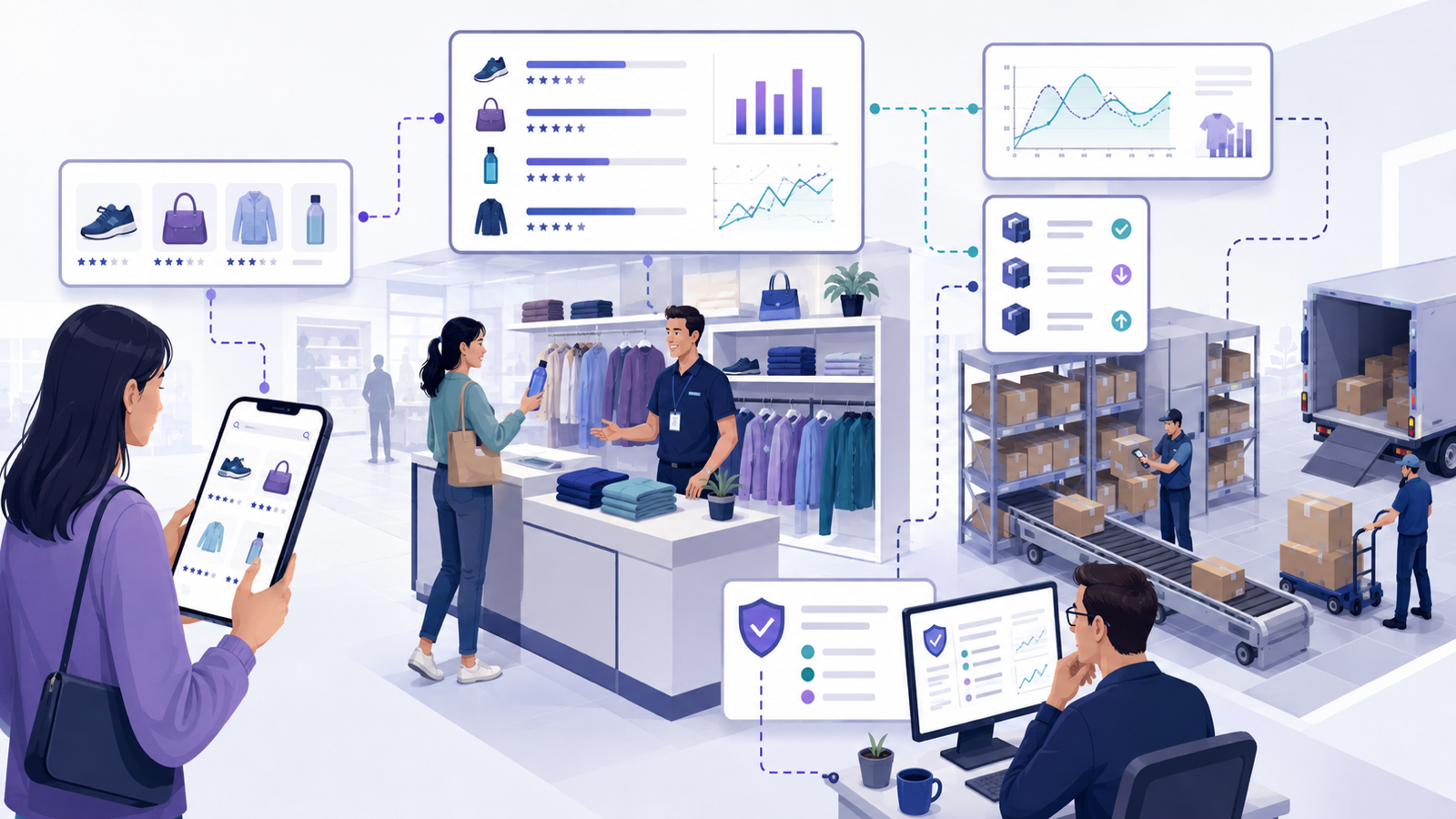
If you are new to the topic, start with What Is Artificial Intelligence? For a broader industry view, see Real-World Applications of AI.
What Does AI in Retail Mean?
AI in retail means using AI and machine-learning systems to support tasks involved in selling products and serving customers. Depending on the use case, a system might rank products, estimate future demand, classify customer messages, identify unusual transactions, recognize objects in images or generate text.
Retail AI is not one technology. A recommendation engine, a demand-forecasting model, a chatbot and a computer-vision checkout system solve very different problems. Many real retail systems also combine AI with business rules, databases, search software, human review and traditional analytics.
Retail AI at a Glance
| Retail problem | What AI can do | Typical output |
|---|---|---|
| Product discovery | Rank search results and recommendations | Ordered list of products |
| Customer support | Classify, retrieve or generate responses | Answer, summary or routing decision |
| Demand planning | Estimate future demand from historical and contextual data | Forecast |
| Inventory | Support replenishment and allocation decisions | Suggested stock action |
| Store operations | Analyze images, video or sensor data | Detection, count or alert |
| Pricing and promotions | Estimate demand or optimize within defined rules | Price or promotion recommendation |
| Order risk | Score transactions for suspicious patterns | Risk score or review flag |
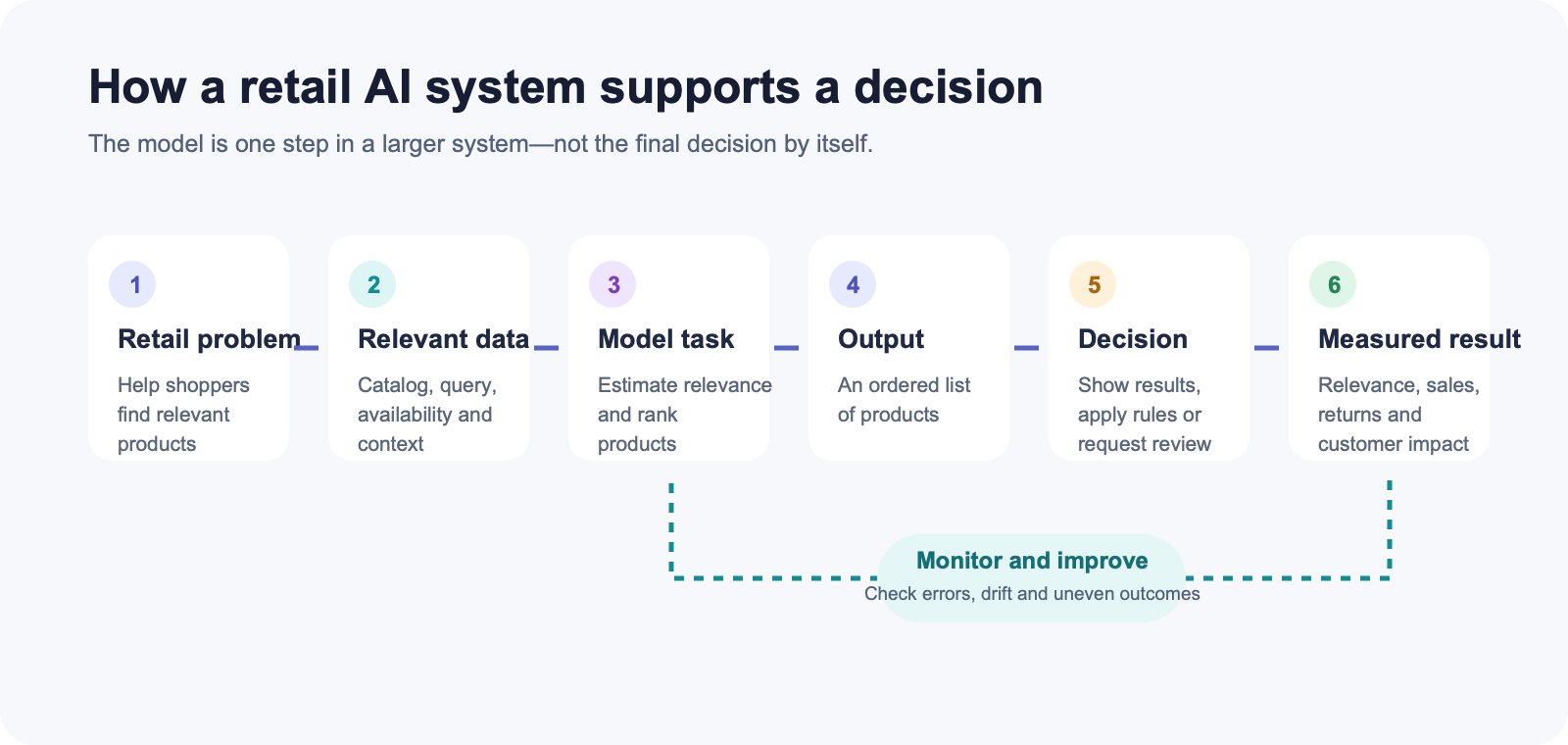
Retail decision-flow example: The model is one step in a larger system; its output is not the final operational decision by itself.
- Retail problem: help shoppers find relevant products.
- Relevant data: catalog, query, availability and context.
- Model task: estimate relevance and rank products.
- Output: an ordered list of products.
- Decision: show results, apply rules or request review.
- Measured result: relevance, sales, returns and customer impact.
Monitor and improve: check errors, drift and uneven outcomes, and use the measured results to improve the system.
1. Product Search and Recommendations
One of the most visible uses of AI in retail is helping shoppers find products. Search and recommendation systems can use product-catalog information together with signals such as search queries, product views, clicks and purchases to rank items that may be relevant to a shopper.
For example, a shopper searching for “waterproof jacket for cool-weather hiking” may benefit from a system that connects the meaning of the query with catalog attributes and then ranks suitable products. Recommendations work similarly, but the system may emphasize a shopper’s prior interactions, the current page, popular items or other context.
Google Cloud’s current AI Commerce Search documentation describes machine-learning-based search and recommendation capabilities that use catalog information and user events. That is a useful example of the underlying pattern: catalog + behavior/context → ranking model → ordered products. Google Cloud: AI Commerce Search documentation.
A higher-ranked product is not necessarily “the perfect product.” Retailers still need to evaluate relevance, conversion effects, diversity, availability, margin objectives and possible feedback loops. Personalization also raises privacy questions when it relies on detailed behavioral data.
2. Customer Service and Shopping Assistants
AI can support retail customer service by answering common questions, retrieving product information, summarizing conversations, classifying requests and routing difficult cases to people. Modern conversational systems may also help shoppers compare products or refine what they are looking for.
These systems commonly use natural language processing (NLP). Generative AI can add more flexible responses and conversational product discovery, but it also introduces a critical risk: generated answers can be incorrect, incomplete or unsupported. Product specifications, return policies, prices and safety information should be grounded in authoritative data rather than treated as facts simply because a model generated them.
For a broader introduction to these systems, see What Is Generative AI?
3. Demand Forecasting, Inventory and Fulfillment
Retailers have to decide how much stock to hold, where to place it and when to reorder. Machine-learning forecasting systems can combine historical sales with signals such as seasonality, promotions, local patterns, weather or logistics conditions to estimate future demand.
The result is a forecast, not a guarantee. Forecast quality can fall when customer behavior changes, new products have little history, promotions distort normal demand or unusual events break older patterns. Human planners and business rules may still be needed for supplier constraints, minimum order quantities, perishability, lead times and safety stock.
Walmart has publicly described using AI and forecasting systems across supply-chain and inventory decisions. That provides a concrete example of AI assisting operational planning without implying that the model alone controls the entire supply chain. Walmart: supply-chain technology and AI.
4. Merchandising, Promotions and Pricing
AI can help retailers group customers, estimate demand for products, select promotions, rank merchandise and measure how shoppers respond. These uses overlap with AI in Marketing, but the retail-specific focus is on decisions tied directly to products, assortment, promotions and the shopping journey.
Dynamic Pricing vs Personalized Pricing
Dynamic pricing changes prices in response to factors such as demand, inventory, time or market conditions. Personalized or surveillance pricing can use information about a particular consumer or audience segment to tailor prices, products or promotions. The two ideas can overlap, but they are not the same.
This distinction matters because granular consumer data can raise privacy, transparency and fairness concerns. In 2025, the U.S. Federal Trade Commission reported initial findings from a surveillance-pricing study showing that intermediaries can use data such as location, browsing behavior and shopping history to tailor prices or offers. FTC: surveillance pricing study.
Retailers should therefore evaluate pricing systems not only for revenue outcomes, but also for customer trust, data use, unintended discrimination, applicable law and whether shoppers can understand what affects the price or offer they receive.
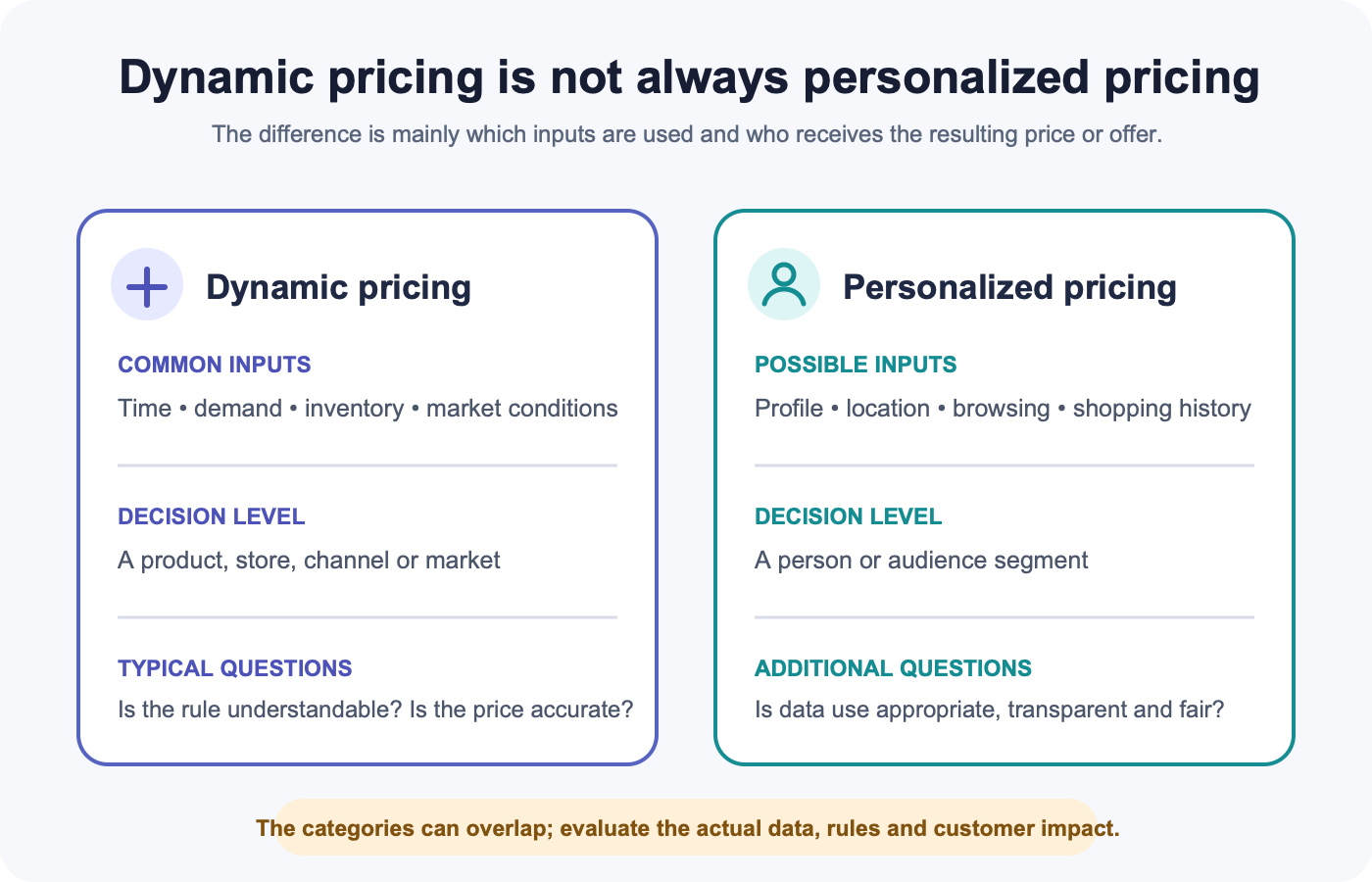
Pricing comparison in text: The distinction depends mainly on the inputs used and who receives the price or offer.
- Dynamic pricing: common inputs are time, demand, inventory and market conditions. The decision may apply to a product, store, channel or market. Check whether the rule is understandable and the price is accurate.
- Personalized pricing: possible inputs include a profile, location, browsing and shopping history. The decision applies to a person or audience segment. Also check whether data use is appropriate, transparent and fair.
The categories can overlap. Evaluate the actual data, rules and customer impact.
5. Store Operations and Computer Vision
Computer vision can analyze images or video to identify objects and patterns. In retail, potential uses include shelf monitoring, product recognition, queue analysis, visual search, loss-prevention support and some forms of assisted or automated checkout.
These systems should not be treated as infallible. Lighting, camera position, occlusion, packaging changes and unusual store conditions can affect performance. When a system can affect customers or employees, retailers also need to consider notice, privacy, accessibility, false detections and appropriate human review.
6. Fraud and Order-Risk Detection
Retailers and ecommerce platforms can use machine learning to look for patterns associated with suspicious orders. A model might consider transaction details and historical behavior to produce a risk score or flag an order for additional review.
Shopify, for example, documents fraud recommendations powered by machine-learning algorithms trained on historical transactions. Importantly, a high-risk recommendation does not automatically prove fraud: merchants can review, verify, cancel or refund an order. Shopify: reviewing orders with fraud analysis.
This is the right mental model for retail fraud systems: signals → risk model → score or flag → operational decision. False positives can block legitimate shoppers, while false negatives can allow fraudulent orders through. Both errors matter.
Broader financial fraud belongs more naturally in AI in Finance, while cyber-threat detection belongs in the site’s cybersecurity coverage.
7. Generative AI in Retail
Generative AI adds a different set of retail use cases. It can help draft product descriptions, summarize reviews, assist customer-service agents, generate marketing variations, answer catalog questions and support conversational product discovery.
These capabilities should be separated from other retail AI. Demand forecasting, recommendations, fraud scoring and computer vision are not simply “generative AI.” Retailers may use several model families in the same customer or operations workflow.
Generative systems also require controls for incorrect output, unsupported claims, brand consistency, sensitive information and content that should be reviewed before publication or customer use.
Potential Benefits of AI in Retail
- Faster information retrieval: search and support systems can help customers or staff reach relevant information more quickly.
- More scalable personalization: ranking and recommendation systems can tailor product ordering across large catalogs.
- Decision support: forecasting and optimization systems can give planners another source of evidence when making inventory or logistics decisions.
- Pattern detection: machine learning can identify relationships or unusual behavior that would be difficult to review manually at large scale.
- Automation of repetitive work: some classification, summarization and monitoring tasks can be partially automated or assisted.
These are potential benefits. Whether they appear in practice depends on data quality, model performance, workflow design, integration, staff training and the metric used to define success.
Risks and Responsible Use
Retail AI affects customers, employees and business decisions, so model performance is only part of the evaluation. NIST’s AI Risk Management Framework identifies characteristics such as validity and reliability, safety, security and resilience, accountability and transparency, explainability, privacy and fairness with harmful bias managed. NIST AI Risk Management Framework.
Privacy and Data Use
Personalization can involve browsing history, purchases, location, account information or other behavioral data. Retailers should know what data is collected, why it is needed, how long it is retained, who can access it and which privacy requirements apply to the specific activity. Consent is important where required, but it is not the only possible legal basis for processing in every jurisdiction.
Fairness and Unequal Outcomes
Recommendations, fraud scores, promotions and pricing systems can affect different customers differently. Retailers should test for uneven error rates or outcomes and investigate whether data, model choices or business rules disadvantage particular groups or use cases.
Human Oversight and Escalation
Not every AI output should trigger an automatic action. High-impact or uncertain cases may need human review, clear escalation paths and a way to correct mistakes. This is especially important for fraud flags, personalized pricing, sensitive customer-service situations and generated product information.
Workforce Effects
AI may automate, augment or reshape particular retail tasks. The effect is not uniform across jobs or companies. Retailers should plan for training, role redesign and clear responsibility when employees are expected to supervise or act on AI-generated recommendations.
How Should Retailers Evaluate an AI System?
A useful retail AI project starts with a measurable problem, not with the goal of “adding AI.” A practical evaluation can ask:
- What decision or task is the system supporting?
- What data is available, and is it appropriate for the intended use?
- What output will the model produce?
- How will performance be measured? Search relevance, forecast error, order-review precision, support resolution or another task-specific metric may matter.
- What happens when the model is wrong?
- Which privacy, fairness, security or accessibility risks apply?
- When should a person review or override the system?
- How will performance be monitored after deployment?
This keeps the focus on the full system: retail problem → data → model output → human or automated decision → measurable result → monitoring.
Frequently Asked Questions
How is AI used in retail?
Common uses include product search, recommendations, conversational support, demand forecasting, inventory planning, computer vision, merchandising, pricing support and fraud-risk scoring.
What is an example of AI in retail?
A recommendation system is a simple example. It can combine product-catalog data with shopper interactions such as views or purchases to rank products that may be relevant.
Can AI predict retail demand accurately?
AI and machine-learning models can estimate demand, but they do not guarantee accurate forecasts. Performance depends on the data, the stability of demand patterns, promotions, external conditions and how the model is validated and monitored.
Does AI automatically prevent retail fraud?
No. AI can score or flag suspicious transactions, but legitimate orders can be flagged and fraudulent orders can be missed. Retailers need suitable thresholds, monitoring and review processes.
What are the main risks of AI in retail?
Important risks include privacy concerns, security problems, biased or uneven outcomes, inaccurate generated information, false fraud alerts, opaque pricing or personalization, over-automation and poor performance when customer behavior changes.
Continue Learning About AI Applications
Retail is one part of the wider AI applications landscape. Continue with Real-World Applications of AI to compare how similar capabilities are used across industries.
- AI in Business
- AI in Marketing
- AI in Finance
- Machine Learning Explained
- What Is Natural Language Processing?
- What Is Generative AI?