
Quantum computing is a specialized form of computing that uses quantum-mechanical effects to process information. It may offer major advantages for particular problems, but it is not a universally faster replacement for classical computers—and today’s systems remain experimental.
This beginner-friendly guide explains what qubits do, why interference and measurement matter, where quantum speedups are possible, what current hardware can and cannot do, and how quantum computing relates to artificial intelligence. It is an adjacent emerging-technology reference, not a numbered lesson in the core AI curriculum.
Last reviewed and updated: August 30, 2026.
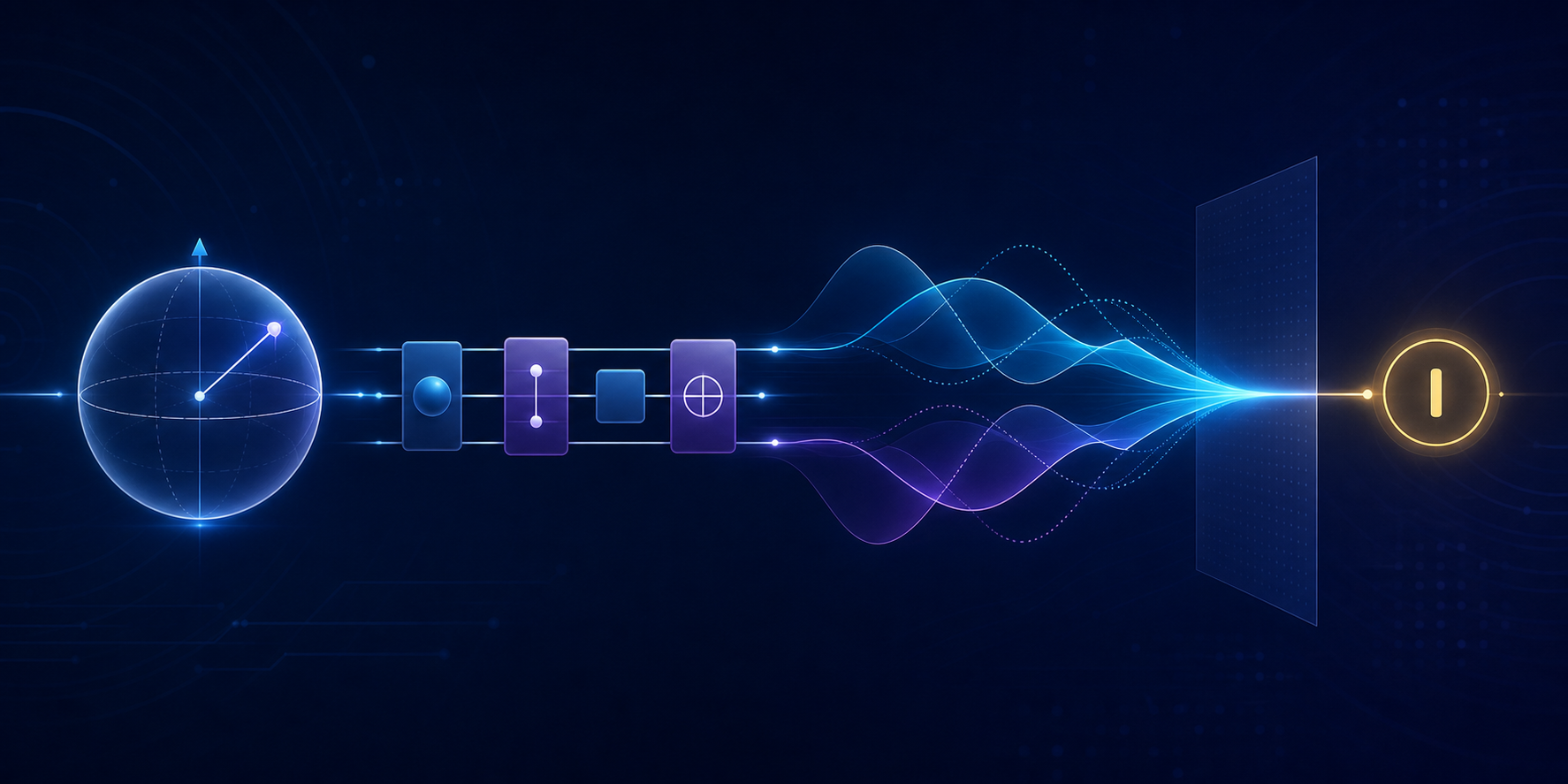
Quantum computing in plain English
A classical computer stores information in bits whose values are 0 or 1. A quantum computer uses qubits. A qubit has a quantum state described by amplitudes associated with possible measurement outcomes, commonly labeled 0 and 1.
People often say a qubit is “0 and 1 at the same time.” That can be a useful first analogy, but it is incomplete. A single measurement does not reveal both answers. It produces one classical outcome according to the state’s probabilities. Quantum algorithms must shape those probabilities so useful results become more likely.
The three ideas beginners need
- Superposition: a qubit’s state can contain amplitudes associated with more than one possible measurement outcome.
- Interference: quantum amplitudes can reinforce or cancel one another. Algorithms use interference to increase the probability of useful outcomes and suppress others.
- Measurement: reading a qubit produces classical information. A quantum computer cannot simply evaluate every possible answer and reveal them all. NIST explains why measurement cannot extract every result from a computation in superposition.
Entangled qubits share a joint quantum state whose measurement outcomes can display correlations that independent classical states cannot reproduce. Entanglement does not allow usable information to travel faster than light, and it does not by itself make every computation faster.
A compact quantum-computation workflow
In gate-based quantum computing, a quantum gate is an operation that changes the state of one or more qubits. A simplified workflow is:
- Prepare qubits: initialize the states needed for the problem.
- Apply gates: carry out the algorithm’s sequence of operations.
- Shape interference: use that gate sequence to reinforce useful outcomes and suppress others. Interference is part of the computation, not a separate device added afterward.
- Measure: obtain classical outcomes from the qubits.
- Repeat when needed: prepare and run the circuit again to estimate outcome probabilities or other quantities.
A single run does not reveal every possible answer. The algorithm determines which outcomes are useful and how repeated results should be interpreted.
Are quantum computers faster than classical computers?
Not at everything. A quantum computer may outperform classical computers when a suitable problem, effective algorithm, capable hardware, manageable error rates, and a fair comparison with the best classical method all line up. Many everyday tasks—and most current AI workloads—have no known quantum advantage.
Quantum speedup is problem-specific. Input preparation, repeated runs, error correction, and the cost of extracting a classical answer also matter.
Shor’s and Grover’s algorithms
Shor’s algorithm
Shor’s algorithm shows that a sufficiently large, fault-tolerant quantum computer could efficiently solve integer-factorization and discrete-logarithm problems. These support widely used public-key systems such as RSA and elliptic-curve cryptography.
Can quantum computers break modern encryption today? No. Current machines lack the scale and fault tolerance needed to attack cryptographically relevant keys. The long-term risk still matters because security migrations take years.
Grover’s algorithm
Grover’s algorithm provides a quadratic query advantage for certain unstructured-search or “oracle” problems. It does not make ordinary databases, web search, logistics, or AI automatically faster.
Physical qubits, logical qubits, and fault tolerance
Quantum information is fragile. Environmental interactions, imperfect controls, and noisy measurements introduce errors, so raw qubit count alone does not show how useful a machine is.
- Physical qubit: an individual hardware qubit.
- Logical qubit: quantum information encoded across multiple physical qubits so errors can be detected and corrected.
- Error mitigation: methods that reduce noise without full error correction.
- Quantum error correction: encoding and control techniques designed to detect and correct errors while preserving quantum information.
- Fault-tolerant computing: computation designed so errors do not accumulate uncontrollably during long algorithms.
Useful comparisons also consider gate fidelity, coherence, connectivity, circuit depth, execution speed, workload, and logical-qubit quality. Researchers are pursuing superconducting circuits, trapped ions, neutral atoms, photonics, spin-based qubits, and other platforms. No approach has conclusively won.
Gate-based computing and quantum annealing
Gate-based systems apply sequences of quantum operations and are associated with algorithms such as Shor’s and Grover’s. Quantum annealing is a specialized approach built around energy-minimization formulations. Whether either approach offers an advantage depends on the problem, hardware, and classical comparison.
What can quantum computers be used for?
Most high-impact uses remain research directions rather than established commercial transformations.
- Quantum simulation: studying molecules, materials, and other quantum systems is a natural target because classical simulation can become extremely difficult as systems grow.
- Cryptanalysis: future fault-tolerant systems could threaten widely deployed public-key cryptography.
- Optimization: QAOA and quantum annealing are being researched for particular problems. Practical superiority remains problem- and hardware-dependent.
- Drug and materials research: quantum simulation may eventually help analyze molecular behavior, but faster drug discovery and commercial impact are not established outcomes.
Specialized experiments have demonstrated advantage on particular benchmark tasks. That is meaningful progress, but not proof that broadly useful, general-purpose quantum advantage has arrived.
Post-quantum cryptography is not QKD
- Post-quantum cryptography (PQC) uses classical algorithms designed to resist known classical and quantum attacks. It runs on classical systems. NIST finalized its principal first PQC standards in 2024 and advises organizations to begin migration.
- Quantum key distribution (QKD) uses quantum-physical properties to distribute key material between compatible systems. It requires specialized infrastructure and does not make the surrounding system automatically secure.
Quantum networks may distribute quantum states or entanglement. They do not enable instantaneous communication or faster-than-light transmission of classical information.
How does quantum computing relate to AI?
Quantum machine learning is a real research field, but current AI does not require quantum computers. Modern machine learning and deep learning systems run on classical hardware.
Researchers are exploring quantum methods for structured learning problems, quantum data, sampling, and optimization, while classical AI can help design, calibrate, and control quantum experiments. Hybrid workflows may become useful in specific cases.
Loading classical data into quantum states, training noisy models, comparing against improving classical methods, and obtaining fault-tolerant hardware remain substantial obstacles. Evidence for broad practical advantage on mainstream classical-data tasks is unsettled, as emphasized in a Nature Machine Intelligence assessment of quantum advantage for machine learning. For the established learning path, begin with Artificial Intelligence Explained, then continue to Machine Learning Explained and Types of Machine Learning.
A short history and the current state
Foundational ideas from Richard Feynman and David Deutsch in the 1980s were followed by Shor’s algorithm in 1994 and Grover’s in 1996. Since then, cloud access, larger processors, specialized benchmarks, and error-correction experiments have accelerated research.
Quantum computing is advancing quickly, but broadly useful fault-tolerant machines remain under development. Today’s processors support research, education, hardware experiments, and narrowly scoped demonstrations. They are not replacements for classical computers. A credible progress claim should name the task, hardware, error model, classical baseline, and limits.
One-question self-check
Which statement is accurate?
- A qubit lets us read 0 and 1 from one measurement.
- Entanglement can transmit messages faster than light.
- Quantum algorithms may provide speedups for particular problems when suitable algorithms and capable hardware exist.
Answer: 3. Measurement returns limited classical information, and entanglement does not enable faster-than-light communication.
Frequently asked questions
Is a quantum computer just a faster computer?
No. It uses a different computational model and may accelerate particular problems. Many tasks have no known quantum advantage.
Does a qubit store both 0 and 1 as readable answers?
No. Its state can contain amplitudes associated with both outcomes, but one measurement returns a classical result according to the state’s probabilities.
Does entanglement allow faster-than-light communication?
No. It produces nonclassical correlations but cannot send usable information faster than light.
Can quantum computers break encryption now?
No current machine can break cryptographically relevant RSA or elliptic-curve keys. Future sufficiently large fault-tolerant systems could threaten them, which is why PQC migration has begun.
Will quantum computing make AI dramatically faster?
Not generically, and not today. Quantum approaches may eventually help particular structured workloads or quantum data, but practical advantage for mainstream machine learning is not established.
Where to learn next
Quantum computing is an adjacent technology, not a prerequisite for modern AI. Continue through the core learning path:
Sources and further reading
- NIST: Quantum Computing Explained
- IBM Quantum Learning: Basics of Quantum Information
- NIST: What Is Post-Quantum Cryptography?
- NIST CSRC: Post-Quantum Cryptography
- Cerezo et al., “Challenges and opportunities in quantum machine learning,” Nature Computational Science (2022)
- Nature Machine Intelligence, “Seeking a quantum advantage for machine learning” (2023)
Reviewed for conceptual accuracy and source quality. Quantum-computing claims should always be evaluated against the specific task, hardware, and classical baseline.