
Knowledge representation in AI means encoding entities, concepts, relationships, rules and constraints in forms a computer can store, query or reason over. It gives information a defined structure and meaning for a particular task.
A library system, for example, might represent books, their authors, individual copies and borrowing rules. Those representations help software answer questions such as “Which copies are available?” or apply a rule about which items can be borrowed.
This guide covers explicit, symbolic methods and how they relate to learned numerical representations. For the broader picture, start with Artificial Intelligence Explained.
Reviewed:
What knowledge representation does
A representation selects the details that matter for a task. Our illustrative library model includes a copy identified as A17, its availability and the book it belongs to. A different application might need shelf locations or the condition of each copy.
The structure supports several operations:
- Store: record that A17 is a book copy.
- Query: retrieve copies recorded as available.
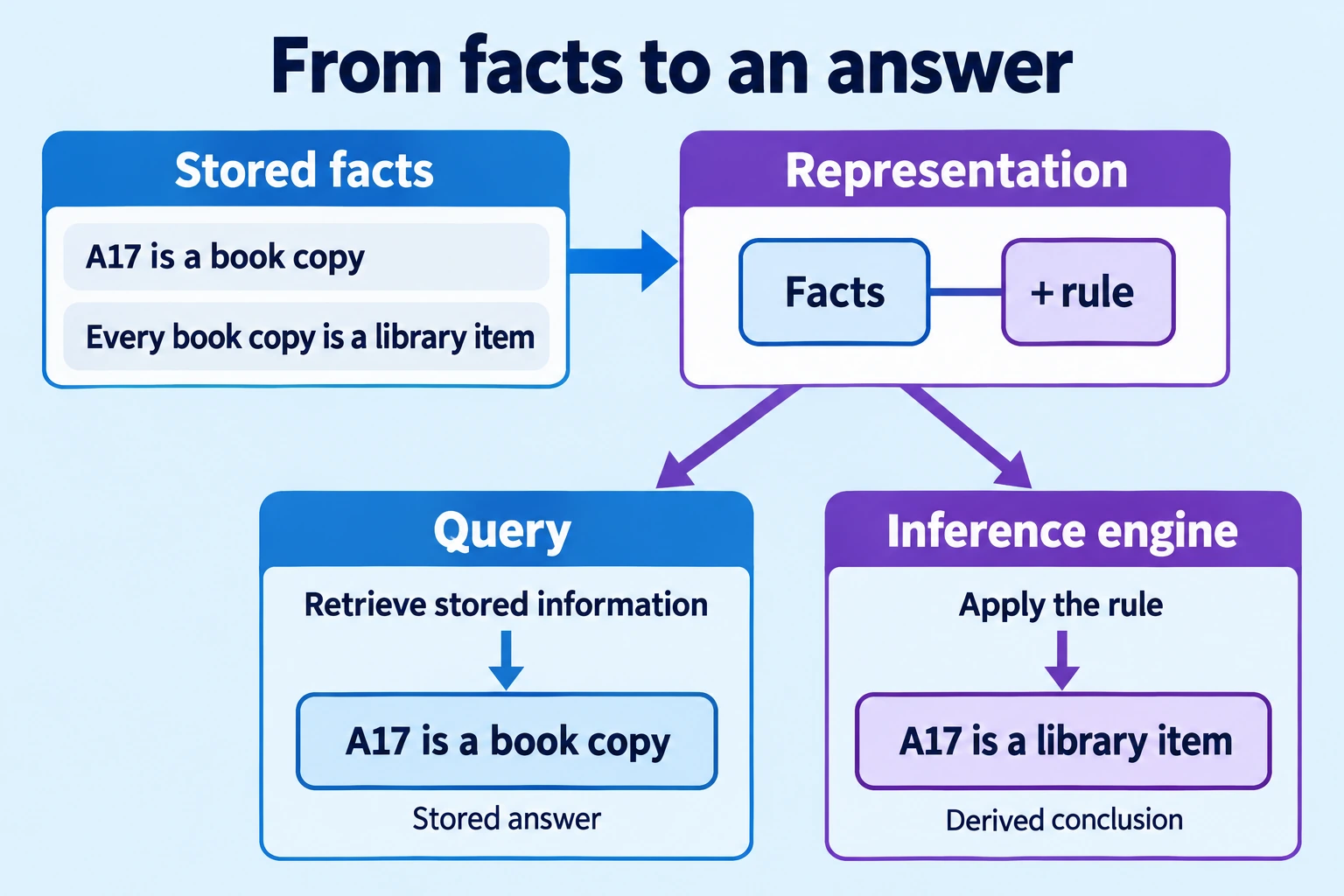
- Infer: combine “A17 is a book copy” with “Every book copy is a library item” to conclude that A17 is a library item.
These operations depend on the model’s definitions and available information. A representation can omit important details or contain errors, a limitation discussed in the research paper What Is a Knowledge Representation?
Knowledge representation vs knowledge engineering
Knowledge representation concerns how information is modeled and what operations that model supports. Should a borrowing policy be expressed as rules? Which relationships belong in the catalogue?
Knowledge engineering is the practical work of acquiring, modeling, validating, integrating and maintaining that knowledge. It includes checking policies with librarians, reconciling duplicate records and deciding who can approve changes.
The representation is one part of the system; engineering makes it useful in an application. How Artificial Intelligence Works explains the wider relationship between data, models and outputs.
Six main knowledge representation methods
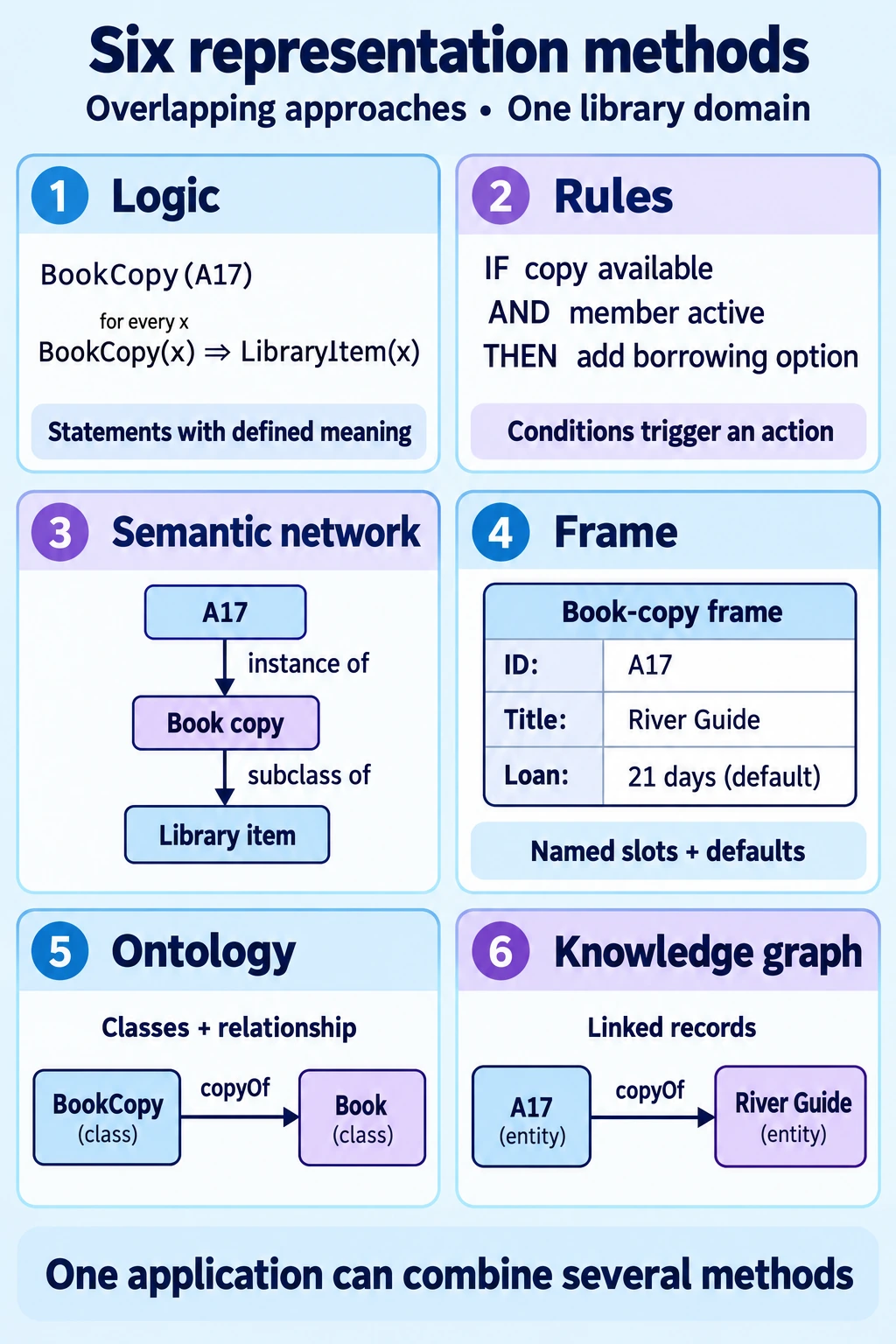
These approaches overlap. An ontology can use logic, a knowledge graph can follow an ontology, and rules can operate on graph data.
1. Logic
Logic represents statements with formally defined meanings. Propositional logic combines whole statements; first-order logic also expresses objects, relationships and claims about groups of objects.
For example, “Every book copy is a library item” and “A17 is a book copy” support the conclusion “A17 is a library item.” A suitable reasoner can derive that conclusion without storing it separately beforehand. More expressive logics can represent richer relationships, but may require more computation.
2. Rules
Rules express conditions and their consequences. A simplified library rule could be: IF a copy is available AND a member’s account is active, THEN add that copy to the member’s borrowing options.
Production rules trigger actions, which can include adding or changing facts. Declarative rules state relationships or conclusions. The W3C Rule Interchange Format primer explains this distinction. Rules are useful for explicit policies, but exceptions and conflicting rules need deliberate handling.
3. Semantic networks
A semantic network represents concepts or entities as nodes and meaningful relationships as labeled links. A small network might connect “A17” to “Book copy” with an “instance of” link, and “Book copy” to “Library item” with a “subclass of” link.
This makes relationships easy to inspect. Automatic inference depends on what the links mean and which reasoning procedures the system implements; drawing connected nodes alone does not supply those procedures.
4. Frames
Frames organize information about a typical object or situation into named slots. A book-copy frame might have slots for copy ID, title, location and loan period.
Frame systems can inherit information from broader categories and use default values that a more specific record overrides. A default loan period might be 21 days, with a reference copy marked as non-borrowable. Marvin Minsky’s original frames paper describes this use of structured information and revisable defaults.
5. Ontologies
An ontology formally defines a domain’s concepts, properties and relationships. Our library ontology might distinguish a Book from a BookCopy and define the relationship “copy of.” Shared definitions help teams combine information consistently.
OWL, the Web Ontology Language, supports formal statements that reasoners can use to derive consequences or identify logical inconsistencies. Checking whether records contain required fields is a separate validation task; it does not happen automatically just because an ontology exists.
6. Knowledge graphs
A knowledge graph connects identifiable entities through explicit relationships. In our fictional catalogue, one statement could be A17 → copy of → River Guide. Other statements can connect that book to its author, subjects and publisher.
RDF is one standard for representing such statements as subject–predicate–object triples, described in the W3C RDF primer. Knowledge graphs can also use other graph models. They support relationship-based queries and data integration; reasoning requires suitable semantics and software.
Knowledge base, ontology, knowledge graph and inference engine
These terms describe related parts of a system:
- Knowledge base: the organized collection of knowledge an application uses. Here, that means stored facts and any associated rules or definitions.
- Ontology: the formal vocabulary and relationships used to describe a domain.
- Knowledge graph: knowledge represented as connected entities and relationships.
- Inference engine: the component that applies a reasoning procedure to derive conclusions from represented knowledge.
A knowledge base may contain an ontology and graph data, with an inference engine operating on them. A database can store the information. These roles can overlap within a product, but storing, defining, querying and inferring remain different tasks.
Symbolic vs learned representations
Symbolic representations make facts, categories and relationships explicit. You can inspect a statement such as “A17 is a book copy” or check a borrowing rule. Their usefulness depends on the quality and coverage of those statements.
Learned representations encode patterns numerically. An embedding is a vector, or list of numbers, that a trained model assigns to an input such as a word, document or image. Depending on training, nearby vectors can identify inputs with similar meanings or features.
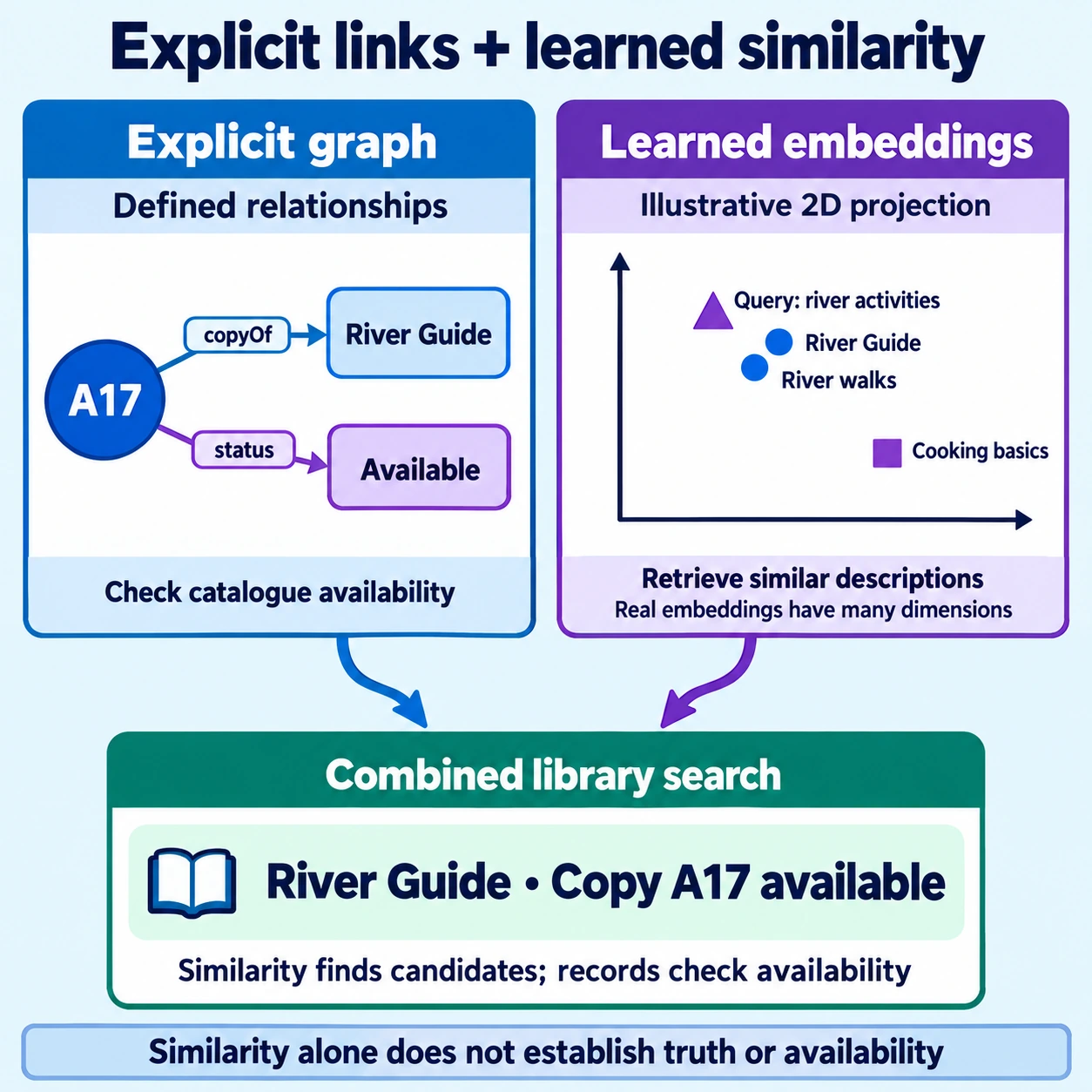
For example, Sentence-BERT produces sentence embeddings designed for similarity comparison and tasks such as semantic search. In our library, embeddings might retrieve descriptions relevant to “beginner gardening,” while explicit records determine whether the suggested copies are available.
Vector similarity does not establish a fact or a logical relationship. An embedding also does not expose a list of named relationships in the way a graph does. Neural model parameters and intermediate representations contain learned structure, rather than a conventional, directly editable catalogue of facts.
See Machine Learning Explained for how models learn from examples, and Neural Networks Explained for the model structures behind many learned representations.
The knowledge-engineering lifecycle
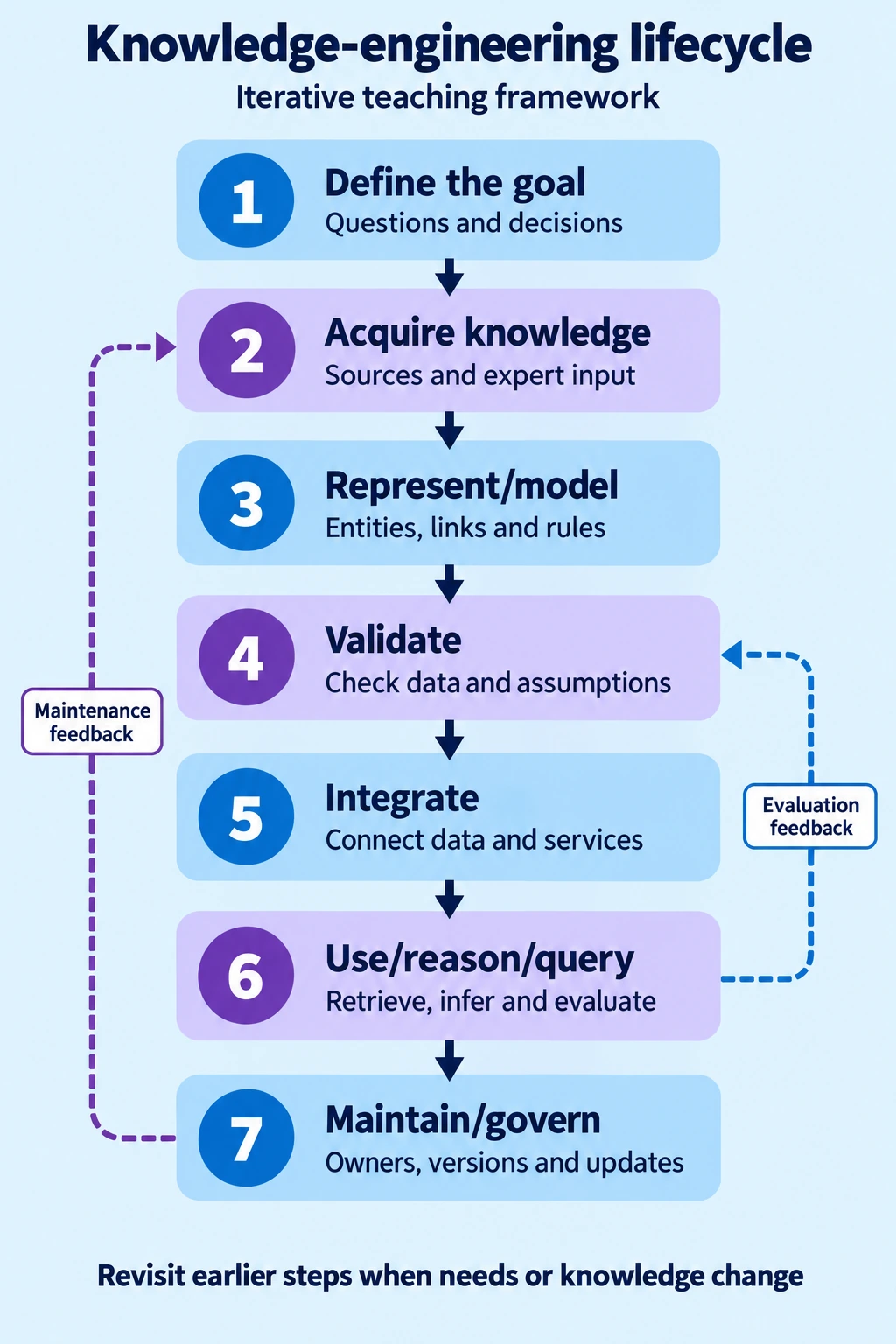
A practical workflow is define the goal → acquire knowledge → represent/model → validate → integrate → use/reason/query → maintain/govern. This is a teaching framework, not a universal standard; teams revisit earlier steps as they test the system.
- Define the goal. Decide what questions or decisions the system must support. For the library, start with finding available copies, rather than modeling everything about publishing.
- Acquire knowledge. Gather catalogue records, policies and expert input. Record sources, permissions and when information was valid.
- Represent/model. Choose entities, relationships, rules and identifiers. Reuse suitable vocabularies where possible. Ontology editors such as Protégé can help with formal modeling.
- Validate. Check representative questions, conflicting rules, missing values and incorrect relationships. Include expert review. For RDF data, SHACL can express constraints such as required properties.
- Integrate. Connect the model to application data and services. Reconcile duplicate identifiers, resolve source conflicts and rerun validation after merging.
- Use/reason/query. Retrieve available copies or apply borrowing rules. Test whether outputs answer the intended questions accurately.
- Maintain/govern. Assign owners, track versions, control access and review updates. Correct outdated policies and retain enough provenance to investigate errors.
Automated extraction can help acquire knowledge, but extracted statements need checks before they are treated as trusted facts. Updating a database does not necessarily retrain a model, and a model-generated update is not automatically correct.
Applications, GraphRAG and neuro-symbolic AI
Expert systems and linked data
Rule-based decision support: MYCIN was a research expert system that used rules and certainty factors in work on infectious-disease diagnosis and antibiotic recommendations. Its developers’ account of the MYCIN experiments provides a historical example of separating domain knowledge from procedures that use it.
Structured retrieval: DBpedia extracts structured information from Wikipedia and makes it available as linked data, including through SPARQL queries. This illustrates how explicit entities and relationships enable queries across records. Results still depend on the accuracy and completeness of the underlying data.
Knowledge graphs and GraphRAG
Retrieval-augmented generation, or RAG, supplies retrieved information to a language model when it generates an answer. Graph-based approaches can add relationships and connected context to that retrieval.
In Microsoft’s GraphRAG implementation, local search combines graph information with source-text passages. Global search uses generated summaries of graph communities, or groups of connected entities, to address questions about a collection more broadly.
This is a current application of knowledge engineering. Extracting relationships, preserving sources and evaluating answers all matter. Graph construction adds work and cost, and generated relationships or summaries can contain errors. Whether it improves retrieval should be tested on the actual questions and documents.
Hybrid and neuro-symbolic systems
Hybrid systems combine different methods. Neuro-symbolic systems specifically connect neural models with symbolic structures or reasoning.
The DeepProbLog research paper demonstrates one concrete combination: a neural component identifies handwritten digits, while a logic program expresses how to add them. It integrates learned predictions with explicit rules and probabilistic reasoning.
Such combinations do not guarantee correct outputs. The neural predictions, symbolic assumptions and integration all need evaluation.
Limits and practical trade-offs
- Incomplete knowledge: missing information should not automatically be treated as false. The appropriate interpretation depends on the system’s assumptions.
- Ambiguity and bias: category boundaries, conflicting sources and extraction errors can affect results. Document modeling choices and test representative cases.
- Scale: larger graphs and more expressive rules can increase storage, query and reasoning costs.
- Change: policies and facts become stale. Keep source dates, ownership and review processes visible.
- Traceability: explicit rules can make some conclusions easier to inspect, but an inspectable explanation can still rely on incorrect premises.
Frequently asked questions
Does every AI system need an explicit knowledge base?
No. Many systems learn representations from data without a separately maintained symbolic knowledge base. Explicit knowledge is useful when an application needs defined relationships, rules, governed facts or structured queries.
Is a knowledge graph the same as an ontology?
Their roles differ. An ontology defines concepts and relationships; a knowledge graph connects represented entities. A graph can use an ontology, and an ontology can itself be encoded as a graph.
Does adding a knowledge graph stop a language model making errors?
No. The graph, retrieval process and generated answer can each introduce errors. Source checks and task-specific evaluation remain necessary.
Quick knowledge check
- Which method organizes information into named slots with possible default values?
- Which component applies reasoning procedures to derive conclusions: an ontology or an inference engine?
- What comes immediately after represent/model in this guide’s lifecycle?
- Does similarity between two embeddings prove a logical relationship?
Answers: 1. Frames. 2. An inference engine. 3. Validate. 4. No; similarity reflects the model’s learned representation.
Lifecycle recap: define the goal → acquire knowledge → represent/model → validate → integrate → use/reason/query → maintain/govern.
Where to learn next
Next, read Symbolic AI vs Neural Networks to compare explicit rules with learned patterns and see why an application might combine them.