
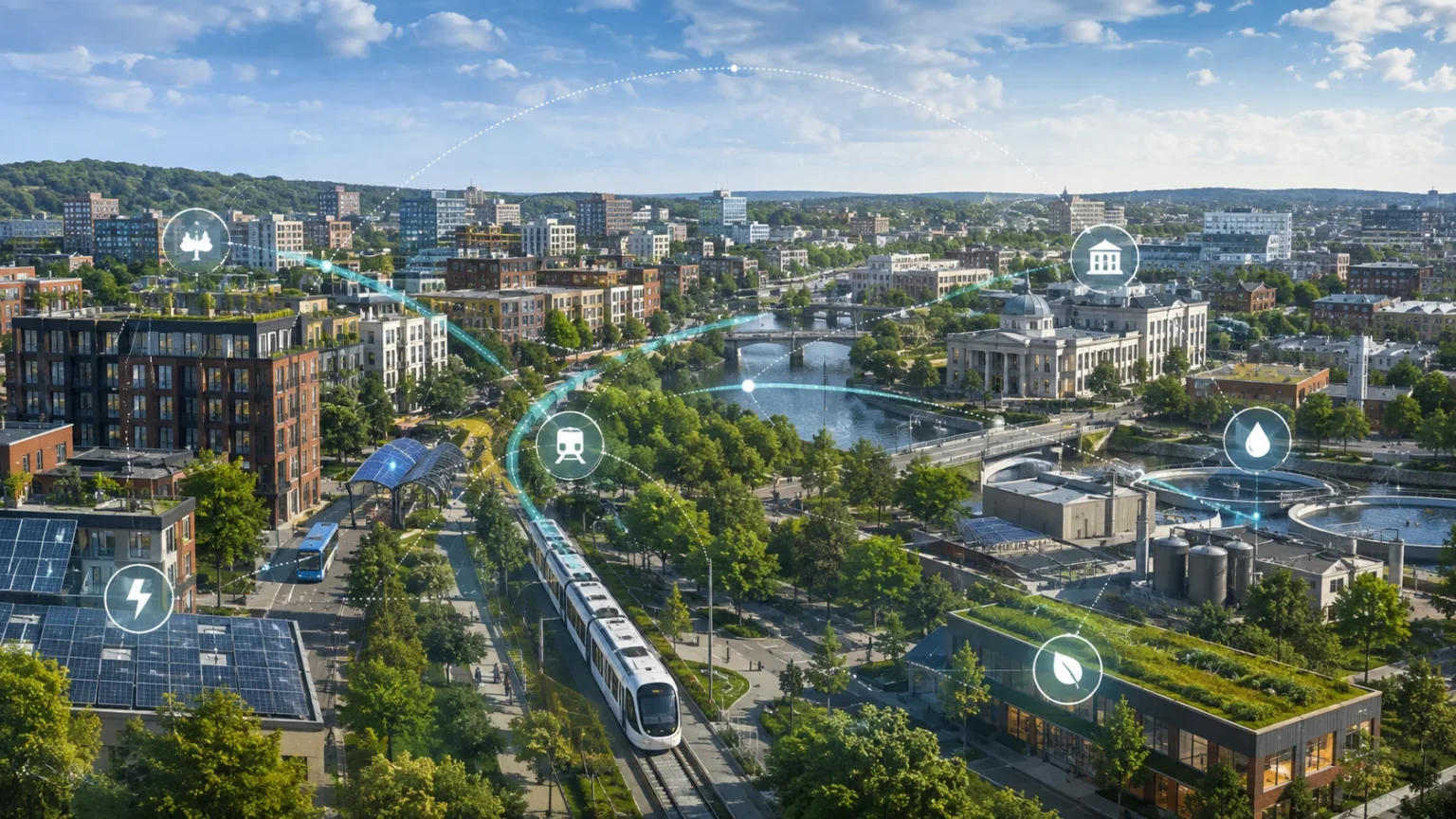
AI can help cities predict demand, analyze images, optimize operations, and support decisions—but it is only one part of a smart-city system. This guide explains how AI relates to sensors, connectivity, automation, digital twins, and urban planning; where it is used; what evidence can and cannot show; and what responsible deployment requires.
New to the topic? Start with Artificial Intelligence Explained for the foundations before exploring urban applications.
Reviewed and updated: September 2026
What is a smart city?
A smart city uses information and communication technologies, data, and other tools to improve quality of life, urban services, competitiveness, and long-term economic, social, environmental, and cultural sustainability. That definition, used by the International Telecommunication Union (ITU), is broader than AI.
A city can use networked traffic lights, digital permitting, environmental sensors, open-data platforms, or automated utility controls without using machine learning. AI becomes relevant when an urban problem benefits from tasks such as prediction, classification, computer vision, language processing, optimization, or decision support.
AI, IoT, automation, and digital twins are not the same
| Technology | Primary role | Smart-city example |
|---|---|---|
| Sensors and IoT | Collect and transmit observations | A road sensor reports vehicle counts |
| Connectivity | Moves data between devices and systems | A secure network sends readings to a control center |
| Automation | Executes predefined rules | A pump switches on when a threshold is reached |
| AI model | Learns patterns to classify, predict, generate, or optimize | A model forecasts traffic 20 minutes ahead |
| Digital twin | Represents an asset or system for monitoring and simulation | A city tests a road redesign in a virtual model |
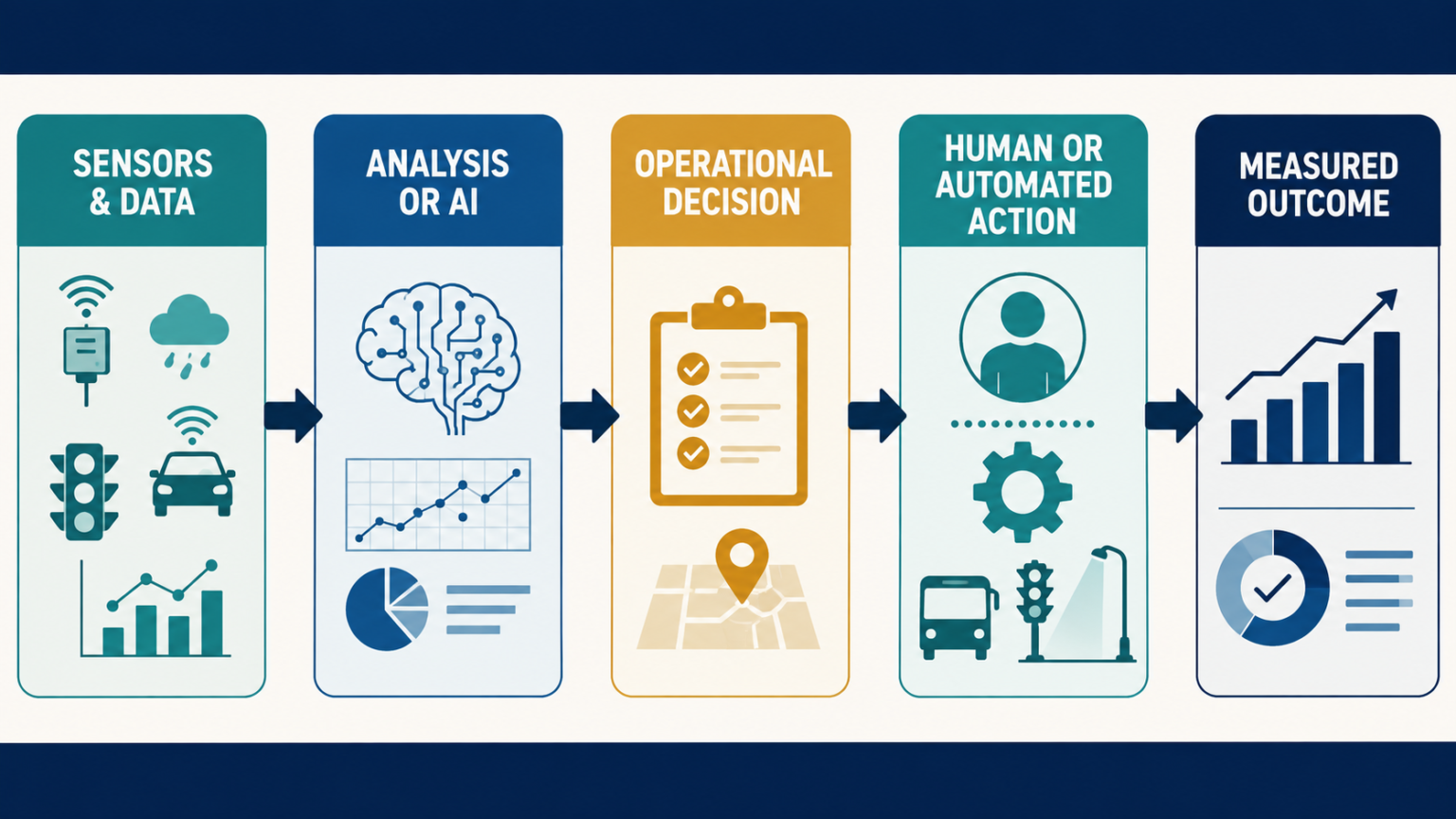
A useful sequence is: urban service → data collection → analysis or AI → operational decision → human or automated action → measured outcome. Every step can introduce errors, delays, security risks, or accountability questions.
How AI is used in smart cities
Mobility and transportation
Transport agencies can use machine learning for traffic forecasting, incident detection, transit-demand estimates, fleet maintenance, route planning, and adaptive signal control. The value is not simply “AI optimizes traffic.” A credible deployment shows what data it uses, what decision changes, who retains control, and whether outcomes improve without shifting congestion or risk elsewhere.
Singapore illustrates the distinction between current automation and planned AI. The Land Transport Authority says its existing GLIDE system dynamically adjusts traffic lights using road sensors. Its newer CRUISE system, still under development in the agency’s October 2025 update, is intended to add more data sources and AI-based predictive capabilities. The authority also emphasizes testing and human oversight. This is evidence of a staged deployment—not proof that an AI system already controls the full traffic network. Read the LTA update.
Energy, water, and infrastructure
AI may support electricity-load and renewable-generation forecasting, fault detection, predictive maintenance, leak detection, and operational scheduling. These tools can improve planning or reduce some waste, but they cannot guarantee reliability. Physical capacity, weather, maintenance, market rules, engineering controls, and staff response still matter. Dynamic pricing and optimization also require affordability and equity analysis, not only efficiency metrics.
Copenhagen is often described using an outdated goal of carbon neutrality by 2025. The city’s official Climate Strategy 2035 sets the direction for reducing emissions within Copenhagen and the global climate footprint associated with the city’s activities. AI may contribute to forecasting or municipal operations, but climate results depend on wider policy, infrastructure, energy, and behavioral changes; they should not be attributed to AI alone.
Waste and environmental monitoring
Computer vision can help classify materials in sorting facilities, while fill-level sensors and forecasting models can inform collection routes. Cities can also combine sensor, satellite, and geospatial data to estimate air quality, identify heat patterns, or detect infrastructure change. Model outputs still need calibration, field validation, and a defined response process. For the scientific methods behind environmental monitoring, continue to AI in Environmental Science.
GeoAI and urban planning
GeoAI combines AI methods with geographic information such as maps, satellite imagery, land records, sensor feeds, and administrative data. Planners may use it to study land use, housing and service accessibility, mobility, infrastructure needs, environmental exposure, and disaster risk.
Scenario models can compare possible interventions, but they do not decide what a city should value. Missing informal settlements, outdated records, biased historical decisions, or uneven sensor coverage can make a precise-looking map misleading. Local knowledge and public participation remain essential. UN-Habitat’s assessment of responsible AI in cities emphasizes governance, institutional capacity, and people-centered design alongside technical capability.
Digital twins for monitoring and simulation
A digital twin is a digital representation of an asset or system that can be synchronized with real-world information and used for monitoring or simulation. A twin may incorporate AI, but it does not have to. According to ITU guidance on smart-city digital twins, simulations can help reveal problems and compare strategies before real-world implementation.
The limitations matter: a twin reflects its assumptions, data, and scope. It may not capture informal behavior, rare events, distributional effects, or the lived experience of residents. Cities should state what the model leaves out and avoid treating simulation results as certainty.
Potential Benefits of AI in Smart Cities
When a well-defined city service is suited to the technology, AI may help staff anticipate demand, identify maintenance needs earlier, prioritize inspections, reduce some operational waste or compare planning options. These are potential benefits, not guaranteed results. A city should compare the system with its previous process and non-AI alternatives, measure costs and service outcomes, and check whether benefits and errors are distributed fairly across neighborhoods and residents. Faster analysis matters only if it leads to a useful, accountable action.
Public safety and predictive policing: a high-risk use
Urban public-safety systems can analyze video, detect objects, prioritize incoming reports, support emergency routing, or search watchlists. Predictive-policing systems may estimate where recorded incidents are more likely based on historical data. These capabilities do not establish that a person is dangerous, that a location will experience a crime, or that deploying more police will reduce harm.
Evidence for public-safety tools must be tied to the outcome an evaluation actually measured. An association with faster analysis or higher case-clearance rates is not proof that predictive policing prevents crime. Cities should publish evaluation methods, uncertainty, error rates, and possible displacement or feedback effects.
Why facial recognition needs stricter scrutiny
- False matches and missed matches: a system can associate the wrong person or fail to find the right one.
- Uneven performance: NIST’s ongoing face-recognition evaluations document demographic variation in error rates across algorithms and operating conditions.
- Bias in the full process: camera placement, image quality, watchlist composition, threshold choices, and follow-up procedures can compound model errors.
- Privacy and civil liberties: monitoring public space can affect anonymity, expression, assembly, and trust even when no arrest occurs.
- Necessity and proportionality: a city should show that a clearly defined public need exists and that a less intrusive method would not reasonably achieve it.
- Human oversight: a match should be treated as an investigative lead, not a determination. Trained review, documentation, an appeal or redress route, and accountable decision-makers are necessary.
Before procurement or deployment, cities should define the legal basis, permitted purpose, geographic and time limits, retention rules, accuracy thresholds, independent testing, audit access, public reporting, and conditions for suspension. See AI Ethics for the broader principles and AI in Governance for public-sector oversight.
What responsible urban AI requires
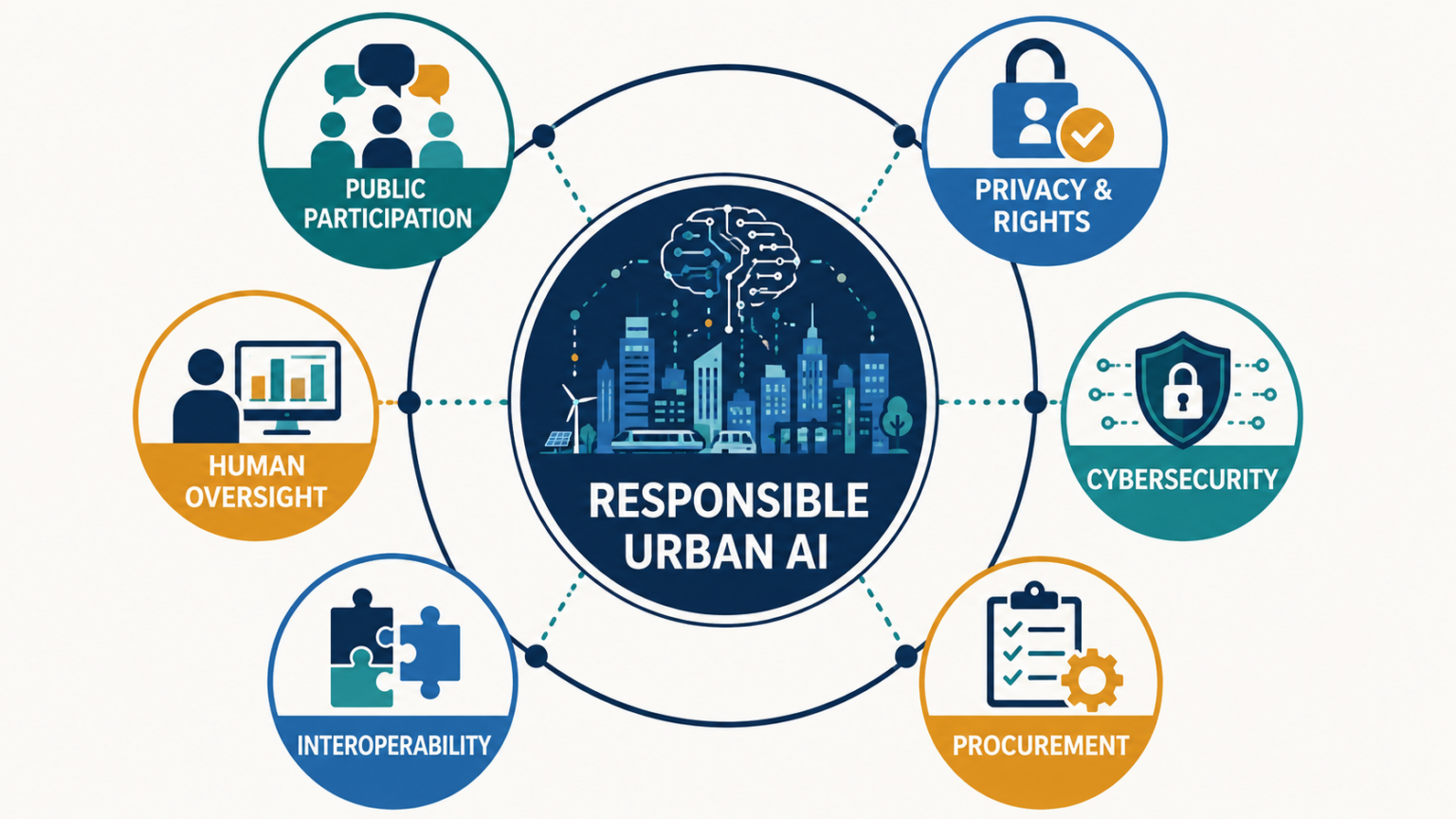
A technically capable model does not by itself produce a successful city service. Responsible deployment is an institutional and public-governance task.
- Start with a public problem and measurable goal. Do not begin with a vendor product and search for a use.
- Assess impacts before procurement. Examine rights, privacy, equity, accessibility, environmental cost, failure modes, and non-AI alternatives.
- Write enforceable procurement terms. Require documentation, testing data, security controls, audit rights, incident reporting, data-return or deletion rules, and an exit plan that prevents vendor lock-in.
- Design for interoperability. Open interfaces and shared data definitions help systems work across agencies and make replacement practical. ITU standards treat interoperability as a core smart-city requirement.
- Secure the whole lifecycle. Protect sensors, networks, models, accounts, software supply chains, and operational technology; plan for degraded and manual operation. Learn more in AI in Cybersecurity.
- Build institutional capacity. City staff need domain, data, legal, security, procurement, and community-engagement skills—not only access to a model.
- Include the public early. Residents should be able to understand the purpose, challenge assumptions, identify local harms, and influence whether and how a system is used.
- Monitor outcomes and stop when necessary. Publish meaningful measures, review disparate effects, investigate incidents, and suspend systems that fail their stated goals or safeguards.
Where urban AI is developing next
Near-term development is likely to focus on better integration of GeoAI, digital twins, edge computing, and language-based interfaces. More autonomous or agent-like systems may also be proposed for city operations. The central question is not whether a tool is advanced; it is whether a city can govern it, test it in local conditions, keep people in meaningful control, and demonstrate public value.
Key takeaways
- A smart city is an urban system using ICT and other tools; it is not automatically an AI city.
- AI is most useful where prediction, perception, language, optimization, or decision support addresses a defined service need.
- Case-study claims should separate technical capability, evaluated evidence, and hoped-for outcomes.
- Surveillance and predictive policing require heightened scrutiny because errors and misuse can affect rights and liberty.
- Governance, procurement, interoperability, cybersecurity, staff capacity, and public participation are core operating requirements.
Continue the learning path
Next: AI in Governance explains the public-sector oversight and accountability needed around urban AI.
Related routes: AI in Public Policy for policy analysis and design, and AI in Disaster Management for preparedness, response, and recovery. Explore the broader AI Applications learning path.
Sources and further reading
- ITU: Smart sustainable cities
- ITU-T Y.4223: Common smart-city requirements and capabilities
- UN-Habitat: Global Assessment of Responsible AI in Cities
- Singapore LTA: GLIDE and CRUISE traffic-management systems
- NIST: Face Recognition Technology Evaluation—demographic effects
- ITU-T Y.4600: Digital twin systems for smart cities