

AI in governance has two connected meanings: how public institutions use artificial intelligence to deliver services and run operations, and how those institutions control their own AI use. The first is about practical applications. The second is about accountability.
AI can help classify documents, route requests, translate information, forecast demand, detect unusual patterns and support caseworkers. It does not automatically make government fairer, more transparent or more accurate. Those outcomes depend on the data, purpose, design, staff, oversight and remedies surrounding the system.
This guide explains both sides of AI in governance for a general audience. It describes current governance frameworks but is not legal advice; public institutions must determine which laws, standards and policies apply in their jurisdiction and use case.
Last reviewed: .
What Does “AI in Governance” Mean?
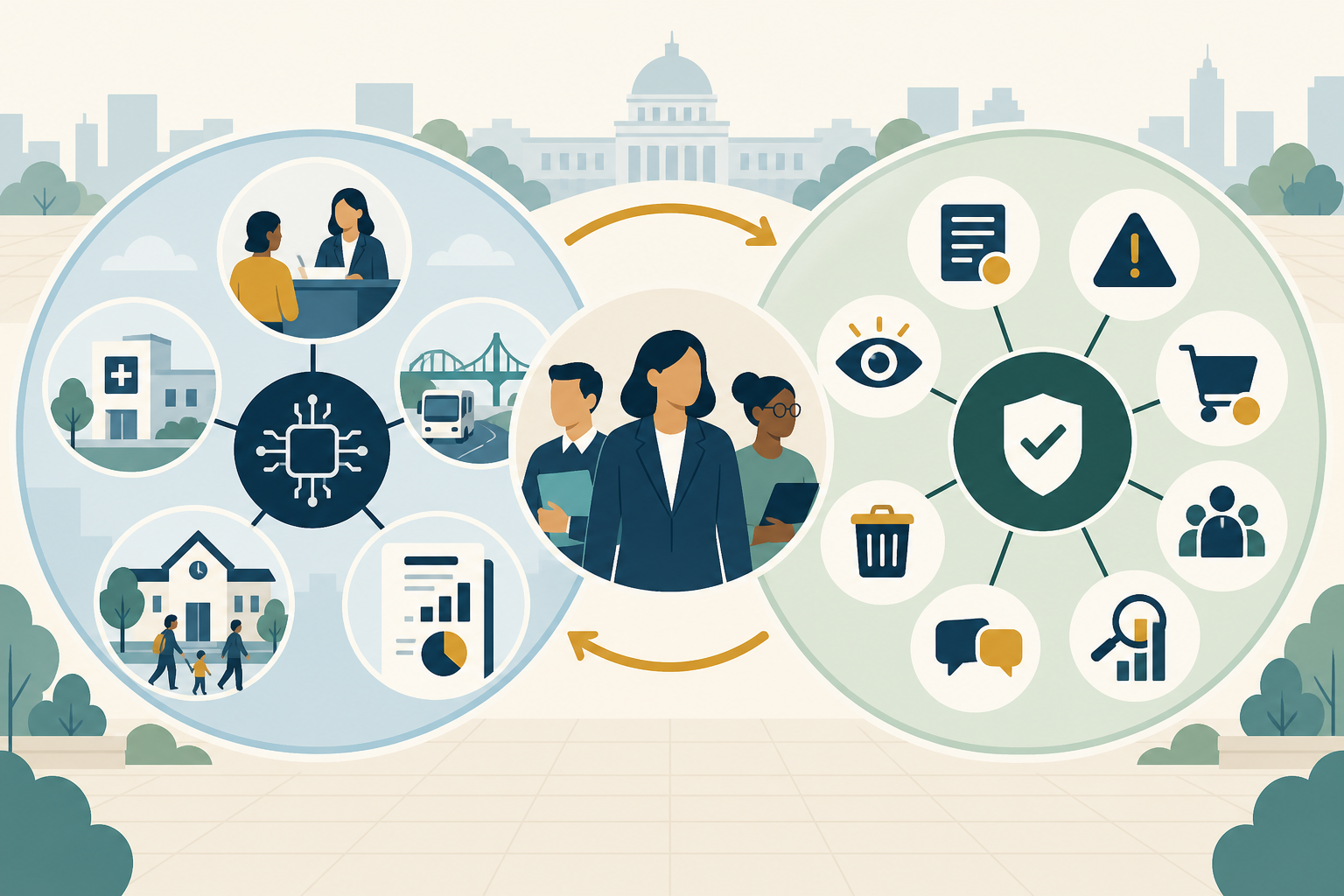
Governing with AI means using AI in public administration: for example, assisting staff, organizing records, answering routine questions or identifying patterns that merit review. Governing AI means establishing the policies, responsibilities and controls that apply before, during and after a government AI system is used.
The distinction matters. AI ethics asks what values and principles should guide AI. AI governance turns those principles into operating practice through ownership, assessments, documentation, testing, oversight, monitoring and accountability.
Where Governments Use AI
Administrative workflows
Public agencies can use AI to classify correspondence, extract information from forms, route cases, search records and draft routine material for staff review. Automation may reduce some manual errors or delays, but it can introduce different errors at scale. Agencies still need quality checks, fallback procedures and staff who can recognize when an output is wrong.
Citizen information and access
Chatbots, translation tools and search assistants can help people find information outside office hours or in more languages. A citizen-facing tool should clearly disclose that it uses AI, protect personal data and provide an accessible route to a person. It should never make an unavailable digital channel the only way to obtain an essential service.
Planning, forecasting and inspection support
Models can help estimate service demand, identify operational bottlenecks or flag records for inspection. A flag is not proof of a violation, and a forecast is not a fact. Data gaps, changing conditions and false positives can all distort results. Qualified officials must interpret outputs within their legal and operational context.
AI can also support policy analysis and simulation, but that topic belongs in the dedicated guide to AI in public policy. City infrastructure and emergency-response applications are covered in AI in smart cities and AI in disaster management.
Why Government AI Is Different
Government exercises public authority. Its decisions can affect benefits, licenses, taxes, education, healthcare access, immigration, enforcement, liberty and other rights. People may have no practical alternative provider and may be required to interact with an agency. That raises the standard for necessity, proportionality, due process and public accountability.
High-impact uses need especially careful safeguards. An eligibility model may help staff process applications, but it can also contribute to wrongful denials or unequal error rates. Historical policing data may reflect earlier enforcement patterns rather than an unbiased measure of underlying crime, creating feedback loops. In courts or enforcement, statistical consistency is not the same as justice or lack of bias.
For decisions with serious consequences, people should receive meaningful notice when AI materially influences an outcome, an understandable explanation appropriate to the context, review by a qualified person and a practical way to challenge errors. Legal research and professional legal workflows are addressed separately in AI in legal services.
Core Safeguards for Government AI
1. Defined roles and responsibility
Every system needs an accountable owner. Agencies should document who approves the purpose, who manages data, who validates performance, who oversees vendors, who can stop the system and who remains responsible for the final public decision. “The algorithm decided” is not an accountability structure.
2. An AI inventory
An organization cannot govern systems it does not know it uses. An inventory can record each system’s owner, purpose, users, affected groups, data sources, vendor, risk level, approval status, deployment date and review schedule. Public-facing registers can improve scrutiny where disclosure is appropriate, while sensitive security or personal information may require limits.
3. Risk and impact assessment
Before procurement or deployment, an agency should ask whether AI is necessary and whether a less risky approach could meet the need. An assessment can identify who may be affected, intended benefits, foreseeable harms, privacy and discrimination risks, failure consequences, accessibility needs, human-review procedures and monitoring requirements. Higher-impact uses warrant deeper assessment and stronger approval.
4. Human oversight that works
Human involvement is meaningful only when reviewers have time, training, authority and enough information to question the system. A person who routinely accepts recommendations without examination is vulnerable to automation bias. Oversight plans should define when staff must intervene, what evidence they review and how overrides are recorded.
5. Transparency and documentation
Transparency is a governance choice, not an automatic benefit of AI. Documentation should explain the system’s purpose, limits, approved users, data dependencies and known risks. People interacting with an AI assistant should normally know it is not human. When an AI system materially informs a decision, the agency should provide information that helps the affected person understand and challenge the outcome, subject to applicable privacy, security and legal constraints.
6. Testing, monitoring and audit
Pre-deployment testing should reflect the real population and operating environment. After launch, agencies should monitor accuracy, error types, unequal impacts, security incidents, user feedback, overrides and changes in data or model behavior. Independent review may be appropriate for high-impact uses. An audit should test evidence and controls; it should not be a one-time label that guarantees safety or compliance.
7. Complaints, review and remedies
People need a visible, accessible way to report problems and contest AI-assisted outcomes. The process should state who reviews a complaint, the response timeline, available human reconsideration and how systemic issues are corrected. Agencies should track complaints as evidence for monitoring, not treat them as isolated customer-service events.
8. Lifecycle governance and retirement
Governance continues after approval. A practical lifecycle is: define the need → assess risk and impact → approve and procure → test → deploy with oversight → monitor and audit → correct or suspend → retire safely. Retirement plans should address records, data retention, vendor access, replacement processes and notice to affected users. A system should be suspended or withdrawn when it no longer performs acceptably or its risks cannot be controlled.
- Define the needIdentify the public purpose and consider whether AI is necessary.
- Assess risk and impactExamine affected groups, rights, privacy, security and failure consequences.
- Approve and procureAssign ownership and put enforceable safeguards into approvals and contracts.
- TestValidate performance, accessibility and oversight in realistic conditions.
- Deploy with oversightTrain staff, disclose appropriate information and preserve human alternatives.
- Monitor and auditTrack errors, unequal impacts, incidents, overrides, drift and complaints.
- Correct or suspendRespond to evidence of harm and stop use when controls are inadequate.
- Retire safelyClose vendor access, manage records and data, and notify affected users.
Government AI Procurement and Vendor Governance
Many public bodies buy AI services rather than build them. Outsourcing technology does not outsource public responsibility. Before signing a contract, procurement teams should test vendor claims and require enough documentation and access to govern the system throughout its life.
- Define the approved purpose, performance requirements and prohibited uses.
- Clarify data ownership, permitted reuse, retention, location and deletion.
- Require documentation of training or evaluation data where relevant and lawful.
- Secure testing, audit, incident-notification and access rights.
- Control model updates, subcontractors and material system changes.
- Set accessibility, privacy and cybersecurity requirements.
- Plan for portability, continuity, termination and vendor lock-in.
Contracts should also identify who responds when the system fails. Trade-secret claims should not prevent a public institution from obtaining the information it needs for lawful oversight, explanations, audits and remedies.
Major AI Governance Frameworks Governments Should Know
These frameworks have different purposes and legal effects. Some are voluntary guidance, one is a certifiable management-system standard, and others create treaty or regulatory obligations for covered parties. They can inform a governance program, but listing them does not establish compliance.
- NIST AI Risk Management Framework (AI RMF 1.0): a voluntary, rights-preserving and use-case-agnostic framework organized around Govern, Map, Measure and Manage. Its cross-cutting Govern function addresses policies, roles, inventories and ongoing risk management. NIST notes that version 1.0 is being revised.
- OECD AI Principles and government guidance: the principles, updated in 2024, cover human rights and democratic values, transparency and explainability, robustness, security, safety and accountability. The OECD’s framework for trustworthy AI in government connects practical enablers, proportionate guardrails and stakeholder engagement.
- UNESCO Recommendation on the Ethics of Artificial Intelligence: adopted in 2021, it centers human rights and dignity and calls attention to oversight, impact assessment, audit, transparency, fairness, privacy and human determination across the AI lifecycle.
- ISO/IEC 42001:2023: an international standard specifying requirements for establishing, implementing, maintaining and continually improving an AI management system. It uses a management-system approach to organizational policies, objectives, risks and opportunities.
- European Union AI Act: a binding, risk-based EU regulation with staged application. It entered into force on August 1, 2024. Prohibited-practice rules and AI-literacy obligations began applying on February 2, 2025; governance rules and general-purpose AI model obligations followed on August 2, 2025. The general application date was August 2, 2026. The Commission’s current timeline lists December 2, 2027 for the specified high-risk uses in Annex III and August 2, 2028 for high-risk systems embedded in regulated products under Annex I, following the 2026 AI Omnibus changes. Institutions must check the exact provisions, transition rules and jurisdiction that cover their use, using current official guidance and qualified legal advice.
- Council of Europe Framework Convention on AI, Human Rights, Democracy and the Rule of Law: opened for signature on September 5, 2024. Signature, ratification and entry into force are different steps. Entry into force requires five ratifications, including at least three Council of Europe member states. The latest Treaty Office status chart retrievable for this review was dated September 12, 2026: it recorded one ratification, by the European Union on May 15, 2026, and no entry-into-force date. That dated record is not confirmation of later changes. Institutions should check the latest chart, applicable treaty commitments and domestic law before relying on a legal obligation.
Common Risks and Failure Modes
- Bias and discrimination: data, labels, objectives or deployment choices can create unequal errors or reinforce existing disadvantage.
- Privacy and surveillance: combining government datasets can expose sensitive information or enable uses beyond the original purpose.
- Security: systems and data can be manipulated, leaked or disrupted.
- Opacity: staff or affected people may not understand a system’s role, evidence or limitations.
- Automation bias: officials may defer to an output even when contrary evidence exists.
- Digital exclusion: language, disability, connectivity or digital-literacy barriers can prevent access.
- Model or data drift: performance can deteriorate as populations, policy or operating conditions change.
- Scale: a system can repeat the same error across thousands of cases before the pattern is noticed.
How Public Institutions Can Adopt AI Responsibly
- Start with a defined public need, not a technology in search of a problem.
- Consider non-AI alternatives and avoid automation where it is unnecessary or disproportionate.
- Assign an accountable owner and add the system to an inventory.
- Engage affected communities, frontline staff, accessibility experts and independent reviewers early.
- Complete proportionate risk, rights, privacy, security and impact assessments before approval.
- Set procurement, testing, documentation, human-oversight and complaint requirements.
- Pilot narrowly, measure real outcomes and avoid scaling on the strength of vendor demonstrations alone.
- Monitor after deployment, publish appropriate information and act on incidents and feedback.
- Reassess after material changes and retire systems that no longer meet their purpose or safeguards.
The goal is not to assume AI will improve public decisions. It is to determine, with evidence, whether a particular system delivers a legitimate benefit while preserving rights, accountability and workable human alternatives.
Sources and Review Notes
This guide prioritizes primary institutional sources and separates voluntary guidance, management-system standards, regulations and treaty commitments. Framework names are not evidence that a particular system is safe, effective or legally compliant. The October 2, 2026 review checked the framework references and the Commission’s application timeline; the retrievable Council of Europe status record is dated separately above. Applicability can change, and this educational overview is not legal advice.
- NIST AI Risk Management Framework
- OECD AI Principles
- UNESCO Recommendation on the Ethics of AI
- ISO/IEC 42001:2023
- European Commission: AI Act and application timeline
- Council of Europe Framework Convention
- Council of Europe Treaty Office: signatures and ratifications
Related Guides and Next Step
Next: Learn the principles behind responsible AI in our AI Ethics guide. Ethics defines the values; governance puts them into practice.
For specialist public-sector applications, continue with AI in Public Policy, AI in Legal, AI in Cybersecurity, AI in Smart Cities or AI in Disaster Management. Browse the broader learning path in Real-World Applications of AI.