
Artificial intelligence can help space missions interpret data, select targets and support decisions when Earth is too far away for immediate control. But AI is not the same thing as automation or autonomy. This guide explains the difference, shows where AI is genuinely used, and examines the safeguards that keep people responsible for mission decisions.
Updated: October 2026
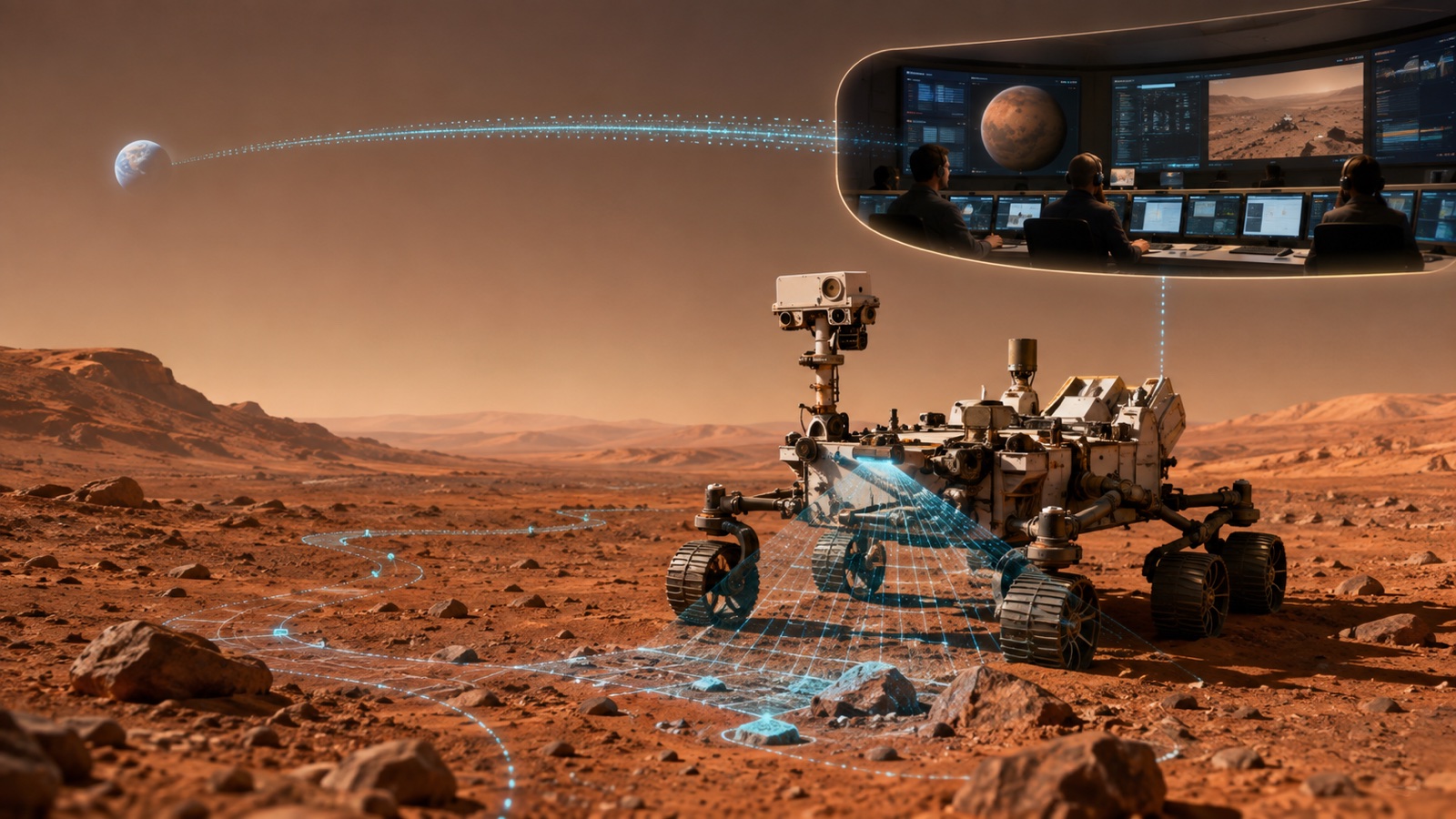
What does AI mean in space exploration?
Space systems combine many kinds of software. Calling every system that acts without a person “AI” hides important differences:
- Automation follows predefined instructions, such as carrying out a timed sequence of commands.
- Autonomy lets a system assess conditions and choose among permitted actions without waiting for a new command from Earth.
- Artificial intelligence is a broad family of techniques for tasks such as perception, planning, pattern recognition and decision support. Machine learning is one part of AI; not every algorithm learns from data.
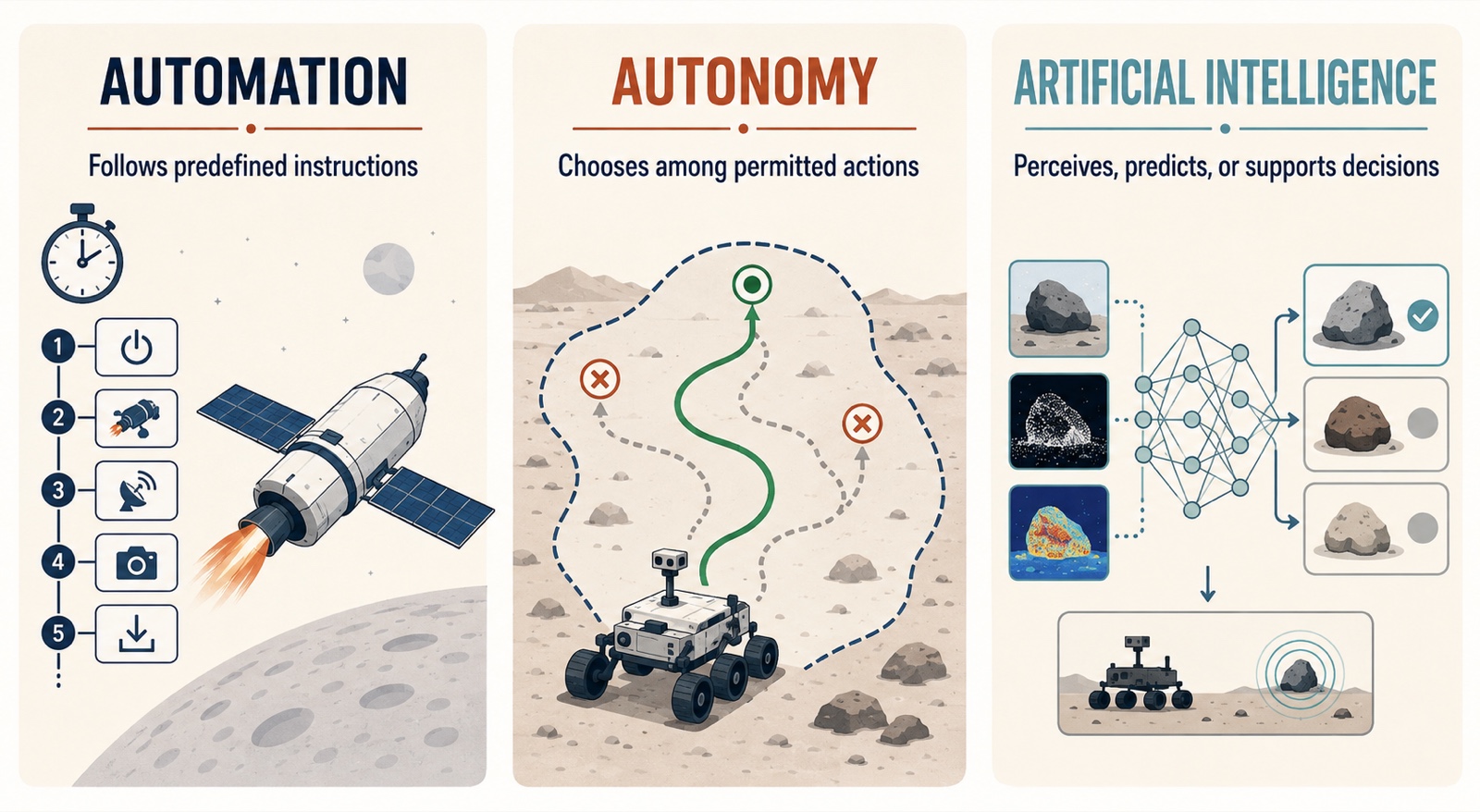
A spacecraft can be autonomous without using machine learning. It might rely on rules, conventional control software, optical navigation or optimization. Conversely, an AI model may analyze images on Earth without controlling a spacecraft at all. For useful background, see our guides to artificial intelligence, machine learning and computer vision.
Why greater autonomy matters in space
Radio signals travel at the speed of light, but the distances are enormous. A rover on Mars cannot be driven with a live joystick from Earth. Communications can also be intermittent and bandwidth is limited. Onboard systems therefore need to execute plans, respond to local hazards and sometimes prioritize observations while mission teams are out of the loop.
That does not mean a spacecraft receives unlimited freedom. Engineers define goals, operating boundaries and safety rules. The useful pattern is usually people set objectives → software evaluates a constrained situation → the spacecraft acts within approved limits → results return to Earth for review.
Benefits of AI in space exploration
When used for a well-defined task, AI can help mission teams make better use of limited time, data and spacecraft resources:
- Faster local responses: onboard AI can help select a science target or prioritize an observation before instructions can arrive from Earth.
- More useful observations: systems such as PIXL adaptive sampling and Dynamic Targeting can focus measurements on scientifically useful targets or avoid unusable images.
- More manageable datasets: models can screen large collections of telescope or spacecraft data so researchers can focus their review on promising signals.
- Planning support: AI planning tools can turn mission goals into candidate activity schedules while accounting for operational constraints.
These benefits depend on the task, hardware and validation. They do not mean that AI guarantees a safer or more successful mission, or that every autonomous spacecraft function uses AI.
Autonomous rovers and spacecraft
Mars rovers: local navigation, not unrestricted control
Rover teams traditionally choose science objectives and plan routes or waypoints on Earth. Onboard navigation software then uses cameras and other sensors to estimate position, evaluate nearby terrain, avoid hazards and choose safe movements between waypoints. The rover is autonomous at the local level, but people still direct the mission.
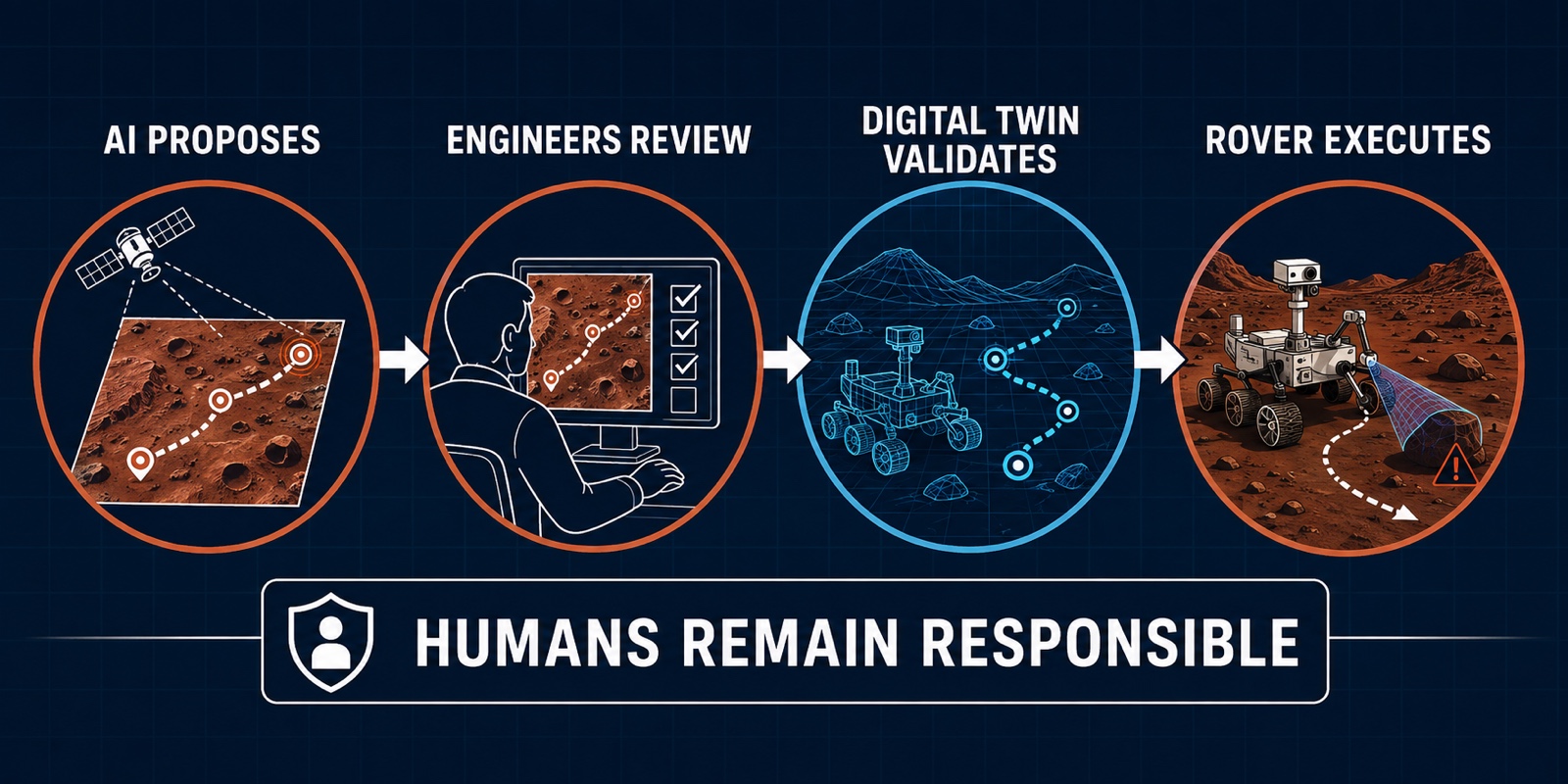
In December 2025, Perseverance completed the first drives on another world whose waypoints were generated by a vision-capable generative-AI system. The demonstration did not hand the mission over to a chatbot: engineers reviewed the proposed route, processed the commands through a digital twin of the rover and verified more than 500,000 telemetry variables before sending them to Mars. Perseverance then executed the approved drives while its onboard autonomy handled terrain. The workflow was AI proposes → engineers verify → digital twin validates → rover executes. Read the NASA/JPL report on Perseverance’s AI-planned drive.
OSIRIS-REx: a lesson in careful terminology
During its sample collection at asteroid Bennu, OSIRIS-REx used Natural Feature Tracking. The optical-navigation system compared live camera images with onboard maps and could update the spacecraft’s predicted position and trajectory. NASA describes this as autonomous navigation, but that description alone does not establish that it was a machine-learning system. OSIRIS-REx is therefore a strong example of autonomy, not proof that every autonomous spacecraft capability is AI. See NASA’s explanation of the OSIRIS-REx sample-collection sequence.
AI for onboard science and target selection
Some of the clearest spaceflight AI examples do not steer the vehicle. They help instruments decide what to measure within priorities chosen by scientists.
PIXL adaptive sampling
Perseverance’s Planetary Instrument for X-ray Lithochemistry (PIXL) maps the chemical composition of tiny areas of Martian rock. Its adaptive-sampling software analyzes measurements as they are collected and can spend longer examining minerals of interest. NASA describes this as the first use on Mars of AI making autonomous science decisions from real-time rock-composition analysis. Scientists decide what kinds of minerals matter; the instrument helps focus limited observation time. Learn more from NASA’s PIXL overview.
AEGIS autonomous targeting
AEGIS—Autonomous Exploration for Gathering Increased Science—uses rover imagery to detect candidate rocks, extract visual and geometric features, filter unsuitable targets and rank the remainder against a profile supplied by the science team. It can then point a remote-sensing instrument at the selected target without waiting for Earth. AEGIS has been used on Opportunity, Curiosity and Perseverance. JPL’s AEGIS project page explains the workflow and its onboard safety checks.
AI in mission operations and planning
Planning, scheduling, simulation and optimization are not automatically AI. In practice, mission systems may mix AI methods with conventional algorithms and human judgment. Credible uses include:
- planning and scheduling activities within time, power and instrument constraints;
- detecting unusual telemetry and helping operators investigate anomalies;
- selecting science targets or prioritizing which data should be sent first;
- supporting—not replacing—engineering decisions; and
- executing approved tasks onboard when Earth cannot respond quickly.
The right question is not “Does this mission use AI?” but “Which technique is used, what input does it receive, what decision can it make, and what remains under human control?”
A concrete example is JPL’s ASPEN (Automated Scheduling and Planning Environment), an AI planning framework that uses a spacecraft model and mission goals to build activity plans. For the Orbital Express satellite-servicing demonstration, ASPEN was used to schedule the daily activities of the mission’s two satellites. This is a specific planning role, not a claim that the spacecraft independently chose their mission objectives. NASA’s Orbital Express operations paper describes the application.
AI for astronomical data analysis
Telescopes produce more observations than researchers can inspect manually. Machine-learning systems can screen light curves, classify candidate signals and rank cases for expert attention. This is assistance in a scientific workflow, not an AI independently proving a discovery.
NASA’s ExoMiner is a useful example. The deep neural network evaluates signals in Kepler telescope data and helps distinguish likely planets from false positives. In 2021, NASA reported that ExoMiner helped validate 301 additional exoplanets. The result still depended on mission data, established validation criteria and scientific review. Read NASA’s ExoMiner report.
The learning pattern is: large telescope dataset → candidate signals → machine-learning screening → scientific validation. Later ExoMiner work extends this approach to data from the Transiting Exoplanet Survey Satellite (TESS), showing how models can help researchers focus attention without replacing the standards required to confirm a planet.
AI aboard Earth-observing satellites
Earth observation is adjacent to space exploration, so it belongs here only briefly. In a 2025 flight test, NASA/JPL’s Dynamic Targeting system analyzed look-ahead imagery onboard a satellite and decided where to point an instrument in under 90 seconds. The cloud-avoidance demonstration showed how onboard AI can reduce unusable observations and respond before a short-lived target passes beneath the spacecraft. See NASA’s Dynamic Targeting explanation.
For wider uses of satellite data on our planet, continue with AI in environmental science or AI in disaster management.
Limits and safety in space
Space is a demanding environment for any computer system. AI adds capabilities, but it also adds validation work.
- Limited computing and memory: flight-qualified processors may be far less powerful than current terrestrial hardware.
- Power and heat: computation competes with instruments, communications and mobility for a limited energy budget.
- Radiation and hardware reliability: electronics must tolerate faults in an environment where physical repair is usually impossible.
- Latency and bandwidth: a spacecraft may need to act before new instructions arrive and cannot transmit every raw observation.
- Unfamiliar conditions: terrain, lighting or sensor readings may differ from training and test data.
- Verification and validation: engineers must test how software behaves in normal, edge-case and failure scenarios.
- Difficult updates: changing deployed flight software can be slow and risky.
Safe deployment uses bounded authority, conservative fallback behavior, simulations and hardware testing, traceable logs, and explicit rules for when the system must stop or defer. The Perseverance demonstration’s digital-twin checks illustrate this engineering mindset.
Human oversight and responsible deployment
Mission organizations remain accountable for what autonomous systems do. Humans choose mission goals, define acceptable risk, approve software and operating boundaries, monitor results, and decide how to respond to anomalies. Explainability and traceability are especially valuable when operators must reconstruct why a system selected a route, target or action.
Planetary protection is broader than AI ethics. Requirements intended to prevent harmful forward contamination of other worlds and backward contamination of Earth apply to qualifying missions whether decisions are manual, automated or AI-assisted.
NASA Planetary Protection
AI-specific responsibility centers on reliability, human authority, safe fallback behavior, testing, traceability and accountability. For the broader principles, see our guide to AI ethics.
What researchers are developing next
Near-term research is more concrete than predictions about fully AI-controlled colonies or interstellar travel. Current work focuses on longer rover drives with less operator workload, better onboard science prioritization, risk-aware decision-making, anomaly management and coordination between spacecraft. JPL’s MAARS research, for example, investigates drive-by science and energy-aware autonomous navigation for future rovers.
These projects should be described as research and demonstrations, not guaranteed mission capabilities. Progress depends on flight-qualified hardware, careful validation and a clear scientific reason to grant additional autonomy.
Knowledge check
- Why is autonomy not automatically AI?
Autonomy describes a system’s ability to act without immediate human input. It may use AI, conventional rules, control software or several techniques together. - What did the AI system do in Perseverance’s 2025 drive demonstration?
It proposed route waypoints. Engineers and a digital twin validated the commands before transmission, and the rover executed the approved drive with onboard navigation. - How do PIXL and AEGIS support science?
PIXL can adapt measurements in response to real-time composition data; AEGIS can rank and select targets that match scientist-defined priorities. - What does ExoMiner contribute?
It screens telescope signals to help researchers distinguish likely exoplanets from false positives; scientific validation remains essential. - Why is planetary protection separate from AI ethics?
Contamination controls apply to relevant missions regardless of whether AI is involved.
Frequently asked questions
Is AI controlling space missions by itself?
No. AI and autonomy usually operate within goals, constraints and safety rules defined by mission teams. The degree of onboard decision-making varies by mission and task.
How is AI used on Mars rovers?
Examples include local terrain assessment, science-target selection and adaptive instrument sampling. A 2025 Perseverance demonstration also used generative AI to propose drive waypoints that engineers validated before upload.
Can AI discover planets?
Machine-learning models can find and classify promising signals in telescope data. Scientists still apply validation criteria, check alternative explanations and report the result.
What is the biggest challenge for AI in space?
There is no single challenge. Limited computing, radiation, power, communications, unfamiliar environments and the need for exceptionally reliable behavior all shape what can safely fly.
Continue learning
Next: AI in Robotics—How Artificial Intelligence Helps Robots Perceive, Plan and Act. It is the closest next step for understanding how machines combine perception, planning, control and human-defined goals.
Browse more examples in the AI Applications learning hub.