
Last reviewed and updated: September 1, 2026
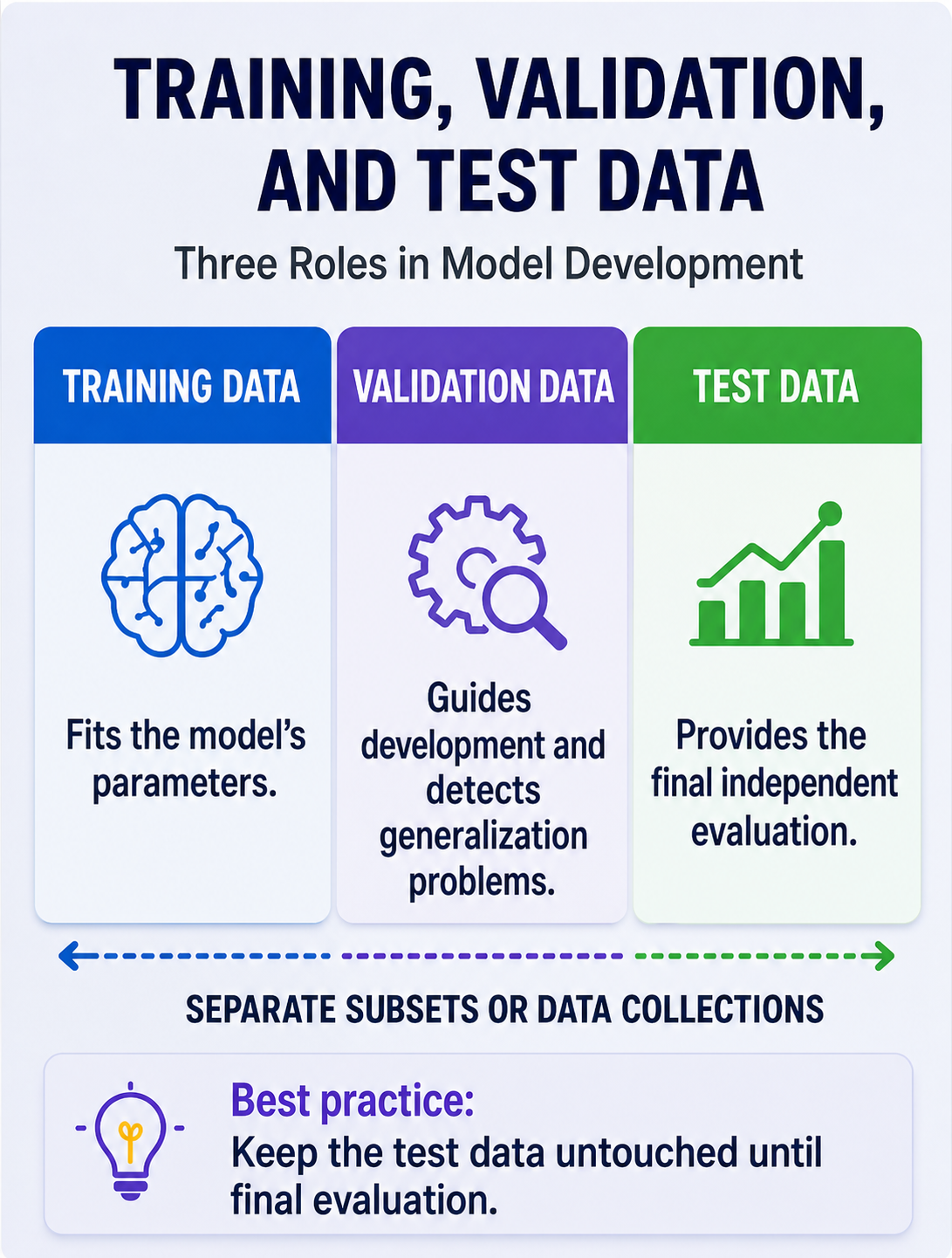
Training, validation, and test data are separate data subsets or collections, and each has a different job. Training data teaches the model, validation data guides development choices, and test data provides a final check on unseen examples.
Keeping these roles separate helps produce a more honest estimate of how a model will perform after deployment. If you need the broader foundation first, read What Is a Dataset in Machine Learning?.
What Is Training Data?
Training data is the subset used to fit a model’s parameters. In supervised learning, each training example normally includes input features and a known label or target.
During training, the algorithm repeatedly examines these examples and adjusts its internal parameters to reduce prediction error. Because the model learns directly from this subset, performance on the training data alone does not show how well it will generalize.
What Is Validation Data?
Validation data supports decisions made while a model is being developed. Teams may use it to compare algorithms, tune hyperparameters, select features, choose decision thresholds, or decide when to stop training.
Validation can use one dedicated subset or a cross-validation procedure. The important point is that validation results influence development choices, while the final test set should remain outside that loop.
What Is Test Data?
Test data is a held-out subset used after the model, features, preprocessing steps, and hyperparameters have been finalized. Its purpose is to estimate how the selected system performs on genuinely unseen examples.
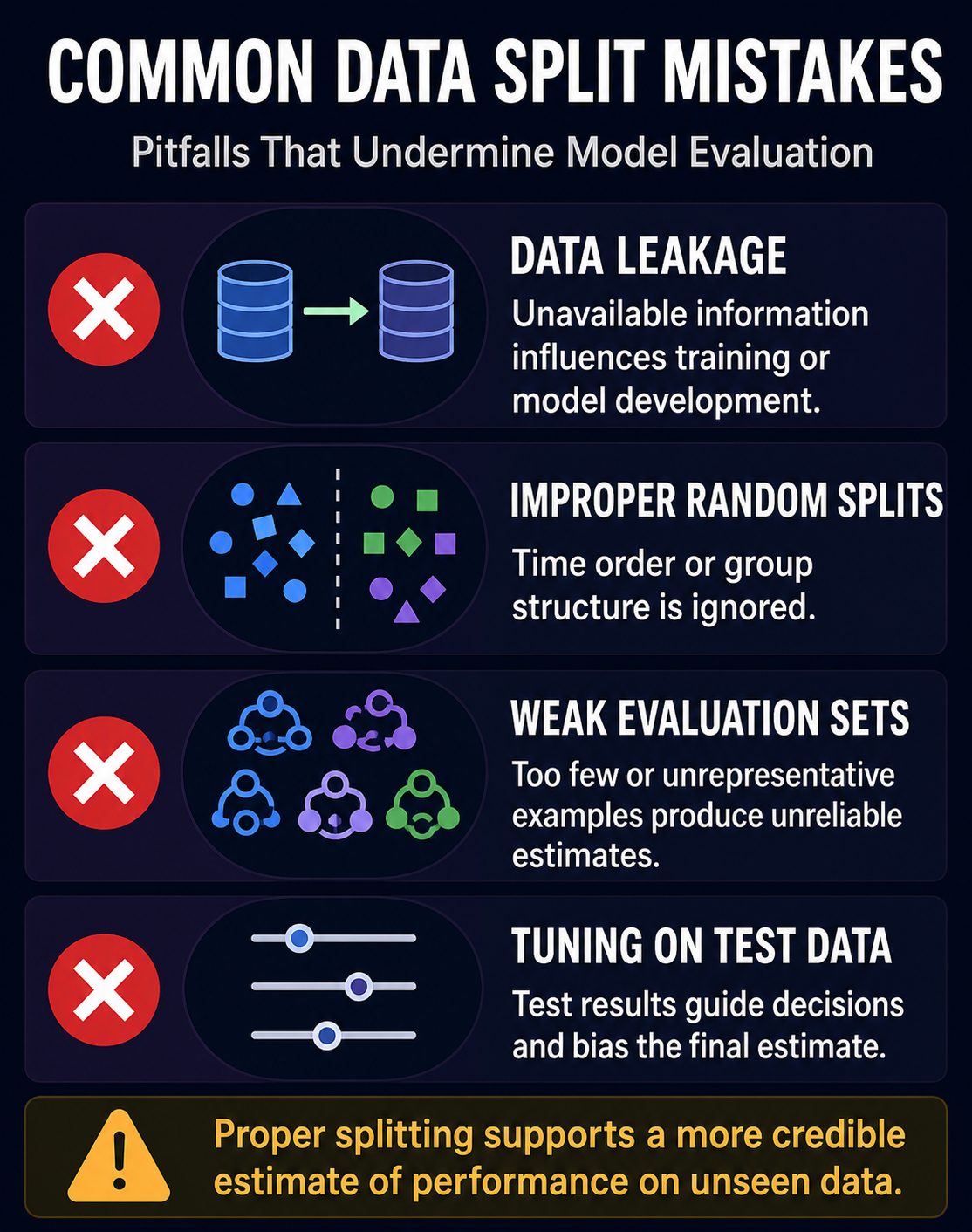
If a team repeatedly checks the test results and changes the model in response, the test set gradually becomes another validation set. This is sometimes called test-set wearout. A trustworthy final evaluation requires data that has not already guided development.
Training vs Validation vs Testing
| Dataset | Primary role | What it may influence |
|---|---|---|
| Training | Fit the model’s parameters | The patterns and relationships learned by the model |
| Validation | Guide model development | Model choice, features, hyperparameters, thresholds, and stopping decisions |
| Test | Provide the final independent evaluation | Reporting and release decisions—not additional tuning |
A Simple Example
Imagine building a model that predicts whether a customer will cancel a subscription.
- Train: The model learns relationships from historical customer records in the training set.
- Validate: Several model versions are compared using validation data. The team chooses features, settings, and a decision threshold without consulting the test set.
- Test: After every development choice is locked, the selected model is evaluated once on the held-out test data.
This process does not guarantee strong real-world performance. The data must also represent the customers and conditions the model will encounter after deployment.
Why Split Data?
A model can appear successful when evaluated on examples it has already seen. Separate validation and test data help reveal whether it has learned patterns that transfer to new cases instead of memorizing noise or peculiarities in the training set.
Splitting data does not prevent overfitting by itself. It makes generalization problems easier to detect and measure. Learn more in Overfitting vs Underfitting.
Is an 80/20 Split Always Best?
No. An 80/20 train/test split is a common teaching example, not a universal rule. The appropriate approach depends on dataset size, class distribution, time dependence, group structure, evaluation uncertainty, and the cost of collecting more data.
A large dataset may reserve a small percentage for evaluation while still producing thousands of test examples. A small dataset may benefit from cross-validation. The goal is not to follow a fixed percentage; it is to create an evaluation that is large enough, representative, and independent.
When Random Splitting Is Appropriate
Random splitting can work when examples are reasonably independent, drawn from the same distribution, and free from meaningful time or group relationships. Even then, duplicates and near-duplicates should not appear across subsets.
For classification, stratification can preserve approximately the same class proportions in each subset. However, stratification does not fix leakage, group dependence, poor coverage, or a mismatch between historical and future data.
When You Should Not Use a Simple Random Split
Time-series data
If a model predicts the future from the past, training on later examples and testing on earlier ones creates an unrealistic evaluation. A chronological split or time-aware cross-validation is normally more appropriate.
Grouped data
Records from the same person, household, device, patient, or organization may be closely related. If one group appears in both training and testing, the result can look better than performance on a genuinely new group. Keep related groups together and use group-aware splitting.
Imbalanced classification
A rare class can be underrepresented or absent in a small evaluation subset. Stratification may preserve class proportions, but the test set must still contain enough examples of each important outcome for meaningful evaluation.
Leakage-sensitive problems
Duplicate examples, post-outcome information, or features derived from the full dataset can expose information that would not be available when a prediction is made. The split must reflect the real prediction boundary.
What Is Data Leakage?
Data leakage occurs when training or development uses information that would not legitimately be available when the model makes real predictions. Leakage can produce impressive validation or test scores that disappear after deployment.
Scikit-learn’s data leakage guidance shows why preprocessing must stay inside the training process. For example, a scaler, imputer, feature selector, or vocabulary should be fitted using training data only. The learned transformation is then applied unchanged to validation and test data. Fitting the transformation on the complete dataset allows evaluation information to influence training.
Cross-Validation
Scikit-learn’s cross-validation guidance describes how cross-validation repeatedly divides development data into training and validation folds. This can provide a more stable estimate when one validation split would be too small or sensitive to chance.
Cross-validation should match the data structure. Ordinary shuffled folds are not appropriate for every problem; time-series and grouped datasets require specialized approaches. Preprocessing must also be fitted separately inside each training fold.
Cross-validation supports model selection, but it does not remove the need for a final untouched test set when an independent final estimate is required.
How Splits Relate to Model Evaluation
A good data split and a good metric answer different questions. The split determines which examples are used for evaluation. The metric determines how performance is measured. Both must match the real-world task.
Accuracy alone may be misleading for imbalanced outcomes, and a representative test set may still become outdated if real-world conditions change. See Model Evaluation Metrics Explained for the next part of evaluation design.
Frequently Asked Questions
What is the difference between training and testing data?
Training data is used to fit a model. Test data is held back and used after development to estimate performance on unseen examples.
What is validation data used for?
Validation data guides development decisions such as choosing a model, tuning hyperparameters, selecting features, and setting thresholds.
Does splitting data prevent overfitting?
No. Splitting creates an independent way to detect and measure generalization problems, but the model can still overfit.
Is 80/20 always the best split?
No. The appropriate proportions and procedure depend on the dataset, task, dependencies, and amount of evaluation evidence needed.
Should time-series data be randomly split?
Usually not when the goal is to predict future events. A chronological split or time-aware validation better reflects that use case.
Sources and Further Reading
- Google Machine Learning Crash Course: Dividing the Original Dataset
- scikit-learn User Guide: Cross-Validation
Continue Learning
Once the data is divided correctly, the next step is preparing it without contaminating the evaluation sets. Continue to Data Preprocessing Explained.