
What Are the Types of Machine Learning?
Machine learning is a branch of artificial intelligence that allows computers to learn from data instead of being explicitly programmed.
But not all machine learning works the same way.
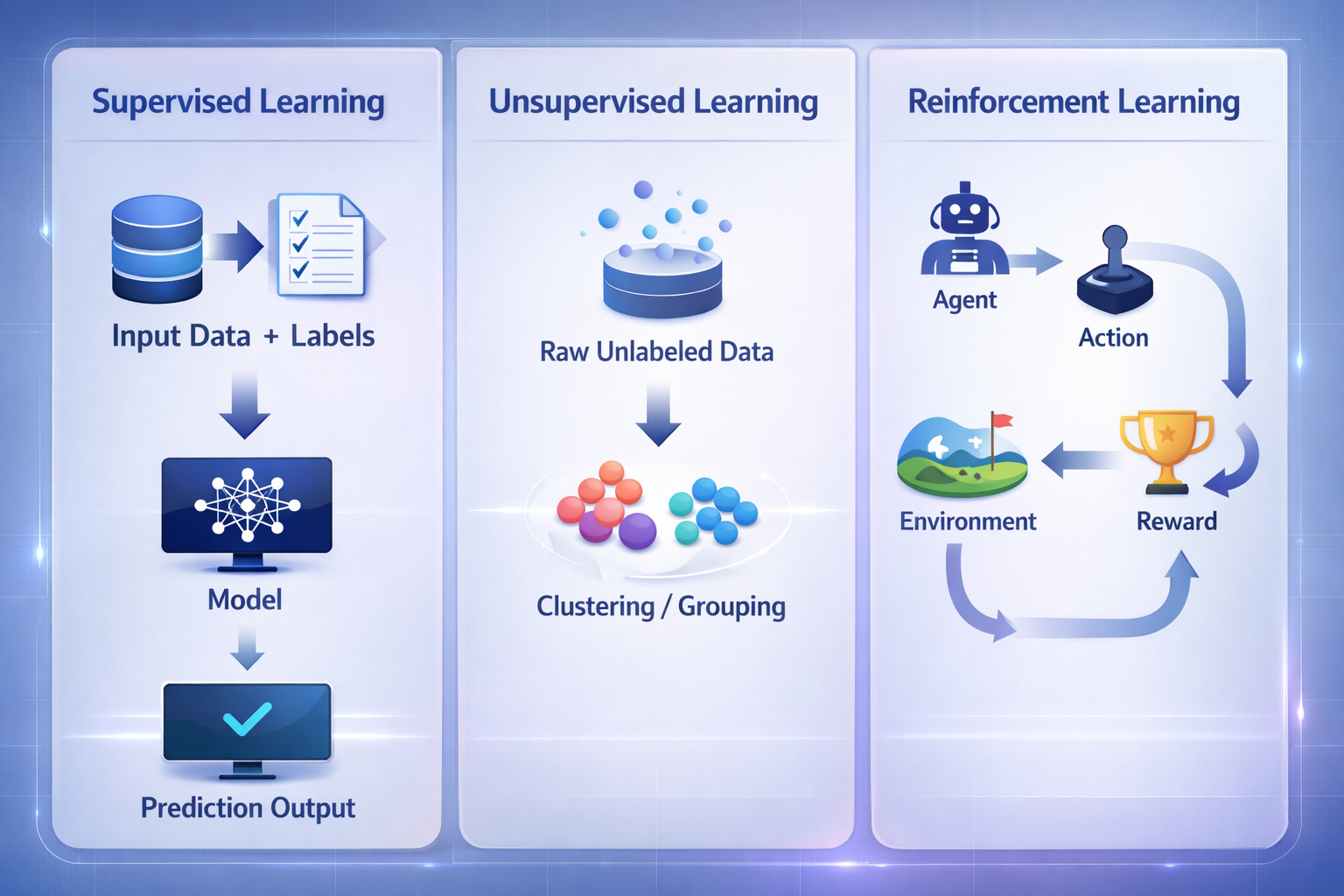
There are three core types of machine learning, each designed for different kinds of problems:
- Supervised Learning → learns from labeled data
- Unsupervised Learning → finds patterns in unlabeled data
- Reinforcement Learning → learns through trial and error
Understanding these types is essential because they form the foundation of nearly all AI systems today.
Types of Machine Learning are the main ways computers learn from data. The three primary types are supervised learning, unsupervised learning, and reinforcement learning, each using different methods to identify patterns, make predictions, or improve decisions over time.
👉 Artificial Intelligence Explained
How Machine Learning Types Work (Step-by-Step)
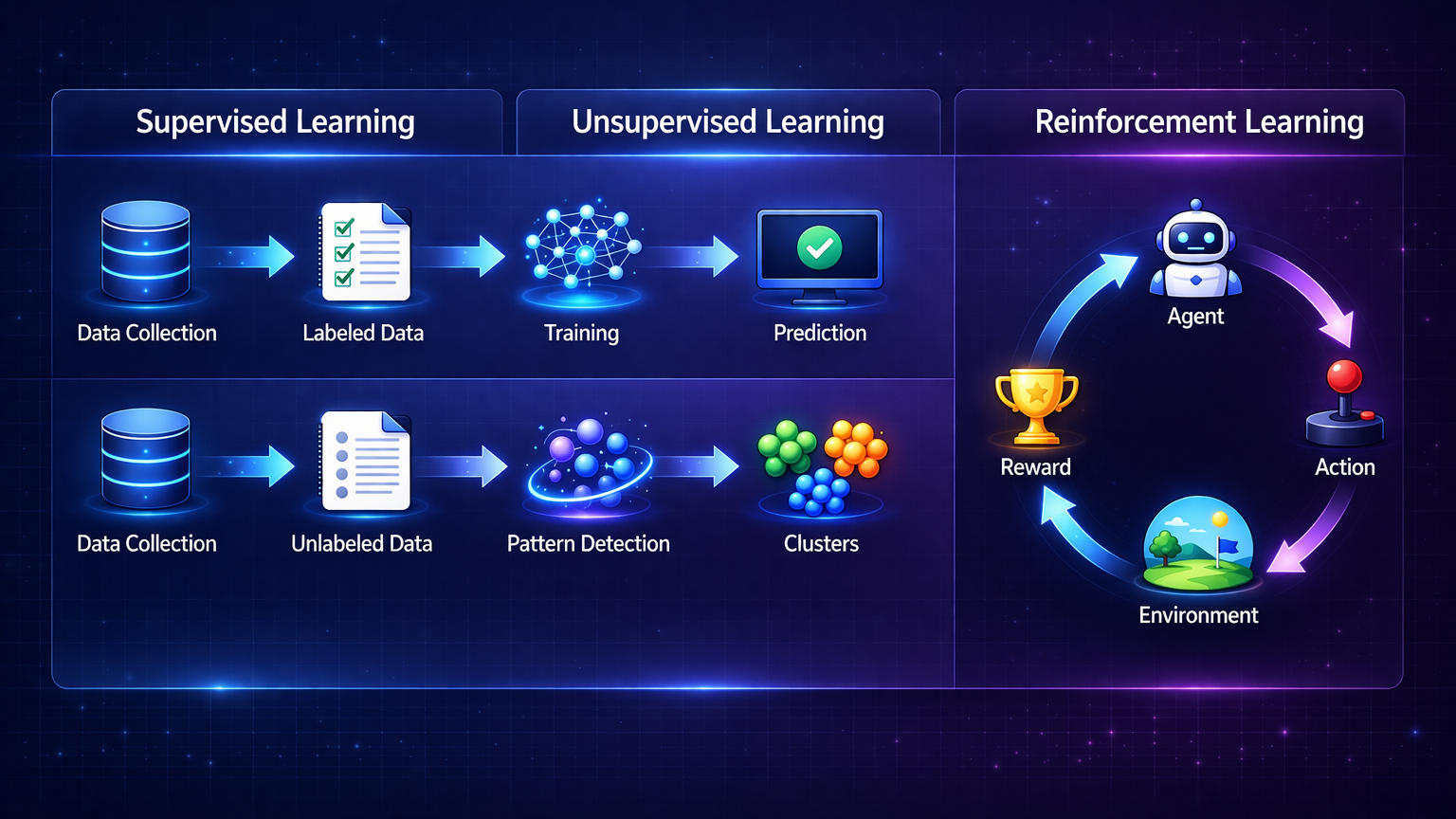
Even though each type is different, they follow a similar high-level process:
Step 1: Data Collection
Machine learning systems start with data:
- Images
- Text
- Numbers
- User behavior
Step 2: Data Preparation
Data is cleaned and organized so the model can understand it.
Step 3: Learning Process
This is where the types differ:
- Supervised → learns from correct answers
- Unsupervised → discovers hidden patterns
- Reinforcement → learns from rewards and mistakes
Step 4: Model Training
The system adjusts itself to improve accuracy.
Step 5: Predictions or Decisions
The trained model is used in real-world applications.
Key Concepts Beginners Must Understand
Before diving deeper, here are a few important concepts:
| Concept | Simple Explanation |
| Data | Information used to train models |
| Features | Important pieces of data (e.g., age, price) |
| Labels | Correct answers (used in supervised learning) |
| Model | The system that learns patterns |
| Training | Teaching the model using data |
| Prediction | Output generated by the model |
👉 Training vs Testing Data
The 3 Main Types of Machine Learning
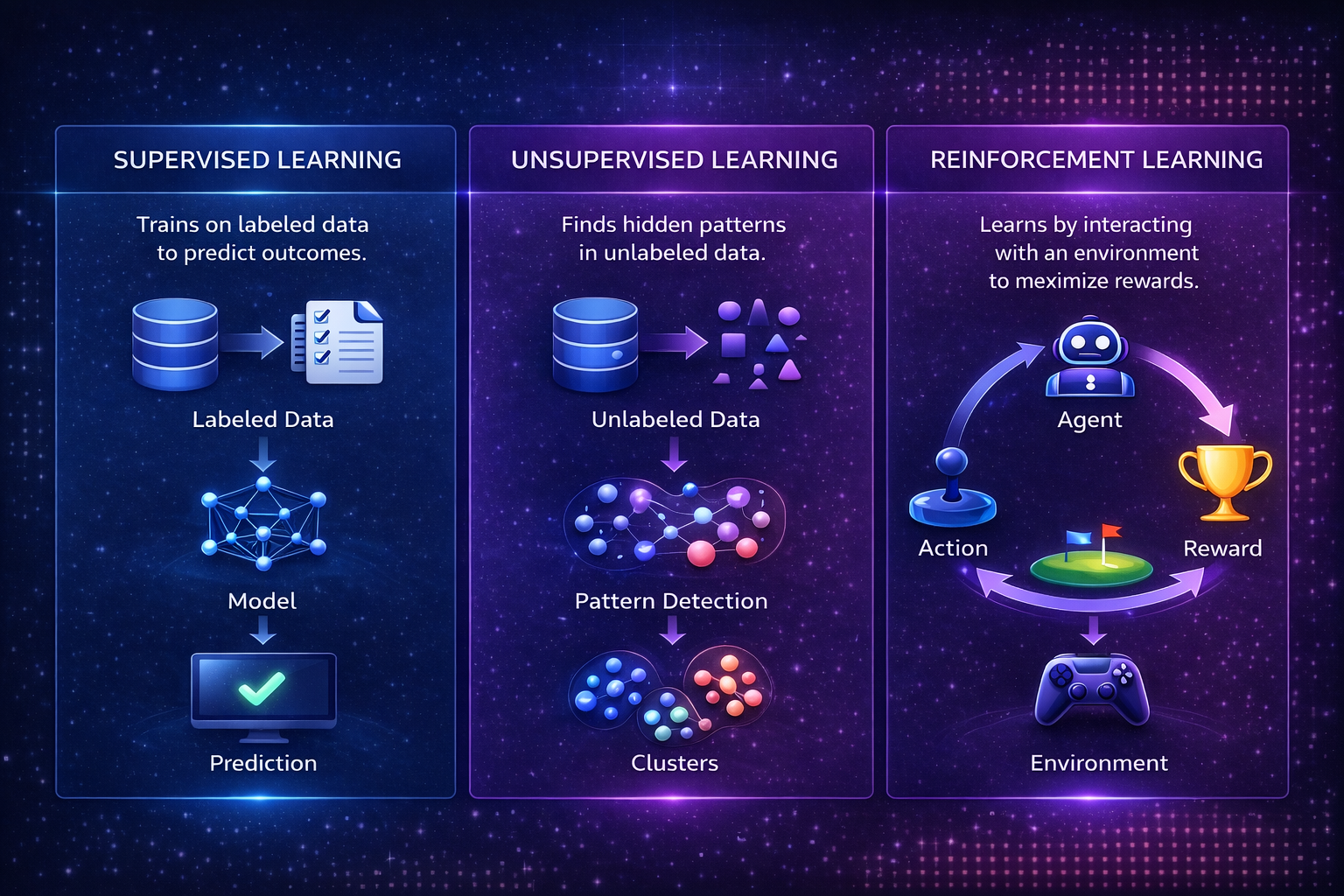
1. Supervised Learning
Definition:
Supervised learning uses labeled data, meaning the correct answers are already known.
How It Works
The model learns by comparing:
- Input → Output
- Example → Correct answer
Over time, it learns patterns that allow it to make predictions.
Example
Email spam detection:
- Input: Email content
- Output: Spam or Not Spam
The model learns from thousands of labeled emails.
Real-World Uses:
- Fraud detection
- Image recognition
- Medical diagnosis
- Price prediction
👉 Supervised Learning Explained
2. Unsupervised Learning
Definition:
Unsupervised learning works with unlabeled data and finds patterns on its own.
How It Works
Instead of being told the answer, the model:
- Groups similar data
- Detects hidden structures
Example
Customer segmentation:
- The system groups customers based on behavior
- No labels are provided
Real-World Uses
- Market segmentation
- Recommendation systems
- Anomaly detection
👉 Unsupervised Learning Explained
3. Reinforcement Learning
Definition:
Reinforcement learning teaches machines through trial and error using rewards and penalties.
How It Works
The system:
- Takes an action
- Receives feedback (reward or penalty)
- Adjusts behavior
Example
Self-driving cars:
- Correct decisions → reward
- Mistakes → penalty
Real-World Uses
- Robotics
- Game AI (like chess or Go)
- Autonomous vehicles
- Recommendation engines
👉 Reinforcement Learning Explained
Comparison of Machine Learning Types
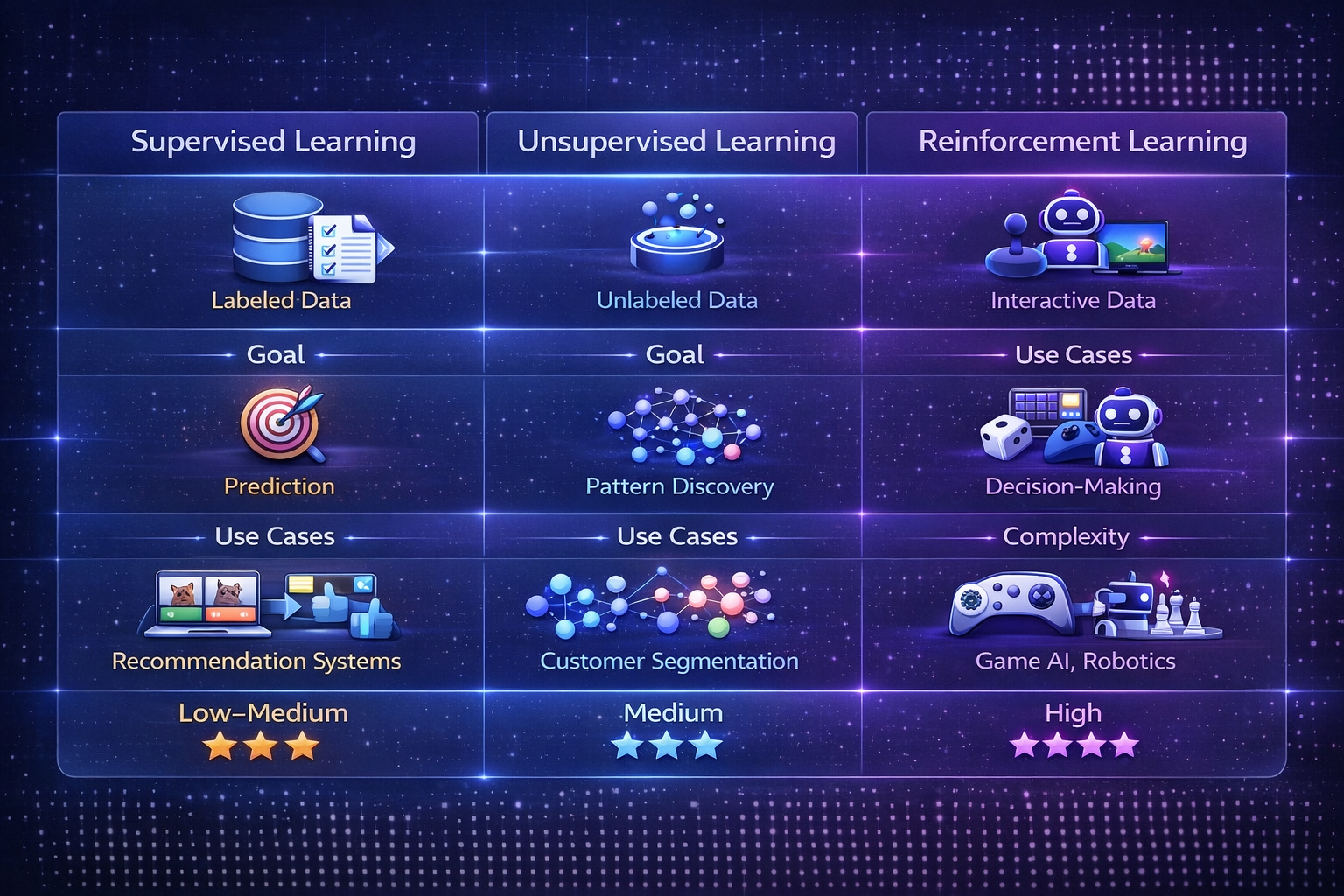
| Feature | Supervised Learning | Unsupervised Learning | Reinforcement Learning |
| Data Type | Labeled | Unlabeled | Interactive |
| Goal | Predict outcomes | Find patterns | Optimize decisions |
| Feedback | Immediate | None | Reward-based |
| Example | Email spam filter | Customer grouping | Self-driving car |
Real-World Applications of Machine Learning Types
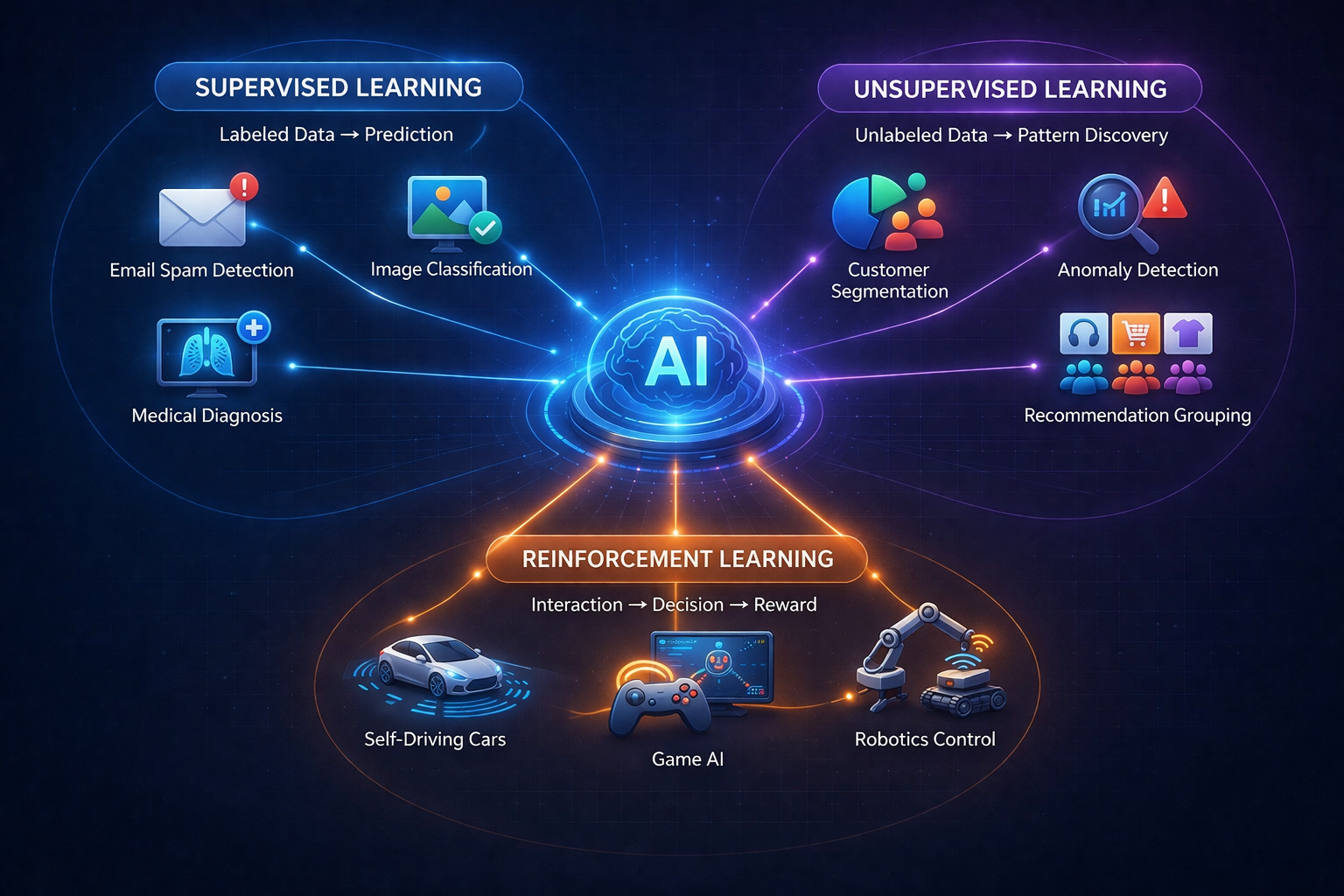
Machine learning types power many everyday technologies:
Supervised Learning Applications
- Google search ranking
- Voice assistants
- Medical diagnosis tools
Unsupervised Learning Applications
- Netflix recommendations
- Customer behavior analysis
- Fraud detection patterns
Reinforcement Learning Applications
- AI playing video games
- Autonomous drones
- Smart traffic systems
👉 Real-World Applications of AI
Advantages of Different Machine Learning Types
Supervised Learning
✔ High accuracy when data is labeled
✔ Easy to evaluate performance
✔ Widely used in industry
Unsupervised Learning
✔ No need for labeled data
✔ Useful for discovering hidden patterns
✔ Works well with large datasets
Reinforcement Learning
✔ Learns complex behaviors
✔ Adapts over time
✔ Ideal for decision-making systems
Limitations of Machine Learning Types
Supervised Learning
❌ Requires labeled data (time-consuming)
❌ Can overfit if not trained properly
Unsupervised Learning
❌ Harder to evaluate results
❌ May find patterns that aren’t meaningful
Reinforcement Learning
❌ Requires lots of training time
❌ Complex to design reward systems
Types of Machine Learning vs Deep Learning
Machine learning is a broad field, and deep learning is a subset of it.
| Concept | Machine Learning | Deep Learning |
| Scope | Broad category | Subset of ML |
| Data Needs | Moderate | Large datasets |
| Complexity | Medium | High |
| Examples | Decision trees | Neural networks |
Deep learning uses neural networks to automatically learn complex patterns.
Future of Machine Learning Types
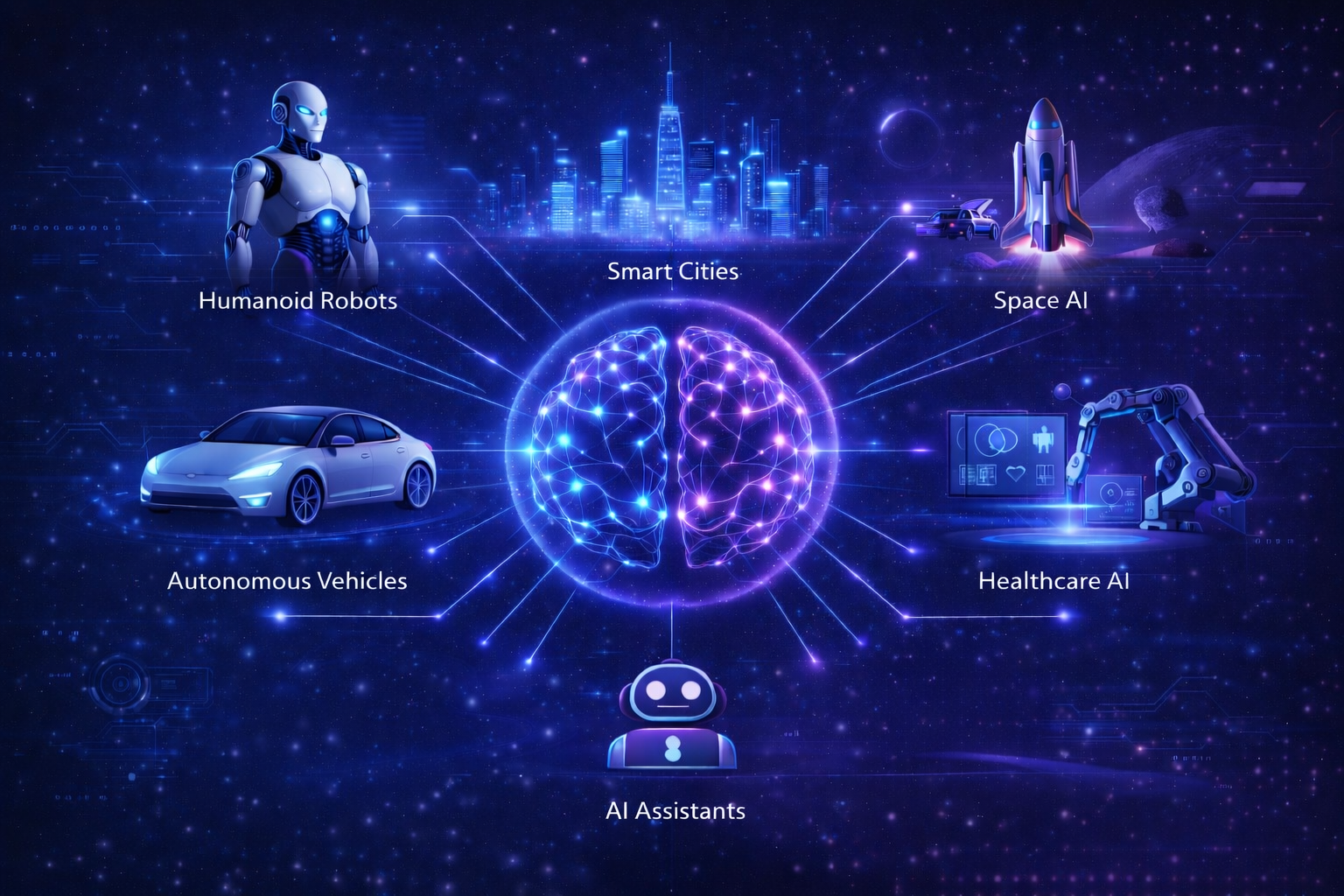
Machine learning is evolving rapidly.
Key Trends
- Automated Machine Learning (AutoML)
- Hybrid learning systems (combining multiple types)
- Real-time learning systems
- More efficient models with less data
What This Means
In the future:
- AI systems will learn faster
- Less labeled data will be needed
- Models will become more adaptive
According to research from IBM and MIT, machine learning will continue to drive innovation across industries like healthcare, finance, and transportation.
How This Fits Into the AI Learning Path
Understanding the types of machine learning is a key step in your AI journey.
This article is part of a structured learning system designed to guide you step-by-step.
Recommended path:
- Artificial Intelligence Explained
- Machine Learning Explained
- Types of Machine Learning (this article)
- Deep Learning Explained
- Neural Networks Explained
FAQ — Types of Machine Learning
1. What are the main types of machine learning?
The three main types are supervised learning, unsupervised learning, and reinforcement learning.
2. Which type of machine learning is most common?
Supervised learning is the most widely used because it produces accurate and predictable results.
3. What is the difference between supervised and unsupervised learning?
Supervised learning uses labeled data, while unsupervised learning works with unlabeled data.
4. What is reinforcement learning in simple terms?
It’s learning through trial and error using rewards and penalties.
5. Can machine learning combine different types?
Yes, many modern systems use hybrid approaches combining multiple learning types.
6. Which type is used in self-driving cars?
Reinforcement learning is heavily used, along with supervised learning.
7. Do all machine learning models need labeled data?
No, only supervised learning requires labeled data.
8. Is deep learning a type of machine learning?
Yes, deep learning is a specialized subset of machine learning.
9. What type is best for beginners to learn first?
Supervised learning is the easiest starting point.
10. Why are there different types of machine learning?
Different problems require different approaches to learning from data.
Conclusion
The types of machine learning—supervised, unsupervised, and reinforcement learning—are the foundation of modern AI systems.
Each type serves a unique purpose:
- Supervised learning predicts outcomes
- Unsupervised learning discovers patterns
- Reinforcement learning optimizes decisions
Together, they power everything from recommendation systems to self-driving cars.
Recommended Next Articles
To continue learning:
- 👉 Machine Learning Explained
- 👉 Supervised Learning Explained
- 👉 Unsupervised Learning Explained
- 👉 Reinforcement Learning Explained
- 👉 Deep Learning Explained
By understanding these core concepts, you’re building a strong foundation for mastering artificial intelligence.