
Artificial intelligence has become a major part of our daily lives—from voice assistants and recommendation systems to self-driving cars and AI chatbots. At the heart of many of these technologies are neural networks.
Neural networks are one of the most important concepts in deep learning, allowing machines to learn patterns, make decisions, and improve over time.
In this beginner-friendly guide, you’ll learn:
- What neural networks are
- How neural networks work step-by-step
- Key concepts you need to understand
- Types of neural networks
- Real-world applications
- Advantages and limitations
- How they compare to other AI methods
What Are Neural Networks?
Neural networks are computer systems inspired by the human brain that learn patterns from data using layers of connected nodes.
They are widely used in artificial intelligence for tasks such as image recognition, speech processing, recommendation systems, and natural language understanding.
According to IBM, neural networks are a foundational technology behind modern AI systems and deep learning applications.
Neural Networks Simplified
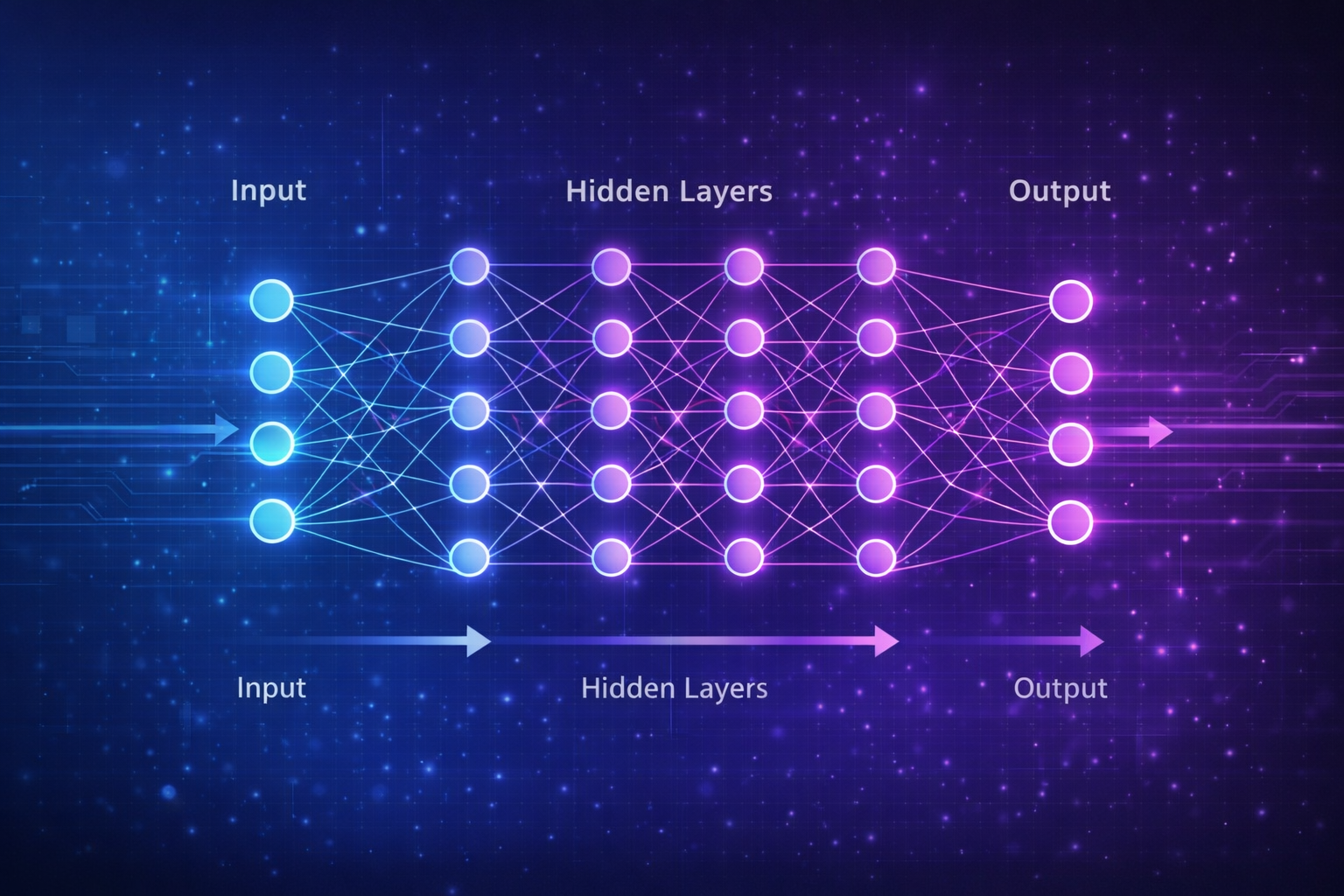
A neural network is a type of model used in deep learning, a subset of machine learning.
It is inspired by how the human brain works. In the brain, neurons communicate through connections. Similarly, artificial neural networks use nodes (artificial neurons) connected in layers.
These networks learn by analyzing data and identifying patterns.
For example, a neural network can:
- Recognize faces in photos
- Translate languages
- Recommend videos on YouTube
- Detect fraud in banking systems
If you’re new to AI, start with Artificial Intelligence Explained and Machine Learning Explained to understand the bigger picture.
How Neural Networks Work (Step-by-Step)

Neural networks process information through a series of layers.
Step 1 – Input Layer
The input layer receives data.
Examples:
- Pixels from an image
- Words from a sentence
- Customer data
Each input is passed into the network.
Step 2 – Hidden Layers
Hidden layers process the data.
Each node:
- Receives input
- Applies a calculation
- Passes the result forward
Connections between nodes have weights, which determine how important each input is.
Step 3 – Activation Functions
Each neuron uses an activation function to decide whether to pass information forward.
Common types:
- ReLU
- Sigmoid
- Softmax
These functions allow neural networks to learn complex patterns.
Step 4 – Output Layer
The output layer produces the final result.
Examples:
- “Cat” vs “Dog”
- Spam vs Not Spam
- Price prediction
Step 5 – Learning Through Training
Neural networks learn through repetition.
Process:
- Make a prediction
- Compare it to the correct answer
- Measure the error
- Adjust weights (backpropagation)
Over time, the network becomes more accurate.
Key Concepts Beginners Must Understand
Training Data
Neural networks learn from data.
Most commonly:
- Supervised Learning (labeled data)
👉 See: Supervised Learning Explained
- Unsupervised Learning (unlabeled data)
👉 See: Unsupervised Learning Explained
Weights and Bias
Weights determine how strongly inputs affect the output.
Bias helps adjust predictions.
Together, they control how the network learns.
Deep Learning
When neural networks have many hidden layers, it’s called deep learning.
👉 Learn more: Deep Learning Explained
Overfitting
Sometimes a neural network memorizes data instead of learning patterns.
This is called overfitting and reduces real-world accuracy.
Types of Neural Networks
Different types of neural networks are used for different tasks.
Feedforward Neural Networks
- Simplest type
- Data moves in one direction
- Used for basic predictions
Convolutional Neural Networks (CNNs)
- Designed for images
- Detect edges, shapes, and objects
- Used in computer vision
Recurrent Neural Networks (RNNs)
- Designed for sequences
- Remember past information
- Used in speech and text processing
Transformers
- Modern architecture used in AI models like ChatGPT
- Focus on relationships between data
- Power language models
Research from Google AI highlights transformers as a major breakthrough in AI development.
Real-World Applications of Neural Networks

Neural networks are used everywhere.
Image Recognition
- Face unlock on smartphones
- Medical imaging
- Security systems
Voice Assistants
- Siri
- Alexa
- Google Assistant
Recommendation Systems
- Netflix movie suggestions
- Amazon product recommendations
- YouTube video suggestions
Healthcare
- Disease detection
- Medical imaging analysis
Self-Driving Cars
- Detect objects
- Understand surroundings
- Make driving decisions
Finance
- Fraud detection
- Risk analysis
Advantages of Neural Networks
Powerful Pattern Recognition
They can detect patterns humans cannot easily program.
High Accuracy
With enough data, they perform extremely well.
Automation
They reduce the need for manual rule-based systems.
Adaptability
They improve over time as they learn from more data.
Limitations of Neural Networks
Require Large Data
Neural networks often need massive datasets.
High Computing Power
Training requires GPUs or cloud computing.
Black Box Problem
It’s hard to understand how decisions are made.
Training Time
Large models can take hours or days to train.
Neural Networks vs Machine Learning
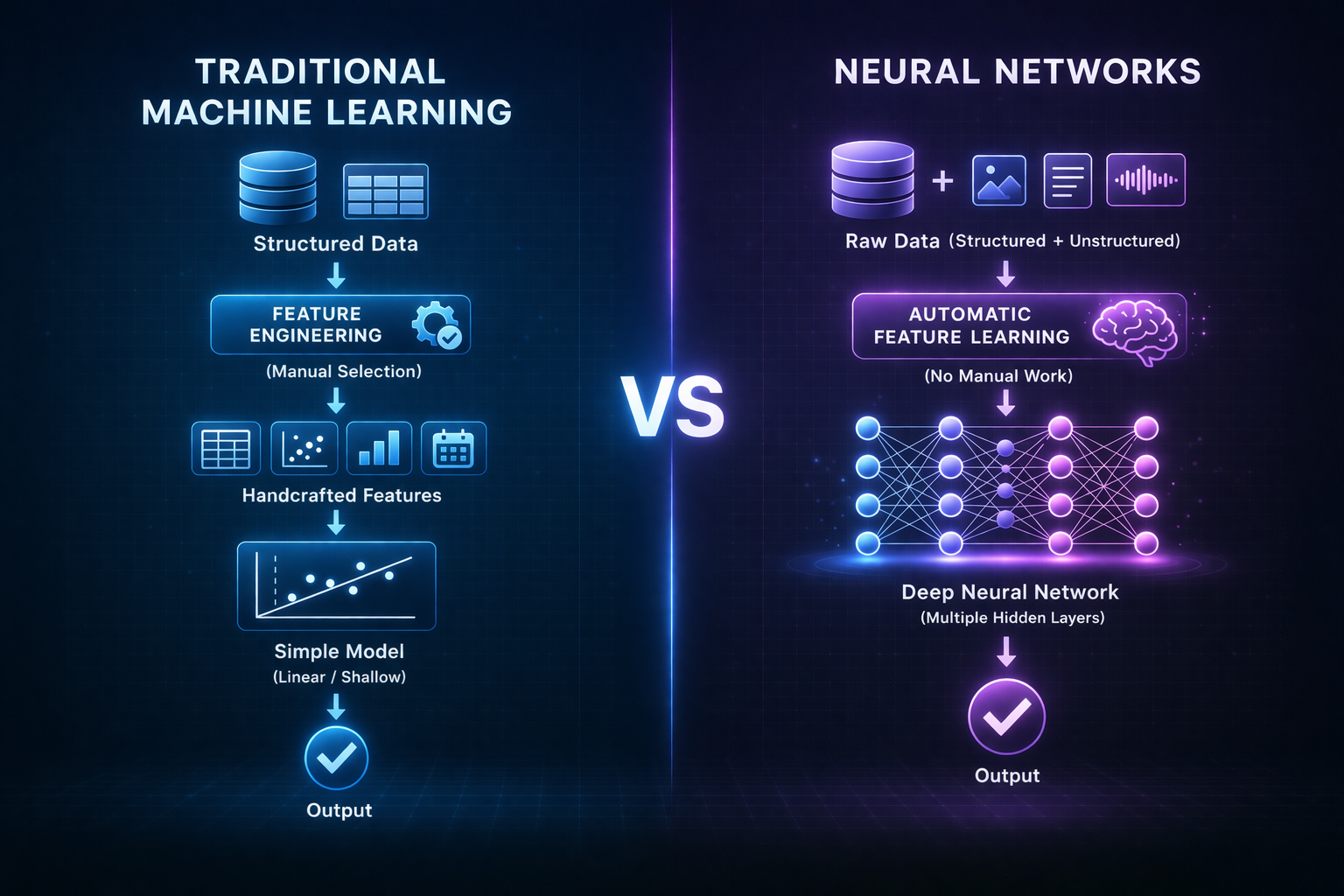
| Feature | Traditional Machine Learning | Neural Networks |
| Complexity | Lower | Higher |
| Data Needs | Moderate | High |
| Feature Engineering | Manual | Automatic |
| Best Use Cases | Structured data | Images, text, audio |
Neural networks are a key part of Machine Learning Explained and are used across different learning types, including Reinforcement Learning Explained.
The Future of Neural Networks

Neural networks are evolving rapidly.
Future trends include:
- Smarter AI systems
- Lower training costs
- Multimodal AI (text + images + video)
- Better explainability
Neural networks will play a major role in:
- Healthcare innovation
- Robotics
- Autonomous systems
- Education
- Climate solutions
FAQ: Neural Networks Explained
What are neural networks in simple terms?
Neural networks are systems that learn patterns from data using connected layers of nodes, similar to how the brain processes information.
Are neural networks part of deep learning?
Yes. Neural networks are the core technology behind deep learning.
What is the difference between AI and neural networks?
AI is a broad field, while neural networks are a specific method used within machine learning and deep learning.
What are neural networks used for?
They are used for image recognition, speech processing, recommendations, fraud detection, and more.
Do neural networks need coding?
Yes, but many tools make it easier to build and train them.
What is deep learning?
Deep learning refers to neural networks with many layers that can learn complex patterns.
What is backpropagation?
It is the process of adjusting weights to improve predictions.
Are neural networks used in ChatGPT?
Yes. ChatGPT is powered by advanced neural networks called transformers.
Can neural networks learn without labeled data?
Yes, through unsupervised learning
Conclusion
Neural networks are one of the most powerful technologies in modern artificial intelligence.
They allow machines to learn from data, recognize patterns, and make intelligent decisions—just like humans, but at scale.
From recommendation systems and voice assistants to healthcare and self-driving cars, neural networks are shaping the future of technology.
Recommended Next Articles
To continue learning, explore:
- Artificial Intelligence Explained
- Machine Learning Explained
- Deep Learning Explained
- Supervised Learning Explained
- Unsupervised Learning Explained
- Reinforcement Learning Explained
This article follows the AllForTheAI.com structured learning system and contributes to building a scalable AI knowledge hub.