

AI shapes much of what people see and experience on social media. It helps platforms rank feeds, recommend accounts and videos, analyze text and images, detect possible policy violations, personalize advertising, assist creators, and identify synthetic content.
This guide explains how those systems work, what they can and cannot do, and why privacy, transparency, user control, and human oversight matter. It focuses on the platform systems behind social media; for the brand and campaign perspective, see AI in marketing.
Published April 11, 2024 · Reviewed October 1, 2026
What Is AI in Social Media?
AI in social media refers to machine-learning and related systems used to rank and recommend content, process language, analyze images and video, detect abuse or policy violations, personalize ads and experiences, assist creators, and generate or modify content.
Several technologies often work together:
- Machine learning supports ranking, prediction, recommendations, classification, and anomaly detection.
- Natural language processing (NLP) helps systems process posts, comments, captions, searches, and conversations.
- Computer vision helps analyze images and video.
- Deep learning supports complex language, vision, audio, and multimodal models.
- Generative AI can create or edit text, images, audio, and video.
Where AI Appears on a Social Platform
- Feeds and recommendations: ordering posts, videos, accounts, groups, or topics.
- Search and discovery: interpreting queries, matching content, and surfacing related material.
- Moderation and safety: detecting spam, scams, harassment, graphic material, coordinated abuse, or other possible policy violations.
- Advertising: estimating relevance, predicting responses, ranking ads, measuring outcomes, and detecting invalid activity.
- Creator tools: captions, translation, editing, idea generation, summaries, and synthetic media.
- Accessibility: automatic captions, speech recognition, translation, and image descriptions.
- Platform operations: account integrity, trend detection, customer support, and system monitoring.
How AI-Powered Recommendations Work
A recommendation system does not read a user’s mind or fully “understand” their interests. It estimates which items may best satisfy one or more objectives using available signals.
A common design starts with candidate generation, which narrows a large content pool to a manageable shortlist. Scoring and ranking then estimate the relevance of those candidates, while re-ranking can apply additional constraints such as diversity, freshness or user feedback. The objectives are the goals the system is designed to pursue, such as satisfaction or relevance; signals are the information used to estimate them. A platform can use different models and rules for its home feed, short videos, search and other surfaces.
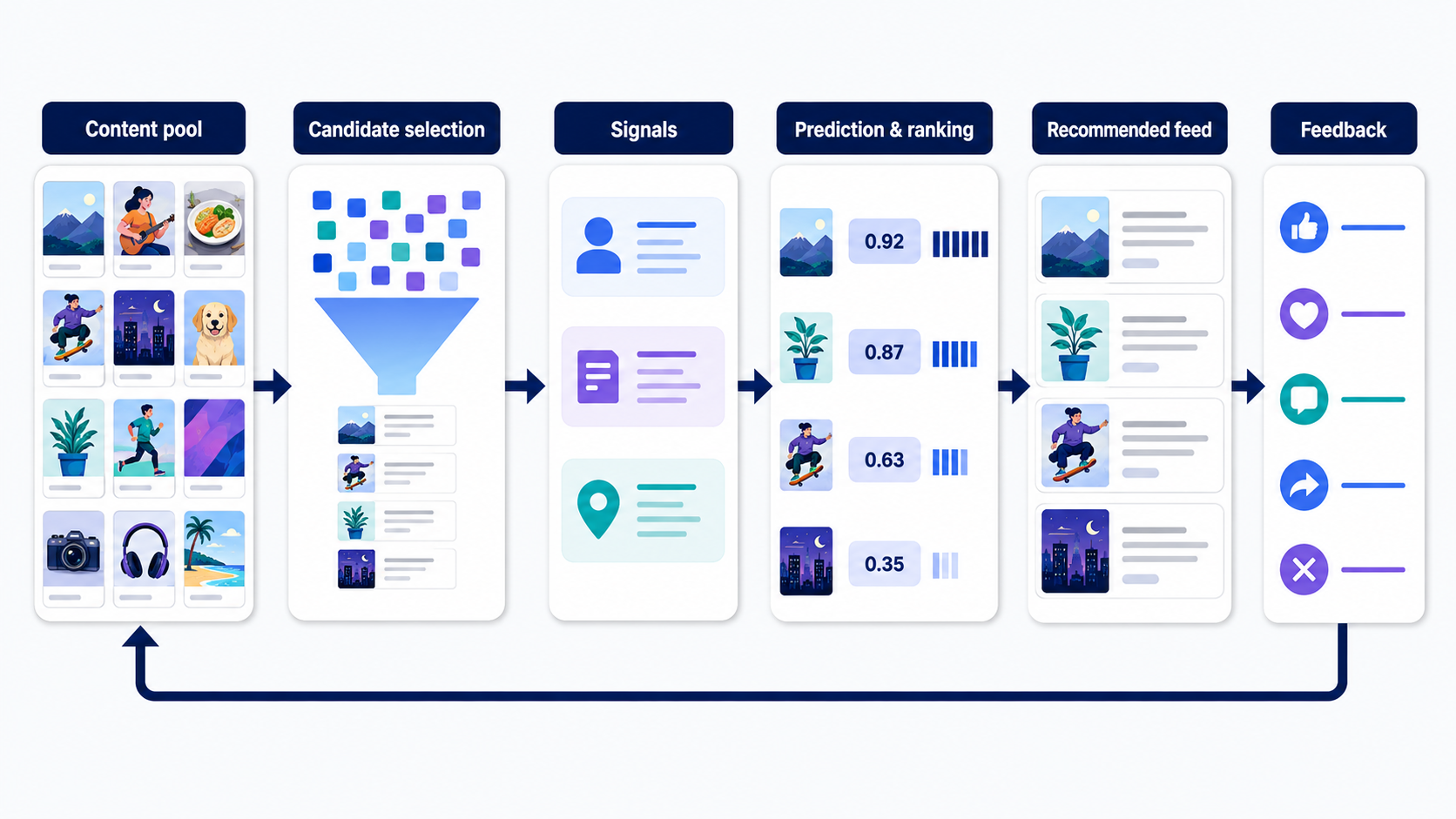
Signals can include watch or reading history, follows and subscriptions, likes and dislikes, “not interested” feedback, content information, current context, and satisfaction feedback. The exact signals, models, and objectives differ by platform and feature. YouTube, for example, documents a mixture of viewing history, subscriptions, explicit feedback, and satisfaction signals in its recommendation-system guidance.
Does the algorithm continuously learn from every action?
User interactions can update a profile, session context, or the signals used for later recommendations. That does not mean the underlying model retrains itself after every view or like. Platforms can update personalization quickly while retraining, testing, and deploying their models on separate schedules.
AI for Text, Images, and Video
NLP can help classify spam, interpret searches, detect repeated abuse patterns, translate text, generate captions, and summarize conversations. Computer-vision models can classify visual content, detect objects or scenes, assist search, and provide signals for moderation. Audio models may transcribe speech or detect sound patterns. Multimodal systems combine more than one type of input—for example, a video’s frames, audio, caption, and surrounding text.
These models produce estimates, not guaranteed truths. Slang, coded language, satire, cultural context, low-quality media, and rapidly changing events can all produce mistakes.
AI for Content Moderation and Platform Safety
Moderation is not simply “AI finds harmful content and removes it.” A real workflow may include:
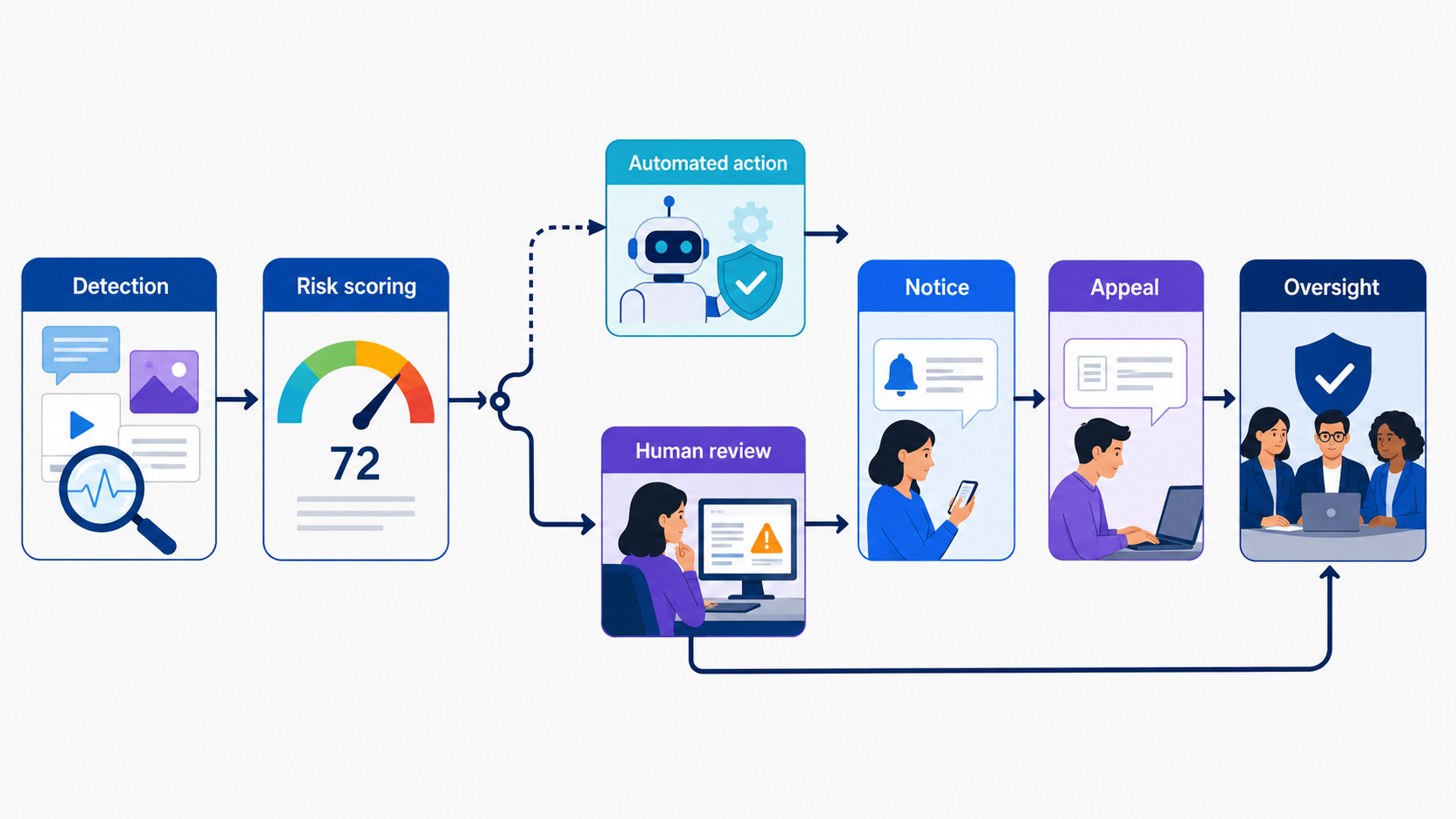
Automation can help platforms process large volumes of content, identify likely violations, prioritize urgent cases, and detect repeated behavior. Human reviewers and policy teams remain essential for uncertain, contextual, or high-impact decisions. Meta’s Transparency Center, for example, describes technology, review, enforcement, and appeals as parts of a broader system.
Moderation also involves governance choices: what a policy prohibits, how consistently it is applied, how errors are corrected, and how competing interests such as safety and expression are balanced. No classifier can make those choices neutral or eliminate false positives and false negatives.
A false positive flags content that does not violate the relevant policy; a false negative misses content that does. The cost of each error depends on the context, which is why teams evaluate more than overall accuracy. Model Evaluation Metrics Explained introduces precision, recall and related measures for understanding these trade-offs.
Generative AI and Synthetic Social Media Content
Generative AI is already part of social media. Creators and platforms use it to draft captions and scripts, generate or edit images and video, translate or dub content, create effects, produce ad variations, and power conversational assistants.
The same tools can make authenticity harder to judge. Synthetic audio or video may imitate a real person, omit important context, or be used for deception. Useful safeguards include creator disclosure, visible labels, provenance records, content credentials, reporting tools, and additional review for high-risk material.
YouTube explains when creators must disclose realistic altered or synthetic media in its altered-content guidance. Meta explains its evolving approach to AI-content labels. The C2PA standard supports tamper-evident provenance information, but provenance and detection tools are not perfect and do not determine whether a claim is true.
AI in Advertising and Analytics
Social advertising systems can use machine learning to estimate ad relevance or response likelihood, rank eligible ads, help select audiences, optimize delivery, detect fraud, and measure results. Analytics tools can group behavior, identify patterns, and flag emerging activity.
These systems may combine prediction models, ranking, auction rules, experiments, and human-set objectives. It is inaccurate to map targeted advertising to one technique such as reinforcement learning. Trend signals are also uncertain: popularity can change quickly, coordinated activity can distort measurements, and a forecast is not a fact. Brand strategy, campaign optimization, and marketing workflows belong in the fuller AI in Marketing guide.
Benefits of AI in Social Media
- Discovery: helps people find relevant accounts, communities, and content within an enormous supply.
- Accessibility: supports captions, translation, speech tools, and image descriptions.
- Scale: helps route moderation cases, spam, and suspicious activity for action or review.
- Creative assistance: speeds up drafting, editing, localization, and experimentation.
- Relevance: can reduce the effort required to find useful content or services.
Risks and Limitations
Privacy and profiling
Personalization works because platforms have signals about users, content, and context. The trade-off is therefore not simply “personalization equals convenience.” It is a relationship among personalization, data collection and profiling, user control, and privacy. A 2024 FTC staff report raised concerns about extensive data collection, targeted advertising, retention, and limited user control at major social-media and video-streaming services.
Where data-protection law applies, platforms must identify an appropriate legal basis, explain relevant practices, and meet applicable obligations. Consent is one possible basis under the GDPR, not the only one; Article 6 lists multiple lawful bases. This is general educational information, not legal advice.
Bias, context, and uneven errors
Training data, labels, policy definitions, optimization goals, and deployment context can all contribute to uneven performance. A moderation or ranking system may work differently across languages, communities, content formats, and new events. Regular evaluation should include error rates and impacts—not only average accuracy.
Information exposure and user autonomy
Recommendation systems influence which information people encounter. They may narrow or amplify patterns of exposure depending on the system, its objectives, available content, social networks, user choices, and context. That is more accurate than treating polarization as a simple chain from “algorithm” to “echo chamber.” Engagement optimization may also favor material that attracts attention without being accurate, useful, or healthy.
Synthetic media and manipulation
AI-generated media can support creativity and accessibility, but it can also enable impersonation, scams, fabricated evidence, and content produced at misleading scale. Labels help only when they are clear, applied consistently, and understood by users.
Transparency, Labels, and Human Oversight
Responsible platform systems need more than a model. They need people, policies, controls, and ways to challenge mistakes. Useful measures include:
- plain-language explanations of why content or an ad was shown;
- meaningful controls for recommendations, sensitive topics, and advertising preferences;
- clear notices when content is removed, limited, or demonetized;
- appeals and human review for consequential or disputed decisions;
- labels and provenance signals for realistic synthetic or altered media;
- testing across languages and communities, with published transparency information where practical.
How the Technologies Fit Together
| Platform task | Possible AI components | Why people still matter |
|---|---|---|
| Rank a feed | Prediction, recommendation, and ranking models | People set objectives, evaluate impacts, and provide controls |
| Review a post | NLP, vision, audio, and multimodal classifiers | Context, policy interpretation, appeals, and edge cases |
| Create or edit media | Generative text, image, audio, or video models | Accuracy, permission, disclosure, and creative judgment |
| Deliver ads | Prediction, ranking, auctions, and measurement models | Privacy choices, campaign goals, fairness, and compliance |
Frequently Asked Questions
How is AI used in social media?
AI is used to rank and recommend content, understand search queries, analyze text and visual media, support moderation, personalize ads, detect suspicious behavior, improve accessibility, and generate or edit content.
Does social media AI know what I am thinking?
No. Recommendation models estimate likely responses from available signals. A useful prediction is not the same as understanding a person’s mind, intentions, or full interests.
Can AI moderate social media without humans?
Automation can handle or prioritize many cases, but human governance, review, and appeals remain important—especially when context is uncertain or a decision has serious consequences.
Are AI-content labels always reliable?
No. Labels may depend on creator disclosure, metadata, platform tools, or detection systems. Each method can miss content or create ambiguity, so a label should be treated as one signal rather than proof of truth or falsehood.
Sources and Further Reading
- YouTube — How recommendations work: signals, user feedback and differences between recommendation surfaces
- Google for Developers — Recommendation systems overview: candidate generation, scoring and re-ranking
- YouTube — Disclosing use of GenAI content: platform disclosure requirements for realistic AI-generated or meaningfully altered content
- FTC — 2024 staff report on social-media and video-streaming data practices: privacy, data use and user-control concerns
- NIST — Generative AI Profile: a cross-sector risk-management reference
Continue Learning
Next: AI Ethics explains the wider questions of privacy, bias, accountability and human oversight behind social-media AI.
For the component technologies and related applications, continue with the guides below.
- Feeds, ranking, and personalization: Machine Learning Explained
- Posts, comments, search, and chat: Natural Language Processing Explained
- Images and video: Computer Vision Explained
- AI-created and AI-edited media: What Is Generative AI?
- Brands, campaigns, and marketing workflows: AI in Marketing
- The broader landscape: Real-World Applications of AI