
Structured and unstructured data describe how information is organized, but they are not absolute categories of usefulness or intelligence.
Structured data follows an explicit schema or predictable fields. Unstructured data does not naturally fit a fixed row-and-column model. Between them sits semi-structured data, which has some machine-readable organization without a rigid relational schema.
Modern AI systems increasingly transform unstructured information into structured representations such as embeddings, extracted entities, labels, or metadata.
Quick Answer: Structured vs Unstructured Data
Structured data follows a predefined schema, so fields are predictable and easy to query. Unstructured data does not fit a fixed tabular schema and commonly includes text, images, audio, and video. Semi-structured data sits between the two, using tags, keys, or metadata without requiring rigid relational tables.
For AI and machine learning, the distinction matters because each type usually needs a different preparation pipeline. Tabular data may be ready for feature engineering, while text, images, and audio often require tokenization, embeddings, tensors, or other learned representations before a model can use them effectively.
What Is Structured Data?
Structured data is organized according to a defined schema.
Common examples include:
- Customer records with fixed fields.
- Transaction tables.
- Inventory databases.
- Sensor measurements stored in consistent columns.
- Financial records with defined attributes.
Structured data is often stored in relational databases, spreadsheets, warehouses, or other systems where fields and data types are explicit.
What Is Unstructured Data?
Unstructured data lacks a single predefined tabular schema that directly captures its content.
Examples include:
- Natural-language documents.
- Emails.
- Images.
- Video.
- Audio recordings.
- Free-form support conversations.
“Unstructured” does not mean random or meaningless. A photograph has rich spatial structure and language has syntax and semantics; the term mainly describes the absence of a convenient fixed database-style schema for the content.
What Is Semi-Structured Data?
Semi-structured data contains organizational markers or metadata but does not require the rigid schema associated with traditional relational tables.
Examples can include:
- JSON documents.
- XML.
- Email headers and bodies.
- Event logs.
- Documents with metadata fields plus free-form content.
The same information can also move between categories depending on how a system stores and represents it.
Structured vs Unstructured vs Semi-Structured
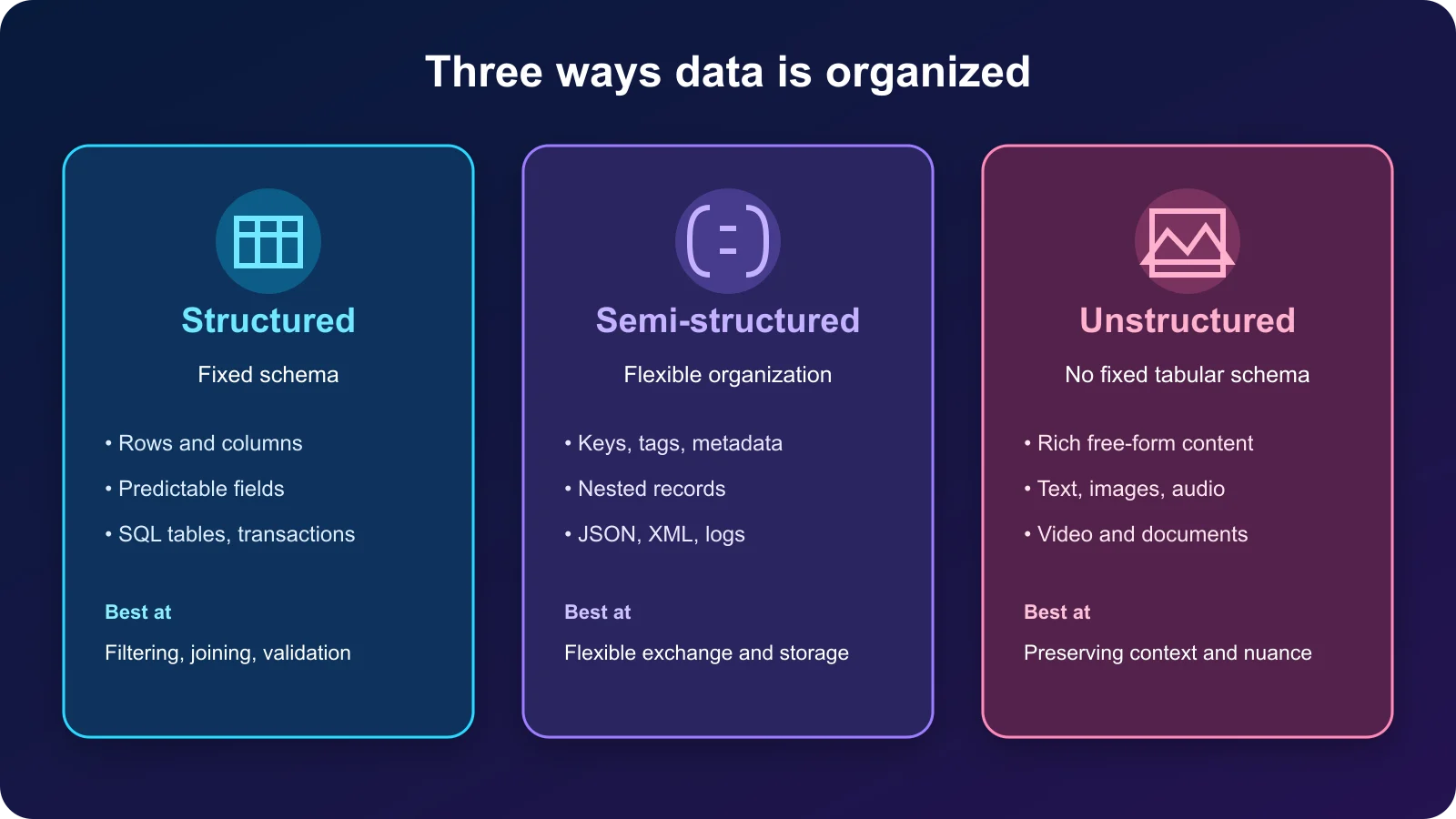
| Type | Typical organization | Examples |
|---|---|---|
| Structured | Explicit schema and fields | SQL tables, transaction records, tabular measurements |
| Semi-structured | Flexible structure plus tags/keys/metadata | JSON, XML, logs, email metadata |
| Unstructured | No single fixed tabular schema for content | Text, images, audio, video |
Structured vs Unstructured Data: Key Differences
The biggest difference is not whether the information is valuable. It is how predictable its organization is. Structured data is designed around known fields, which makes filtering, joining, validating, and querying relatively straightforward. Unstructured data preserves richer forms of information but usually requires an additional processing step before software can analyze it at scale.
- Schema: Structured data uses predefined fields; unstructured data does not rely on one fixed tabular schema.
- Querying: Structured records are often directly searchable with database queries, while unstructured content usually needs search, extraction, NLP, computer vision, speech processing, or embeddings.
- Flexibility: Unstructured data can preserve nuance that would be difficult to squeeze into fixed columns.
- Preparation: Structured data may still need cleaning and feature engineering, while unstructured inputs commonly require more substantial representation and preprocessing.
- Storage: Structured data is commonly associated with relational databases and warehouses; unstructured and semi-structured content is also common in object storage, document stores, data lakes, and search systems.
Advantages and Limitations of Structured Data
Structured data is especially useful when consistency matters. Customer IDs, transaction amounts, dates, inventory counts, and measurements are easier to validate and aggregate when every record follows the same schema.
Its main limitation is rigidity. A schema designed for one business process may not capture unexpected context without adding new fields or changing the model. Structured data can also be incomplete or misleading even when every row is perfectly formatted.
Advantages and Limitations of Unstructured Data
Unstructured data can preserve far more context. A customer review communicates tone and reasoning, an image contains visual relationships, and an audio recording includes timing and acoustic information that a small set of database fields might omit.
The tradeoff is that this information is harder to query directly. Organizations often need AI, machine learning, natural language processing, computer vision, speech recognition, or information-extraction systems to convert the raw content into representations that can be searched or analyzed.
Real-World Examples
A single application can contain all three categories at once. An online store might keep a product ID, price, and inventory count as structured fields; store flexible product metadata as JSON; and keep product descriptions and images as unstructured content. A healthcare system might combine structured appointment fields with semi-structured messages and unstructured clinical notes or scans.
This is why modern data pipelines rarely choose one data type exclusively. They combine different representations according to the job the system needs to perform.
Why the Distinction Matters for AI
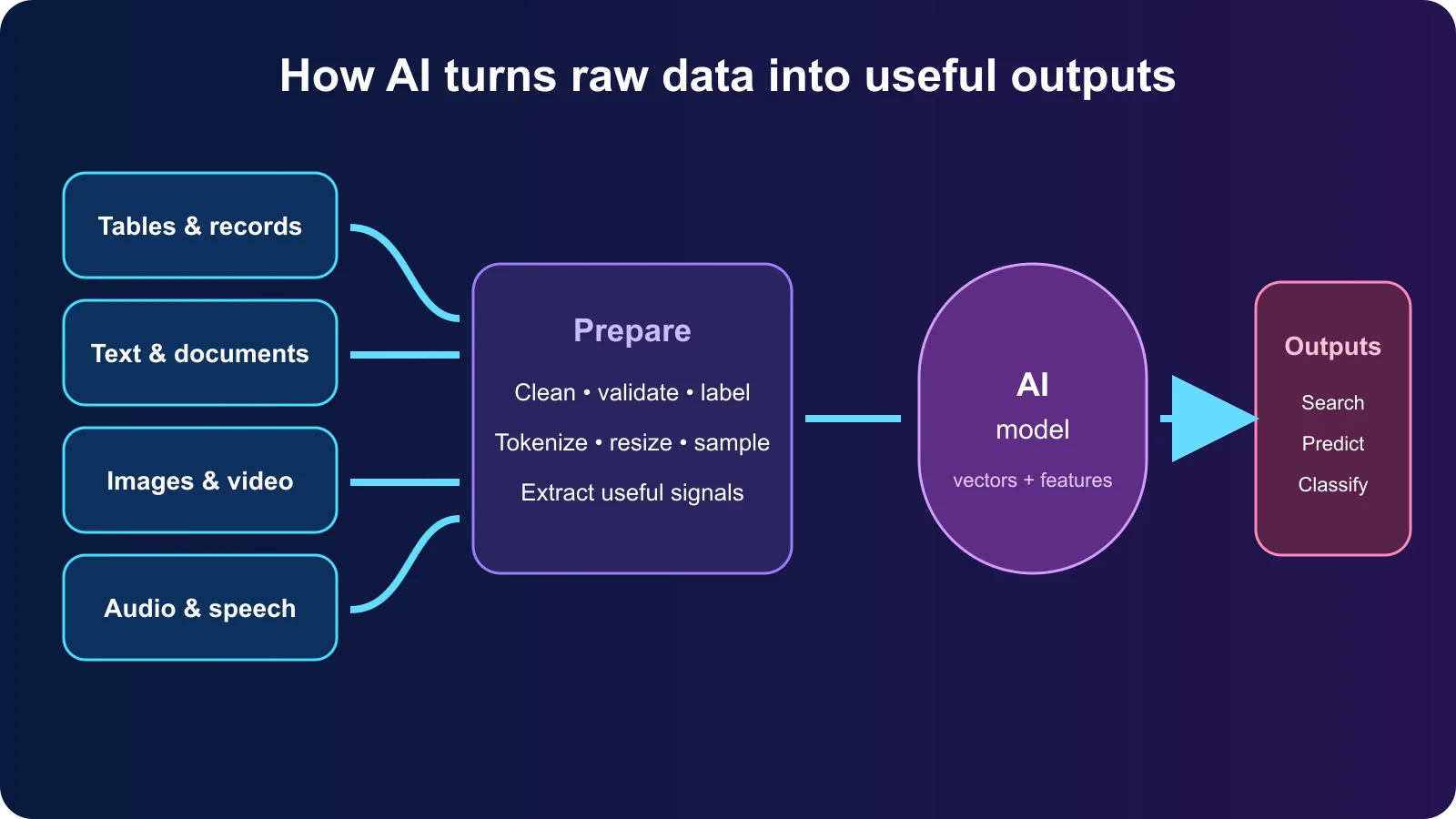
Different data forms require different representations and preprocessing.
Structured/tabular models can operate directly on engineered numeric and categorical features. Language systems tokenize text and learn or use vector representations. Computer-vision systems convert images into tensors and learned visual features. Audio systems operate on waveforms or derived representations.
Read Data Preprocessing Explained, How NLP Works, and Computer Vision Explained.
Embeddings Bridge the Gap
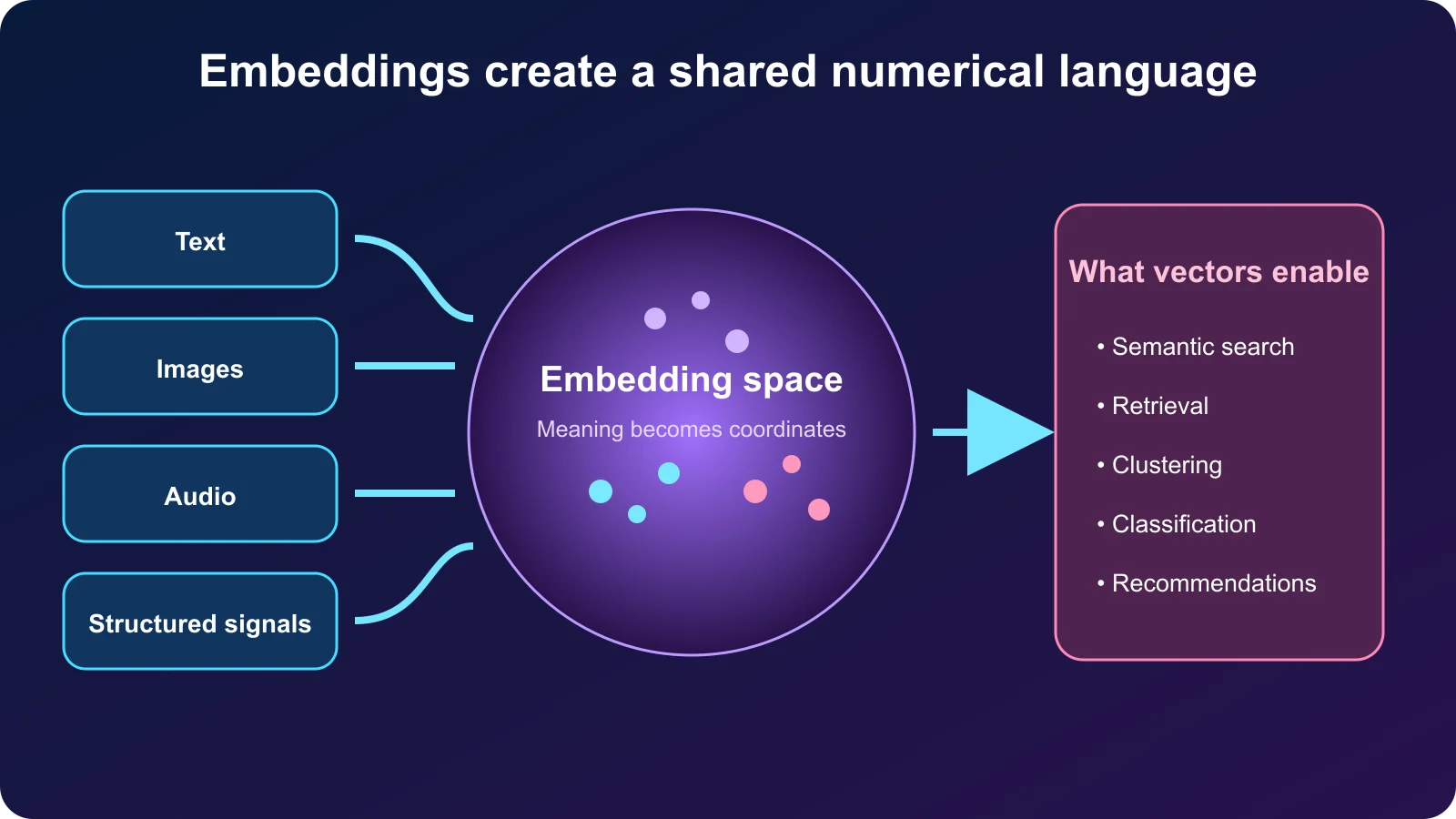
Embeddings convert complex inputs into numerical vectors that capture learned relationships useful for downstream tasks.
Text, images, audio, products, users, and other entities can all be represented as embeddings.
This does not make the original content “structured” in every sense, but it gives software a structured numerical representation that can support retrieval, clustering, classification, recommendation, and other operations.
Multimodal Data
Modern AI systems often combine several modalities at once.
For example, a product record might contain structured fields such as price and category alongside unstructured product images and descriptions. A multimodal system can use these sources together rather than forcing the entire dataset into one category.
Data Quality Is Separate From Data Structure
Structured data is not automatically high quality, and unstructured data is not automatically low quality.
Quality depends on factors such as:
- Accuracy.
- Completeness.
- Relevance.
- Consistency.
- Representativeness.
- Timeliness.
- Label quality where labels are required.
A perfectly formatted table can contain incorrect values, while a collection of documents can contain highly valuable information.
Storage Format Does Not Determine Meaning
A CSV file is usually used for structured data, but a column inside it could contain long free-form text. JSON is often semi-structured, but a tightly controlled JSON schema can represent highly structured records.
It is therefore better to ask how the information is organized and used than to classify it solely by file extension.
Frequently Asked Questions
Is JSON structured or unstructured data?
JSON is commonly described as semi-structured because keys and nesting provide organization without requiring a fixed relational schema.
Are images unstructured data?
Images are generally treated as unstructured data in data-management terminology, although they contain rich internal spatial structure that vision models exploit.
Can AI turn unstructured data into structured data?
AI systems can extract structured fields, labels, entities, embeddings, summaries, and metadata from unstructured inputs. The quality of those derived representations still needs evaluation.
Is most business data unstructured?
The proportion varies significantly by organization and how data is defined. Broad percentage claims should be treated cautiously unless they are tied to a specific study and definition.
Is CSV structured or semi-structured data?
CSV is usually used for structured tabular data because rows follow a consistent set of columns. However, the file format alone does not guarantee that every field contains structured content; a CSV column can still hold free-form text.
Are databases always structured?
No. Relational databases are designed around structured schemas, while document and NoSQL databases can store flexible or semi-structured records. The organization of the data matters more than the word “database.”
Why is unstructured data harder to analyze?
Its meaning is not already separated into predictable fields. A model or processing pipeline may first need to identify words, objects, speakers, entities, topics, features, or numerical representations before useful analysis can begin.
What type of data is best for machine learning?
There is no single best type. The right data depends on the task. A fraud model may rely heavily on structured transactions, a language model works with text, and a vision model works with images. Data quality, relevance, coverage, and representation matter more than the category alone.
Can structured and unstructured data be used together?
Yes. Many modern AI systems are multimodal or combine multiple data sources. A recommendation system, for example, might use structured purchase history together with text descriptions, images, and learned embeddings.
Common Misconceptions
“Unstructured” does not mean disorganized or useless. Images contain spatial relationships, language contains grammar and meaning, and audio contains temporal structure. The term refers to the absence of one convenient predefined tabular schema.
Structured data is not automatically cleaner. A table can still contain missing, duplicated, biased, stale, or incorrect values.
File extensions do not settle the classification. JSON is often considered semi-structured, while CSV commonly represents structured data, but the actual schema and how the information is used are what matter most.
Authoritative References
For additional definitions and examples, see IBM’s overview of structured vs unstructured data and Google Cloud’s guide to unstructured data.