
Machine learning is not one single method. It includes several ways of training systems to recognize patterns, make predictions, discover structure, or choose actions.
For beginners, three major introductory paradigms are especially useful:
- Supervised learning learns from examples paired with target labels or known outputs.
- Unsupervised learning searches for structure in data without a separate target label for every example.
- Reinforcement learning learns action strategies from rewards generated through interaction.
These are a strong starting point, not an exhaustive taxonomy. Semi-supervised and self-supervised learning are also important modern approaches. Transfer learning is a reuse strategy, while deep learning is a model family that can be trained with several learning paradigms.
Last reviewed and updated: September 1, 2026.
Prerequisite: For the broader foundation, start with Machine Learning Explained.
What Are the Main Types of Machine Learning?
The clearest way to compare learning paradigms is by the signal that guides learning:
- Supervised learning: target labels or known outputs tell the model what it should predict.
- Unsupervised learning: patterns and relationships in unlabeled data provide the structure to discover.
- Reinforcement learning: rewards from interaction guide a sequence of actions.
Each paradigm defines “better” differently. A supervised model may reduce prediction error, an unsupervised method may find stable and useful structure, and a reinforcement-learning agent may improve expected cumulative reward. Real systems can combine more than one paradigm.
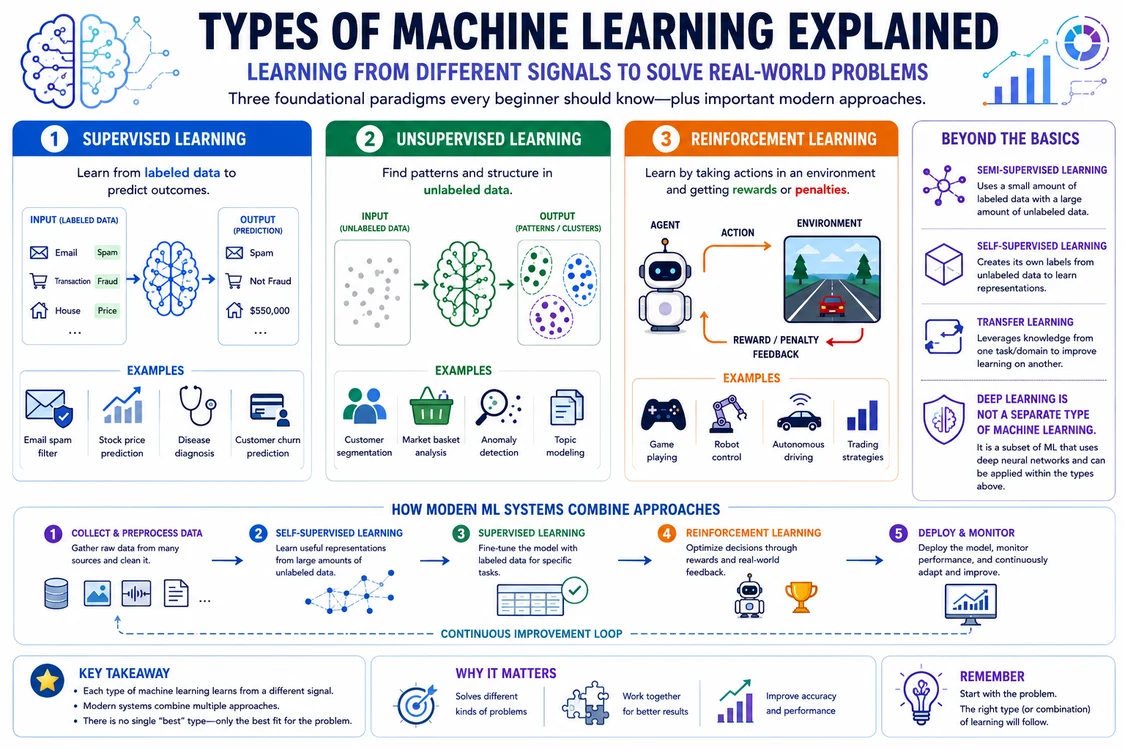
1. Supervised Learning
Supervised learning uses examples where the desired output is known. A spam filter can learn from emails labeled “spam” or “not spam,” while a price model can learn from houses paired with their sale prices.
The two common task types are classification, which predicts a category, and regression, which predicts a continuous numerical value. Performance is evaluated on data the model did not use for fitting, with metrics chosen for the actual task.
Supervised learning is useful when reliable labeled examples and a clear prediction target exist. Its limitations include label cost, inherited bias or errors, overfitting, and performance loss when real-world data differs from the training data.
Continue with Supervised Learning Explained for labels, features, classification, regression, training, and evaluation. See Training vs Testing Data in Machine Learning for the data split that supports honest evaluation.
2. Unsupervised Learning
Unsupervised learning works without a separate target label for every example. It searches for useful structure, relationships, or representations in the available data.
For example, a clustering method can group observations with similar characteristics, while dimensionality reduction can represent high-dimensional data with fewer variables. The resulting groups or representations still require interpretation; a discovered pattern is not automatically meaningful.
Evaluation may consider stability, internal metrics, domain interpretation, downstream task performance, or human review. No universal “accuracy” score proves that every unsupervised result is useful.
Read Unsupervised Learning Explained for the broader mechanics, K-Means Clustering Explained for one clustering method, and Feature Selection vs Feature Extraction for a related representation topic.
3. Reinforcement Learning
Reinforcement learning focuses on sequential decision-making. An agent observes an environment, chooses an action, and receives a reward that helps it learn a policy for future choices.
A clean example is a game-playing agent. It tries actions, observes their consequences, and gradually learns a strategy that performs better under the reward function.
Reinforcement learning is appropriate when actions affect later outcomes and success can be expressed through interaction and rewards. Its challenges include costly exploration, unintended reward incentives, sample demands, safety, and evaluation over long time horizons. Complex systems such as autonomous vehicles usually combine many methods and should not be described as purely reinforcement-learning systems.
Read Reinforcement Learning Explained for deeper concepts and algorithms.
Beyond the Three Major Introductory Paradigms
Semi-Supervised Learning
Semi-supervised learning combines a smaller labeled dataset with a larger unlabeled dataset. It can help when raw data is abundant but reliable labels are expensive, while still depending on assumptions about how the labeled and unlabeled examples relate.
Self-Supervised Learning
Self-supervised learning creates training targets from the data itself—for example, predicting a masked word or the next token in a sequence. It can use large unlabeled datasets while constructing a supervised-style objective from the data’s structure.
Transfer Learning Is a Strategy
Transfer learning is a reuse and adaptation strategy, not a peer top-level learning paradigm. A model trained on one dataset or task can be adapted to a related task, often through fine-tuning.
Deep Learning Is Not a Fourth Peer Paradigm
Deep learning is a family of machine-learning methods based on multilayer neural networks. A deep-learning model can use supervised, self-supervised, semi-supervised, or reinforcement-learning objectives. Deep learning therefore describes a modeling approach, not a learning-signal category equivalent to supervised, unsupervised, or reinforcement learning. For the modeling layer, read Deep Learning Explained.
Comparison of Machine Learning Types
This comparison focuses on the learning signal, data setup, typical task, and how results are evaluated.
| Approach | Learning signal and data setup | Typical task | Evaluation or limitation |
|---|---|---|---|
| Supervised | Examples paired with target labels or outputs | Classification or regression | Held-out prediction metrics; label quality and distribution shift matter |
| Unsupervised | No separate target label for every example | Clustering, dimensionality reduction, structure discovery | Stability, interpretation, or downstream usefulness; no single universal score |
| Reinforcement | Rewards generated through interaction | Sequential decision-making and control | Expected cumulative reward; exploration, safety, and reward design matter |
| Semi-supervised | Smaller labeled set plus a larger unlabeled set | Prediction or representation learning with limited labels | Assumptions, pseudo-label quality, and domain mismatch |
| Self-supervised | Targets created from the structure of the data | Pretraining and representation learning | Objective fit, downstream evaluation, compute, and data quality |
Which Type of Machine Learning Should You Use?
- Use supervised learning when you have a clear prediction target and reliable labeled examples.
- Use unsupervised learning when the goal is to discover structure or useful representations without a known target for every example.
- Use reinforcement learning when the task is sequential, actions influence future outcomes, and useful reward feedback is available.
- Consider semi-supervised or self-supervised learning when labeled data is limited but substantial unlabeled data exists.
- Consider transfer learning when a suitable pretrained model can be adapted to the task.
The final choice also depends on data quality, cost, risk, interpretability, compute, deployment constraints, and the evaluation plan. See Model Evaluation Metrics Explained for choosing measures that match the task.
Sources and Further Reading
These primary references provide definitions and introductory explanations for the learning paradigms discussed in this guide:
- Google for Developers: What Is Machine Learning? — an introduction to supervised, unsupervised, and reinforcement learning.
- NIST Computer Security Resource Center: Machine Learning — a standards-based glossary definition of machine learning.
- NIST Computer Security Resource Center: Reinforcement Learning — a glossary definition focused on rewards, interaction, and environmental feedback.
Frequently Asked Questions
What are the three main types of machine learning?
Supervised, unsupervised, and reinforcement learning are the three most common introductory paradigms. They are useful for learning the field, but they are not an exhaustive taxonomy of every modern training approach.
Is deep learning a type of machine learning?
Yes. Deep learning is a family of machine-learning methods, but it is not a fourth peer learning paradigm. Deep neural networks can be trained using several different learning signals.
Does unsupervised learning use no labels at all?
Its training objective generally does not rely on a separate target label for every example. Labels may still be used later for evaluation, interpretation, validation, or downstream tasks.
Where to Learn Next
Next lesson: Continue with the first major paradigm and learn how labeled examples support classification and regression.
After that, continue to Unsupervised Learning Explained and Reinforcement Learning Explained.