
Updated: August 2026
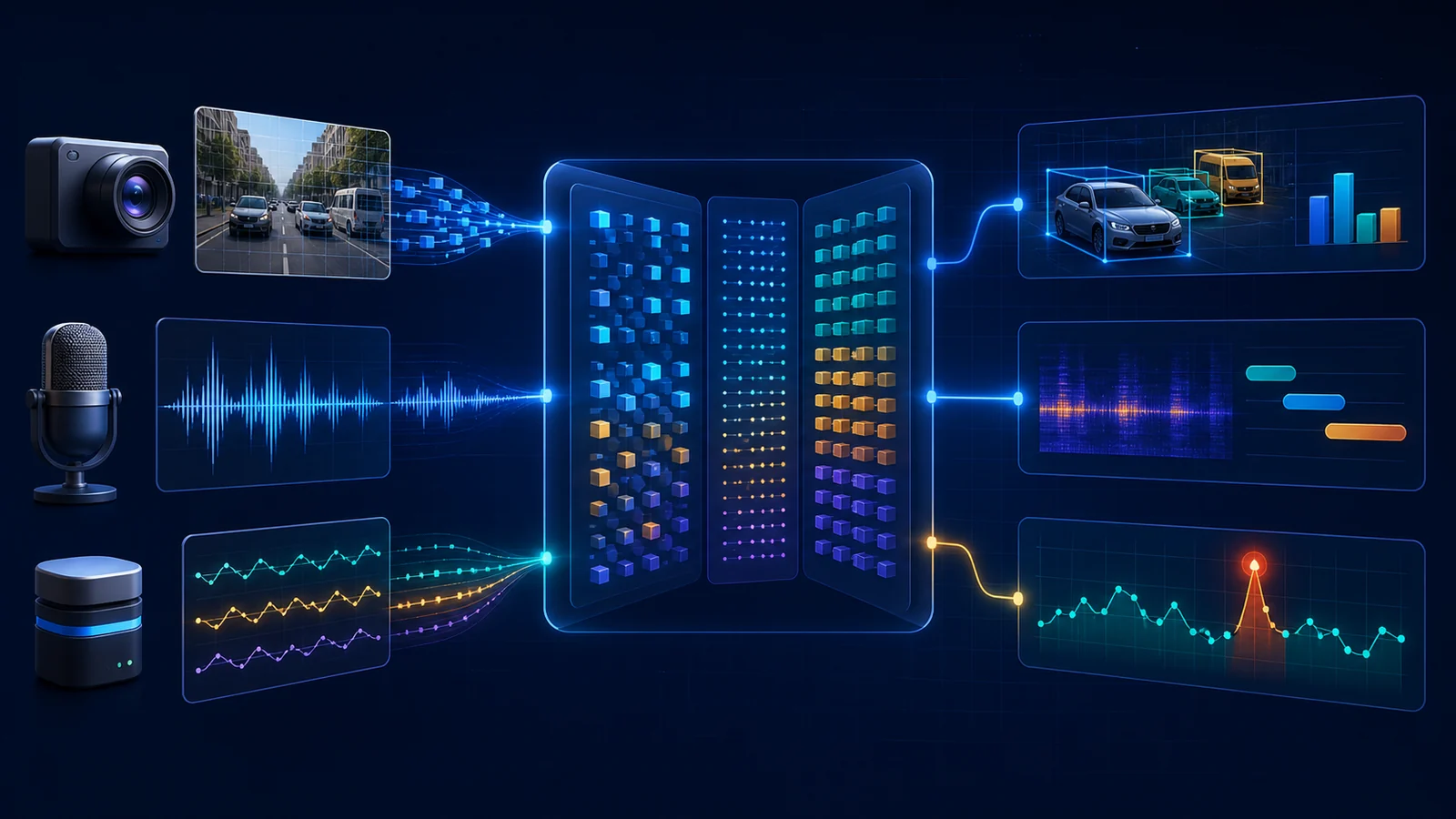
Machine perception is how computational systems extract useful information from images, video, audio, speech, and other sensor data. It helps an AI system produce task-specific outputs—but it does not mean the system sees, hears, or understands the world like a person.
This beginner guide explains what machine perception includes, how a typical perception pipeline works, how it differs from computer vision, and why real-world validation matters.
Key takeaways
- Machine perception is a broad field covering visual, audio, speech, multimodal, and sensor data.
- Computer vision is one branch of machine perception, focused specifically on images and video.
- Perception systems transform inputs into representations and task-specific outputs; they do not experience sensory information.
- Benchmark accuracy alone does not prove that a system will work safely or reliably after deployment.
What is machine perception?
Machine perception is the use of computational systems to extract and interpret information from sensory inputs such as images, video, audio, speech, depth measurements, and environmental sensor readings.
It is broader than computer vision. Computer vision focuses on visual information, while machine perception can also include speech and audio processing, multimodal perception, and sensor fusion. Google’s Machine Learning Glossary describes a modality as a high-level data category such as text, images, video, or audio. A multimodal model works with more than one such category as input, output, or both.
The word perception is a useful technical shorthand, but it can be misleading. Machine-perception systems do not literally see, hear, or understand their surroundings. They process data with models designed for defined tasks—for example, detecting an object, transcribing speech, or flagging an unusual sensor reading.
What machine perception includes
- Computer vision: processing images and video for tasks such as classification, detection, segmentation, tracking, and inspection.
- Speech and audio processing: transcribing speech, classifying sounds, detecting audio events, or estimating acoustic properties.
- Multimodal perception: combining information from more than one data type, such as video and audio or images and text.
- Sensor fusion: combining measurements from cameras, radar, depth sensors, microphones, force sensors, or other devices.
A generic machine-perception pipeline
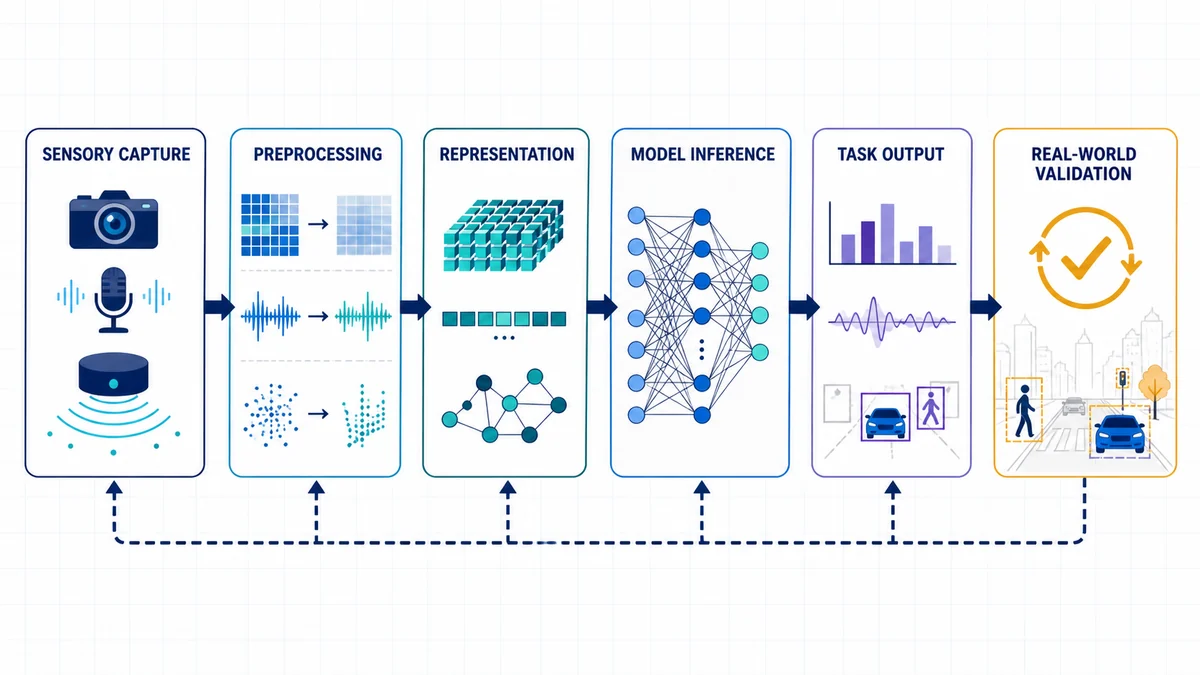
Architectures vary, but the following six-stage model is a useful way to understand the overall flow:
- Capture sensory data. Cameras, microphones, scanners, or other sensors collect the input.
- Preprocess the input. The system may clean, normalize, resize, segment, synchronize, or filter the data.
- Create a representation. The input is converted into a form the selected model can process.
- Run model inference. A trained model applies what it learned to the new input.
- Produce a task output. The result might be a class label, detected object, transcript, score, alert, or control signal.
- Validate in real conditions. Teams compare outputs with expected behavior and investigate errors under realistic operating conditions.
For more detail on the early stages, read Data Preprocessing Explained and What Is a Dataset in Machine Learning?
Machine perception vs. computer vision
Computer vision is the visual branch of machine perception. It works with images and video, while the broader field can include audio, speech, multiple modalities, and physical sensors.
| Area | Primary inputs | Example outputs |
|---|---|---|
| Computer vision | Images and video | Labels, boxes, masks, tracks |
| Speech and audio | Waveforms and spectrograms | Transcripts, sound classes, events |
| Multimodal perception | Two or more data types | Aligned or combined task outputs |
| Sensor fusion | Measurements from multiple sensors | Position, state, risk, or control estimates |
Explore the visual branch in Computer Vision Explained and How Image Recognition Works. The dedicated image-classification and object-detection lessons are still being prepared.
Speech and audio perception
Speech-recognition systems convert spoken audio into text or another linguistic representation. Other audio models can classify sounds, detect events, separate speakers, or estimate acoustic properties.
Speech recognition and natural language processing are related but distinct. Speech recognition deals with the audio signal; NLP works with language representations after or alongside that processing. Continue with Speech Recognition Explained and Natural Language Processing.
Multimodal perception
Multimodal systems combine information from more than one input type. Examples include image plus text, video plus audio, or data from several physical sensors.
Combining modalities can provide useful context for some tasks, but it also adds complexity. The system must align data collected at different times or resolutions and deal with missing, noisy, or contradictory signals. More inputs do not automatically make a system more accurate or dependable.
Neural networks and deep learning
Many modern perception systems use deep neural networks because they can learn useful representations from large datasets. However, not every perception system requires deep learning. Traditional signal processing, rules, statistical methods, and other machine-learning approaches remain useful depending on the problem, available data, operating constraints, and required explainability.
Learn the foundations in Neural Networks Explained and How Deep Learning Works.
Machine perception in robotics
Robots use perception to estimate aspects of their surroundings and support navigation, manipulation, inspection, or interaction. A robot may combine cameras, depth sensors, force sensors, microphones, and position measurements.
Perception is only one part of a robotics system. Planning, control, safety, and physical actuation are separate concerns, and a strong perception model does not guarantee safe overall behavior. Read AI in Robotics for the larger picture.
Key limitations and risks
Sensor and data quality
Poor lighting, background noise, calibration problems, compression, occlusion, or faulty sensors can reduce performance before the model even receives the input.
Ambiguity and confident errors
The same sensory input can support multiple interpretations. A model can also produce a high-confidence output that is wrong.
Distribution shift
A model trained in one environment may perform poorly when deployed with different devices, populations, accents, weather, backgrounds, or operating conditions.
Bias and uneven performance
Training and evaluation data may underrepresent particular groups, environments, languages, or edge cases, leading to uneven error rates.
Robustness and adversarial conditions
Unusual inputs, deliberate manipulation, or conditions absent from training can disrupt perception systems.
Privacy and surveillance
Cameras, microphones, biometric systems, and persistent sensors can create serious privacy and civil-liberties concerns. Technical capability alone does not justify collecting or monitoring sensitive information.
Why real-world validation matters
Benchmark performance is not enough for consequential deployments. Teams should test with representative real-world data, define acceptable error rates, examine failure modes, monitor changing conditions, and provide appropriate human review or fallback procedures.
NIST’s AI Measurement and Evaluation Projects include task-specific evaluation work in areas such as computer vision and speaker recognition. The practical lesson is simple: evaluate the actual system for its intended use instead of assuming quality from a model name or benchmark headline.
Frequently asked questions
Is machine perception the same as computer vision?
No. Computer vision is the visual branch of machine perception. Machine perception can also include speech, audio, multimodal inputs, and other sensor data.
Does machine perception mean AI understands the world like a person?
No. These systems identify patterns and produce task-specific outputs from sensory data. Human-like understanding should not be assumed.
Is image recognition part of machine perception?
Yes. Image recognition and related computer-vision tasks are examples within the broader machine-perception field.
Why does machine perception fail?
Failures can come from noisy sensors, incomplete or unrepresentative training data, ambiguity, distribution shift, bias, adversarial inputs, or poor deployment design.
What to learn next
Machine perception is the umbrella concept. To see how visual inputs become specific outputs, continue with Computer Vision Explained, then explore image classification or object detection.