
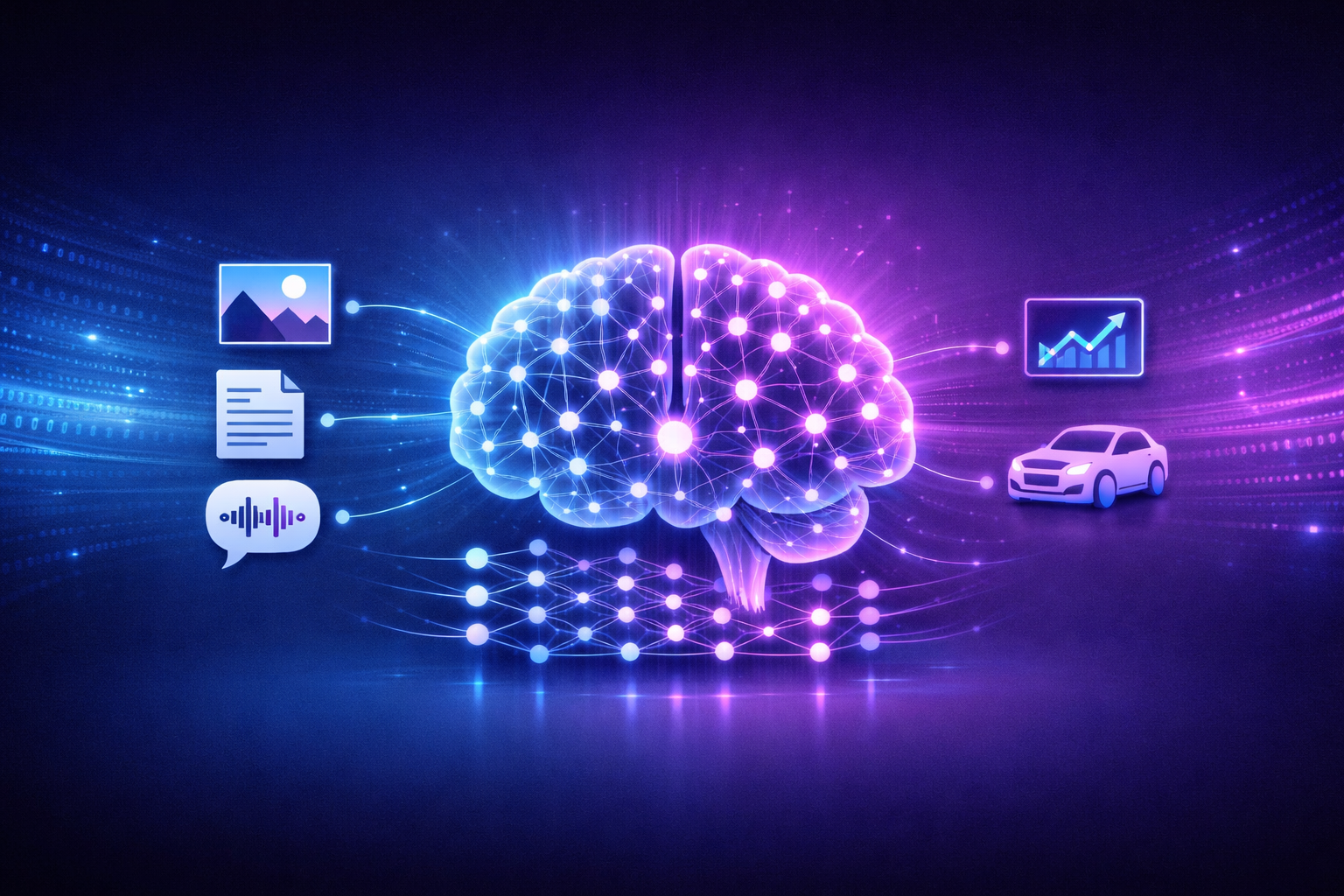
Every time you use ChatGPT, unlock your phone with Face ID, or get Netflix recommendations, deep learning is working behind the scenes.
But how does it actually work?
In this beginner-friendly guide, you’ll learn how deep learning works step-by-step, using simple explanations, real-world examples, and clear analogies—no technical background required.
How Deep Learning Works
Deep learning works by using multi-layered neural networks to learn patterns from large amounts of data. These networks process input data through layers of artificial neurons, calculate errors, adjust internal weights, and improve their predictions over time through repeated training.
What Is Deep Learning?
Deep learning is a type of machine learning that uses artificial neural networks with multiple layers to automatically learn patterns from data.
To understand where it fits:
- Artificial Intelligence → machines that mimic human intelligence
- Machine Learning → systems that learn from data
- Deep Learning → systems that learn using layered neural networks
👉 If you’re new, start with:
- What Is Artificial Intelligence (Beginner Guide)
- What Is Machine Learning (Beginner Guide)
- What Is Deep Learning (Beginner Guide)
Deep learning is powerful because it can learn directly from raw data—without needing humans to manually define rules.
Why Deep Learning Matters
Deep learning is one of the biggest breakthroughs in modern AI.
Before deep learning, engineers had to manually design features for models. Today, deep learning systems can automatically discover patterns in massive datasets.
This is why deep learning powers:
- Chatbots like ChatGPT
- Self-driving cars
- Voice assistants (Siri, Alexa)
- Medical image analysis
👉 In short: deep learning allows machines to learn in a way that’s closer to how humans learn—through experience.
Visualizing How Deep Learning Works
Imagine deep learning as a multi-step transformation pipeline:
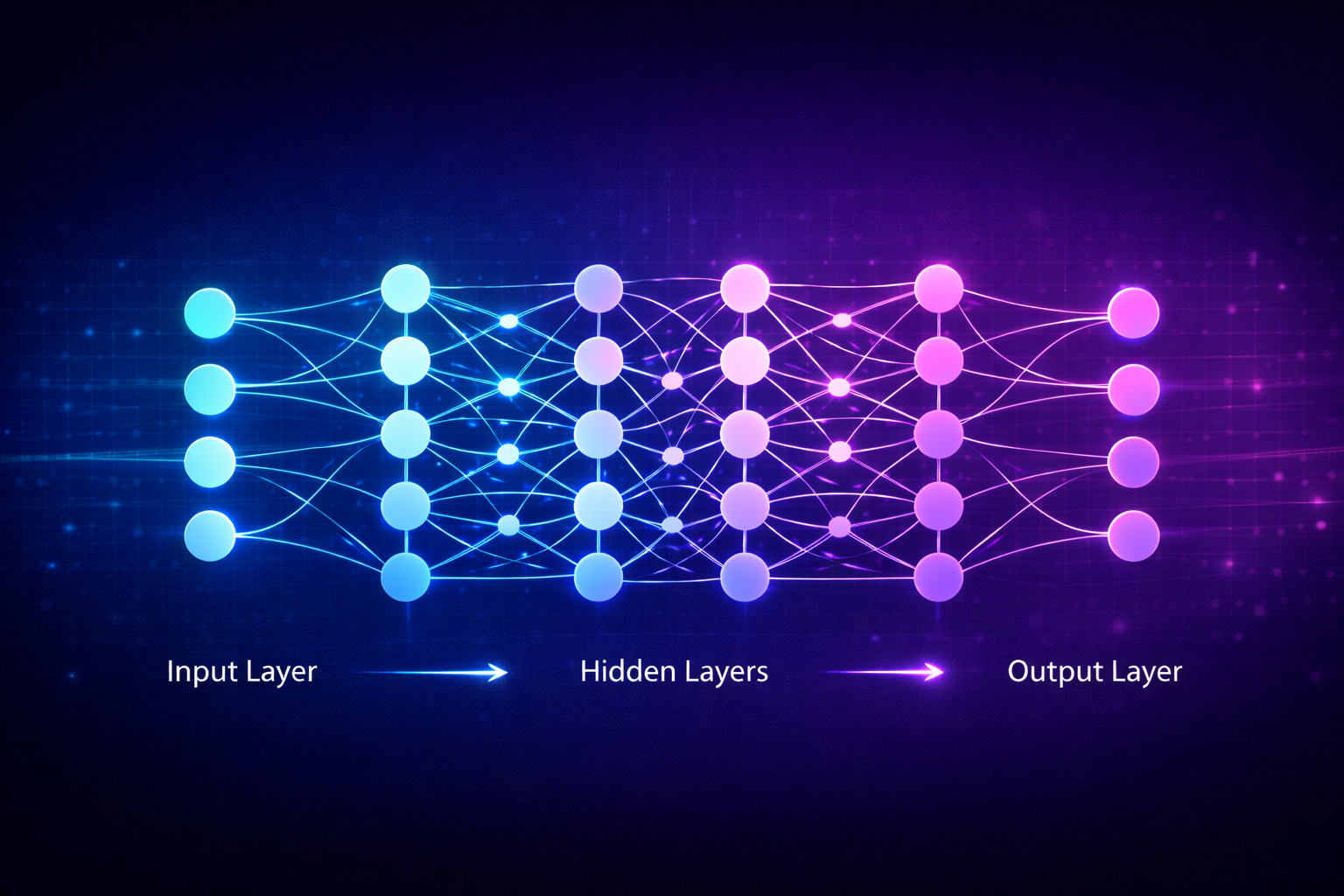
- Input → raw data (image, text, audio)
- Hidden layers → extract patterns step-by-step
- Output → final prediction
Each layer refines the information further—like turning rough sketches into a detailed picture.
👉 This layered approach is what gives deep learning its power.
How Deep Learning Works (Step-by-Step)
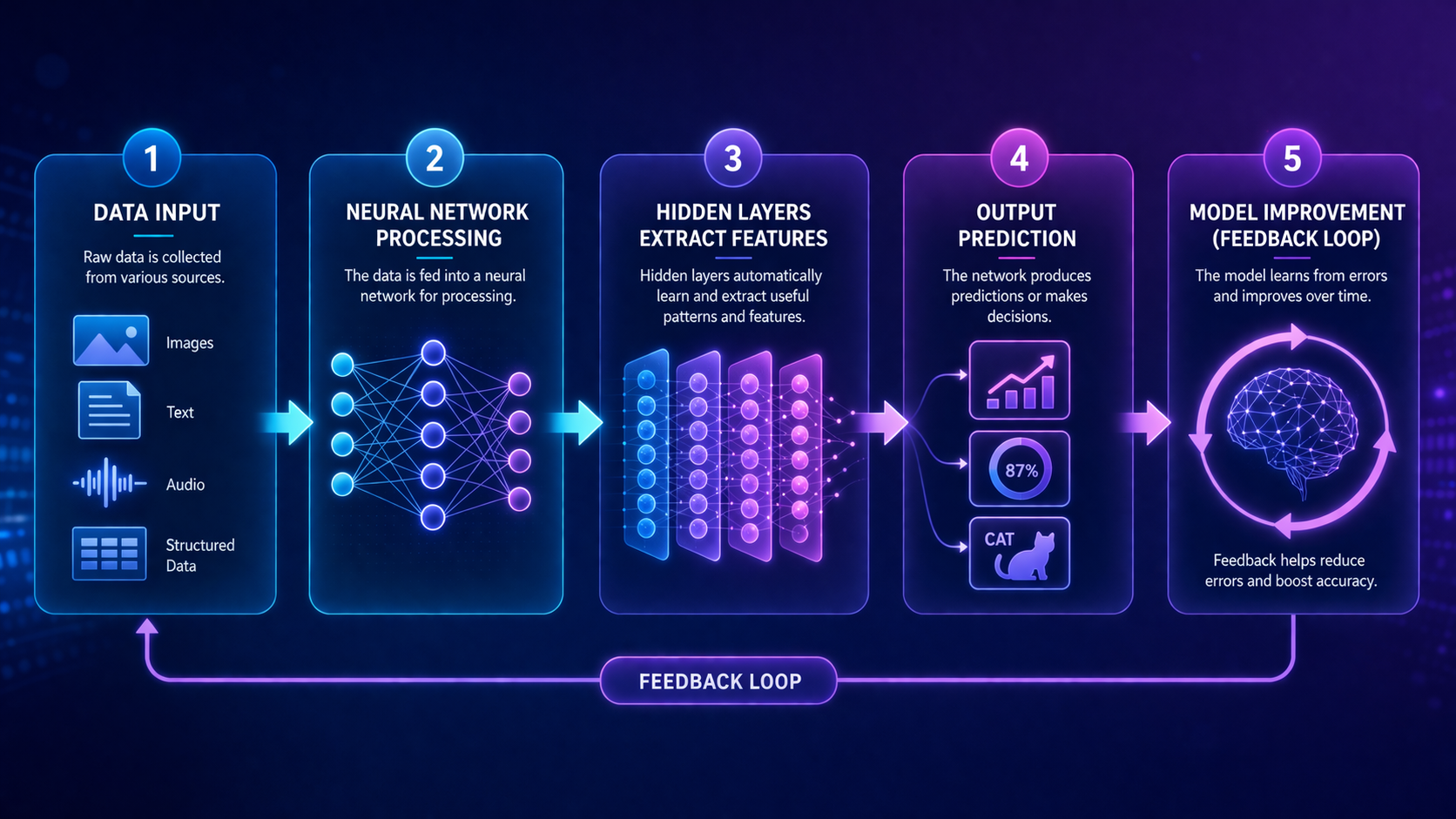
Let’s break it down into a simple, easy-to-follow process.
Step 1: Input Data
Everything starts with data.
This could include:
- Images (photos, X-rays)
- Text (articles, conversations)
- Audio (speech recordings)
- Numerical data
👉 Example: A model learning to recognize cats is trained on thousands of labeled images.
Step 2: Passing Through Neural Network Layers
The data enters a neural network, which contains:
- Input layer → receives raw data
- Hidden layers → process and transform the data
- Output layer → produces a prediction
Each layer contains neurons, which pass information forward.
👉 Think of it like:
- Input → raw image
- Layers → detect edges → shapes → features
- Output → “This is a cat”
👉 Learn more in: Neural Networks Explained
Step 3: Automatic Feature Learning
Unlike traditional machine learning, deep learning automatically learns features.
It identifies patterns like:
- Edges
- Colors
- Shapes
- Objects
👉 Example:
- Early layers detect simple lines
- Middle layers detect shapes
- Deep layers recognize faces or objects
This is why deep learning works so well for complex data like images and language.
Step 4: Making Predictions
After processing the data, the model produces an output.
Examples:
- “This image is a dog”
- “This email is spam”
- “This sentence means X”
At first, predictions are often incorrect.
Step 5: Calculating Error (Loss)
The model compares its prediction with the correct answer.
The difference is called loss.
👉 Example:
- Prediction: cat
- Actual: dog
- Result: high error
The goal is to minimize this error.
Step 6: Backpropagation (Learning Process)
The model learns by adjusting itself.
It:
- Calculates the error
- Sends the error backward through the network
- Updates internal parameters
This process is called backpropagation.
👉 Analogy:
Like adjusting your aim after missing a target.
Step 7: Updating Weights
Each neuron has weights, which determine how important inputs are.
During training:
- Useful patterns → stronger weights
- Irrelevant patterns → weaker weights
Over time, the model becomes more accurate.
Step 8: Repeating the Process (Training Loop)
This process repeats thousands or millions of times.
With each cycle:
- Errors decrease
- Accuracy improves
Eventually, the model learns to make reliable predictions.
Key Concepts Beginners Must Understand
Neural Networks
The foundation of deep learning, inspired by the human brain.
Layers
More layers allow models to learn more complex patterns.
Weights and Biases
Adjustable parameters that control learning.
Activation Functions
Help models learn complex relationships.
Training Data
Data used to teach the model.
👉 Related:
Epochs and Iterations
- Epoch = one full pass through data
- Iteration = one update step
Types of Deep Learning Models
Convolutional Neural Networks (CNNs)
Used for images and visual tasks.
👉 Example: Face recognition
Recurrent Neural Networks (RNNs)
Used for sequential data.
👉 Example: Speech processing
Transformers
Used for language and modern AI systems.
👉 Example: ChatGPT
Real-World Applications of Deep Learning
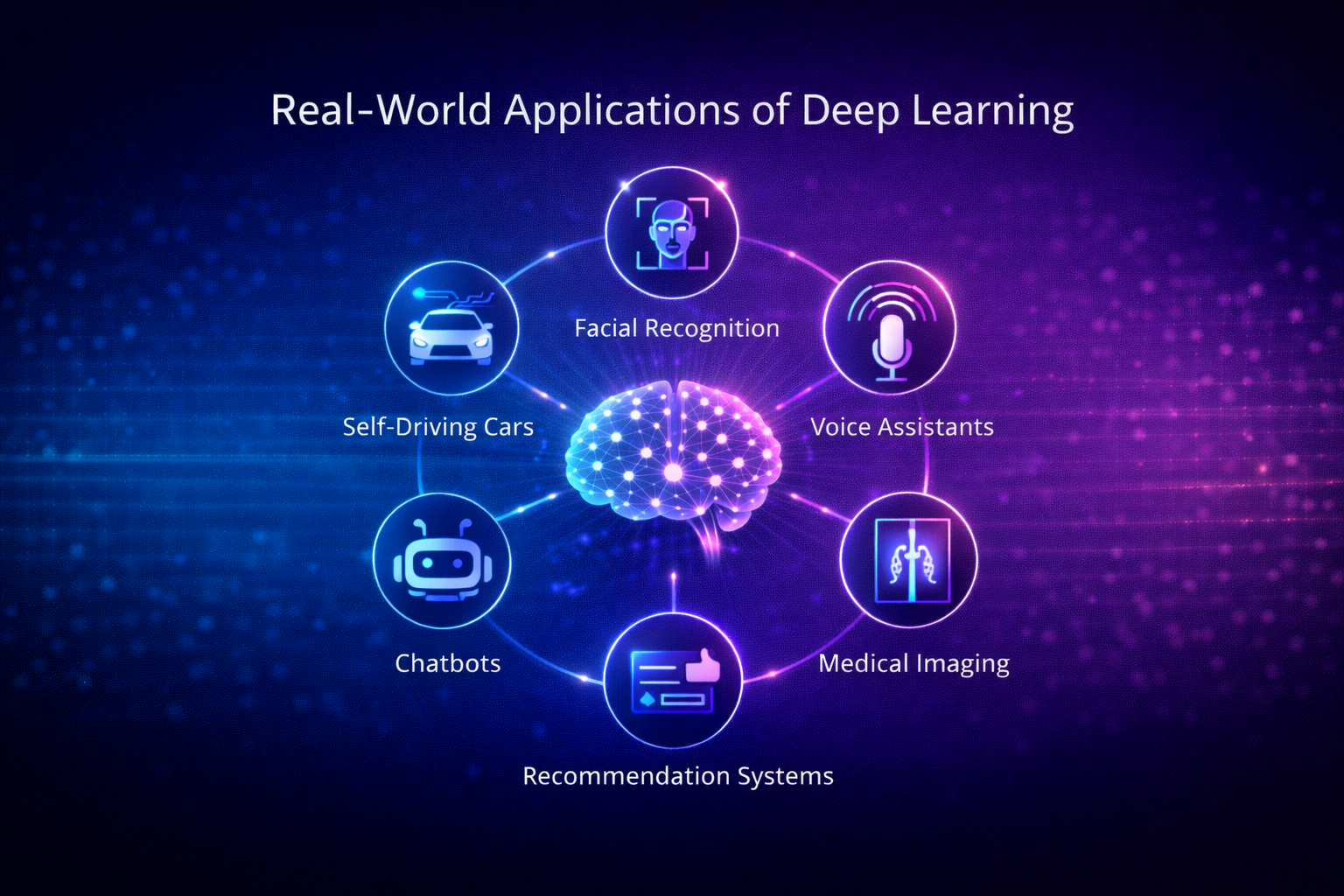
Deep learning is used across many industries:
Healthcare
- Disease detection
- Medical imaging
Self-Driving Cars
- Object detection
- Navigation systems
Natural Language Processing
- Chatbots
- Translation tools
Recommendation Systems
- Netflix, YouTube, Amazon
Computer Vision
- Facial recognition
- Security systems
Advantages of Deep Learning
1. Automatic Feature Learning
No manual feature engineering needed.
2. High Accuracy
Excellent for complex tasks.
3. Scalability
Improves with more data.
4. Versatility
Works across many domains.
Limitations of Deep Learning
1. Requires Large Datasets
Needs significant data to perform well.
2. High Computational Cost
Requires GPUs and powerful hardware.
3. Black Box Nature
Hard to interpret decisions.
4. Risk of Overfitting
May memorize instead of generalize.
Deep Learning vs Machine Learning
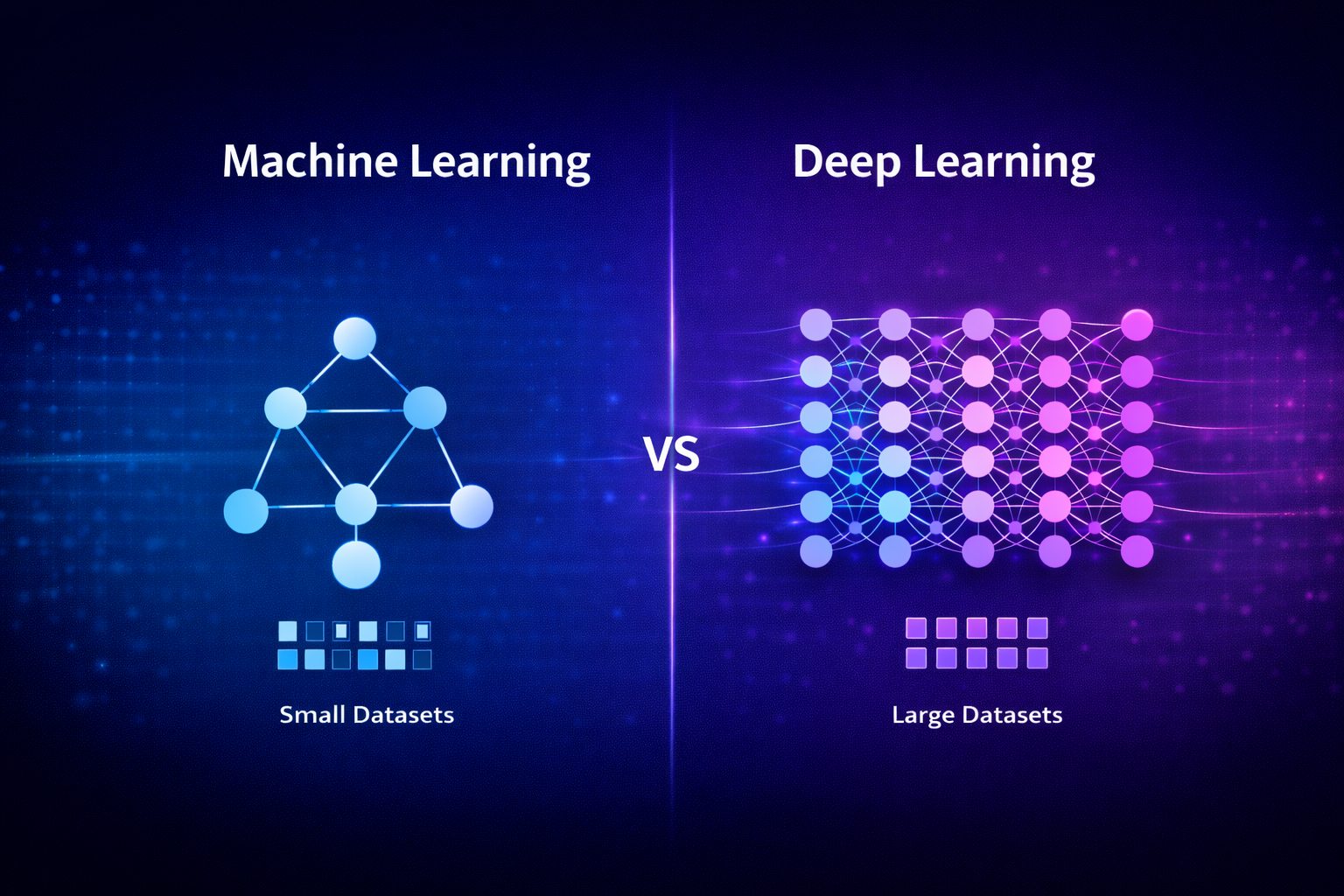
| Feature | Machine Learning | Deep Learning |
| Feature Engineering | Manual | Automatic |
| Data Requirement | Moderate | Very Large |
| Complexity | Lower | Higher |
| Accuracy | Good | Very High (complex tasks) |
| Use Cases | Structured data | Images, audio, text |
When to Use Each
Use machine learning when:
- Data is limited
- Problem is simple
- Interpretability matters
Use deep learning when:
- Data is large
- Problem is complex
- You need high accuracy
👉 Learn more: Deep Learning vs Machine Learning
Future of Deep Learning
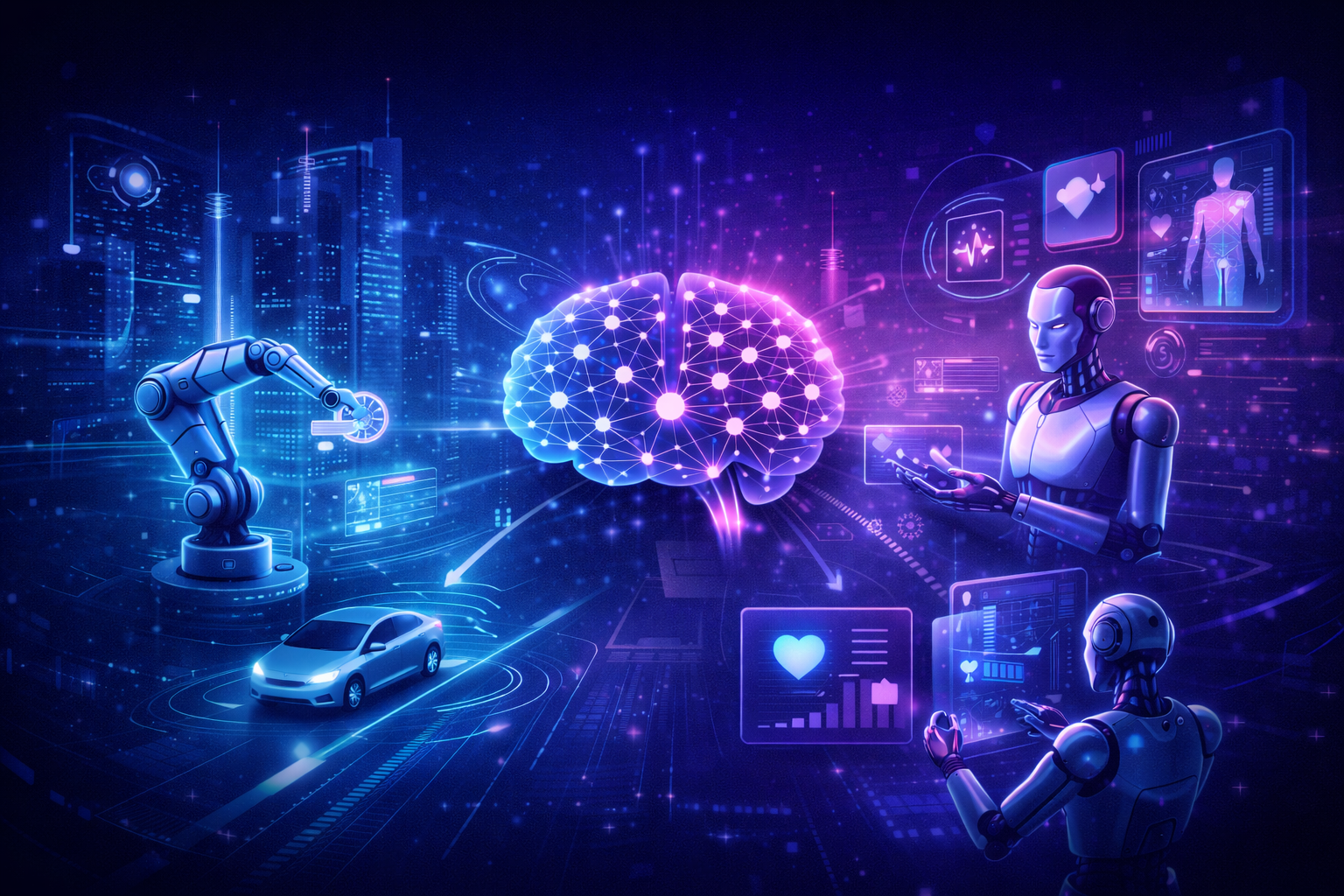
Deep learning is evolving rapidly.
Key trends include:
- Smaller and more efficient models
- Multimodal AI (text + images + audio
- Better explainability
- AI agents and automation
- Integration into everyday devices
The future of AI is deeply connected to advances in deep learning.
External Resources
For deeper exploration:
FAQ: How Deep Learning Works
1. How does deep learning work step by step?
It processes data through layers, makes predictions, calculates error, and updates itself through training.
2. What is deep learning in simple terms?
It’s a way for computers to learn patterns using layered neural networks.
3. Why is it called deep learning?
Because it uses many layers of neurons.
4. What is backpropagation?
A method used to adjust weights based on errors.
5. What are real-life examples of deep learning?
ChatGPT, self-driving cars, facial recognition, and voice assistants.
6. Is deep learning hard to learn?
It can be complex, but beginners can understand the basics easily.
7. Does deep learning require labeled data?
Not always—some models use unlabeled data.
8. Why does deep learning need a lot of data?
More data helps the model learn better patterns.
9. What’s the difference between AI and deep learning?
Deep learning is a subset of AI focused on neural networks.
10. Can deep learning work without human input?
It still requires data and training setup, but it learns patterns automatically.
Conclusion
Deep learning works by passing data through multiple layers of neural networks, learning patterns step-by-step, and improving through repeated training.
It is the technology behind many of today’s most powerful AI systems—from chatbots to self-driving cars.
If you’re building your AI knowledge, your next step is to explore:
- Neural Networks Explained
- Deep Learning vs Machine Learning
- Supervised Learning Explained
- Unsupervised Learning Explained
These topics will help you understand how AI systems truly learn and make decisions.
This article is part of the structured AI learning system at AllForTheAI.com, designed to guide you step-by-step through artificial intelligence concepts.