
Last reviewed: August 2026
Artificial intelligence is used in education for tutoring support, feedback, accessibility, content creation, administration, analytics and teacher assistance.
But the educational value of AI depends on how it is used. A system that generates fluent answers does not automatically improve learning, and schools should distinguish technological capability from evidence of better educational outcomes.
In this guide, you will learn:
- Where AI is used in education.
- What generative AI changes in classrooms.
- Why learning evidence matters more than model capability alone.
- How privacy, academic integrity, accessibility and equity affect adoption.
- Why teachers and students need meaningful agency and AI literacy.

What Is AI in Education?
AI in education refers to computer systems that use techniques such as machine learning, natural language processing, computer vision or generative models for an educational task.
Depending on the system, that task might involve:
- Explaining a concept or generating practice questions.
- Drafting teaching materials or feedback.
- Supporting translation, captioning or text-to-speech.
- Finding patterns in student work.
- Retrieving information from institutional resources.
- Assisting with scheduling or document processing.
The output may be a generated explanation, recommendation, score, alert, translation or draft. Its educational value depends on the intended purpose, accuracy, learner context, instructional design and evidence supporting the use.
This guide is part of the AI Applications learning path. If you are new to the field, begin with What Is Artificial Intelligence? and Machine Learning Explained.
How AI Is Used in Education
Tutoring and learning support
AI systems can explain concepts, generate practice questions, provide hints or adapt examples to a learner’s request.
These tools may expand access to support, but they can also provide incorrect explanations or encourage dependence if students use them to bypass productive struggle. A tutoring feature should therefore be evaluated as an educational intervention—not assumed effective merely because it uses AI.
The U.S. Department of Education’s July 2025 letter explains how grantees and prospective grantees may use federal education grant funds for responsible AI-supported activities, including instructional materials, tutoring and advising, when applicable program rules are met. It is guidance about allowable grant-funded uses—not a national curriculum requirement or proof that every AI tutor improves learning.
Teacher assistance
Teachers can use AI to help draft lesson materials, rubrics, examples, summaries, communications or differentiated activities.
Teacher review remains important because generated content can contain factual errors, inappropriate difficulty, bias or poor alignment with curriculum goals. The amount of review should increase with the consequence of the task.
Feedback and assessment support
AI can help generate formative feedback or identify patterns in student work.
High-stakes grading, admissions and disciplinary decisions require particular caution. Automated output should not be treated as inherently objective or reliable. Institutions should evaluate error rates, subgroup impacts, appeal processes and the role of human judgment.
For a broader explanation of model measurement, see Model Evaluation Metrics Explained.
Accessibility
Speech recognition, text-to-speech, translation, captioning, summarization and adaptive interfaces can improve access for some learners.
Accessibility benefits depend on the individual learner and the system’s performance across languages, accents, disabilities and contexts. A feature should be tested with the people it is intended to support rather than assumed accessible by design.
Administrative work
Schools and universities can use AI for document processing, scheduling assistance, knowledge retrieval, student-support workflows and other operational tasks.
Administrative use can still involve sensitive student data and consequential decisions. A task being “non-instructional” does not remove privacy, security, fairness or accountability requirements.
AI in Education Examples
- K–12 practice: A teacher uses an AI tutor to generate hints for a fractions exercise, reviews the hints, and checks whether students can solve similar problems without the tool.
- Higher-education feedback: A writing instructor uses AI to suggest revision questions while the student retains authorship and explains which suggestions were accepted.
- Accessibility support: A learner uses captions or text-to-speech after the institution tests accuracy, privacy and fit for that learner’s needs.
- Student advising: An institution uses AI to help learners navigate program information, with current source data and a clear route to a human adviser.
The exact risks and rules differ by educational setting. K–12 decisions often require added attention to age appropriateness, parental transparency, child privacy and teacher-led use. Higher education also raises questions about research, disciplinary norms, scholarly authorship, assessment policy and institution-wide procurement. In either setting, local policy and the purpose of the activity should guide use.
Generative AI Changes the Classroom Conversation
Generative AI can produce essays, code, images, explanations, study materials and other outputs on demand.
That creates opportunities, but it also changes questions about:
- What students should create independently.
- When AI assistance should be disclosed.
- How assessment should change.
- Which skills remain essential when tools can generate first drafts.
- How students learn to verify AI output.
Generative systems can produce inaccurate claims, invented sources and confident explanations that omit important context. Students and educators need processes for checking important information rather than relying on fluency as a sign of truth.
Read What Is Generative AI? and Natural Language Processing Explained for the underlying concepts.
AI Literacy Is Becoming Part of Education
Responsible AI education is not only about teaching students how to prompt a chatbot.
UNESCO’s AI Competency Framework for Students describes 12 competencies across four dimensions:
- A human-centred mindset.
- Ethics of AI.
- AI techniques and applications.
- AI system design.
The framework organizes development across three progression levels—Understand, Apply and Create—and emphasizes critical judgment, responsible citizenship, foundational knowledge and inclusive design.
UNESCO’s companion framework for teachers defines 15 competencies across human-centred mindset, ethics, AI foundations and applications, AI pedagogy, and professional learning.
The broader goal is to help learners and educators understand AI critically, use it responsibly and participate in decisions about how it affects education and society.
Does AI Improve Learning?
Sometimes it may, but the answer depends on the tool, instructional design, learner, subject, teacher involvement and evaluation method. The OECD Digital Education Outlook 2026 finds that general-purpose generative AI can improve task performance without producing lasting learning gains, while uses designed around a clear pedagogical purpose show more promise.
AI should not be described as automatically personalizing education or improving achievement. A useful evaluation asks:
- What educational problem is the system solving?
- Is AI the appropriate intervention, or would a simpler approach work better?
- Is there evidence that it improves the intended learning outcome?
- Does it work for the relevant learners and setting?
- What privacy, accessibility, integrity or equity risks does it introduce?
- How will teachers and students review its output?
- How will performance be monitored after adoption?
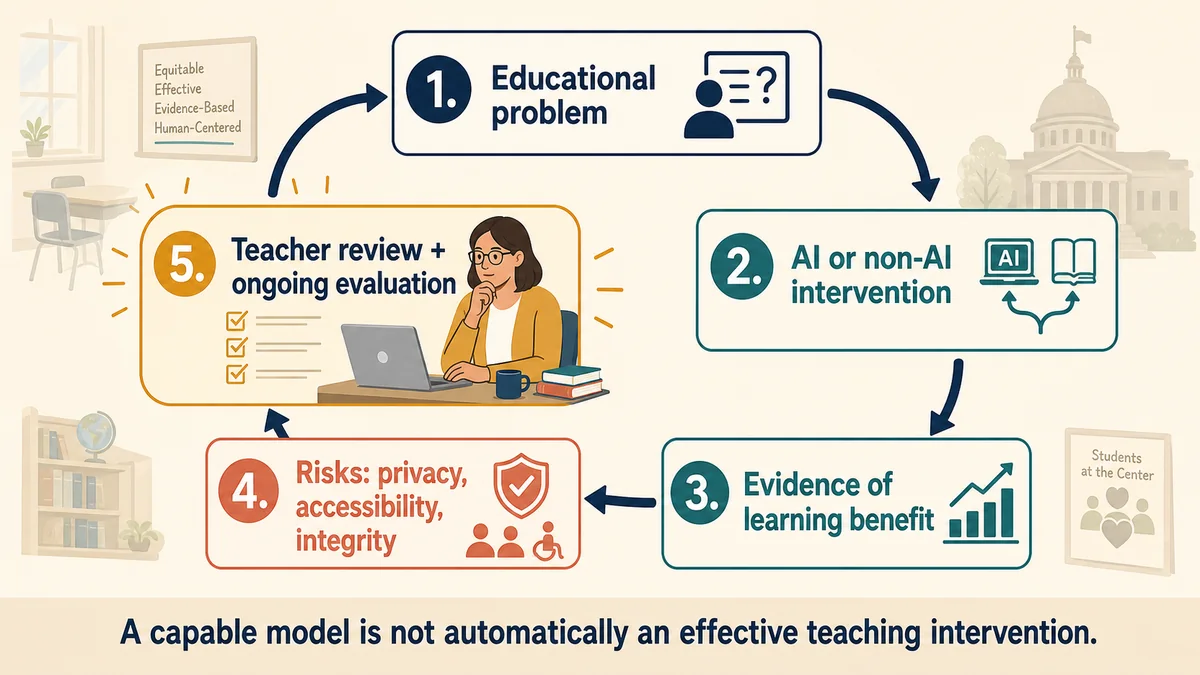
Model accuracy or output quality is not the same as educational effectiveness. A capable system can still fail when it is poorly matched to the learning objective, classroom workflow or needs of particular students.
The U.S. Department of Education’s August 20, 2026 education-technology guidance similarly emphasizes a clear instructional purpose, independent evidence, educator judgment, transparency and regular review of effectiveness. Its practical questions ask what learning problem a tool solves, when and for whom it should be used, for how long, and what evidence shows improved learning.
Academic Integrity
Generative AI complicates traditional assumptions about authorship and independent work.
Institutions need clear policies defining acceptable assistance for different assignments rather than relying only on detection tools. UNESCO’s guidance for generative AI in education recommends a human-centred, age-appropriate approach and stresses pedagogical validation, privacy protection and institutional preparedness.
AI-output detectors can produce false positives and false negatives and should not be treated as standalone proof of misconduct. A peer-reviewed Patterns study also found substantial false-positive bias against non-native English writers. Where appropriate, assessment can place more weight on process, oral explanation, drafts, source evaluation, classroom work and demonstrated understanding.
Student Privacy and Data
Educational AI can involve sensitive information about students, including writing, performance, behavior, disability or personal circumstances.
Before using a system, schools should understand:
- What data it collects.
- How long data is retained.
- Whether data is used for model training.
- Who can access it.
- Which privacy laws and institutional policies apply.
- Whether the tool is appropriate for the learner’s age and setting.
- Whether participation requires unnecessary personal data.
Students should not have to surrender unnecessary personal information simply to participate in ordinary learning.
Equity and Access
AI can expand access to learning support, but it can also deepen existing inequalities.
Important questions include:
- Do all students have reliable devices and connectivity?
- Does the system work across languages and cultures?
- Is it accessible to learners with disabilities?
- Are paid features creating unequal educational advantages?
- Does automation reduce or improve access to human support?
- Are errors or restrictions distributed unevenly across student groups?
See AI and Ethical Considerations for a deeper treatment of bias, fairness and accountability.
Teacher Oversight and Human Agency
Teacher oversight should be meaningful rather than symbolic.
Educators need enough information, time, authority and training to evaluate AI-supported material. A requirement to “review the output” offers little protection if the reviewer cannot understand the relevant inputs, limitations or likely failure modes.
Teachers remain responsible for pedagogy, relationships, context, judgment and the learning environment. AI may assist those responsibilities, but delegating a task to software does not remove institutional accountability.
Responsible Adoption Checklist
Before adopting an AI system, an educational institution should consider the following. The August 2026 U.S. Department of Education guidance reinforces this evidence-first approach and recommends changing course when a tool does not improve learning.
- Educational purpose.
- Evidence of effectiveness.
- Age appropriateness.
- Privacy and security.
- Accessibility and equity.
- Bias and reliability testing.
- Teacher and student training.
- Meaningful human oversight.
- Clear acceptable-use and disclosure rules.
- Ongoing evaluation after deployment.
Broader legal and policy questions are covered in AI in Governance.
Frequently Asked Questions
Will AI replace teachers?
AI can automate or assist particular tasks, but teaching also involves judgment, relationships, motivation, classroom management, responsibility and context. Current systems do not turn those responsibilities into a single automated function.
Is using AI cheating?
It depends on the assignment and institution’s rules. Schools should define when AI assistance is allowed, restricted, prohibited or must be disclosed.
Can students trust AI-generated answers?
No output should be trusted solely because it sounds confident. Important claims, calculations and sources should be checked against reliable evidence.
Does AI automatically personalize learning?
No. A system may adapt content or responses, but personalization is valuable only when it supports an appropriate learning objective and works for the learner and context.
Should schools teach AI literacy?
Increasingly, yes. Students need technical, ethical and critical-thinking skills to understand how AI works, evaluate its output and participate in decisions about its use.
Where to Learn Next
Recommended next guide: Learn how generative systems create text, images and other content in What Is Generative AI?
- Explore more real-world fields in the AI Applications hub.
- Review broader responsibilities in AI and Ethical Considerations and AI in Governance.
- Revisit the foundation in What Is Artificial Intelligence?.
About the Author and Review
This educational guide was prepared for AllForTheAI and reviewed against current primary guidance from UNESCO and the U.S. Department of Education. It explains technology and policy concepts for a general audience and is not legal, educational-policy or institutional-compliance advice.
How This Guide Was Reviewed
The review compared the live article with current primary guidance, separated technological capability from demonstrated educational benefit, removed unsupported vendor-success claims, and checked privacy, accessibility, academic-integrity, equity and teacher-agency considerations. Fast-changing guidance should be revalidated at least every six months and after material policy or platform changes.
Sources and Further Reading
- UNESCO — AI Competency Framework for Students
- UNESCO — AI Competency Framework for Teachers
- UNESCO — Guidance for Generative AI in Education and Research
- U.S. Department of Education — July 2025 Guidance on Federal Grant Funds and AI
- U.S. Department of Education — August 2026 Responsible Use of Education Technology
- OECD — Digital Education Outlook 2026
- Patterns — GPT Detectors Are Biased Against Non-Native English Writers
- AllForTheAI Editorial Policy