
Computer vision is one of the most powerful branches of artificial intelligence — and one you already interact with every day, often without realizing it.
From face unlock on your phone to self-driving cars and medical imaging, computer vision allows AI systems to understand images and video in a way that mimics human sight.
In simple terms, computer vision is how AI learns to “see.” Computer vision focuses on AI image understanding by turning visual data into meaningful insights.
In this beginner’s guide, you’ll learn:
- what computer vision is (in plain English)
- how computer vision works step by step
- the most common computer vision tasks
- real-world examples you already know
- the main types of computer vision models
- limitations and risks to be aware of
- how beginners can start learning computer vision
No technical background required.
What Is Computer Vision?
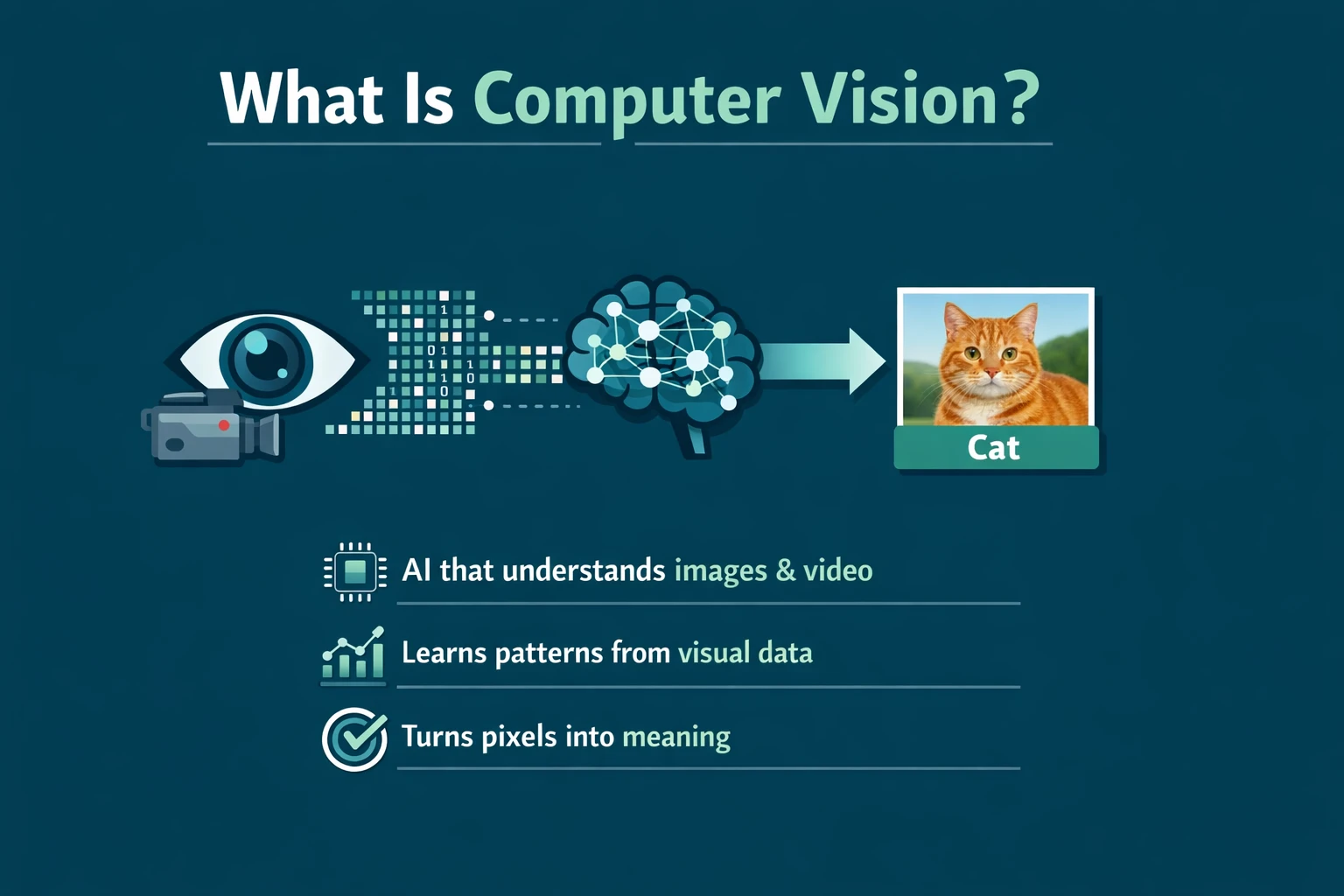
Computer vision is a field of artificial intelligence that enables computers to understand, analyze, and interpret images and video.
Humans see the world visually and instantly recognize objects, faces, and motion.
Computer vision tries to replicate that ability using data, algorithms, and neural networks.
Instead of eyes and a brain, AI uses:
- cameras or image files
- pixels and numbers
- machine learning models
A simple way to think about it:
- Humans see objects
- Computers see pixels
- Computer vision turns pixels into meaning
How Does Computer Vision Work?
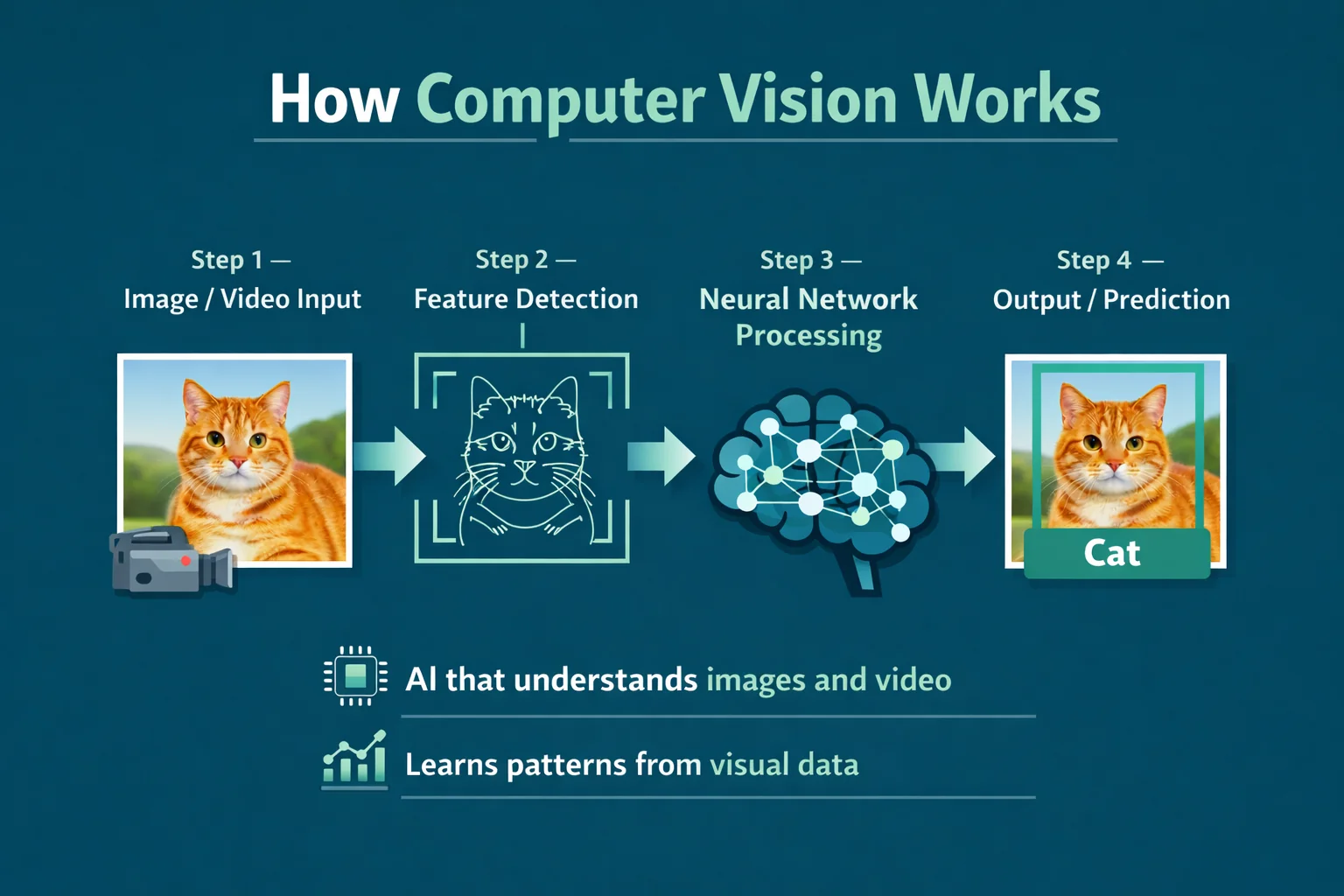
Although it feels almost magical, computer vision follows a fairly logical process.
At a high level, most computer vision systems follow the same four steps.
Step 1 — Image or Video Input
Everything starts with visual data.
This can be:
- a photo
- a video clip
- a live camera feed
- a single video frame
Behind the scenes, images are broken down into pixels, each represented by numerical values.
Before features are extracted, the raw image is often preprocessed — resized, normalized, and cleaned — so that models can analyze it more effectively.
Step 2 — Feature Extraction
Next, the AI looks for patterns inside the image.
Early computer vision systems relied on manually programmed features like:
- edges
- corners
- shapes
Modern systems use deep learning models to automatically learn features such as:
- textures
- colors
- object boundaries
- spatial relationships
This is where neural networks shine.
At its core, computer vision performs visual data analysis with AI models trained on massive image datasets.
Step 3 — Neural Network Processing
The extracted features are fed into a neural network — usually a convolutional neural network (CNN) or a modern vision transformer.
These models:
- compare patterns to what they learned during training
- calculate probabilities
- refine predictions layer by layer
This process is powered by the same deep learning principles explained in Deep Learning 101: Neural Networks for Beginners.
Step 4 — Output or Prediction
Finally, the model produces an output such as:
- a label (“cat,” “car,” “tumor”)
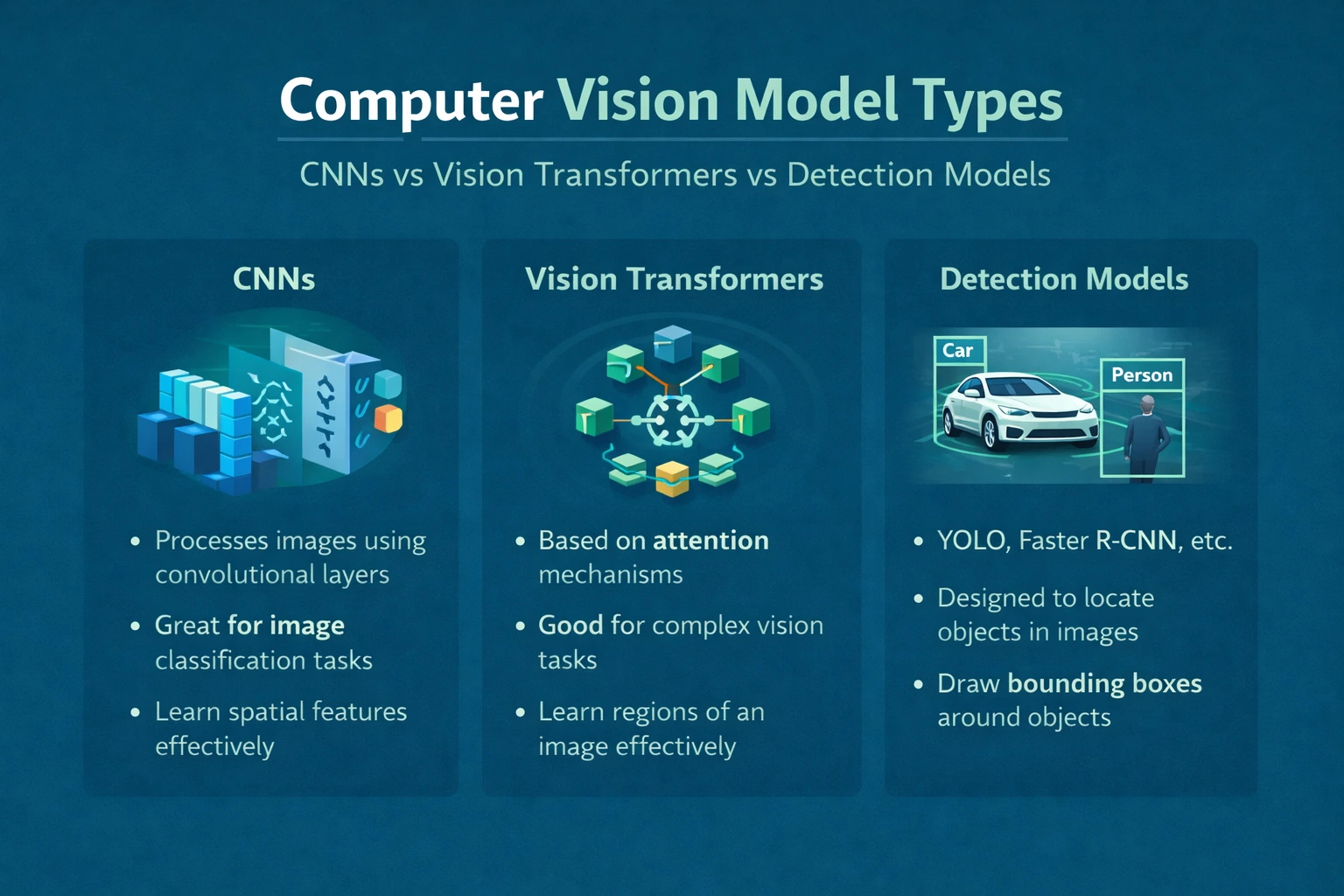
- bounding boxes around objects
- pixel-level segmentation
- motion or behavior detection
In short:
Image → Features → Model → Meaning
Common Computer Vision Tasks
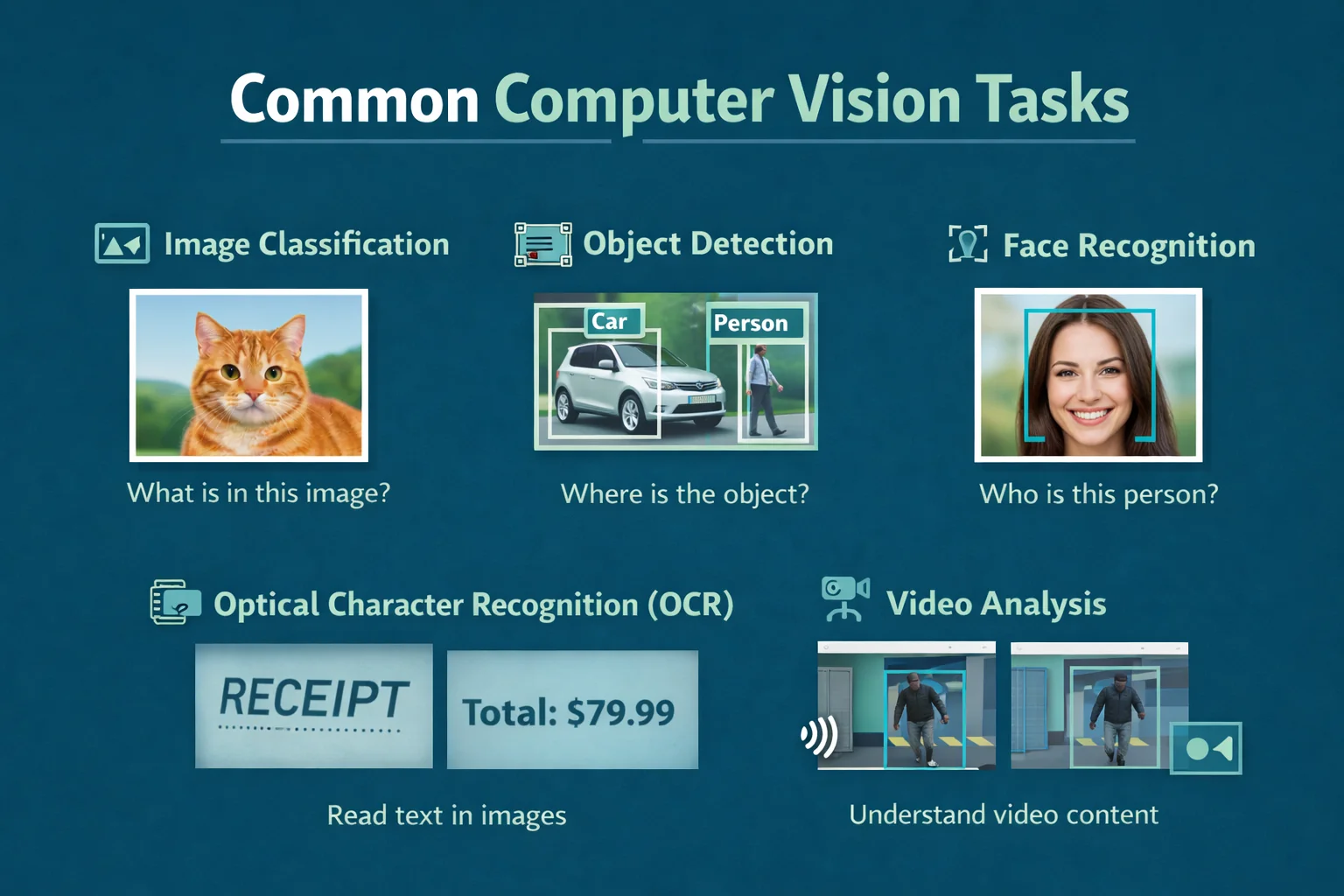
Computer vision isn’t one single task — it’s a collection of related capabilities.
Here are the most common ones you’ll see in real applications.
Image Classification
Image classification answers one question:
“What is in this image?”
Examples:
- identifying animals in photos
- sorting product images
- classifying medical scans
Object Detection
Object detection goes a step further:
“What objects are in this image, and where are they?”
Examples:
- pedestrians in self-driving cars
- people in security footage
- items on a store shelf
Image Segmentation
Segmentation divides an image into meaningful regions at the pixel level.
Examples:
- highlighting tumors in medical images
- separating foreground and background
- precise scene understanding
Face & Pattern Recognition
This task focuses on identifying specific visual patterns.
Examples:
- face unlock on smartphones
- facial recognition systems
- fingerprint or iris recognition
Computer Vision Models Explained
Different computer vision tasks rely on different model types, but a few dominate modern AI.
Convolutional Neural Networks (CNNs)
CNNs are the backbone of traditional computer vision.
They are designed to:
- scan images in small sections
- detect patterns like edges and shapes
- build increasingly complex visual understanding
CNNs are widely used for:
- image classification
- object detection
- medical imaging
Vision Transformers
Vision transformers apply the same attention mechanisms used in language models to images.
Instead of scanning locally like CNNs, they:
- analyze relationships across the entire image
- focus attention on important regions
They perform especially well on large datasets and complex scenes.
Multimodal Models
Multimodal models combine computer vision with other AI fields such as language.
These models can:
- analyze images and text together
- answer questions about images
- generate captions or explanations
This is where computer vision connects directly with NLP explained and generative AI systems.
Where Is Computer Vision Used? (Real Examples)
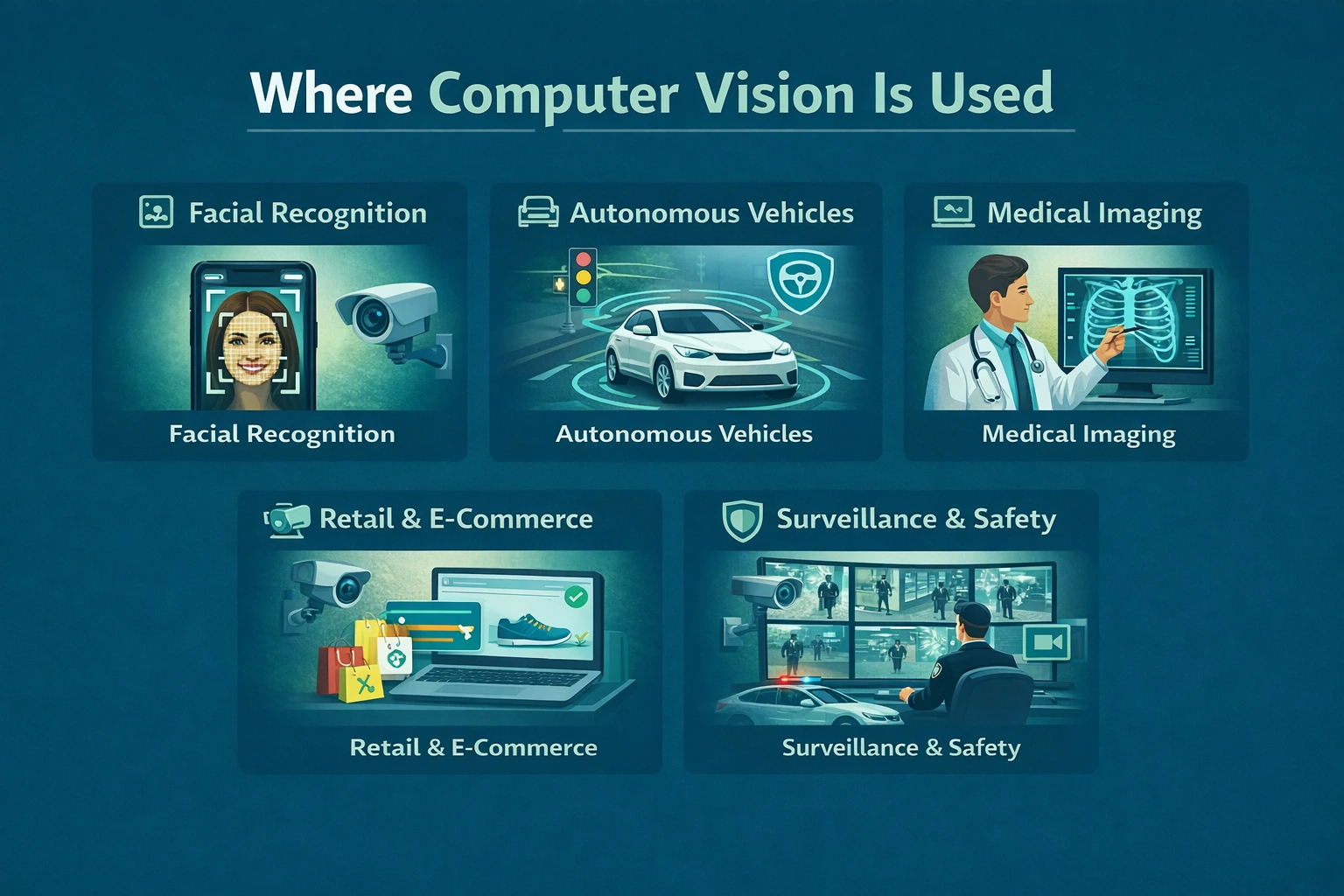
Computer vision is already deeply embedded in modern life.
Agriculture & Farming
Computer vision is increasingly used in agriculture to monitor crops and improve yields.
Examples include:
- drones analyzing crop health
- detecting plant diseases early
- optimizing irrigation and fertilizer use
By analyzing images from fields and satellites, AI helps farmers make better, data-driven decisions.
Sports Analytics
Sports teams use computer vision to analyze player movement and performance.
Common uses include:
- tracking player positions during games
- analyzing posture and motion
- improving training and injury prevention
This allows coaches to gain insights that are difficult to spot with the human eye alone.
Augmented Reality (AR) & Virtual Reality (VR)
Computer vision plays a key role in AR and VR systems.
It enables:
- gesture tracking
- face and body movement detection
- realistic object placement in virtual environments
This technology powers applications like virtual try-ons, immersive gaming, and interactive experiences.
Healthcare
- medical image analysis (X-rays, MRIs, CT scans)
- early disease detection
- surgical assistance
Self-Driving Cars
- lane detection
- traffic sign recognition
- pedestrian detection
- collision avoidance
Retail & E-commerce
- visual search
- automated checkout
- inventory tracking
- product recommendations
Security & Surveillance
- face recognition
- anomaly detection
- crowd monitoring
- access control
Social Media & Content Platforms
- automatic photo tagging
- content moderation
- image enhancement
- augmented reality filters
These computer vision applications show how AI systems interpret and act on visual information in the real world.
Computer Vision vs NLP vs Generative AI
These AI fields are often confused, but they focus on different data types.
- Computer Vision: images and video
- NLP (Natural Language Processing): text and language
- Generative AI: creating new content (text, images, audio, video)
They often work together.
For example, a generative AI system may use computer vision to analyze images and NLP to describe them.
Limitations & Risks of Computer Vision
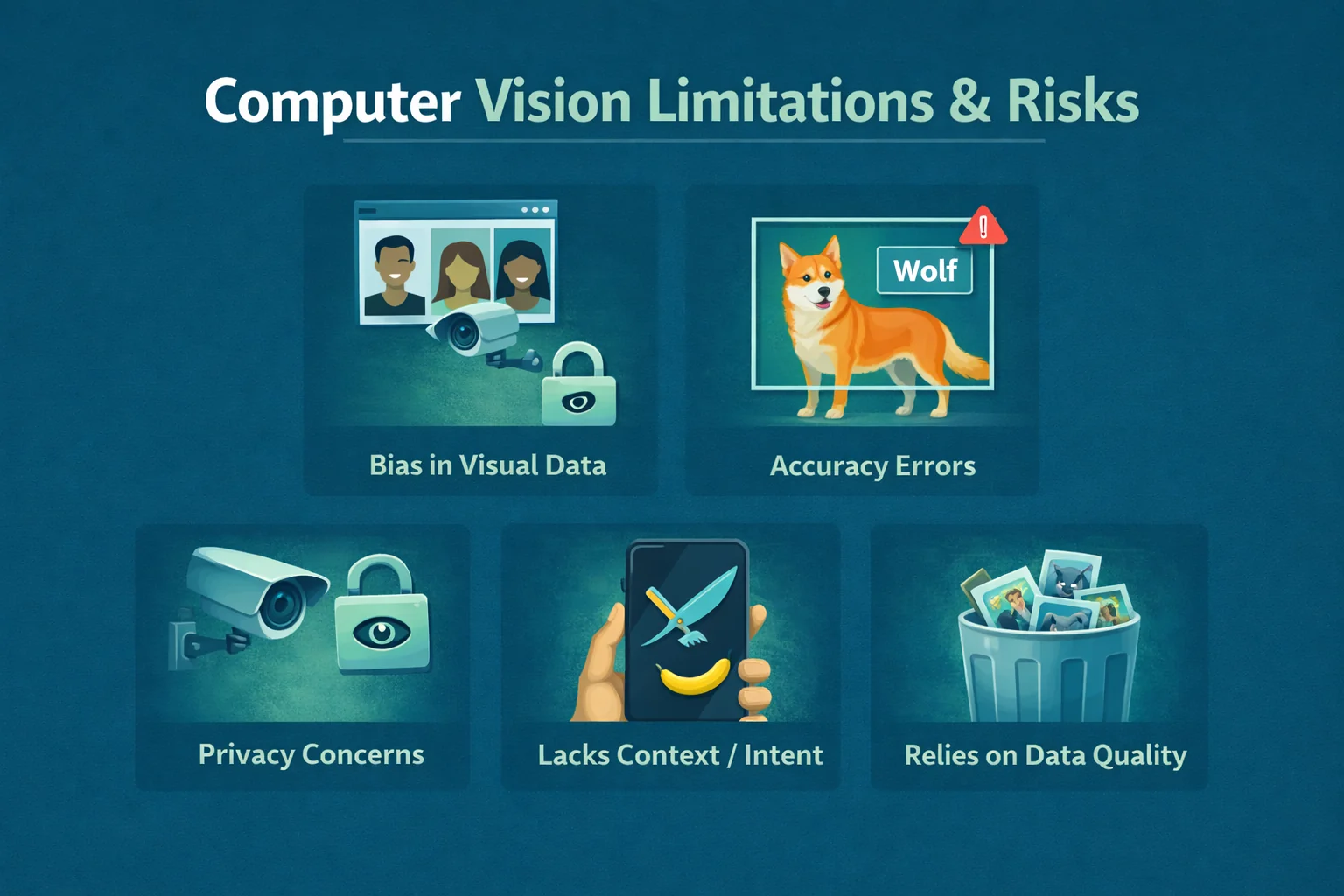
Despite its power, computer vision has important limitations.
Bias in Visual Data
If training images lack diversity, models may:
- perform poorly on certain skin tones
- misidentify objects in uncommon conditions
- reinforce existing biases
Privacy Concerns
Computer vision raises serious privacy questions, especially with:
- facial recognition
- public surveillance
- biometric data
Errors & Misidentification
AI vision systems can:
- mislabel objects
- miss important details
- fail in unusual lighting or angles
Context Blindness
Computer vision sees pixels — not intent or meaning.
An image may be technically recognized correctly but still misunderstood in context.
How to Start Learning Computer Vision
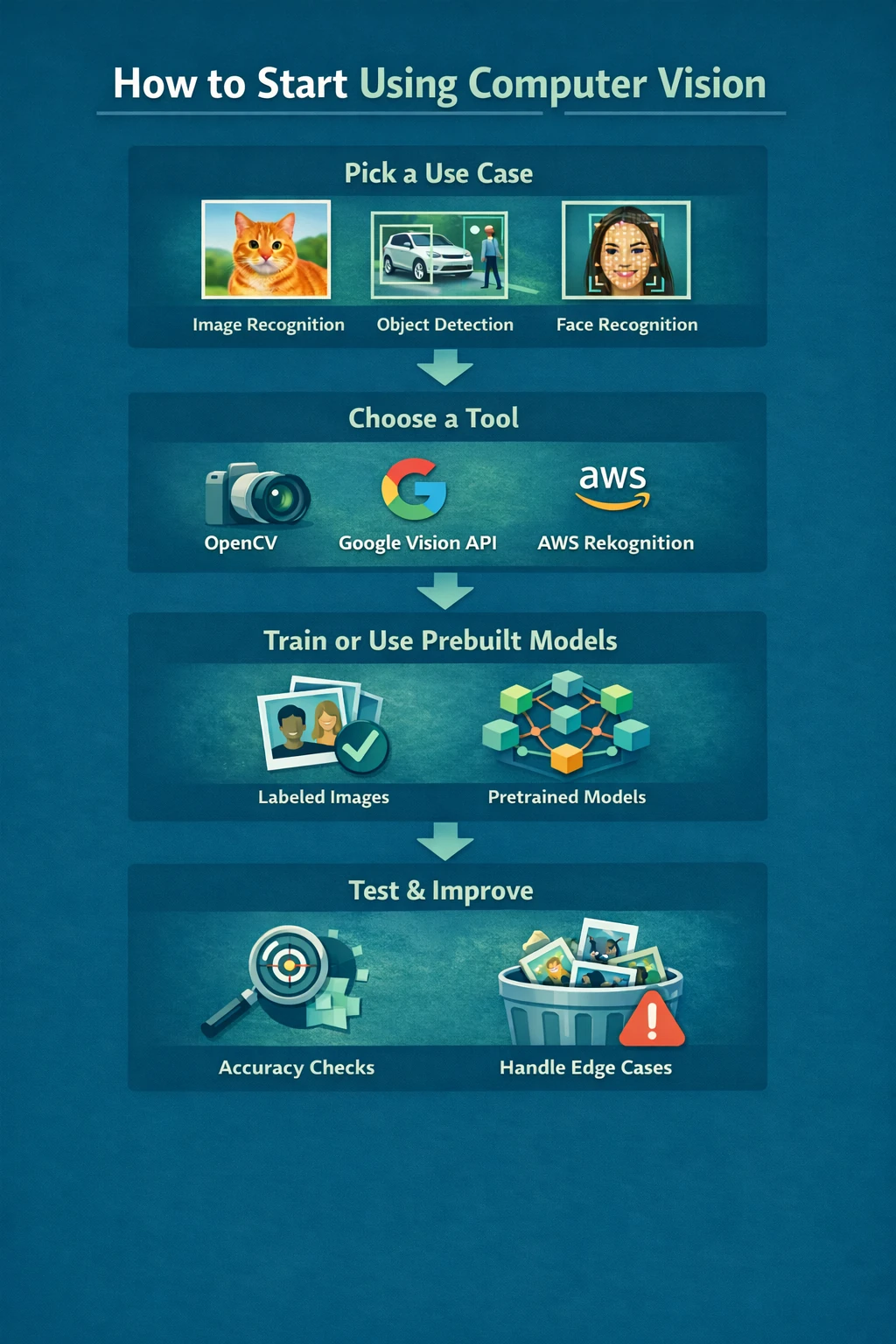
You don’t need to be an expert to begin.
A beginner-friendly path looks like this:
- Learn basic AI and ML concepts
- Understand neural networks (especially CNNs)
- Explore pre-trained computer vision models
- Experiment with simple projects
- Build intuition before complexity
Starting with foundations like machine learning explained and deep learning 101 makes everything easier.
Popular Computer Vision Tools Beginners Encounter
If you explore computer vision further, you’ll often hear about these tools:
- OpenCV — a widely used open-source library for image and video processing
- TensorFlow & PyTorch — frameworks used to train deep learning vision models
- Google Vision API / AWS Rekognition — prebuilt computer vision services for tasks like image labeling and face detection
Beginners usually start by experimenting with pre-trained models before training their own.
FAQ
What is computer vision in simple terms?
Computer vision is AI that allows computers to understand images and video by analyzing visual patterns.
Is computer vision part of AI?
Yes. Computer vision is a major subfield of artificial intelligence.
How accurate is computer vision?
Accuracy depends on data quality, model design, and use case. Some systems outperform humans in narrow tasks, while others still struggle.
Is computer vision the same as image recognition?
Image recognition is one task within computer vision, but computer vision includes many other tasks like detection and segmentation.
How is computer vision used in everyday life?
Phones, cars, social media apps, healthcare tools, and security systems all use computer vision daily.
Conclusion
Computer vision is how AI learns to see, understand, and interpret the visual world.
By turning pixels into patterns and patterns into meaning, computer vision powers everything from medical diagnostics to autonomous vehicles and everyday smartphone features.
The key takeaway is simple:
Computer vision is powerful — but it’s not perfect.
It works best when paired with human judgment, high-quality data, and ethical oversight.
To continue building your AI foundation, explore:
You’re now equipped with one of the most important building blocks of modern AI.