
Named Entity Recognition in Simple Terms
Named Entity Recognition (NER) is a Natural Language Processing (NLP) technique that identifies and classifies important information within text, such as people, organizations, locations, dates, products, and monetary values. NER helps AI systems understand language by recognizing key entities and assigning them to predefined categories.
In simple terms, Named Entity Recognition allows computers to read text and determine who, what, where, and when important information appears in a sentence.
Introduction
Every day, humans naturally identify important information while reading.
Consider this sentence:
“Elon Musk announced a new Tesla factory in Texas on March 15, 2025.”
Without thinking, you immediately recognize:
- Elon Musk → Person
- Tesla → Organization
- Texas → Location
- March 15, 2025 → Date
This ability seems simple to us, but it is surprisingly difficult for computers.
To a machine, a sentence initially appears as a collection of words rather than meaningful concepts. Artificial intelligence systems need a way to recognize which words represent people, places, companies, products, dates, and other important information.
This is where Named Entity Recognition comes in.
Named Entity Recognition, often called NER, is one of the most important technologies in Natural Language Processing. It helps machines understand language by extracting meaningful information from text and converting it into structured data.
NER powers many of the AI systems we use every day, including:
- Search engines
- Chatbots
- Virtual assistants
- Customer support systems
- Healthcare AI platforms
- Financial analytics tools
- Enterprise document search systems
In this guide, you’ll learn what Named Entity Recognition is, how it works, why it matters, and how it helps modern AI systems understand human language.
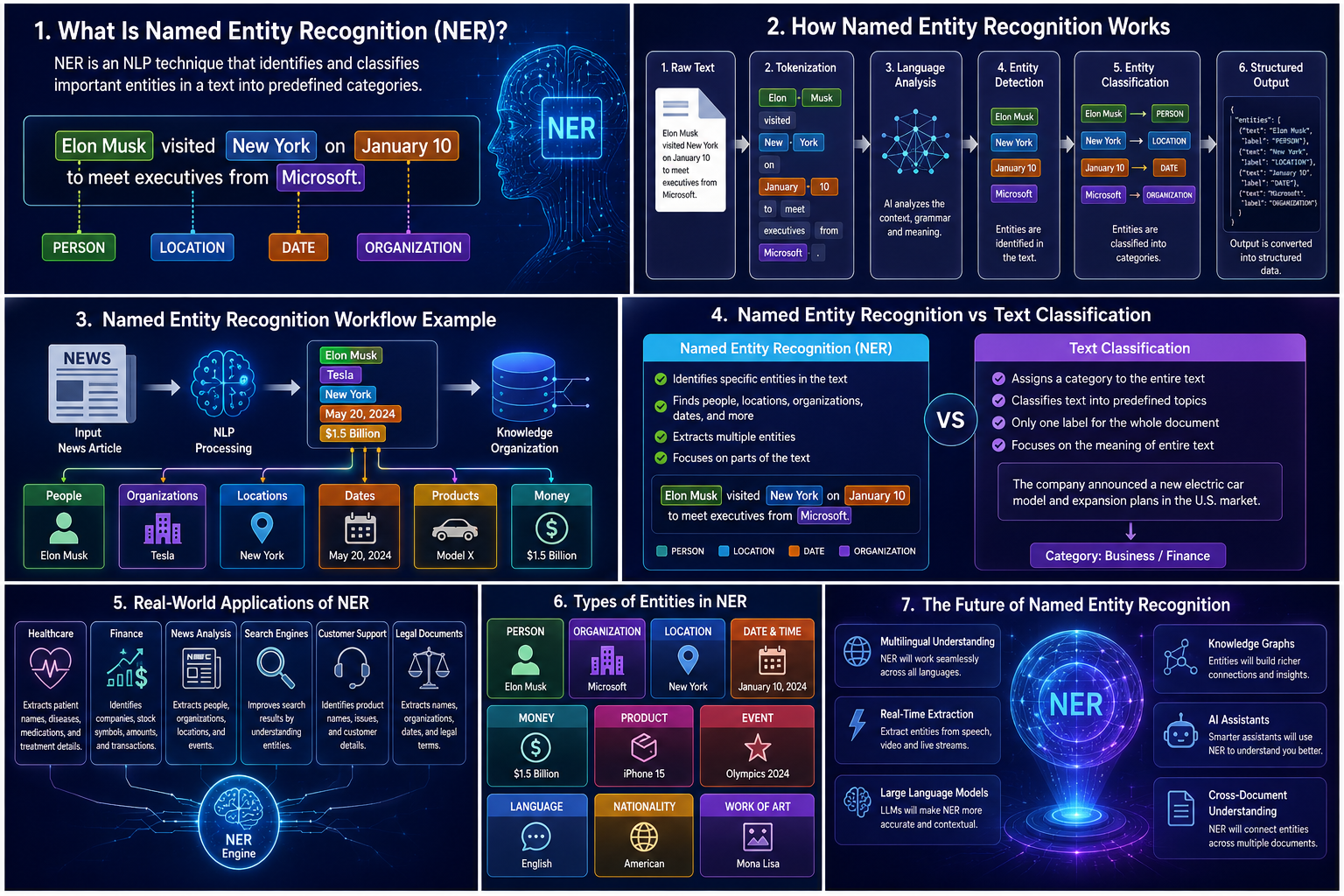
What Is Named Entity Recognition (NER)?
Named Entity Recognition is a Natural Language Processing technique that identifies specific entities within text and assigns them to categories.
Think of NER as a digital highlighter.
Instead of highlighting random words, it highlights meaningful pieces of information and labels them according to their type.
For example:
Sentence:
“Apple announced the iPhone 18 in California.”
An NER system might identify:
| Text | Entity Type |
|---|---|
| Apple | Organization |
| iPhone 18 | Product |
| California | Location |
By identifying these entities, AI systems gain a better understanding of what the text is actually about.
Rather than seeing a sentence as a collection of unrelated words, the AI can recognize important concepts and relationships between them.
This ability makes NER a foundational technology for many advanced NLP applications.
Why Named Entity Recognition Is Important in NLP
One of the biggest challenges in Natural Language Processing is converting unstructured text into structured information.
Humans can easily identify important details within a sentence. Computers need help doing the same thing.
For example:
“Tesla opened a new office in Berlin in 2025.”
Without NER, an AI system sees only text.
With NER, the sentence becomes structured data:
| Entity | Type |
|---|---|
| Tesla | Organization |
| Berlin | Location |
| 2025 | Date |
Once information is structured, AI systems can:
- Search it
- Analyze it
- Organize it
- Compare it
- Store it in databases
- Use it for decision-making
NER acts as a bridge between human language and machine understanding.
Without Named Entity Recognition, many AI systems would struggle to interpret real-world information effectively.
A Simple Analogy for Named Entity Recognition
Imagine reading a newspaper with a set of colored highlighters.
You decide to use:
- Blue for people
- Green for companies
- Yellow for locations
- Red for dates
As you read an article, you highlight important information using the appropriate color.
For example:
“Microsoft opened a new office in London in 2025.”
You would mark:
- Microsoft → Green
- London → Yellow
- 2025 → Red
Named Entity Recognition works in a similar way.
Instead of using physical highlighters, AI models automatically identify and label important information within text.
This helps computers organize information much like a human reader would.
Why NER Matters in Modern AI
Named Entity Recognition has become even more important in the age of artificial intelligence.
Before an AI system can answer questions, summarize documents, or retrieve information, it often needs to understand the key entities involved.
For example, imagine a user asks:
“What did Microsoft announce in London in 2025?”
An AI system may first identify:
- Microsoft → Organization
- London → Location
- 2025 → Date
Once these entities are recognized, the system can search for relevant information and generate a more accurate response.
Modern AI technologies that benefit from NER include:
- Large Language Models (LLMs)
- Chatbots
- AI Agents
- Search Engines
- Knowledge Graphs
- Enterprise Search Systems
- Document Intelligence Platforms
Even though modern AI models are becoming increasingly sophisticated, identifying important entities remains a fundamental part of understanding language.
Named Entity Recognition Example
Let’s walk through a complete example.
Input Sentence
“Microsoft acquired LinkedIn in California in 2016.”
NER Output
| Word or Phrase | Entity Type |
|---|---|
| Microsoft | Organization |
| Organization | |
| California | Location |
| 2016 | Date |
What Happened?
The NER system:
- Read the sentence.
- Identified important entities.
- Classified each entity into a category.
- Produced structured information.
This transformation allows AI systems to understand the key information contained within the text.
The Complete Named Entity Recognition Pipeline
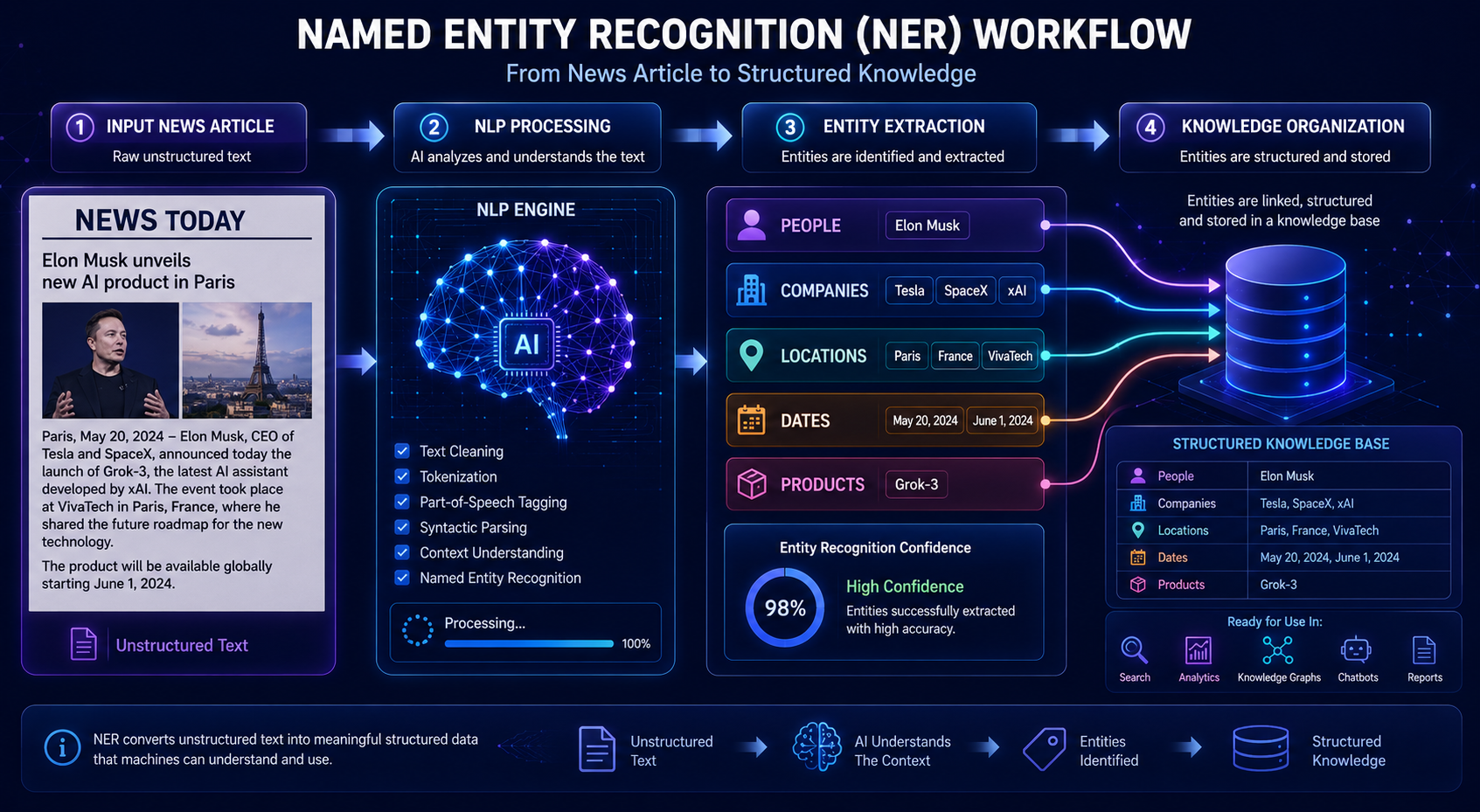
Most NER systems follow a similar workflow.
Step 1: Input Text
A sentence or document enters the system.
Example:
“Google opened a new office in London.”
↓
Step 2: Tokenization
The text is divided into smaller units called tokens.
↓
Step 3: Context Analysis
The AI examines surrounding words to understand meaning.
↓
Step 4: Entity Detection
The system identifies words or phrases that represent entities.
↓
Step 5: Entity Classification
The detected entities are assigned categories.
↓
Step 6: Structured Data Output
The final information is organized into a machine-readable format.
This pipeline transforms raw text into structured information that other AI systems can use.
How Named Entity Recognition Works
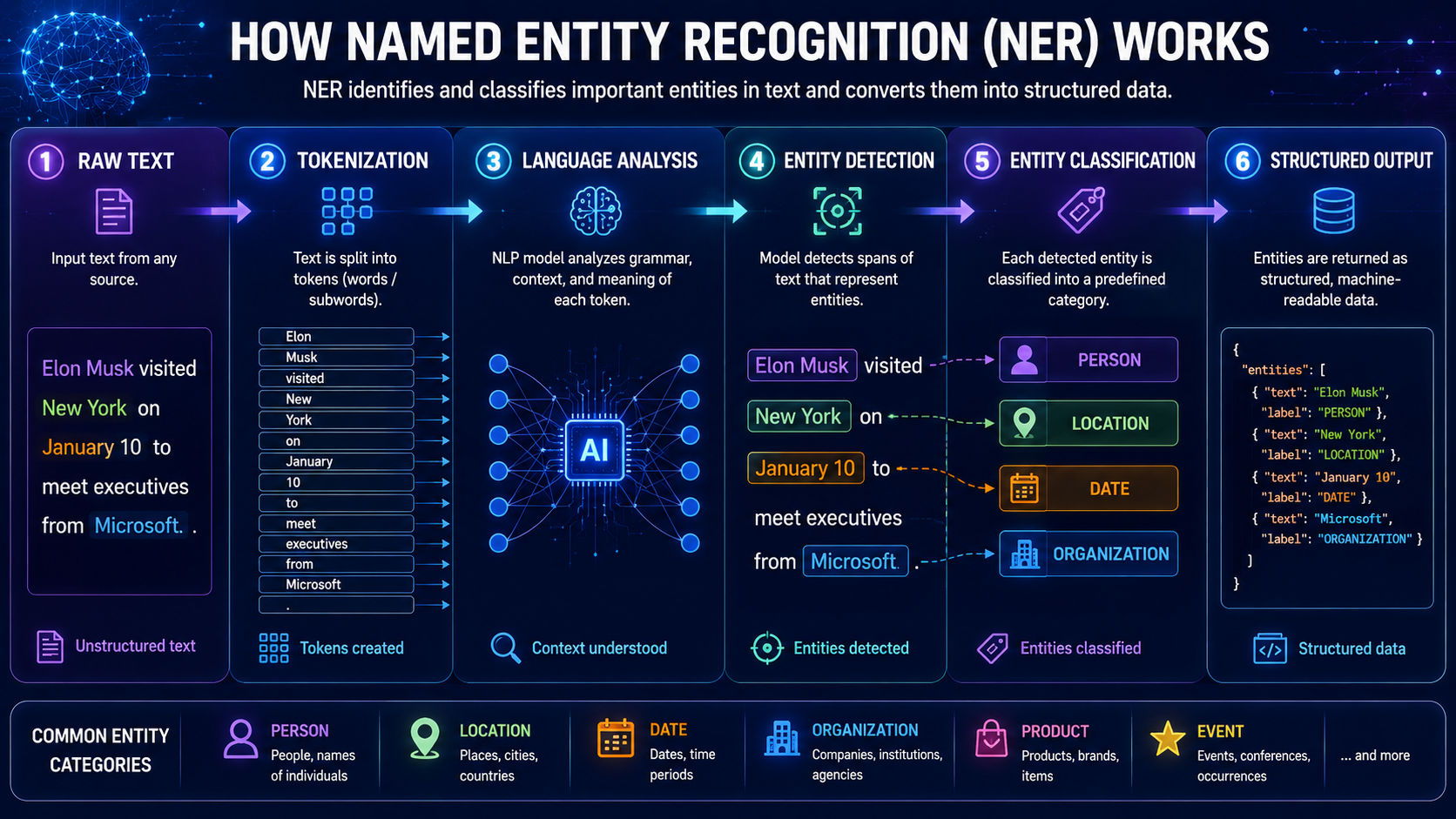
Although modern NER systems can be highly sophisticated, the overall process is relatively easy to understand.
Step 1: Text Input
The system receives text.
Example:
“Google opened a new office in London.”
Step 2: Tokenization
The sentence is broken into smaller pieces called tokens.
Example:
- opened
- a
- new
- office
- in
- London
Tokenization is one of the foundational processes in Natural Language Processing.
Step 3: Context Analysis
The AI analyzes nearby words to understand context.
This is important because some words can have multiple meanings.
For example:
“Amazon” could refer to:
- Amazon the company
- The Amazon rainforest
The surrounding words help determine the correct interpretation.
Step 4: Entity Detection
The model identifies words and phrases that appear to represent meaningful entities.
Example:
- Google → Entity
- London → Entity
Step 5: Entity Classification
The system assigns categories to each detected entity.
Example:
| Entity | Category |
|---|---|
| Organization | |
| London | Location |
Once classified, the information becomes structured and easier for machines to process.
Key Concepts Beginners Should Understand
Named Entities
Named entities are real-world objects that can be identified by a name.
Examples include:
- People
- Companies
- Products
- Cities
- Countries
- Dates
- Events
NER focuses on finding these entities within text.
Named entities are real-world objects that can be identified by a name.
Examples include:
- People
- Companies
- Products
- Cities
- Countries
- Dates
- Events
NER focuses on finding these entities within text.
Entity Labels
Entity labels define the category assigned to an entity.
Common labels include:
| Label | Meaning |
|---|---|
| PERSON | Individual names |
| ORG | Organizations |
| LOC | Geographic locations |
| DATE | Dates and times |
| MONEY | Monetary values |
| PRODUCT | Products and services |
Labels help AI systems understand the role each entity plays within a sentence.
Context
Context is one of the most important concepts in NER.
Consider the word:
Jordan
In one sentence:
“Jordan scored 30 points.”
Jordan is likely a person.
In another sentence:
“Jordan is located in the Middle East.”
Jordan is likely a country.
Understanding context allows AI systems to make accurate classifications.
Information Extraction
Named Entity Recognition is often part of a broader process called information extraction.
Information extraction converts unstructured text into organized, structured data that machines can analyze more efficiently.
This capability powers many modern AI systems and business applications.
Types of Named Entity Recognition
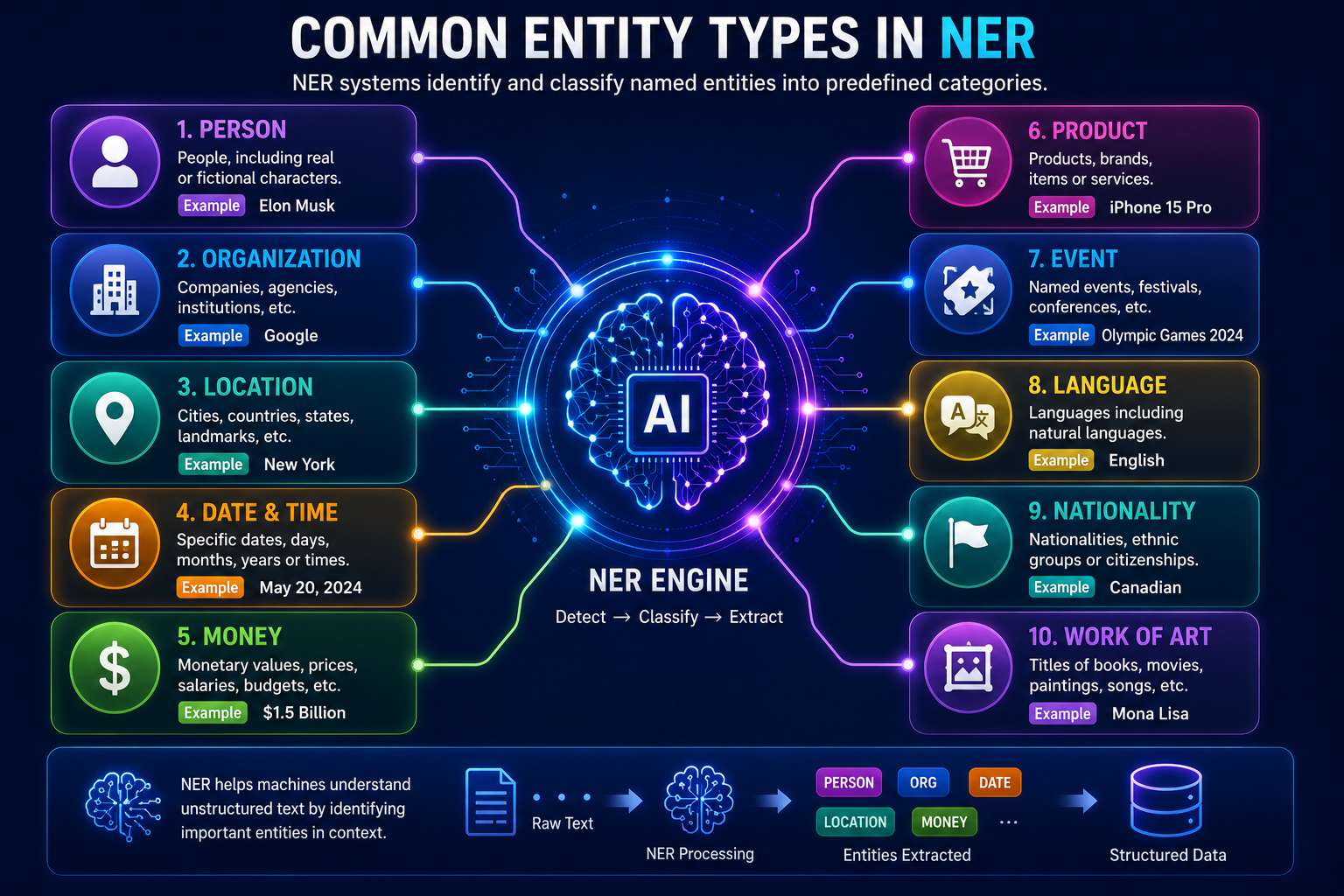
Different NER systems may focus on different categories of entities depending on their purpose and industry.
Some systems recognize only basic entity types, while others are designed to identify highly specialized information.
Person Recognition
Person recognition identifies the names of individuals.
Examples:
- Albert Einstein
- Taylor Swift
- Sundar Pichai
- Elon Musk
This category is commonly used in search engines, social media analysis, and news processing systems.
Organization Recognition
Organization recognition identifies businesses, institutions, and groups.
Examples:
- Microsoft
- NASA
- Stanford University
- OpenAI
This helps AI systems understand which companies or organizations are being discussed.
Location Recognition
Location recognition identifies geographic entities.
Examples:
- New York
- Europe
- Tokyo
- Mount Everest
Location recognition is frequently used in mapping systems, travel applications, and geographic analysis tools.
Date and Time Recognition
These systems identify temporal information.
Examples:
- January 1, 2025
- Monday
- 3:00 PM
- Next Week
This information is especially useful for scheduling assistants and calendar applications.
Numerical Entity Recognition
Some NER systems identify numerical values such as:
- Currency
- Percentages
- Measurements
- Quantities
Examples:
- $500
- 20%
- 15 kilometers
- 1,000 units
Domain-Specific NER
Many industries create customized entity categories.
Healthcare may identify:
- Diseases
- Medications
- Symptoms
- Treatments
Finance may identify:
- Stock symbols
- Financial instruments
- Market indicators
Legal systems may identify:
- Laws
- Regulations
- Case numbers
- Contracts
Specialized NER systems often achieve much higher accuracy within their specific industries.
Common Entity Types in Named Entity Recognition
Although entity categories vary between systems, some entity types appear frequently across industries.
| Entity Type | Example |
|---|---|
| Person | Elon Musk |
| Organization | Microsoft |
| Location | Paris |
| Product | iPhone 18 |
| Date | January 1, 2025 |
| Money | $500 |
| Percentage | 20% |
| Event | Olympic Games |
| Law | GDPR |
| Medical Condition | Diabetes |
These categories help transform unstructured text into organized information that AI systems can analyze more effectively.
The Evolution of Named Entity Recognition
Named Entity Recognition has evolved significantly over the past several decades.
Rule-Based Systems
The earliest NER systems relied on manually written rules.
For example:
- Words beginning with capital letters might be people.
- Certain keywords might indicate locations.
While these systems were easy to understand, they were difficult to scale and often produced inconsistent results.
Machine Learning Approaches
Machine learning introduced a more flexible approach.
Instead of manually defining rules, developers trained models using labeled examples.
The system learned patterns such as:
- How names are typically structured
- Common organization naming conventions
- Typical language surrounding locations
This improved accuracy significantly.
Deep Learning Models
Deep learning introduced neural networks that could automatically learn complex language patterns.
Advantages included:
- Better context understanding
- Higher accuracy
- Less reliance on manual feature engineering
Deep learning allowed NER systems to perform well across larger and more diverse datasets.
Transformer-Based Models
Transformer architectures transformed NLP entirely.
Models such as:
- BERT
- RoBERTa
- GPT
- T5
greatly improved contextual understanding.
Instead of analyzing words individually, Transformers consider relationships between all words in a sentence simultaneously.
This breakthrough dramatically increased NER performance and remains the foundation of modern NLP systems.
Real-World Applications of Named Entity Recognition
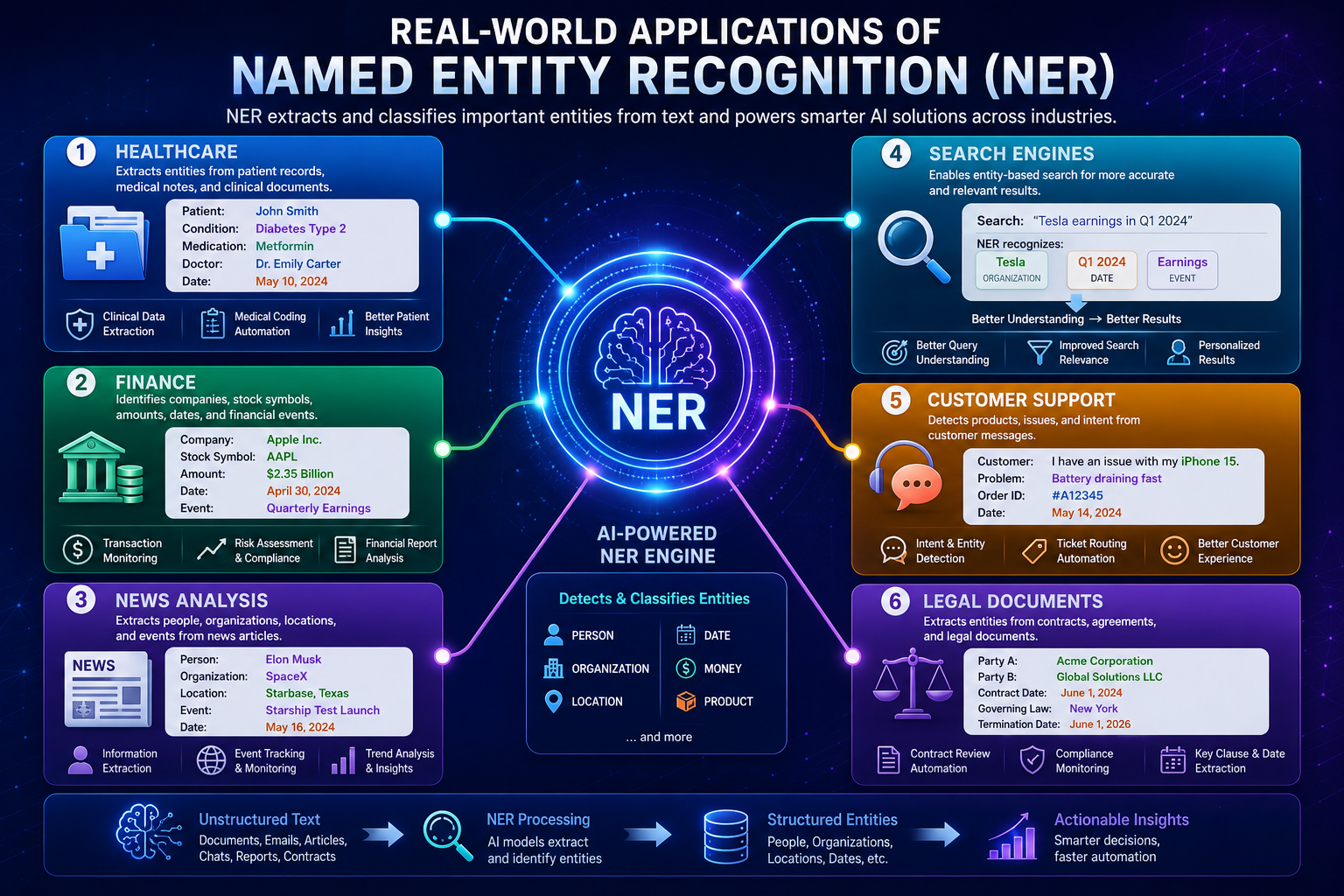
Named Entity Recognition powers countless AI applications used every day.
Search Engines
Search engines use NER to understand user queries more effectively.
For example:
“Hotels near Disney World”
NER helps identify:
- Hotels
- Disney World
This allows the search engine to return more relevant results.
Chatbots and Virtual Assistants
Virtual assistants use NER to understand user requests.
Example:
“Schedule a meeting with Sarah tomorrow.”
NER identifies:
- Sarah → Person
- Tomorrow → Date
This information helps the assistant perform the requested task.
Healthcare
Medical AI systems use NER to extract information from patient records.
Examples include:
- Diagnoses
- Symptoms
- Medications
- Treatments
This helps healthcare professionals process large volumes of information more efficiently.
Financial Services
Banks and financial institutions use NER to identify:
- Companies
- Transactions
- Stock symbols
- Monetary values
This supports fraud detection, compliance monitoring, and financial analysis.
News Analysis
News organizations use NER to automatically identify:
- Politicians
- Companies
- Locations
- Events
This improves content organization and searchability.
Customer Support
Customer service platforms use NER to identify:
- Customer names
- Products
- Order numbers
- Locations
This improves automation and response accuracy.
Industry Examples of Named Entity Recognition
NER creates value across many industries.
| Industry | Example Use Case |
|---|---|
| Healthcare | Detect diseases and medications |
| Finance | Identify companies and transactions |
| E-Commerce | Extract product names and brands |
| Legal | Detect contracts and case numbers |
| Customer Support | Identify names and order IDs |
| News Media | Extract people, places, and organizations |
| Cybersecurity | Identify threat actors and attack targets |
| Education | Analyze academic documents and research papers |
This versatility is one reason NER remains a foundational NLP technology.
How Businesses Use NER Today
Many modern organizations rely on NER to automate information processing.
Customer Support Automation
Companies use NER to identify:
- Customer names
- Product names
- Order numbers
- Locations
This helps support systems respond faster and more accurately.
Healthcare Document Analysis
Healthcare organizations use NER to extract:
- Diagnoses
- Medications
- Procedures
- Symptoms
This reduces administrative workload and improves efficiency.
Financial Intelligence
Banks use NER to identify:
- Transactions
- Companies
- Financial products
- Regulatory information
This supports fraud detection and risk management.
Legal Technology
Legal platforms use NER to analyze:
- Contracts
- Laws
- Regulations
- Court cases
This helps lawyers review documents more efficiently.
Advantages and Limitations of Named Entity Recognition
Like all AI technologies, NER has both strengths and weaknesses.
| Advantages | Limitations |
|---|---|
| Automatically extracts information | Can misinterpret context |
| Improves AI understanding | Struggles with ambiguous names |
| Saves time and labor | Requires quality training data |
| Enhances search systems | May miss rare entities |
| Supports automation | Different languages add complexity |
| Organizes unstructured data | Context can still be challenging |
Despite its limitations, NER remains one of the most practical and widely used NLP techniques.
Challenges of Named Entity Recognition
Even modern systems face several challenges.
Ambiguous Names
Many words have multiple meanings.
Examples:
- Apple → Company or fruit
- Jordan → Country or person
- Amazon → Company or rainforest
Context is required to determine the correct classification.
New Entities
New products, companies, and events appear constantly.
NER systems may struggle to recognize entities that did not exist when they were trained.
Multiple Languages
Different languages use different naming conventions.
Building multilingual NER systems requires significantly more training data and complexity.
Informal Language
Social media posts often contain:
- Slang
- Misspellings
- Abbreviations
These variations can reduce recognition accuracy.
Named Entity Recognition vs Other NLP Tasks
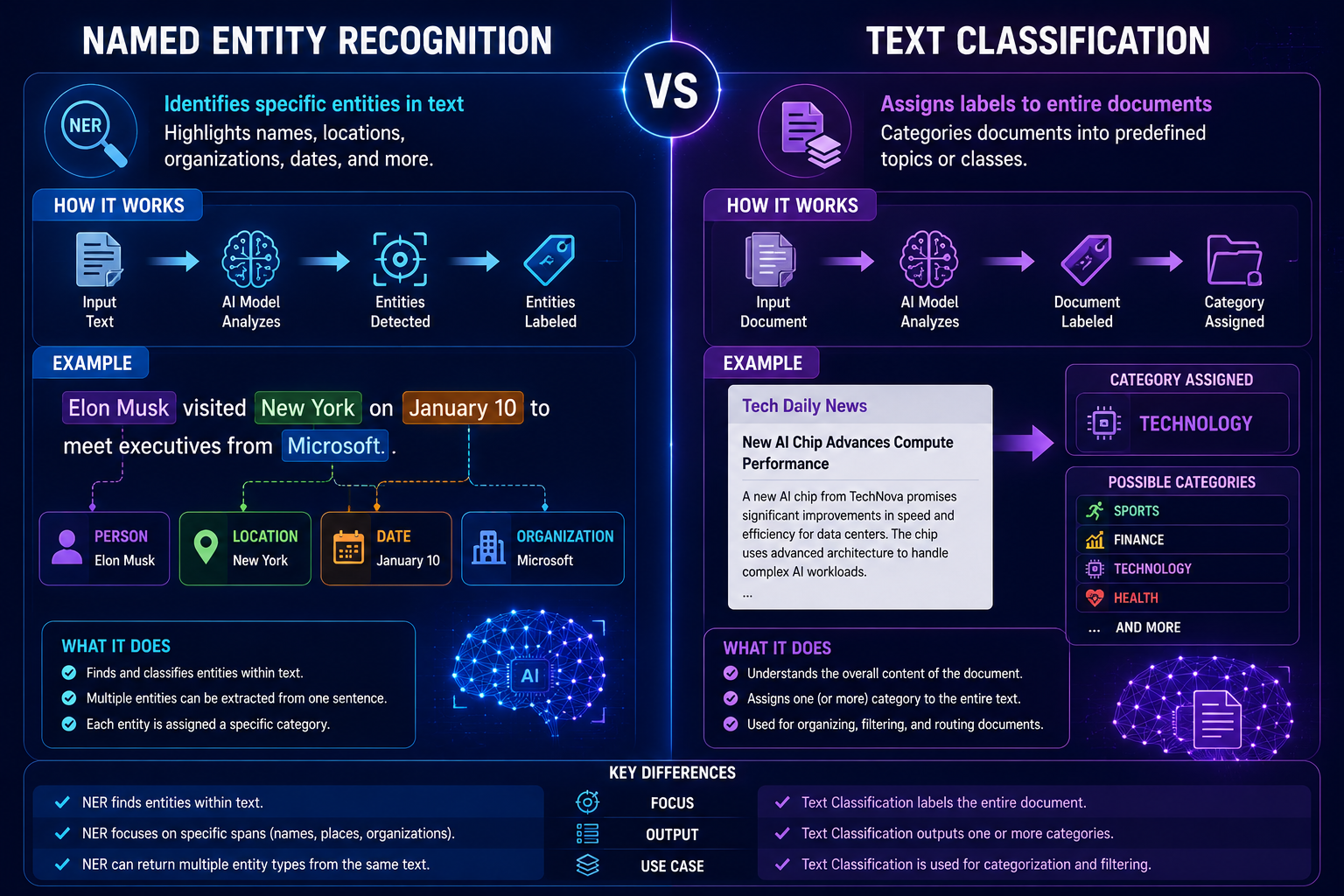
NER is only one component of Natural Language Processing.
| NLP Task | Purpose |
|---|---|
| Tokenization | Split text into tokens |
| Named Entity Recognition | Identify entities |
| Sentiment Analysis | Detect emotions and opinions |
| Text Classification | Categorize documents |
| Word Embeddings | Represent words numerically |
| Machine Translation | Translate languages |
| Question Answering | Respond to user questions |
These technologies often work together within larger NLP systems.
Rule-Based vs Machine Learning vs Deep Learning NER
The approach used can significantly impact performance.
| Approach | Advantages | Limitations |
|---|---|---|
| Rule-Based | Easy to understand and control | Difficult to scale |
| Machine Learning | Learns patterns from data | Requires labeled datasets |
| Deep Learning | High accuracy and flexibility | Requires more computing power |
| Transformers | Excellent contextual understanding | Computationally expensive |
Modern NER systems increasingly rely on Transformer-based architectures because of their superior language understanding capabilities.
The Role of Deep Learning in NER
Early Named Entity Recognition systems relied heavily on manually created rules and dictionaries. While these systems worked reasonably well for simple tasks, they struggled with complex language, ambiguity, and new entities.
Modern NER systems use:
- Machine Learning
- Deep Learning
- Neural Networks
- Transformer Models
These technologies allow AI systems to learn language patterns automatically from large datasets rather than relying on manually written rules.
As a result, modern NER systems are far more accurate, flexible, and scalable than earlier approaches.
Deep learning has transformed NER from a specialized tool into a core component of modern AI systems.
Transformers and Modern NER
One of the biggest breakthroughs in NLP came with the introduction of Transformer models.
Popular Transformer-based models include:
- BERT
- RoBERTa
- GPT
- T5
Unlike older approaches, Transformers understand words within their broader context.
For example:
“Apple released a new iPhone.”
versus
“I ate an apple after lunch.”
Traditional systems might struggle to distinguish between the company and the fruit.
Transformer models use surrounding context to determine the correct meaning.
This contextual understanding has dramatically improved NER accuracy and made it possible to analyze language at a much deeper level.
Transformers are also the foundation of many modern AI applications, including chatbots, virtual assistants, and large language models.
Named Entity Recognition and Large Language Model
Large Language Models (LLMs) such as ChatGPT, Gemini, Claude, and Llama have changed how AI systems process language.
Interestingly, many LLMs do not always use a separate Named Entity Recognition system.
Instead, they learn entity recognition as part of their overall language understanding capabilities.
For example, if you ask:
“Who founded Microsoft?”
An LLM already understands that:
- Microsoft is an organization
- A founder is a person
This understanding comes from patterns learned during training.
However, dedicated NER systems are still widely used because they offer several advantages:
- Faster processing
- More predictable outputs
- Easier integration into business systems
- Better performance for structured data extraction
- Greater control over entity categories
Many enterprise AI solutions combine LLMs and traditional NER systems to achieve the best results.
This is one reason why NER remains highly relevant even as generative AI continues to advance.
Future Outlook for Named Entity Recognition
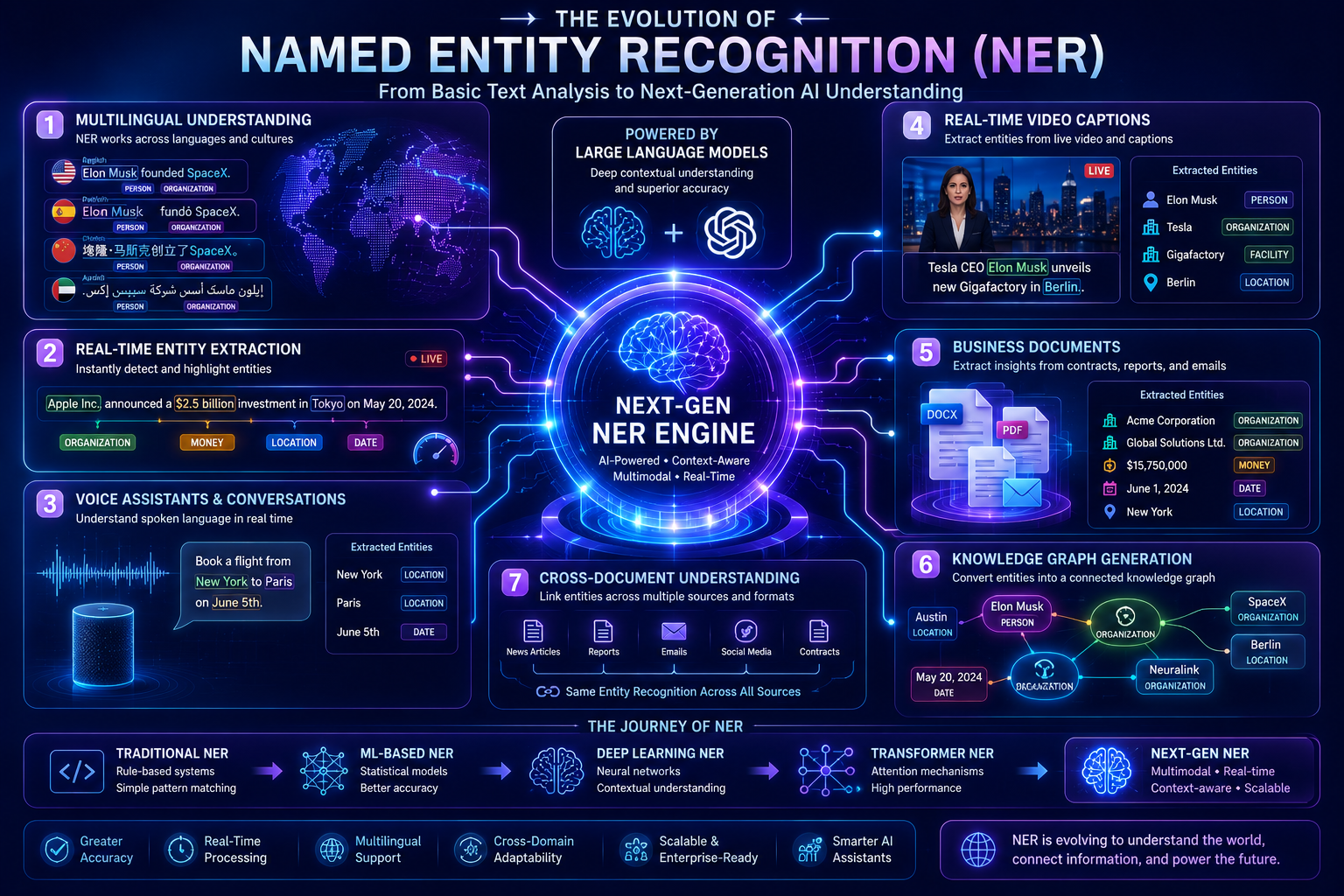
Named Entity Recognition continues to evolve alongside advances in artificial intelligence.
As AI systems become more capable of understanding language, NER is becoming increasingly sophisticated and accurate.
Future developments may include:
- Better multilingual support
- Improved contextual understanding
- Real-time entity recognition
- Industry-specific AI assistants
- Enhanced enterprise document search
- More accurate knowledge extraction
- Improved Retrieval-Augmented Generation (RAG) systems
- Stronger integration with large language models
NER is likely to remain a foundational technology for organizing and understanding information in AI systems.
NER in AI Agents
AI Agents represent one of the fastest-growing areas of artificial intelligence.
Unlike traditional chatbots, AI agents can:
- Analyze documents
- Search databases
- Perform tasks automatically
- Execute workflows
- Interact with external tools
To accomplish these tasks, AI agents must understand important information within text.
NER helps AI agents identify:
- Names
- Companies
- Locations
- Products
- Dates
- Financial information
As AI agents become more capable, Named Entity Recognition will play an increasingly important role in helping them understand and interact with the world.
Why Beginners Should Learn Named Entity Recognition
If you’re new to artificial intelligence, Named Entity Recognition is one of the most valuable NLP concepts to understand.
NER helps explain how machines:
- Read text
- Understand information
- Extract knowledge
- Organize documents
- Power chatbots
- Improve search results
Learning NER also creates a strong foundation for understanding more advanced topics such as:
- Natural Language Processing
- Transformers
- Large Language Models
- AI Agents
- Information Retrieval
- Generative AI
Many modern AI applications depend on the ability to recognize entities accurately.
By understanding NER, you’ll gain deeper insight into how AI systems interpret human language.
Learn More From Trusted Sources
To deepen your understanding of Named Entity Recognition and Natural Language Processing, explore these trusted resources:
IBM
IBM provides excellent beginner-friendly explanations of NLP, information extraction, and entity recognition technologies.
Suggested resource:
IBM’s Guide to Natural Language Processing
Google AI
Google AI publishes research and educational materials covering language understanding, Transformers, and modern NLP systems.
Suggested resource:
These resources provide additional insight into how NER fits into the broader field of artificial intelligence.
Frequently Asked Questions About Named Entity Recognition (NER)
What is Named Entity Recognition in simple terms?
Named Entity Recognition is an NLP technique that identifies important information such as people, places, organizations, products, and dates within text.
Why is Named Entity Recognition important?
NER helps AI systems understand language by extracting meaningful information and converting it into structured data.
How does Named Entity Recognition work?
NER analyzes text, identifies entities, and assigns categories such as person, location, organization, or date.
What are examples of named entities?
Examples include people, companies, locations, products, events, dates, and monetary values.
What is an example of Named Entity Recognition?
In the sentence:
“Tesla opened a factory in Texas in 2025.”
NER identifies:
- Tesla → Organization
- Texas → Location
- 2025 → Date
Is Named Entity Recognition part of machine learning?
Yes. Most modern NER systems use machine learning and deep learning models to recognize entities automatically.
What is the difference between NER and sentiment analysis?
NER identifies entities within text, while sentiment analysis determines whether the text expresses positive, negative, or neutral emotions.
Can NER recognize multiple entity types at the same time?
Yes. A single sentence can contain people, organizations, locations, dates, products, and other entities simultaneously.
Is Named Entity Recognition used in chatbots?
Yes. Chatbots use NER to identify names, locations, dates, products, and other important information mentioned by users.
Is Named Entity Recognition used in ChatGPT?
Yes. Large Language Models can identify entities as part of their language understanding process, although they may do so differently than traditional NER systems.
What industries use Named Entity Recognition?
Healthcare, finance, legal services, cybersecurity, customer support, education, e-commerce, and media organizations all use NER.
What is the future of Named Entity Recognition?
Future NER systems will become more context-aware, multilingual, accurate, and deeply integrated into AI agents and large language models.
Conclusion
Named Entity Recognition (NER) is one of the most important technologies in Natural Language Processing. It allows AI systems to identify meaningful information within text and transform unstructured language into structured data that machines can understand.
From search engines and chatbots to healthcare platforms and financial analytics systems, NER plays a critical role in helping AI interpret human language.
As artificial intelligence continues to evolve through machine learning, deep learning, Transformers, large language models, and AI agents, Named Entity Recognition will remain a foundational technology for understanding and organizing information.
If you’re building your knowledge of NLP, NER is an essential concept that connects many other AI topics together.
Recommended Next Articles
Continue your learning journey with:
- What Is Natural Language Processing (NLP)
- How NLP Works
- Tokenization Explained
- Word Embeddings Explained
- Sentiment Analysis Explained
- Text Classification Explained
- Transformers in NLP
- Chatbots Explained
- Applications of NLP
- Artificial Intelligence Explained
- Machine Learning Explained
- Deep Learning Explained
- Neural Networks Explained
- Supervised Learning Explained
- Unsupervised Learning Explained
- Reinforcement Learning Explained
Understanding Named Entity Recognition provides a strong foundation for understanding how modern AI systems process, organize, and reason about human language.