
Tokenization in Simple Terms
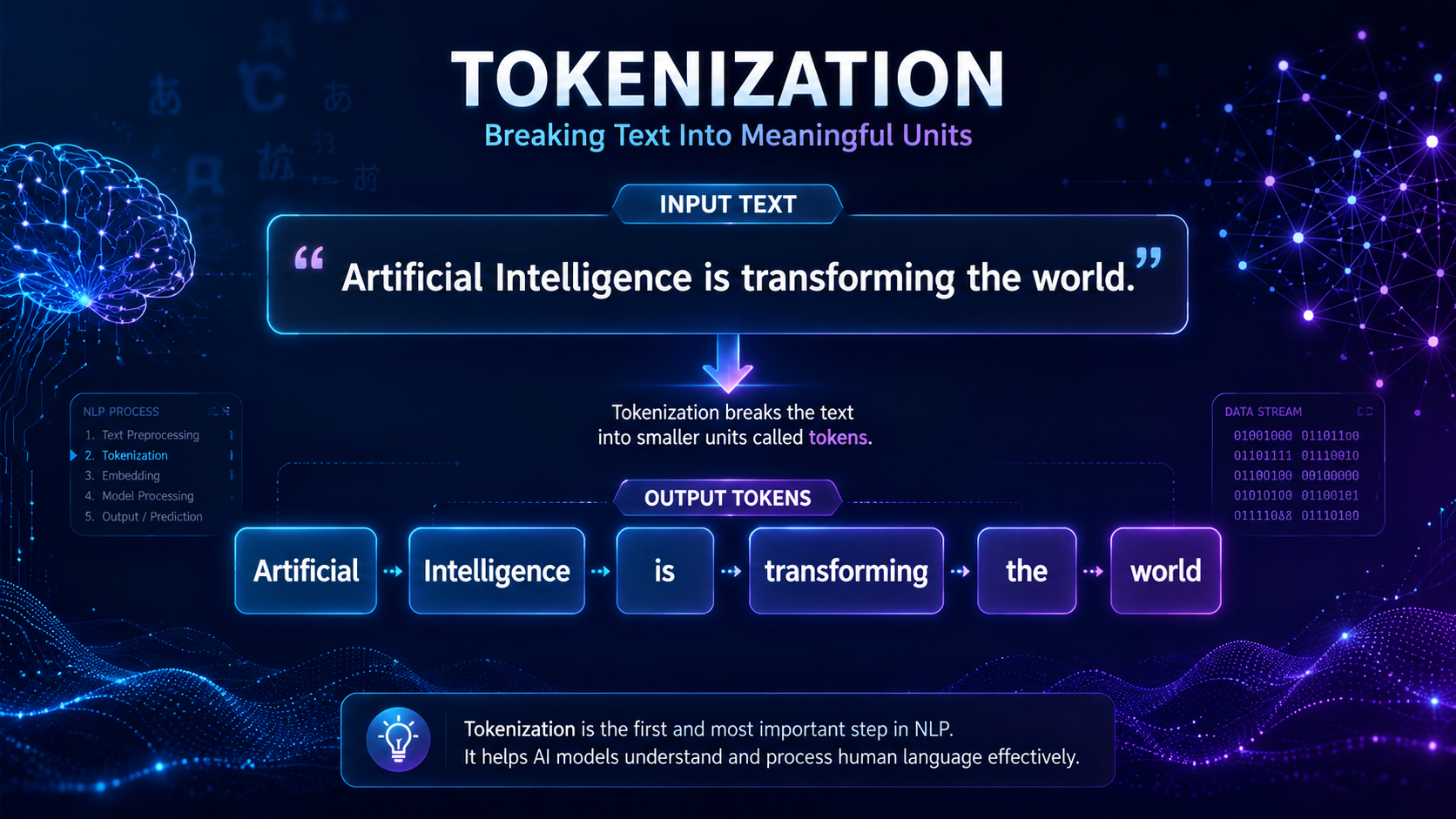
Tokenization is the process of breaking text into smaller units called tokens, which can be words, subwords, characters, or sentences. In Natural Language Processing (NLP), tokenization helps computers convert human language into a structured format that AI models can analyze and understand.
Tokenization is one of the first and most important steps in NLP because it transforms raw text into manageable pieces that machine learning models can process efficiently.
Introduction
When humans read a sentence, we naturally recognize words, punctuation, and meaning. Computers, however, do not understand language the same way people do.
Before an AI system can analyze text, translate languages, answer questions, classify documents, summarize articles, or power a chatbot, it must first break language into smaller components. This process is called **tokenization**.
Tokenization serves as the foundation of modern Natural Language Processing (NLP). Without it, technologies such as ChatGPT, Google Search, Siri, Alexa, machine translation systems, and AI-powered assistants would struggle to understand human language.
Although tokenization may sound simple, it plays a critical role in helping AI systems understand and generate language. Whether you’re chatting with an AI assistant, searching the web, or receiving product recommendations online, tokenization is often working behind the scenes.
In this guide, you’ll learn what tokenization is, how it works, the different types of tokenization, where it’s used in real-world AI systems, and why it remains one of the most important concepts in NLP.
What Is Tokenization?
Tokenization is the process of dividing text into smaller units called **tokens**.
These tokens act as the basic building blocks that AI systems use to analyze language.
Depending on the application, a token may represent:
- A word
- A part of a word
- A character
- A sentence
- A punctuation mark
For example, consider the sentence:
Artificial intelligence is changing the world.
A simple tokenizer might break it into:
- Artificial
- intelligence
- is
- changing
- the
- world
Instead of processing one large block of text, an AI model can work with these individual pieces and learn patterns more effectively.
A Simple Analogy
magine receiving a giant box of LEGO bricks that are already assembled into one massive structure.
To understand how the structure works, you would first separate it into individual pieces.
Tokenization works similarly. It breaks language into smaller components so an AI system can analyze how those pieces fit together.
Why Humans Don’t Need Tokenization
Humans naturally recognize words, punctuation, and sentence boundaries while reading.
For example, when you see:
I love artificial intelligence.
You instantly understand where one word ends and the next begins.
Computers do not have this ability naturally. They need tokenization to separate text into meaningful units before any analysis can begin.
Why Is Tokenization Important?
Tokenization is essential because computers cannot directly understand language.
Before machine learning algorithms can analyze text, the text must be converted into a structured format.
Tokenization helps AI systems:
- Identify words and phrases
- Understand sentence structure
- Detect language patterns
- Analyze meaning and context
- Prepare data for machine learning models
Nearly every NLP task begins with tokenization.
Examples include:
- Chatbots
- Search engines
- Machine translation
- Sentiment analysis
- Text summarization
- Spam detection
- Question-answering systems
- Large Language Models (LLMs)
Without tokenization, most NLP systems would not function effectively.
Why Modern AI Depends on Tokenization
Today’s AI systems process enormous amounts of text every second.
Large Language Models such as ChatGPT and Gemini cannot directly analyze paragraphs or documents as humans do. Instead, they first break language into tokens and then learn relationships between those tokens.
This makes tokenization one of the foundational technologies behind modern AI.
Why Tokenization Is the Foundation of Natural Language Processing
Tokenization is often the very first step in an NLP pipeline.
Before AI can determine sentiment, identify names, classify documents, translate languages, or generate responses, it must first separate text into meaningful pieces.
Many popular NLP applications rely on tokenization, including:
- Sentiment Analysis Explained
- Named Entity Recognition (NER)
- Text Classification Explained
- Transformers in NLP
- Chatbots Explained
- Applications of NLP
In many ways, tokenization acts as the bridge between human language and machine understanding.
Without tokenization, advanced NLP systems would have no reliable way to process text.
Tokenization as the Gateway to AI Understanding
Think of tokenization as the front door of an NLP system.
Every piece of text must pass through that door before it can be analyzed.
Whether an AI model is performing translation, summarization, classification, or text generation, tokenization is usually the first step.
This is why tokenization appears repeatedly throughout the entire NLP field.
How Tokenization Works
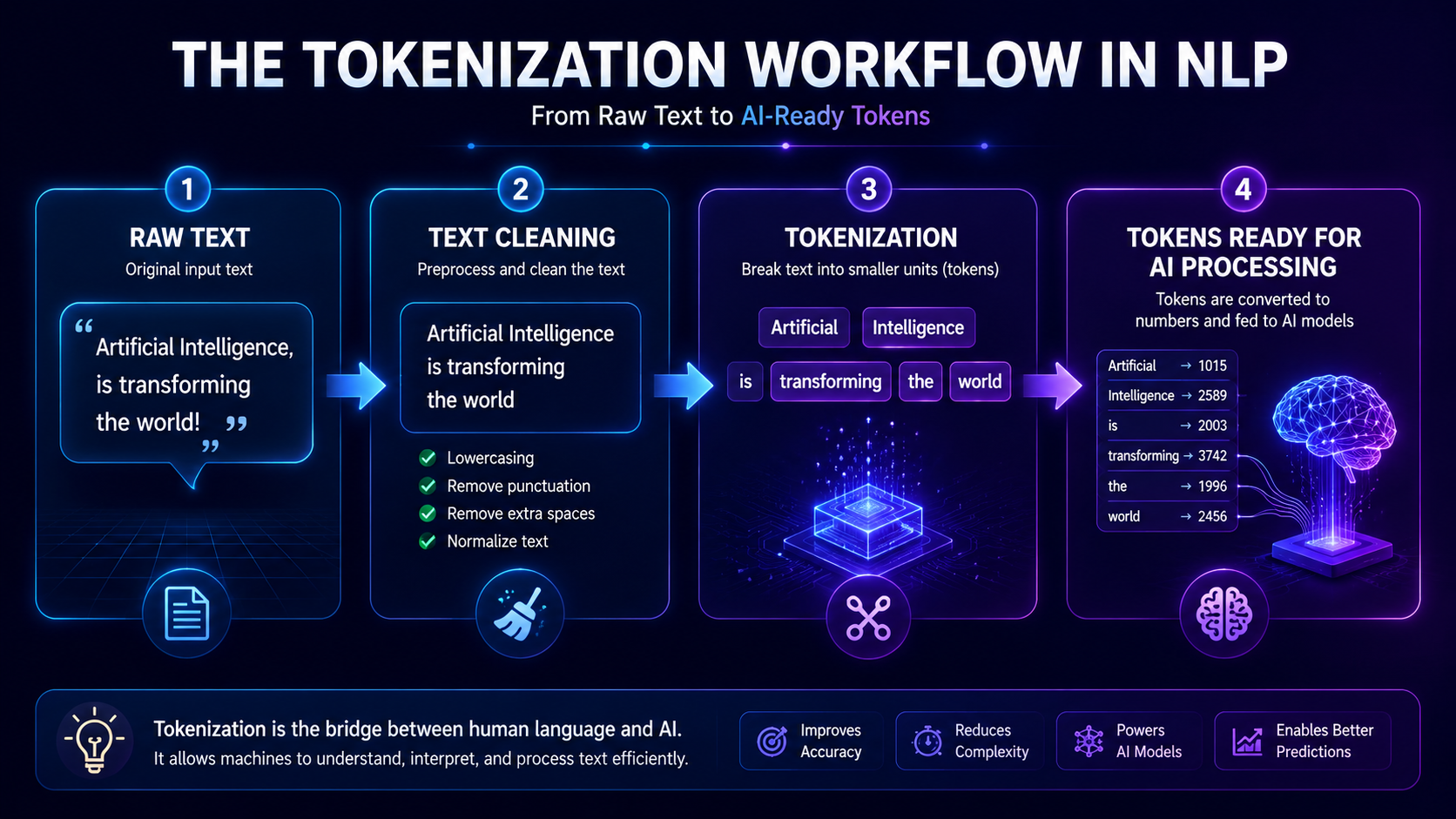
Tokenization typically follows a series of steps before language is processed by an AI model.
Step 1: Receive Raw Text
The process begins with unstructured text.
Example:
I love learning about artificial intelligence!
At this stage, the text is simply a string of characters.
Step 2: Detect Boundaries
The tokenizer identifies where words, sentences, or subwords begin and end.
It uses:
- Spaces
- Punctuation
- Language-specific rules
- Statistical methods
- Learned language patterns
Step 3: Create Tokens
The text is divided into individual units.
| Original Text | Tokens |
|---|---|
| I love AI! | I, love, AI, ! |
Step 4: Assign Numerical Values
AI models work with numbers rather than words.
Each token receives a numerical identifier.
| Token | Token ID |
|---|---|
| I | 101 |
| love | 205 |
| AI | 450 |
These IDs allow computers to process language mathematically.
Step 5: Send Tokens to the Model
The tokens are then analyzed by:
- Machine Learning models
- Neural Networks
- Deep Learning systems
- Transformers
- Large Language Models
The model examines relationships between tokens to understand meaning and context.
Tokenization Example: From Raw Text to AI Processing
One of the easiest ways to understand tokenization is to watch how a sentence changes as it moves through an NLP system.
Original Text
ChatGPT helps people learn about artificial intelligence.
Word Tokenization
The sentence may first be split into individual words:
- ChatGPT
- helps
- people
- learn
- about
- artificial
- intelligence
Subword Tokenization
Many modern AI models use subword tokenization instead of full words.
The same sentence might become:
- Chat
- GPT
- helps
- people
- learn
- about
- artificial
- intelligence
Token IDs
Computers do not process words directly.
Each token is converted into a numerical identifier.
| Token | Example ID |
|---|---|
| Chat | 532 |
| GPT | 118 |
| helps | 402 |
| people | 251 |
These numbers are then processed by machine learning models, neural networks, and transformers.
This transformation from text to tokens is what allows AI systems to analyze and generate language.
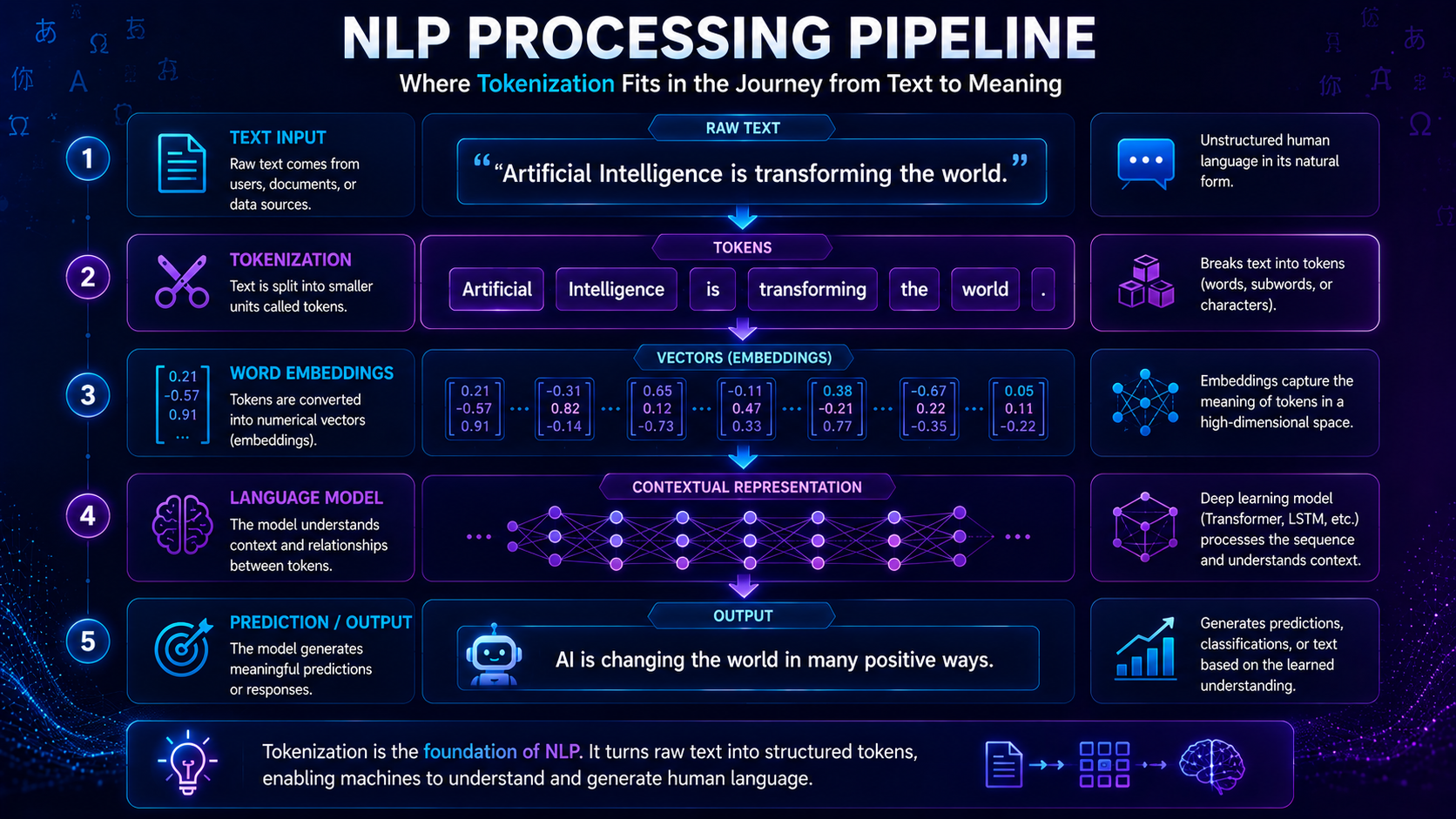
Where Tokenization Fits in the NLP Pipeline
Tokenization is just one step in a larger Natural Language Processing workflow.
| Step | Process |
|---|---|
| 1 | Raw Text Input |
| 2 | Tokenization |
| 3 | Text Cleaning and Preprocessing |
| 4 | Word Embeddings |
| 5 | NLP Model Processing |
| 6 | Prediction or Generated Response |
For example, when a user asks ChatGPT a question, the text is first tokenized before moving through embeddings and transformer layers.
This pipeline shows why tokenization is often considered the foundation of modern NLP systems.
Types of Tokenization
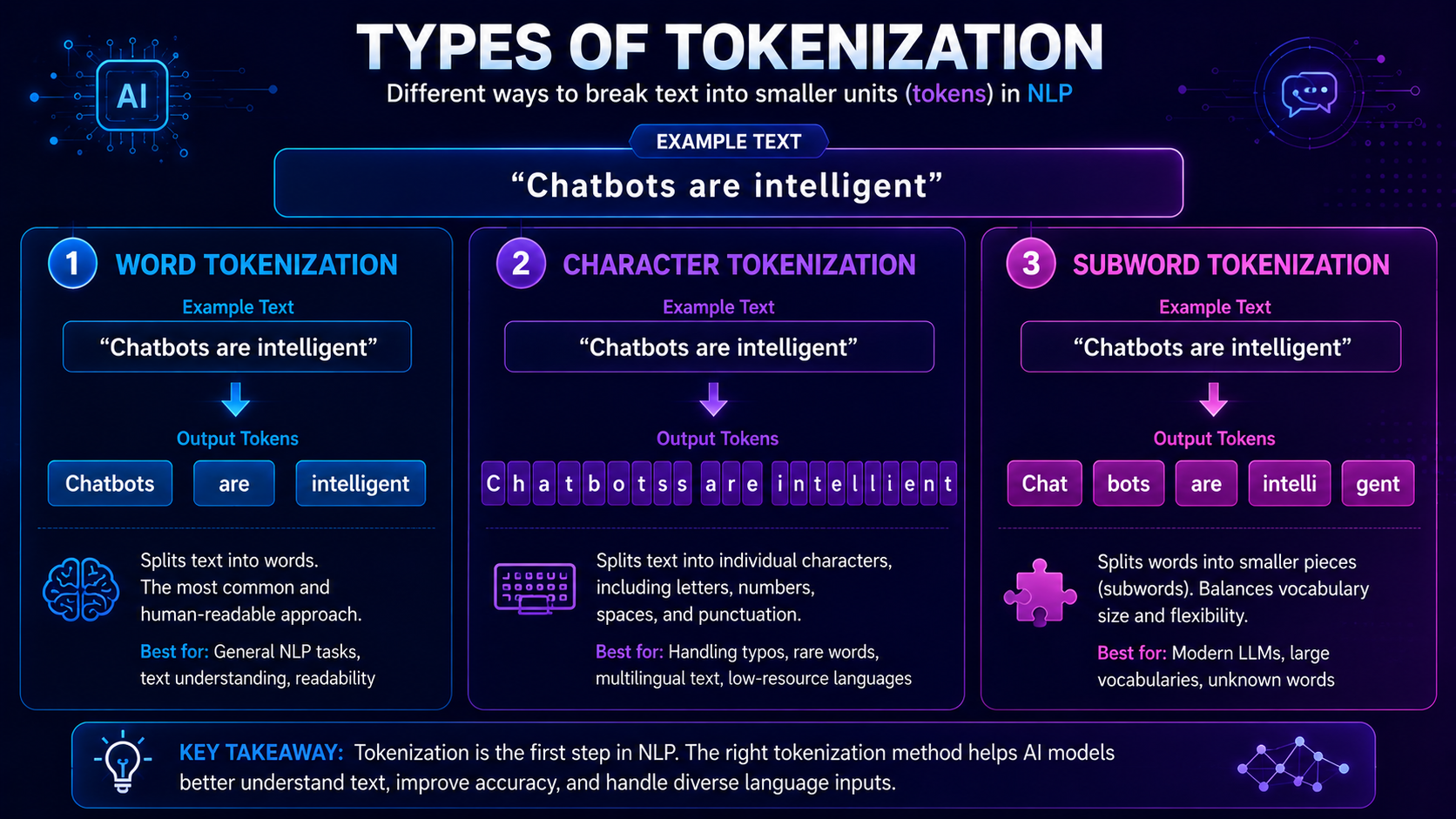
Different NLP applications use different tokenization methods.
Comparison of Tokenization Types
| Type | Example | Best Used For |
|---|---|---|
| Word Tokenization | AI is powerful | General NLP tasks |
| Sentence Tokenization | Splitting paragraphs into sentences | un-believe-able |
| Character Tokenization | A-I | Handling unknown words |
| Subword Tokenization | un-believe-able | Transformers and LLMs |
Word Tokenization
Word tokenization splits text into individual words.
Example:
AI is transforming healthcare.
Becomes:
- AI
- is
- Transforming
- Healthcare
Sentence Tokenization
Sentence tokenization divides text into complete sentences.
Example:
AI is powerful. It is changing industries.
Becomes:
- AI is powerful.
- It is changing industries.
Character Tokenization
Character tokenization breaks text into individual characters.
Example:
AI
Becomes:
- A
- I
Subword Tokenization
Subword tokenization splits words into smaller meaningful units.
Example:
unbelievable
May become:
- un
- believe
- able
Modern transformer-based models frequently use subword tokenization because it handles rare and unknown words more efficiently.
Key Concepts Beginners Should Understand
Before diving deeper into tokenization, there are a few important concepts every NLP beginner should know.
Vocabulary
A vocabulary is the collection of tokens that a model recognizes.
Every NLP model has a vocabulary containing words, subwords, symbols, and special tokens.
Generally, larger vocabularies allow models to understand more language variations, although they may also require more computing resources.
Token IDs
Computers do not understand words directly.
Each token is assigned a numerical identifier called a token ID.
For example:
| Token | Token ID |
|---|---|
| AI | 450 |
| Learns | 782 |
| Quickly | 912 |
These numerical values allow machine learning algorithms to process language mathematically.
Unknown Tokens
Sometimes a model encounters a word that is not present in its vocabulary.
Historically, these words were replaced with a special token such as:
[UNK]
Modern tokenization methods reduce this problem by splitting unfamiliar words into smaller subword units.
Context
The meaning of a word often depends on nearby words.
For example:
The bank approved my loan.
and
The fisherman sat on the river bank.
Both sentences contain the word “bank,” but the meaning is different.
Modern NLP systems use context to determine the correct interpretation.
How ChatGPT Uses Tokenization
One of the easiest ways to understand tokenization is to see how it works inside ChatGPT.
Suppose a user enters the prompt:
What is machine learning?
A tokenizer may break this into:
- What
- is
- Machine
- Learning
- ?
The process then looks like this:
- The prompt enters ChatGPT.
- The text is tokenized.
- Tokens are converted into embeddings.
- Transformer layers analyze relationships between tokens.
- The model generates a response.
This entire process happens in fractions of a second.
Every question you ask ChatGPT begins with tokenization.
Why ChatGPT Counts Tokens Instead of Words
Many users notice that AI platforms often measure usage in tokens rather than words.
This is because the model processes tokens internally.
A single word may become:
- One token
- Multiple tokens
- A combination of subword tokens
Because tokens represent the actual units processed by the model, they provide a more accurate measurement than word counts.
Tokenization and Transformers
Modern NLP systems are largely powered by transformer architectures.
Before a transformer can process language, tokenization must occur.
The workflow generally follows these steps:
- Text enters the system.
- The tokenizer converts text into tokens.
- Tokens become vector representations called embeddings.
- The transformer analyzes relationships between tokens.
- The model generates predictions or responses.
This is why tokenization is closely connected to topics such as:
Without tokenization, transformer models would have no structured way to analyze language.
Tokenization in Large Language Models
Large Language Models such as ChatGPT, Gemini, Claude, and Llama rely heavily on tokenization.
These systems often process subword tokens rather than complete words.
This helps them:
- Handle unfamiliar words
- Support multiple languages
- Reduce vocabulary size
- Improve efficiency
- Understand rare language patterns
This is also why LLM usage is measured in tokens rather than words.
A token can represent:
- A whole word
- Part of a word
- Punctuation
- Symbols
- Special control tokens
Every prompt and response in an LLM is processed as a sequence of tokens.
How Many Tokens Are in a Word?
Many beginners assume that one token always equals one word.
In reality, tokenization is much more flexible.
Some words may be represented by a single token, while others may be split into multiple tokens.
Examples
| Text | Approximate Tokens |
|---|---|
| AI | 1 |
| ChatGPT | 1-2 |
| Artificial | 1-2 |
| Artificial Intelligence | 2-4 |
| Supercalifragilisticexpialidocious | Many |
This is one reason AI systems count tokens instead of words.
The token is the true unit of processing inside the model.
Why Longer Words Often Use More Tokens
Rare, complex, or unusual words are more likely to be split into multiple tokens.
For example:
cybersecurity
may be processed as:
- cyber
- security
This approach helps models understand unfamiliar vocabulary without requiring enormous vocabularies.
What Are Token Limits?
Large Language Models can only process a certain number of tokens at one time.
This limit is called the context window.
The context window includes:
- Your prompt
- Previous conversation history
- The model’s response
When the token limit is reached, the model may:
- Forget older information
- Remove previous context
- Be unable to process additional text
Why Token Limits Matter
Token limits affect:
- Conversation length
- Document analysis
- AI memory capabilities
- API pricing
- Overall model performance
As AI technology advances, context windows continue to grow larger, allowing models to process longer documents and more complex conversations.
Real-World Applications of Tokenization
Tokenization powers many AI applications people use every day.
Chatbots and Virtual Assistants
ChatGPT, Siri, Alexa, and Google Assistant tokenize user requests before generating responses.
Search Engines
Search engines tokenize both user queries and web pages to improve search accuracy.
Machine Translation
Translation systems break text into tokens before converting it into another language.
Sentiment Analysis
Businesses analyze reviews, surveys, and social media posts by first tokenizing text.
Spam Detection
Email providers tokenize incoming messages to identify suspicious content.
Text Classification
AI systems categorize documents, articles, and messages using tokenized text.
Text Summarization
AI-powered summarization tools tokenize lengthy documents before generating concise summaries.
Why Tokenization Appears Throughout NLP
Tokenization is one of the few concepts that appears in nearly every NLP application.
| NLP Task | Uses Tokenization? |
|---|---|
| Sentiment Analysis | Yes |
| Named Entity Recognition (NER) | Yes |
| Text Classification | Yes |
| Machine Translation | Yes |
| Chatbots | Yes |
| Search Engines | Yes |
| Transformers | Yes |
| Large Language Models | Yes |
No matter which NLP topic you study next, tokenization will almost always be one of the first processing steps involved.
This is one reason tokenization is considered one of the foundational concepts of Natural Language Processing.
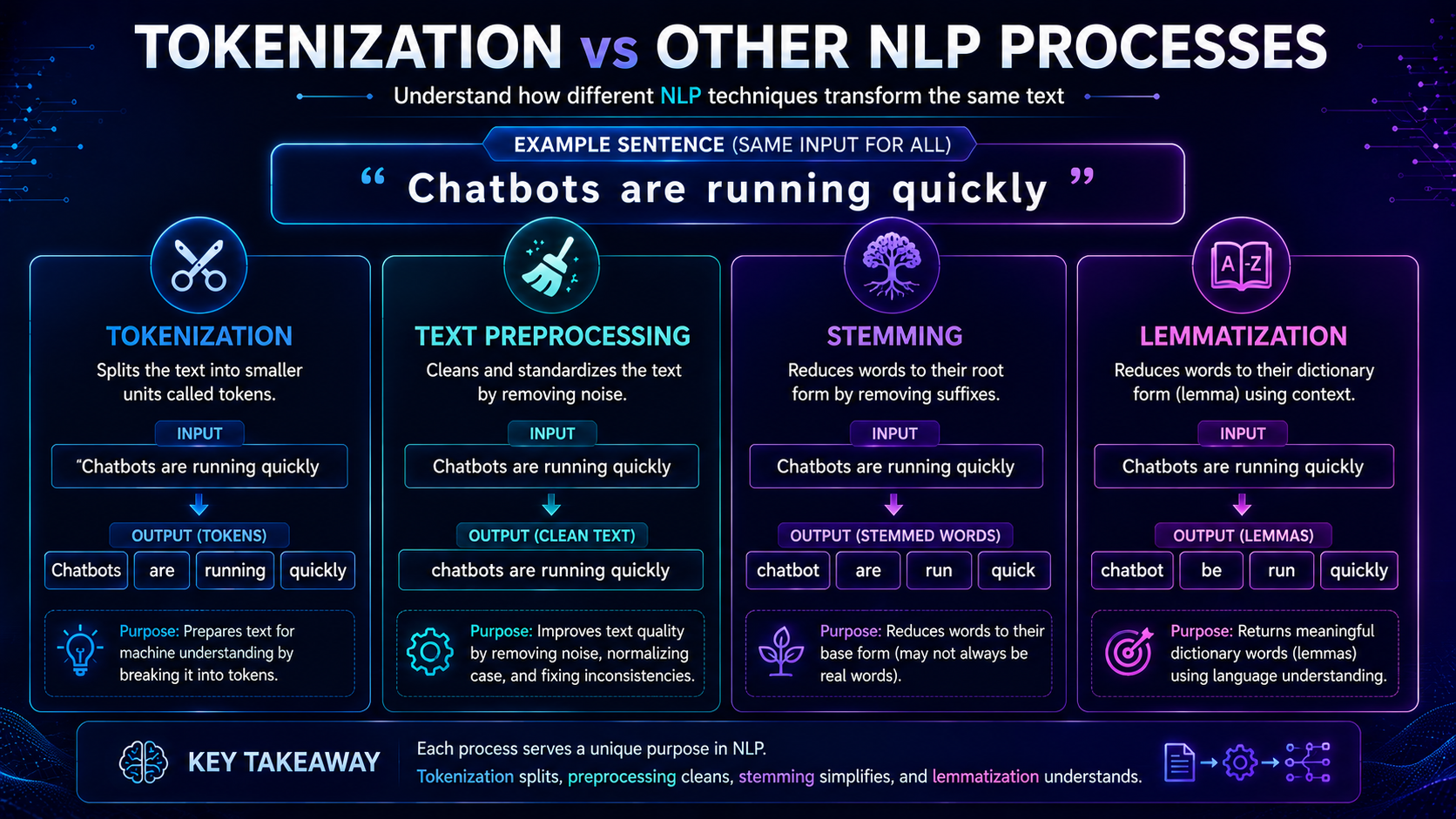
Tokenization vs Stemming vs Lemmatization
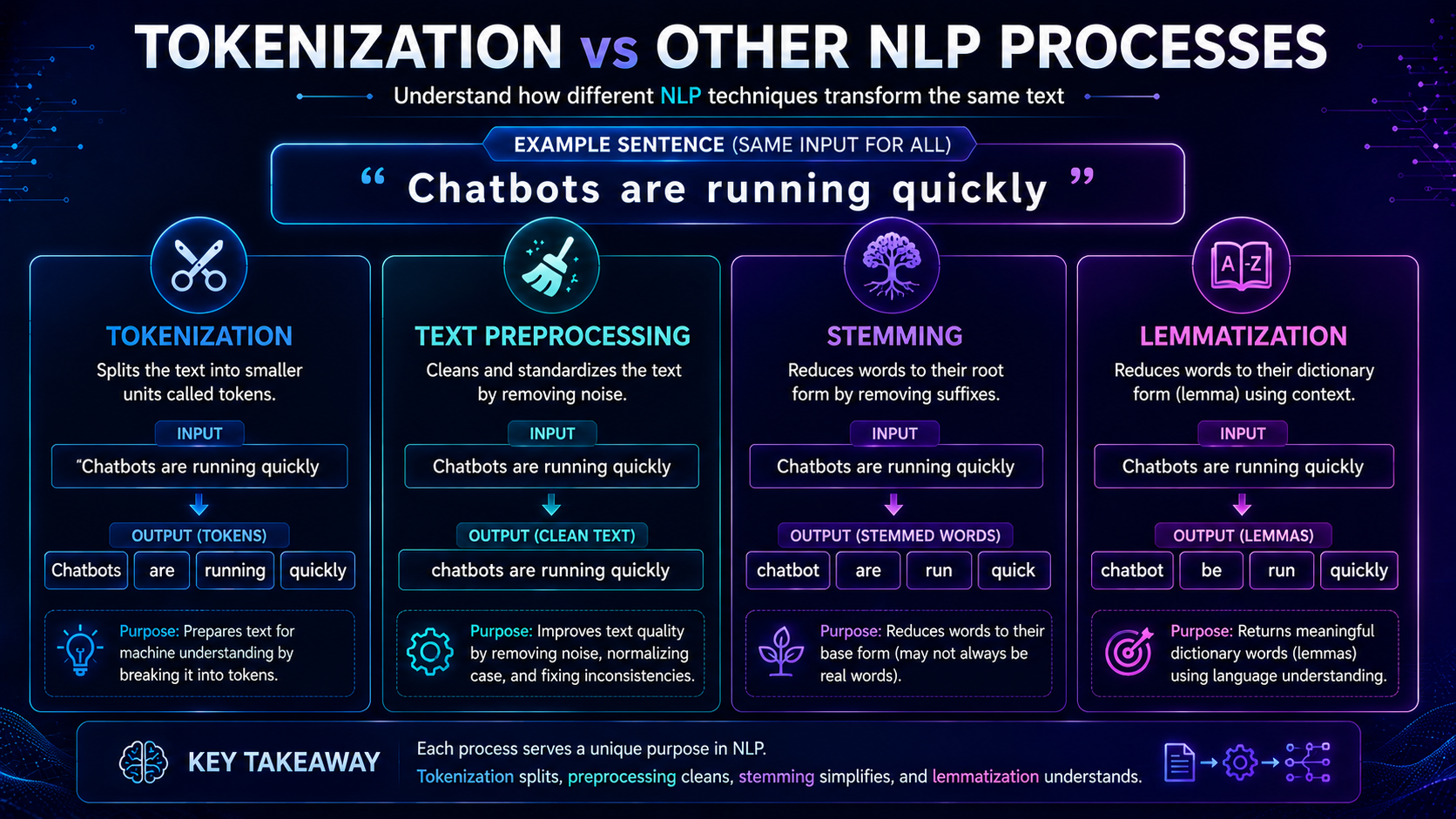
Many beginners confuse these three NLP preprocessing techniques.
Although they often work together, they serve different purposes.
| Technique | Purpose |
|---|---|
| Tokenization | Split text into tokens |
| Stemming | Remove word endings |
| Lemmatization | Convert words to root forms |
Example
| Original Word | Stemming | Lemmatization |
|---|---|---|
| Running | Run | Run |
| Studies | Studi | Study |
| Better | Better | Good |
When Each Technique Is Used
Tokenization organizes text into manageable pieces.
Stemming simplifies words by removing endings.
Lemmatization converts words into their dictionary forms.
Together, these techniques help AI systems analyze language more effectively.
Advantages and Limitations of Tokenization
| Advantages | Limitations |
|---|---|
| Simplifies text processing | Different languages require different tokenization methods |
| Enables NLP and machine learning | Some context can be lost |
| Improves language analysis | Complex languages present challenges |
| Supports large-scale AI systems | Ambiguous words may be difficult to process |
| Makes text easier to organize | Poor tokenization can reduce accuracy |
Tokenization provides enormous benefits, but selecting the right tokenization strategy remains important for achieving the best results.
Common Challenges of Tokenization
Although tokenization may seem straightforward, human language is surprisingly complex.
Different languages, writing styles, and communication patterns can make tokenization difficult.
| Challenge | Example |
|---|---|
| Multiple Languages | Chinese text without spaces |
| Slang | LOL, BRB |
| Emojis | 😊 |
| Compound Words | Cybersecurity |
| Ambiguous Words | Bank |
| Misspellings | Recieve vs Receive |
| Technical Terms | AI-specific vocabulary |
Modern NLP systems use increasingly sophisticated tokenizers to overcome these challenges.
Multiple Languages
Languages such as Chinese and Japanese often do not use spaces between words.
This makes identifying word boundaries significantly more difficult than in English.
Slang and Informal Language
Internet language changes rapidly.
New abbreviations, memes, and social media expressions constantly appear, making accurate tokenization challenging.
Ambiguous Language
The same word can have multiple meanings depending on context.
Advanced NLP systems rely on surrounding tokens to interpret the correct meaning.
Common Misconceptions About Tokenization
Many beginners misunderstand what tokenization actually does.
Tokenization Is Not Understanding
Breaking text into tokens does not mean the AI understands the meaning.
Tokenization simply prepares text for later analysis.
Tokens Are Not Always Words
Modern AI systems frequently split words into smaller subword units.
This helps them process unfamiliar vocabulary more effectively.
More Tokens Do Not Mean Better Results
Generating more tokens does not automatically improve performance.
Efficient tokenization is usually more important than creating additional tokens.
Tokenization Is Not the Same as Translation
Tokenization prepares text for processing, but it does not convert one language into another.
Translation occurs later in the NLP pipeline.
Common Beginner Mistakes About Tokenization
Mistake #1: Thinking Tokens Are Always Words
Many beginners assume every token represents a complete word.
In reality, modern tokenizers often split words into smaller components.
Mistake #2: Assuming Tokenization Creates Understanding
Tokenization prepares text for analysis, but understanding comes later through machine learning models and neural networks.
Mistake #3: Confusing Tokenization With Word Embeddings
Tokenization breaks text apart.
Word embeddings convert those tokens into meaningful numerical representations.
These are separate processes.
Mistake #4: Ignoring Token Limits
Many new AI users focus only on prompts and responses while overlooking token limits.
Understanding token limits becomes increasingly important when working with Large Language Models.
Tokenization Across Different Languages
Tokenization becomes more challenging when working with multiple languages.
| Language | Tokenization Challenge |
|---|---|
| English | Relatively simple word boundaries |
| Chinese | No spaces between words |
| Japanese | Multiple writing systems |
| Arabic | Complex word structures |
| German | Long compound words |
For example, German often combines multiple concepts into a single long word, while Chinese may not separate words with spaces at all.
This is one reason tokenization remains an active area of NLP research.
Why Tokenization Matters for AI Costs and Performance
Tokenization affects more than language understanding.
It also impacts:
- Computing costs
- Processing speed
- Context window size
- API pricing
- Memory usage
- Model efficiency
Many AI providers charge based on the number of tokens processed.
As a result, efficient tokenization can reduce costs while improving performance.
This has become increasingly important as Large Language Models continue to grow.
How Tokenization Improves AI Accuracy
Good tokenization helps AI systems identify meaningful patterns in language.
When text is broken into useful tokens, machine learning models can more easily recognize relationships between words and concepts.
Benefits include:
- Better language understanding
- Improved pattern recognition
- More accurate predictions
- Reduced ambiguity
- Better performance on large datasets
- Improved multilingual support
Poor tokenization can make language harder for a model to interpret, reducing overall performance.
For this reason, tokenization remains one of the most important preprocessing steps in NLP.
Expert Insight
Modern AI systems do not read language the way humans do. Instead, they process sequences of tokens and learn statistical relationships between them. This is why tokenization remains one of the most important foundations of Natural Language Processing, Transformers, and Large Language Models.
Future Outlook for Tokenization
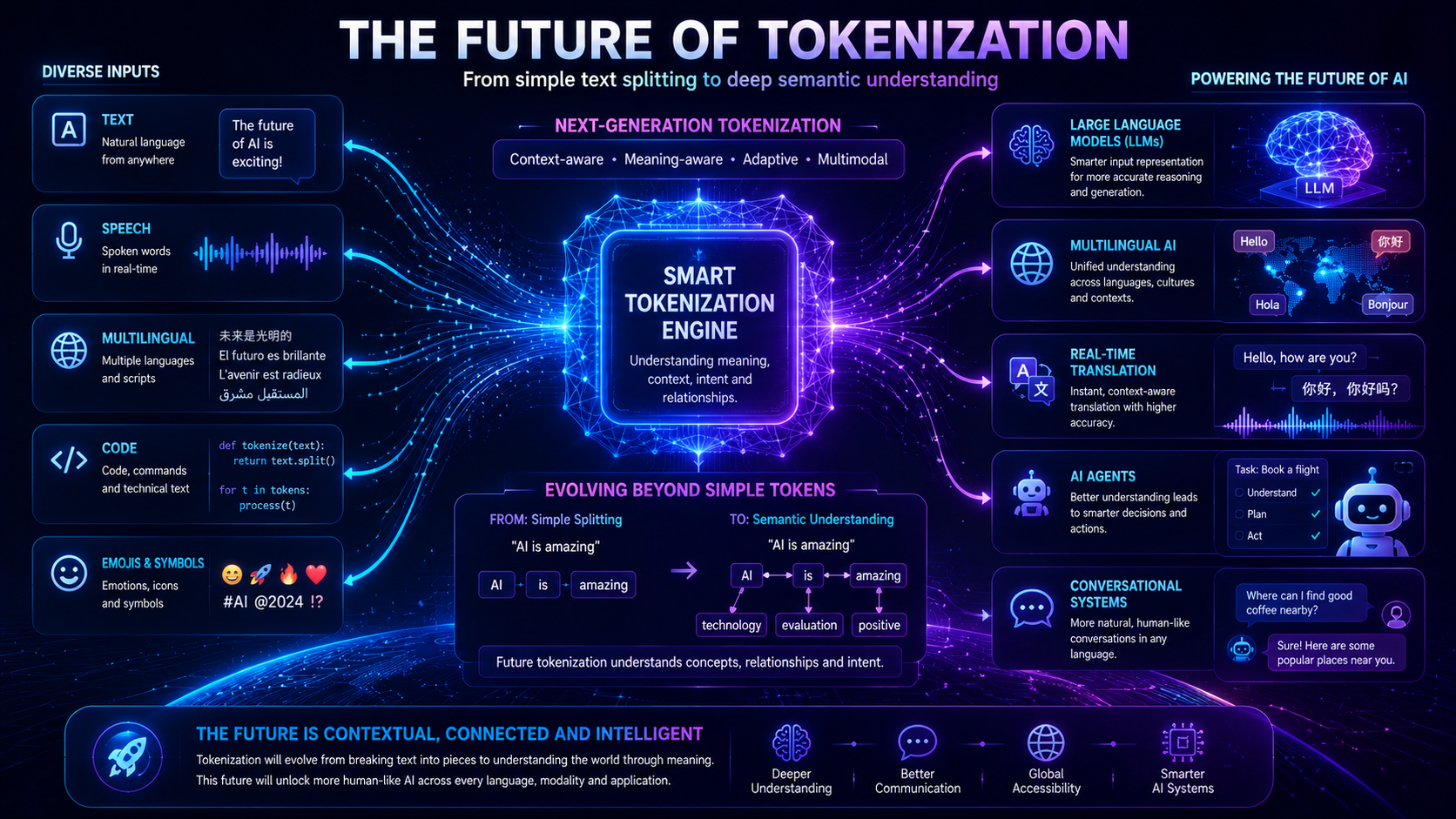
As AI systems become more advanced, tokenization methods continue to improve.
Future developments may include:
- Better multilingual tokenizers
- Improved handling of rare words
- Token compression techniques
- Larger context windows
- More efficient LLM processing
- Faster inference speeds
- Improved reasoning capabilities
- Multimodal tokenization for text, images, audio, and video
Future AI systems may process multiple forms of information using unified token representations, allowing models to understand language, images, and other data types simultaneously.
As Natural Language Processing evolves, tokenization will remain one of the foundational technologies that enable machines to understand human communication.
How Tokenization Has Evolved
Tokenization has changed significantly as NLP technology has advanced.
Early NLP Systems
Early systems relied on simple word splitting and rule-based methods.
Statistical NLP Era
Researchers began developing more sophisticated tokenization techniques using probability and language patterns.
Deep Learning Era
Character-based and subword tokenization became increasingly popular.
Transformer Era
Modern transformer models introduced advanced tokenization approaches designed for large-scale language understanding.
Large Language Models Today
Today’s AI systems use highly optimized tokenizers capable of handling multiple languages, massive vocabularies, and billions of parameters.
Tokenization continues to evolve alongside advances in artificial intelligence.
How Tokenization Connects to the Broader AI Ecosystem
Tokenization is just one component of a much larger AI workflow.
After tokenization, text often moves through systems involving:
- Artificial Intelligence Explained
- Machine Learning Explained
- Deep Learning Explained
- Neural Networks Explained
- Supervised Learning Explained
- Unsupervised Learning Explained
- Reinforcement Learning Explained
Tokenization serves as a foundational building block that connects Natural Language Processing to the broader world of artificial intelligence.
Recommended External Resources
For deeper learning, explore:
IBM’s Guide to Natural Language Processing
IBM provides beginner-friendly explanations of NLP concepts, machine learning, and language models.
Google AI offers educational materials covering tokenization, transformers, and modern NLP systems.
These resources provide excellent supplementary learning for readers who want to continue exploring AI.
Key Takeaways
- Tokenization breaks text into smaller units called tokens.
- It is one of the first steps in Natural Language Processing.
- Modern AI systems often use subword tokenization.
- ChatGPT and other Large Language Models rely heavily on tokenization.
- Tokenization helps convert language into a format computers can understand.
- Better tokenization often leads to more accurate AI systems.
- Tokenization influences both AI performance and operating costs.
- Nearly every NLP application uses tokenization in some form.
FAQ About Tokenization
What is tokenization in simple terms?
Tokenization is the process of breaking text into smaller pieces called tokens so AI systems can analyze language.
Why is tokenization important in NLP?
It converts human language into a structured format that machine learning models can understand.
What is a token?
A token is a unit of text such as a word, character, sentence, punctuation mark, or subword.
Is tokenization used in ChatGPT?
Yes. Every prompt entered into ChatGPT is tokenized before the model processes it.
What is the difference between word tokens and subword tokens?
Word tokens represent complete words, while subword tokens represent smaller parts of words.
Why do AI models count tokens instead of words?
Tokens are the actual units processed internally by AI systems, making them a more accurate measurement than words.
Can one word contain multiple tokens?
Yes. Longer or less common words are often split into multiple tokens.
Can tokenization affect AI accuracy?
Yes. Better tokenization often helps models understand language more effectively and produce more accurate results.
Does every NLP model use tokenization?
Most modern NLP systems use some form of tokenization before processing text.
What happens after text is tokenized?
The tokens are converted into numerical representations and analyzed by machine learning models.
Suggested Learning Path
Now that you understand tokenization, continue building your NLP knowledge with these topics:
- What Is Natural Language Processing (NLP)
- How NLP Works
- Word Embeddings Explained
- Sentiment Analysis Explained
- Named Entity Recognition (NER)
- Text Classification Explained
- Transformers in NLP
- Chatbots Explained
Together, these articles will help you understand how modern AI systems process, analyze, and generate human language.
Conclusion
Tokenization is one of the most important foundational concepts in Natural Language Processing. By breaking text into smaller, manageable units, tokenization enables AI systems to understand, analyze, and generate human language effectively.
Whether you’re using ChatGPT, searching online, translating text, analyzing customer reviews, or interacting with a virtual assistant, tokenization is working behind the scenes to make those experiences possible.
Although it may seem like a simple preprocessing step, tokenization serves as the gateway between human communication and machine understanding. Nearly every NLP application depends on it, making it one of the most valuable concepts for beginners to learn.
As you continue your AI learning journey, explore What Is Natural Language Processing (NLP), How NLP Works, Word Embeddings Explained, Sentiment Analysis Explained, Named Entity Recognition (NER), Text Classification Explained, and Transformers in NLP to build a deeper understanding of how modern AI systems process language.