Featured Snippet: How NLP Works
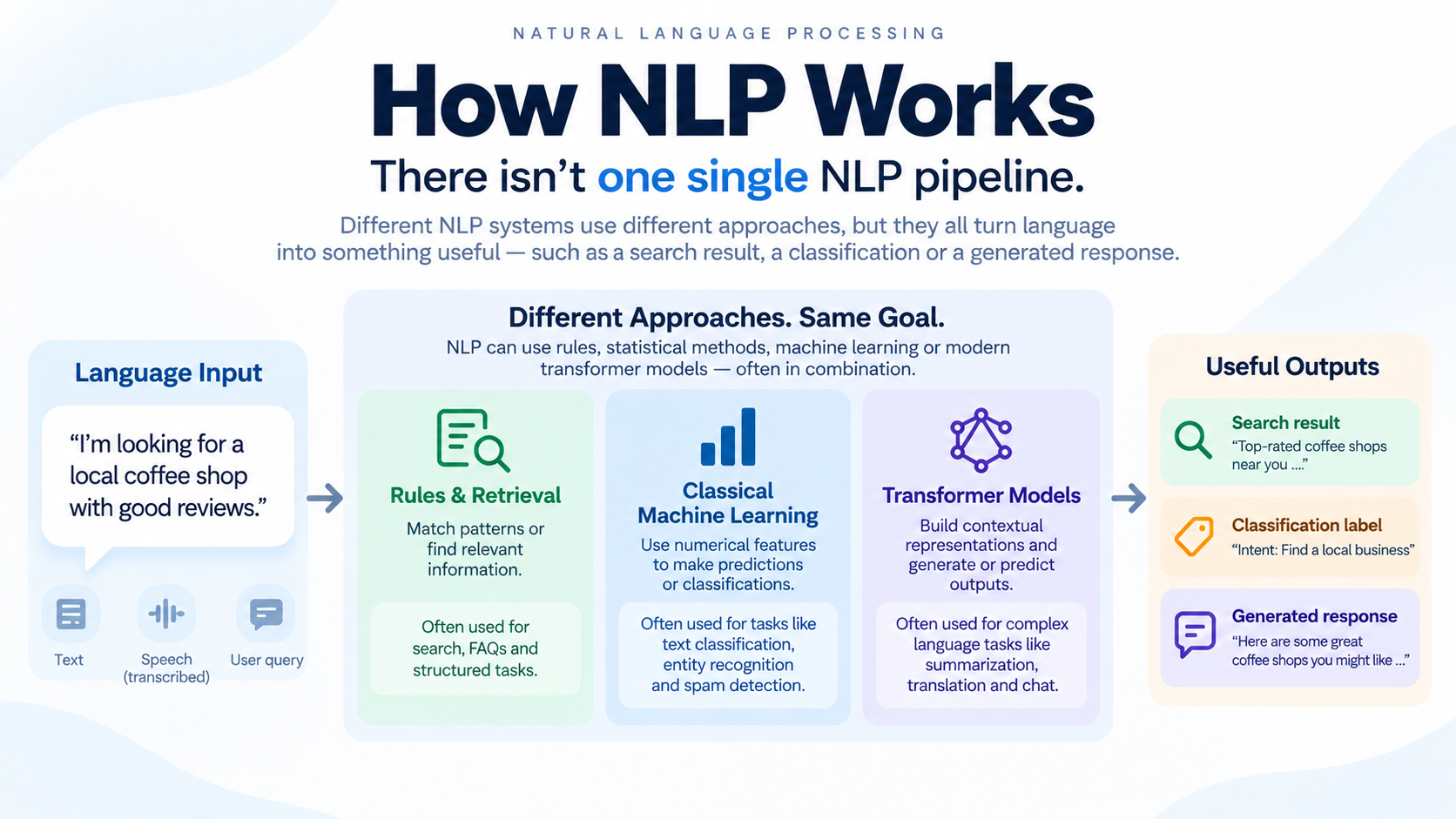
Natural Language Processing (NLP) works by helping computers understand, analyze, and generate human language. It combines artificial intelligence, machine learning, linguistics, and deep learning techniques to transform text or speech into structured data that machines can interpret and use.
In simple terms, NLP allows computers to read, listen, understand, and respond to human language in ways that feel natural and useful.
Introduction
Every day, billions of people interact with technologies that understand language. Whether you’re asking ChatGPT a question, using Siri to set a reminder, translating text with Google Translate, or receiving product recommendations based on customer reviews, Natural Language Processing (NLP) is working behind the scenes.
Human language is incredibly complex. We use slang, idioms, abbreviations, sarcasm, and different sentence structures that can be difficult even for humans to interpret. Computers do not naturally understand language, so NLP provides the tools and techniques needed to bridge the gap between human communication and machine understanding.
Understanding how NLP works is essential because it powers many of today’s most popular AI systems. In this guide, you’ll learn the complete NLP workflow, key concepts, real-world applications, advantages, limitations, and where the technology is heading in the future.

What Is How NLP Works?
When people ask “How NLP Works,” they are referring to the process that allows computers to understand and interact with human language.
At a high level, NLP follows a series of steps:
- Receive language input
- Break language into smaller pieces
- Analyze meaning and context
- Generate an output or response
Think of NLP like a translator between humans and computers.
Humans communicate through words, sentences, and speech. Computers communicate through numbers and data. NLP converts human language into formats computers can understand and then converts computer-generated information back into language humans can understand.
Without NLP, chatbots, voice assistants, translation systems, search engines, and AI writing tools would not exist.
Why Is NLP Important?
Language is one of the primary ways humans share information.
Organizations generate enormous amounts of language data every day through:
- Emails
- Customer reviews
- Social media posts
- Support tickets
- News articles
- Research papers
- Voice recordings
NLP helps AI systems process this information automatically and at scale.
This enables businesses and organizations to gain insights, automate tasks, improve customer experiences, and make better decisions.
For example:
- Hospitals analyze medical records.
- Banks monitor financial news.
- News articles
- News articles
- Voice recordings
NLP helps AI systems process this information automatically and at scale.
This enables businesses and organizations to gain insights, automate tasks, improve customer experiences, and make better decisions.
For example:
- Hospitals analyze medical records.
- Banks monitor financial news.
- E-commerce companies analyze customer reviews.
- Search engines understand user queries.
- Chatbots answer customer questions.
Without NLP, these tasks would require enormous amounts of manual work.
How NLP Works Step-by-Step

The NLP process can be broken into several stages.
Step 1: Collect Language Data
The process begins with input data.
This data may include:
- Written text
- Spoken language
- Documents
- Emails
- Websites
- Social media posts
- Customer conversations
For example, an online retailer may collect thousands of customer reviews for analysis.
The quality of this data plays a major role in how effective the NLP system becomes.
Step 2: Preprocess the Text
Raw language is often messy.
Before AI models can analyze it, the text must be cleaned and standardized.
Common preprocessing tasks include:
- Removing punctuation
- Converting text to lowercase
- Correcting spelling mistakes
- Removing unnecessary characters
- Standardizing formatting
For example:
Original text:
“I LOVE this product!!!”
Processed text:
“love this product
This cleaning process helps NLP systems focus on the meaning of the text rather than formatting inconsistencies.
Step 3: Tokenization
One of the most important NLP steps is tokenization.
Tokenization breaks text into smaller units called tokens.
Example:
Sentence:
“Artificial intelligence is transforming technology.”
Tokens:
- Artificial
- intelligence
- is
- transforming
- technology
These tokens become the building blocks that NLP models analyze.
Modern Large Language Models such as ChatGPT rely heavily on tokenization to process language efficiently.
Step 4: Convert Words into Numbers
Computers cannot understand words directly.
They need numerical representations.
NLP systems convert words into vectors using techniques called word embeddings.
| Word | Numerical Representation |
| Dog | [0.21, 0.43, 0.11] |
| Cat | [0.19, 0.41, 0.12] |
| Car | [0.78, 0.15, 0.65] |
Words with similar meanings often receive similar numerical representations.
This helps AI understand relationships between concepts.
For example, the words “doctor” and “physician” will usually be represented more similarly than “doctor” and “airplane.”
Step 5: Analyze Meaning and Context
Modern NLP systems don’t simply look at individual words.
They also analyze context.
Consider the word:
“Bank”
It could mean:
- A financial institution
- The side of a river
Humans naturally understand the difference based on surrounding words.
Modern NLP models use contextual understanding to determine the intended meaning.
This capability has improved dramatically thanks to deep learning and transformer architectures.
Step 6: Apply Machine Learning Models
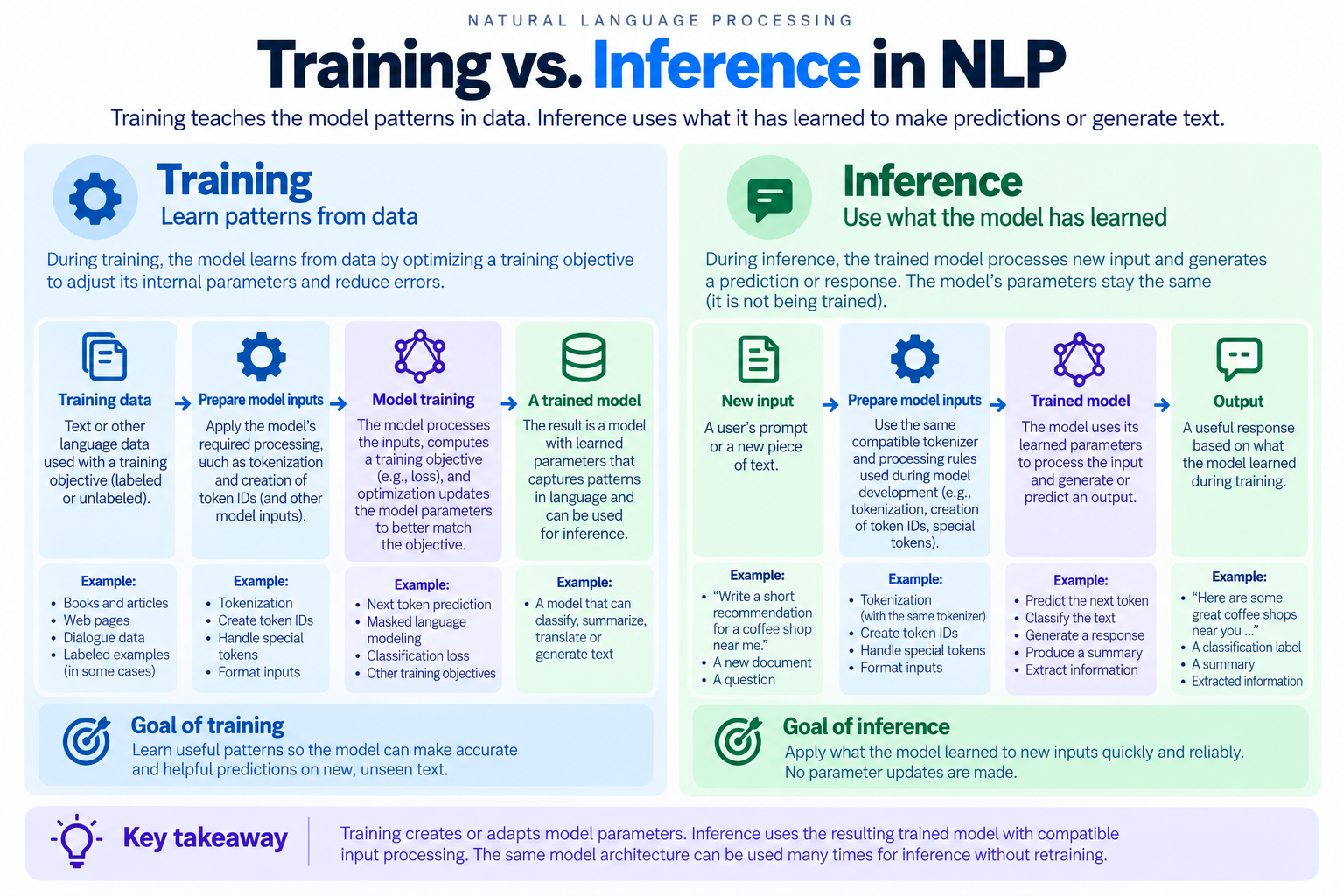
After language has been processed, machine learning models analyze patterns within the data.
The model may be trained to perform tasks such as:
- Sentiment analysis
- Translation
- Classification
- Question answering
- Summarization
- Text generation
The model learns patterns from large datasets and applies those patterns to new information.
This learning process is one reason NLP has improved so dramatically over the last decade.
Step 7: Generate an Output
Finally, the system produces a result.
Examples include:
- A chatbot response
- A translated sentence
- A sentiment score
- A document summary
- A recommendation
- A search result
The output is delivered back to the user in a human-friendly format.
This completes the NLP pipeline.
The NLP Workflow at a Glance

The entire Natural Language Processing process can be summarized as a workflow that transforms human language into machine-readable information and then generates useful outputs.
| Stage | What Happens |
| Input | User provides text or speech |
| Preprocessing | Text is cleaned and standardized |
| Tokenization | Text is split into smaller units |
| Embeddings | Words are converted into numbers |
| Analysis | AI identifies meaning and context |
| Prediction | Model performs a task |
| Output | Results are returned to the user |
A simple way to think about NLP is as a translator between humans and computers.
Human language enters one side of the system, AI analyzes it through several processing stages, and useful information or responses emerge from the other side.
Key Concepts Beginners Should Understand
Tokenization
Tokenization breaks language into smaller units that AI systems can analyze.
Without tokenization, NLP models would struggle to process language efficiently.
Related Topic:
Tokenization Explained
Word Embeddings
Word embeddings transform words into numerical representations.
These representations help AI understand meaning, similarity, and relationships between words.
Related Topic:
Context
Context helps AI determine the meaning of words based on surrounding information.
Modern NLP systems rely heavily on contextual understanding.
Language Models
Language models learn patterns in language from massive datasets.
Examples include:
- GPT
- Gemini
- Claude
- BERT
These models power many modern AI applications.
Transformers
Transformers are deep learning architectures specifically designed for language understanding.
They are the foundation of most modern NLP systems and large language models.
Related Topic:
Why Is Human Language Difficult for AI?
Human language feels natural to people, but it is surprisingly difficult for computers to understand.
Language contains ambiguity, context, emotion, sarcasm, cultural references, and constantly evolving vocabulary. NLP systems must learn how to interpret these complexities accurately.
This challenge is one reason NLP has become one of the most important fields in artificial intelligence.
Ambiguity
Many words have multiple meanings.
For example:
“I saw a bat.”
The word “bat” could refer to:
- An animal
- A baseball bat
Humans usually understand the intended meaning instantly based on context.
Computers must analyze surrounding words and patterns to determine which meaning is correct.
Context
The meaning of language often depends on context.
Consider this sentence:
“The bank is closed.”
Does “bank” mean:
- A financial institution?
- The side of a river?
Without context, it is impossible to know.
Modern NLP systems analyze nearby words and sentence structure to understand the intended meaning.
Sarcasm and Emotion
Humans frequently use sarcasm, humor, irony, and emotional language.
For example:
“Great. Another meeting.”
A person may immediately recognize frustration or sarcasm.
An AI system might mistakenly interpret the word “great” as positive.
Understanding emotional nuance remains one of the biggest challenges in NLP.
Language Variations
People communicate differently depending on:
- Region
- Culture
- Age
- Profession
- Personal preferences
NLP systems must handle:
- Slang
- Abbreviations
- Misspellings
- Dialects
- Multiple languages
This makes language significantly more complex than structured data such as numbers or spreadsheets.
A Real NLP Example From Start to Finish
Understanding individual NLP concepts is helpful, but seeing the complete process in action makes it easier to understand.
Imagine a customer leaves this review:
“The delivery was slow, but the product quality is excellent.”
| NLP Stage | What Happens |
| Input | Customer review enters the system |
| Preprocessing | Text is cleaned and standardized |
| Tokenization | Sentence is split into tokens |
| Word Embeddings | Words become numerical representations |
| Context Analysis | Positive and negative language is identified |
| Sentiment Analysis | Mixed sentiment is detected |
| Output | Review is categorized as neutral or mixed |
The phrase:
“delivery was slow”
expresses a negative opinion.
The phrase:
“product quality is excellent”
expresses a positive opinion.
A modern NLP system recognizes both sentiments and determines that the review contains mixed feedback.
This example demonstrates how multiple NLP techniques work together to extract useful insights from language.
Common NLP Tasks

Natural Language Processing includes many specialized tasks.
Modern AI systems often perform several of these tasks simultaneously.
| NLP Task | Purpose |
| Tokenization | Break text into smaller pieces |
| Text Classification | Categorize text |
| Sentiment Analysis | Detect emotions and opinions |
| Named Entity Recognition | Identify people, places, and organizations |
| Machine Translation | Convert one language into another |
| Summarization | Create shorter versions of documents |
| Question Answering | Respond to user questions |
| Text Generation | Produce human-like text |
For example, ChatGPT combines tokenization, context analysis, question answering, and text generation to create responses.
Related Topics
The Technologies Behind NLP
Natural Language Processing combines several different fields and technologies.
| Technology | Role in NLP |
| Linguistics | Understanding grammar and language structure |
| Artificial Intelligence | Building intelligent systems |
| Machine Learning | Learning patterns from language data |
| Deep Learning | Understanding complex relationships |
| Neural Networks | Processing language information |
| Transformers | Understanding context at scale |
These technologies work together to help computers understand and generate language.
This is why NLP sits at the intersection of several major AI disciplines.
Related Topics
- Artificial Intelligence Explained
- Machine Learning Explained
- Deep Learning Explained
- Neural Networks Explained
How ChatGPT Uses NLP
One of the most popular examples of NLP today is ChatGPT.
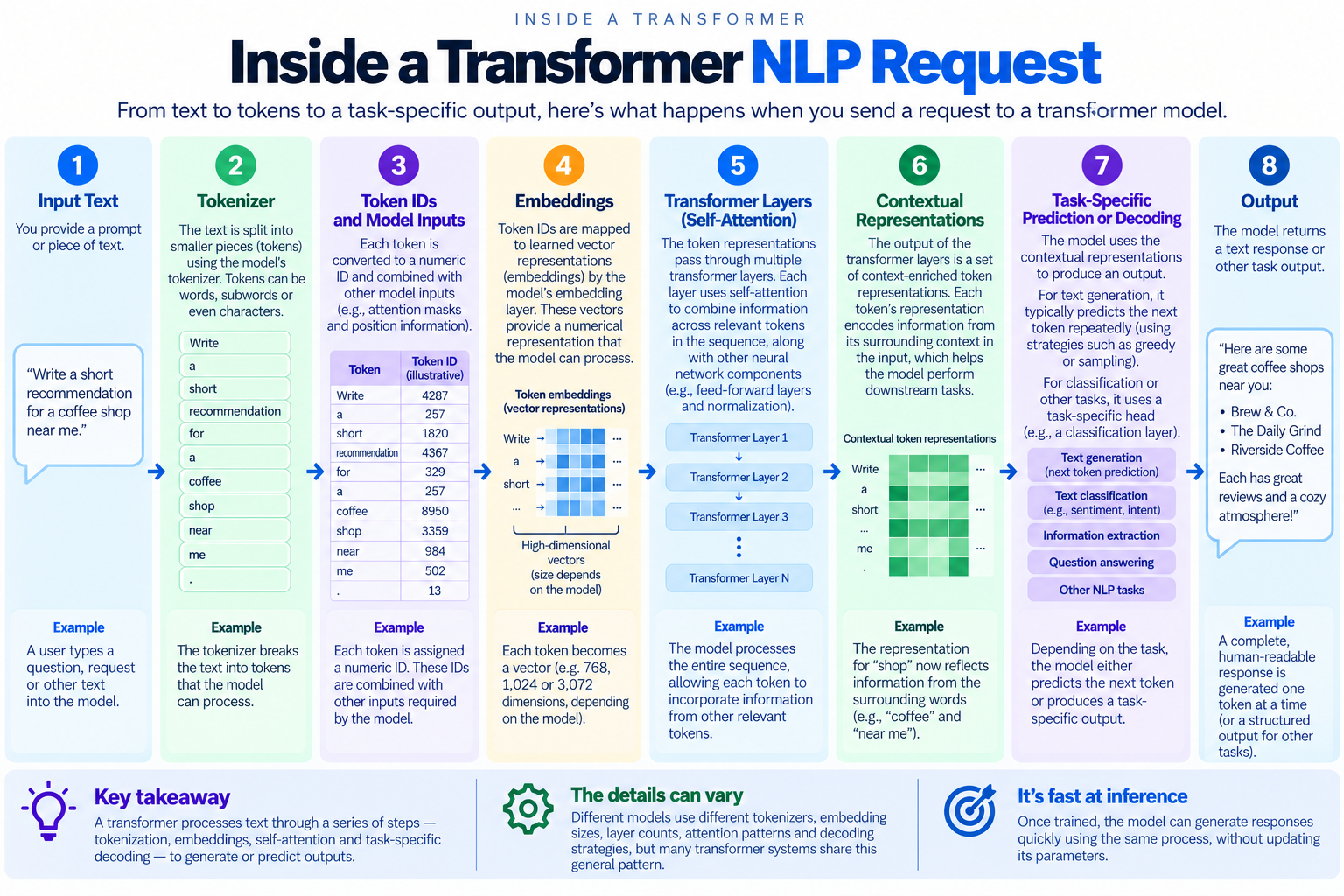
When you enter a prompt into ChatGPT, several NLP processes happen almost instantly.
Step 1: Input Processing
The system receives your prompt.
For example:
“Explain machine learning in simple terms.”
The AI first receives and prepares the text for analysis.
Step 2: Tokenization
The prompt is divided into smaller units called tokens.
These tokens allow the model to process language efficiently.
Step 3: Context Analysis
Transformer models analyze relationships between tokens.
This helps the AI understand what the user is asking and what information is relevant.
Step 4: Prediction
The model predicts the most likely sequence of words that should come next.
This prediction process occurs repeatedly as the response is generated.
Step 5: Response Generation
The AI produces a response that appears natural and conversational.
The entire process happens in fractions of a second.
This demonstrates how modern NLP systems can communicate with humans in remarkably natural ways.
Related Topics
How Google Uses NLP
Many people use NLP every day without realizing it.
Google Search is one of the most common examples.
When you search:
“Best Italian restaurant near me”
Google uses NLP to:
- Understand your intent
- Identify important keywords
- Recognize location information
- Interpret the meaning of the query
- Deliver relevant search results
Without NLP, search engines would struggle to understand what users actually want.
Modern search experiences rely heavily on language understanding technologies.
Real-World Applications of NLP

Natural Language Processing powers countless technologies used every day.
Healthcare
Healthcare organizations use NLP to:
- Analyze medical records
- Summarize patient notes
- Assist diagnosis workflows
- Extract clinical information
Doctors can spend less time processing paperwork and more time helping patients.
Finance
Financial institutions use NLP to:
- Analyze market sentiment
- Detect fraud
- Monitor financial news
- Process documents
This helps organizations make faster and more informed decisions.
Customer Service
Chatbots and virtual assistants rely heavily on NLP.
They help businesses:
- Answer customer questions
- Reduce support costs
- Provide 24/7 assistance
- Improve customer experiences
Many companies now use AI-powered customer support systems as their first line of service.
Education
Educational platforms use NLP for:
- Automated tutoring
- Essay evaluation
- Language learning
- Personalized learning experiences
AI tutors are becoming increasingly common in online learning environments.
E-Commerce
Online retailers use NLP to:
- Analyze reviews
- Improve product search
- Recommend products
- Understand customer feedback
This helps businesses improve products and enhance customer satisfaction.
Advantages and Limitations of NLP
Like any AI technology, Natural Language Processing offers significant benefits but also faces important challenges.
| Advantages | Limitations |
| Automates language processing | Struggles with sarcasm and humor |
| Processes huge amounts of text quickly | Can misunderstand context |
| Improves customer experiences | Requires large training datasets |
| Powers virtual assistants and chatbots | Can inherit bias from data |
| Supports multilingual communication | Human language remains highly complex |
| Extracts insights from unstructured data | Accuracy varies across languages |
Advantages of NLP
Faster Data Analysis
Organizations can analyze millions of documents, reviews, emails, and conversations far faster than humans.
Improved Automation
NLP automates repetitive language-based tasks such as:
- Customer support
- Data entry
- Content categorization
- Document analysis
Better Customer Experiences
Virtual assistants and chatbots can provide instant responses and personalized interactions.
Valuable Business Insights
Companies can identify trends, customer opinions, and emerging issues through language analysis.
Limitations of NLP
Language Is Complex
Human communication often includes:
- Sarcasm
- Idioms
- Humor
- Cultural references
These elements remain difficult for AI to interpret perfectly.
Data Requirements
Modern NLP systems require large amounts of high-quality training data.
Bias Concerns
Models may learn biases present in training datasets.
Context Challenges
Even advanced models can occasionally misunderstand meaning when context is unclear.
Despite these limitations, NLP continues to improve rapidly thanks to advances in machine learning and deep learning.
Traditional NLP vs Modern NLP

Natural Language Processing has evolved dramatically over time.
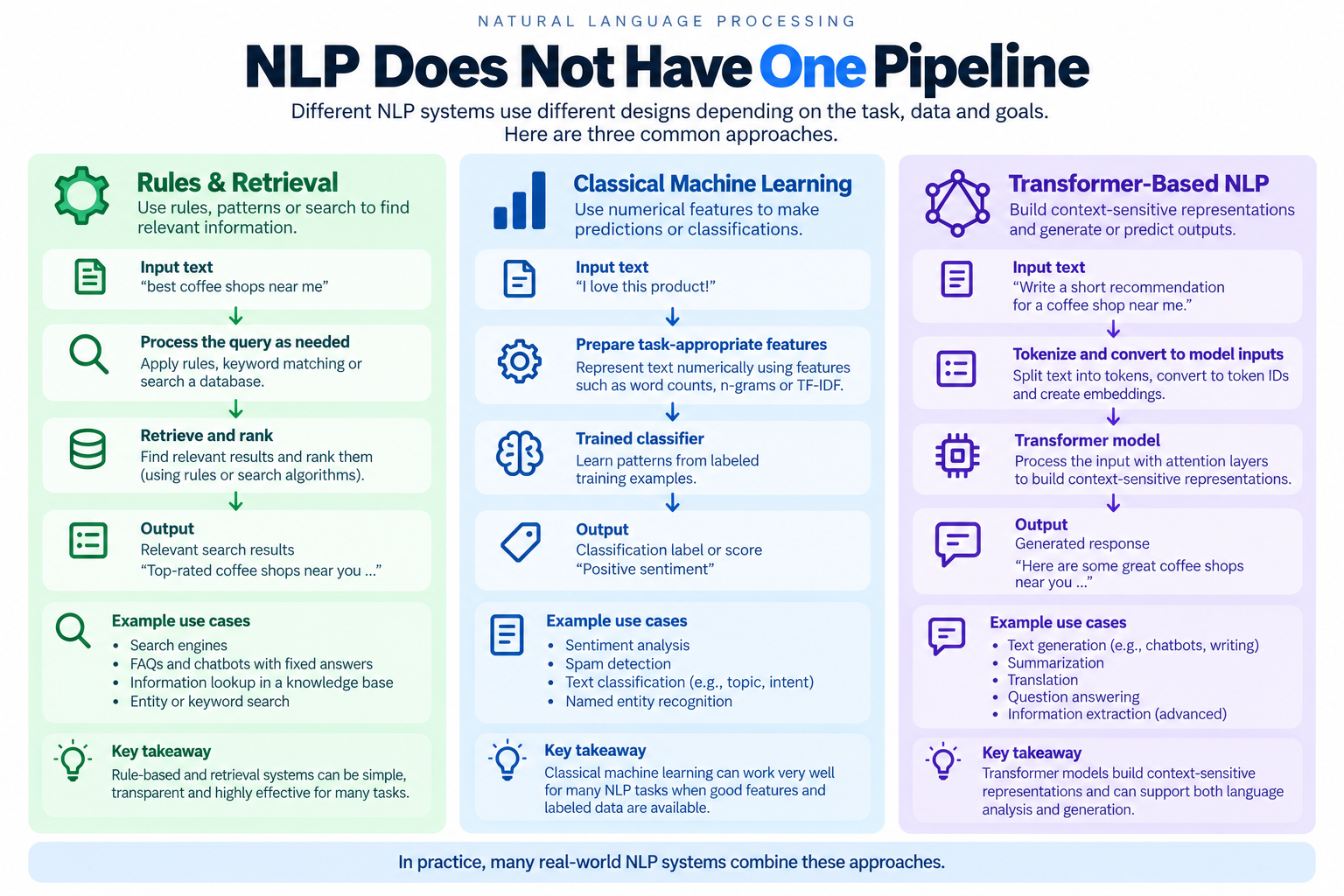
Early NLP systems relied heavily on manually created rules, while modern systems learn directly from data.
| Traditional NLP | Modern NLP |
| Rule-based systems | Deep learning models |
| Limited context understanding | Strong contextual understanding |
| Hand-coded rules | Learned patterns |
| Hand-coded rules | Higher accuracy |
| Lower accuracy | Highly scalable |
| Difficult to scale | Adaptable to many tasks |
Traditional systems required developers to manually program language rules.
Modern NLP models learn language patterns automatically from massive datasets.
The introduction of transformer architectures revolutionized NLP and paved the way for technologies such as ChatGPT, Gemini, and Claude.
NLP vs Machine Learning vs Deep Learning
Many beginners confuse NLP with machine learning and deep learning.
While these technologies are closely related, they serve different purposes.
| Technology | Purpose |
| Artificial Intelligence | Creating systems that perform intelligent tasks |
| Machine Learning | Learning patterns from data |
| Deep Learning | Using neural networks to solve complex problems |
| Natural Language Processing | Understanding and generating human language |
Think of these technologies as layers:
- Artificial Intelligence is the broadest field.
- Machine Learning is a subset of AI.
- Deep Learning is a subset of machine learning.
- NLP is a specialized field that often uses machine learning and deep learning techniques to process language.
Related Topics
- Artificial Intelligence Explained
- Machine Learning Explained
- Deep Learning Explained
- Neural Networks Explained
- Supervised Learning Explained
- Unsupervised Learning Explained
- Reinforcement Learning Explained
Common Misconceptions About NLP
Many beginners have misconceptions about what NLP can and cannot do.
NLP Is Not Just ChatGPT
ChatGPT is one of the most popular NLP applications, but NLP powers many other technologies, including:
- Search engines
- Translation tools
- Spam filters
- Voice assistants
- Recommendation systems
ChatGPT is only one example of NLP in action.
NLP Does Not Truly Understand Language Like Humans
Modern NLP systems can generate highly convincing responses, but they do not think like humans.
Instead, they identify patterns and relationships learned from large amounts of data.
This distinction is important when evaluating AI capabilities.
NLP Is More Than Text
Many people associate NLP only with written language.
In reality, NLP is used for:
- Speech recognition
- Voice assistants
- Audio transcription
- Real-time translation
- Conversational AI
Language exists in many forms, and NLP helps AI work with all of them.
The Future of NLP

Natural Language Processing is evolving rapidly.
As AI systems become more powerful, NLP capabilities continue to expand.
More Human-Like Conversations
Future NLP systems will better understand:
- Context
- Intent
- Emotion
- Nuance
This will make interactions feel increasingly natural.
Real-Time Translation
Advanced translation systems may eventually enable seamless communication between speakers of different languages.
Language barriers could become significantly less important in global communication.
AI-Powered Personal Assistants
Future virtual assistants may:
- Manage schedules
- Conduct research
- Complete tasks
- Coordinate workflows
with minimal human supervision.
Personalized Education
NLP-powered tutoring systems may provide highly customized learning experiences tailored to individual students.
This could transform education worldwide.
AI Copilots in the Workplace
Businesses are increasingly adopting AI assistants that help employees:
- Write reports
- Summarize meetings
- Analyze documents
- Draft communications
These tools are expected to become standard workplace technology.
Multimodal AI Systems
Future AI systems will combine:
- Text
- Images
- Audio
- Video
into unified intelligent systems capable of understanding multiple forms of information simultaneously.
Large Language Models have already transformed the NLP landscape, and future advances will continue making human-computer interaction more natural, efficient, and accessible.
Continue Learning About NLP
If you’re new to Natural Language Processing, these articles provide a logical learning path.
Beginner Level
Intermediate Level
Advanced Level
Following this progression will help you build a strong understanding of modern language AI systems.
Recommended External Resources
To learn more about Natural Language Processing, explore these trusted educational resources:
These sources provide beginner-friendly explanations and deeper technical insights into NLP technologies.
Frequently Asked Questions About How NLP Works
What is NLP in simple terms?
NLP is a branch of AI that helps computers understand, interpret, and generate human language.
How does NLP work?
NLP works by processing language, converting it into data, analyzing patterns, and generating useful outputs.
Why is NLP important?
NLP allows computers to communicate with humans using natural language rather than computer code.
What is tokenization in NLP?
Tokenization is the process of breaking text into smaller units called tokens.
What are word embeddings?
Word embeddings are numerical representations of words that help AI understand meaning and relationships between concepts.
Is NLP part of artificial intelligence?
Yes. NLP is a specialized branch of Artificial Intelligence focused on language understanding and generation.
What role does machine learning play in NLP?
Machine learning helps NLP systems learn patterns from language data and improve their performance over time.
How do chatbots use NLP?
Chatbots use NLP to understand user questions, identify intent, and generate appropriate responses.
What is the difference between NLP and machine learning?
Machine learning is a broad approach to learning from data, while NLP specifically focuses on processing human language.
Why is NLP difficult?
Human language contains ambiguity, context, sarcasm, emotion, and cultural nuances that can be challenging for AI systems to interpret accurately.
What is the NLP pipeline?
The NLP pipeline is the sequence of steps used to process language, including preprocessing, tokenization, embeddings, analysis, prediction, and output generation.
Does ChatGPT use NLP?
Yes. ChatGPT relies heavily on Natural Language Processing, transformer architectures, and deep learning models to understand prompts and generate responses.
What are the two main components of NLP?
The two primary components are Natural Language Understanding (NLU) and Natural Language Generation (NLG).
What is the future of NLP?
The future of NLP includes more advanced language models, real-time translation, personalized AI assistants, and increasingly human-like interactions.
Conclusion
Understanding how NLP works is essential for understanding modern artificial intelligence.
Natural Language Processing enables computers to process language through a series of steps that include data collection, preprocessing, tokenization, word embeddings, context analysis, machine learning, and response generation.
Today, NLP powers search engines, chatbots, virtual assistants, translation systems, recommendation engines, customer support tools, and Large Language Models used by millions of people every day.
As AI continues to evolve, NLP will play an even larger role in helping humans and machines communicate naturally.
Whether you’re exploring AI for personal learning, business applications, or future career opportunities, understanding NLP provides a strong foundation for understanding many of today’s most important AI technologies.
Recommended Next Topics