
Last reviewed: August 2026
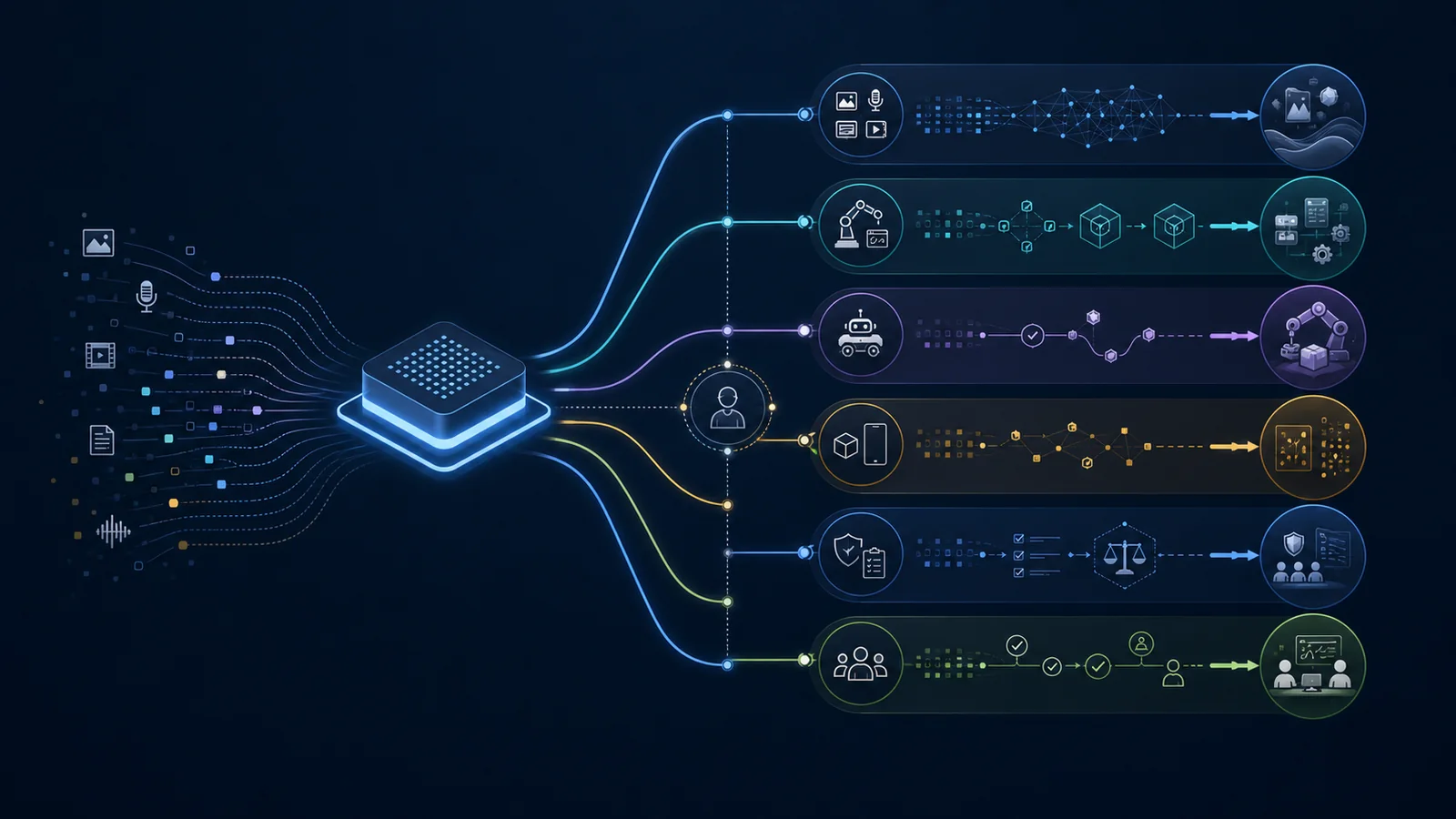
The future of artificial intelligence is uncertain. Some developments are already visible: wider enterprise adoption, increasingly capable multimodal models, growing use of generative AI, expanding regulation, and early deployment of AI agents.
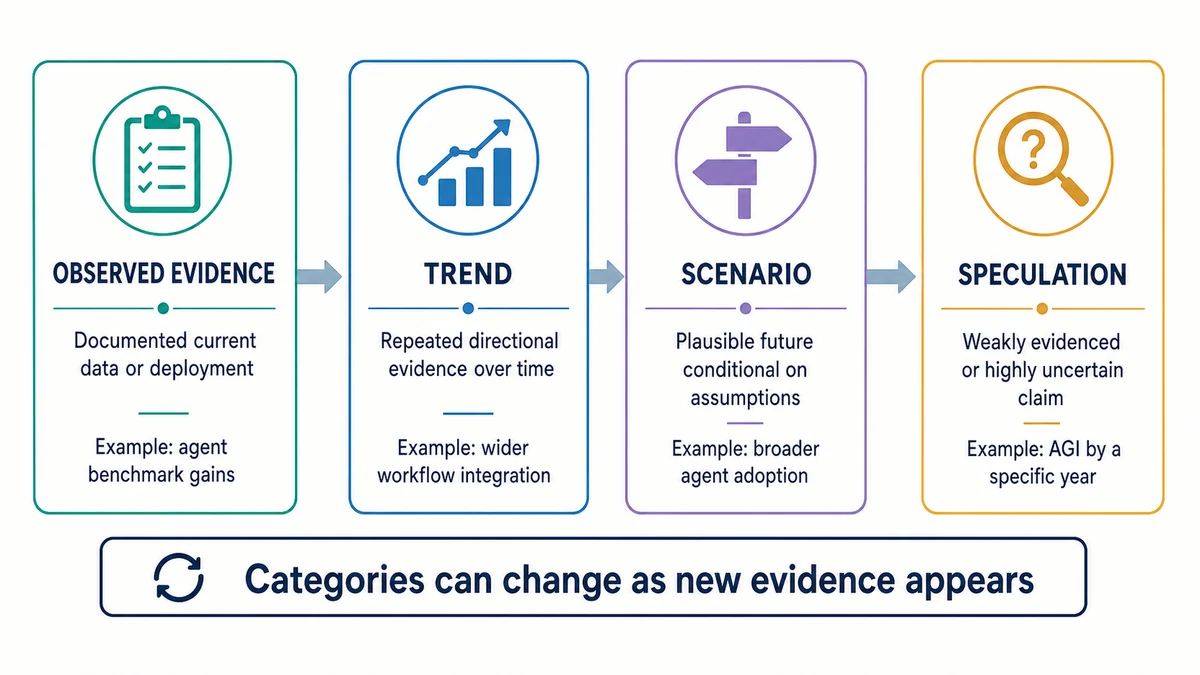
Other claims about artificial general intelligence, mass job displacement, fully autonomous companies, or exact technological timelines remain forecasts rather than established facts. A useful outlook separates observed evidence from trends, scenarios, and speculation.
Key takeaways
- AI capabilities and adoption are advancing, but progress remains uneven across tasks and organizations.
- Agent reliability, robotics, governance, and workflow integration remain major constraints.
- AGI timelines and fixed job-loss predictions should be treated as forecasts, not facts.
- The most credible outlook considers several plausible scenarios rather than one inevitable future.
Trend 1: AI is becoming a general-purpose business technology
AI use has expanded beyond specialized research teams into software development, customer service, marketing, analytics, operations, and knowledge work.
Stanford’s 2026 AI Index economy chapter reports that 88% of surveyed organizations used AI in at least one business function in 2025 and 70% used generative AI in at least one function. AI-agent deployment remained in the single digits across nearly all business functions.
Those figures describe organizations in that survey, not every business worldwide. The important question is not simply whether organizations use AI, but whether they can integrate it into reliable workflows that produce measurable value. For deeper coverage, read AI in Business.
Trend 2: Multimodal models are expanding
AI systems increasingly work across combinations of text, images, audio, video, and structured data. This can enable more natural interfaces and richer applications, but multimodality also expands evaluation, privacy, copyright, safety, and compute challenges.
Multimodal capability should not be interpreted as proof of human-like general intelligence. Learn the underlying distinction in What Is Generative AI?
Trend 3: AI agents are moving from demonstrations toward deployment
Agentic systems combine models with tools, memory, external data, and software applications to perform multi-step tasks. In 2026, agents are an important development area, but the evidence still supports caution around claims of fully autonomous organizations or universal digital workers.
Stanford’s 2026 technical-performance analysis reports that agent performance on OSWorld rose to about 66.3% task success. Agents still failed roughly one in three attempts on that structured benchmark.
The difficult problems increasingly include permissions, reliability, tool safety, monitoring, recovery from failure, and deciding when humans must remain involved. Better benchmark scores do not establish reliable autonomous performance in every real workflow.
Trend 4: Models are becoming components of larger systems
Many useful AI products are not simply one model behind a chat interface. They can combine foundation models, retrieval systems, databases, external tools and APIs, traditional software logic, smaller specialized models, and human review.
The future of AI is therefore also a systems-engineering and organizational-design story. Access to a capable model does not automatically produce a dependable product or workflow.
Trend 5: AI is moving into physical systems
AI is increasingly combined with robotics, autonomous systems, manufacturing, logistics, and scientific equipment. Progress may accelerate as perception, language, planning, simulation, and control systems improve.
Physical-world deployment has constraints that software-only AI does not: hardware cost, safety, reliability, energy use, real-time control, and unpredictable environments. Stanford’s 2026 AI Index illustrates the gap between controlled evaluation and everyday deployment: robotics performance is strong in some simulation benchmarks, while robots succeed in only about 12% of real household tasks.
Exact timelines for broadly capable household or workplace robots remain uncertain. See AI in Robotics for the deeper application context.
Trend 6: Regulation is becoming operational
AI regulation is moving from proposals into enforceable requirements. The European Union’s AI Act is being phased in through a risk-based framework.
The European Commission began enforcing applicable AI Act rules on August 2, 2026, and Article 50 transparency obligations started applying to certain interactive AI systems and AI-generated or manipulated content. The Commission’s enforcement notice and Article 50 guidelines should be rechecked whenever this article is refreshed because requirements follow different phased timelines.
Other jurisdictions use different combinations of AI-specific law, privacy rules, sector regulation, consumer protection, and standards. Regulatory capability is becoming part of AI engineering and deployment rather than a separate policy exercise.
Trend 7: Smaller and specialized models will continue to matter
The future is unlikely to consist only of increasingly large frontier models. Smaller models can offer advantages in cost, latency, privacy, on-device operation, domain specialization, and operational control.
Organizations may increasingly use portfolios of models rather than one universal model for every task. Whether that pattern dominates will depend on capability, infrastructure, economics, and governance needs.
Trend 8: Evaluation will become more important
As AI systems take on more consequential work, benchmark scores alone become less informative. Organizations need to evaluate task success, reliability, factuality, security, fairness, cost, latency, human-intervention requirements, and real user outcomes.
Agentic systems also require evaluation of actions and multi-step behavior, not just generated text. Continue with Model Evaluation Metrics Explained.
What about AGI?
Artificial general intelligence has no universally accepted technical definition or test. Researchers and companies disagree about what capabilities would qualify, whether current scaling approaches are sufficient, and when or whether AGI will arrive.
Any precise AGI timeline should therefore be treated as a forecast, not a fact. Read Types of Artificial Intelligence for the terminology.
Will AI replace jobs?
AI is already changing some tasks and hiring patterns, but the net employment effect remains uncertain. Stanford’s 2026 economy chapter reports that labor-market effects are uneven and concentrated in some hiring pipelines and younger workers in exposed occupations.
It also reports that roughly one-third of surveyed organizations expected AI-related workforce reductions over the following year, while almost half expected little or no change. These are observations and expectations from specific datasets—not proof of one economy-wide employment outcome.
Automation can substitute for some tasks while complementing others. Outcomes depend on technology, economics, organizational adoption, worker adaptation, regulation, and how quickly businesses redesign processes. Fixed job-loss percentages should be treated cautiously unless tied to a clearly defined study and methodology.
Plausible scenarios for the next decade
Rapid capability and deployment growth
Models and agents improve quickly, organizations redesign workflows around them, and AI becomes deeply embedded across economic activity.
Capability growth with slower institutional adoption
Models improve faster than organizations can safely integrate them because of regulation, infrastructure, reliability, workforce, and governance constraints.
A more specialized AI ecosystem
Progress continues, but the market emphasizes combinations of specialized models, tools, robotics, and domain systems rather than one universally capable AI.
Reality may combine elements of all three scenarios.
What is more certain than the predictions?
- AI capabilities are changing rapidly, but progress is uneven across tasks and benchmarks.
- Evaluation and governance become more important as deployment expands.
- Organizations need workflow and systems integration, not merely access to a capable model.
- Regulation and technical standards require periodic revalidation.
- Human roles are likely to change differently across occupations and industries.
- Physical-world AI faces different constraints from software-only systems.
- Forecasts should be revisited frequently rather than treated as permanent facts.
Frequently asked questions
What is the biggest AI trend in 2026?
There is no single trend. Broader enterprise adoption, generative AI, multimodal models, early agent deployment, and operational regulation are among the most consequential.
When will AGI arrive?
There is no reliable consensus timeline, partly because AGI lacks a universally accepted definition and test.
Will AI replace humans?
AI can automate particular tasks, but economy-wide replacement claims are speculative. Human work is likely to change unevenly across occupations and industries.
How often should AI forecasts be updated?
Major claims, examples, and regulatory timelines should be reviewed at least quarterly and whenever a material capability, deployment, regulatory, or labor-market development occurs.
How this outlook was assessed
This article distinguishes observed evidence from emerging trends, plausible scenarios, and speculation. Cited quantitative and regulatory claims were checked against primary sources, while precise AGI, employment, and technology timelines are treated as forecasts rather than facts. Major claims and regulatory timelines are reviewed at least quarterly and whenever material evidence changes.