

AI in marketing means using learned models to predict outcomes, generate material, rank choices, or optimize decisions across the marketing lifecycle. It can support marketers, but it does not make every automated feature intelligent or guarantee better results.
This beginner-friendly guide explains what marketing AI actually does, how it differs from automation and analytics, where predictive and generative systems fit, how to measure impact, and what responsible human oversight requires.
Short version: treat AI as a capability to test—not a shortcut around strategy, evidence, privacy, or editorial judgment.
What Is AI in Marketing?
AI in marketing is the use of artificial intelligence systems to find patterns, estimate likely outcomes, generate content, classify language or images, recommend options, and optimize decisions. Most teams use these capabilities inside advertising, analytics, email, customer-service, ecommerce, and content platforms rather than building models themselves.
Common examples include product recommendations, conversion predictions, bid optimization, audience segmentation, sentiment analysis, chatbot responses, and draft copy or images. These systems may process more information or evaluate more options than a person could manage manually, but accuracy and usefulness still depend on the task, data, objective, model, and deployment conditions.
This page sits in the learning path AI Applications → AI in Business → AI in Marketing.
AI vs Automation vs Analytics
Marketing platforms often combine automation, analytics, and AI. They are related, but they are not interchangeable.
Traditional automation
Follows predetermined rules. Example: send a welcome email after someone submits a form.
Analytics
Measures, summarizes, and visualizes what happened. Example: a dashboard showing traffic, conversions, and revenue by channel.
Artificial intelligence
Uses learned models to infer patterns, rank options, predict outcomes, generate material, or optimize decisions. Example: estimating conversion likelihood or drafting ad variants.
A/B testing is also not inherently AI. It is an evaluation method. AI may generate variants or select options, while an experiment helps determine whether the change caused a meaningful improvement.
Predictive, Optimization, and Generative AI
Predictive and analytical AI
Predictive systems estimate outcomes such as conversion likelihood, churn risk, demand, audience similarity, or the next product a customer may want. Classification and natural language processing (NLP) can also organize feedback, identify topics, or estimate sentiment.
Optimization systems
Optimization systems choose bids, rankings, recommendations, delivery times, or other actions according to a defined objective. For example, Google describes Smart Bidding as using Google AI to optimize bids for conversions or conversion value at auction time. Its guidance also stresses prerequisites such as conversion tracking and appropriate performance evaluation. See Google Ads Smart Bidding documentation.
Generative AI
Generative AI produces drafts or new material such as copy, images, summaries, creative concepts, and chatbot responses. It is only one part of AI in marketing. Generative output can sound confident while being inaccurate, derivative, off-brand, or unsupported, so it requires review.
Where AI Fits Across the Marketing Lifecycle
Research and customer understanding
AI can cluster survey responses, classify support tickets, summarize interview notes, identify recurring themes, or flag changes in customer behavior. These outputs can help teams investigate patterns; they should not be mistaken for direct evidence of customer motivation without validation.
Segmentation, personalization, and recommendations
Models may group audiences, rank products or content, predict preferences, and adapt messages. Relevance may improve when the signal, objective, and timing are appropriate. It may also become intrusive, repetitive, or unfair when data use and audience rules are poorly designed.
Advertising and campaign optimization
Advertising platforms use machine learning for bid decisions, delivery, creative selection, and performance prediction. Possible benefits—such as efficiency or improved conversion value—are outcomes to measure, not automatic properties of enabling an AI feature.
Content and creative workflows
Generative tools can help brainstorm, outline, adapt formats, summarize source material, and draft variations. They do not supply evidence for product claims. For search content, Google says generative AI can support research and structure, while scaled production without added value can violate spam policies. Its guidance prioritizes accuracy, quality, relevance, and people-first usefulness regardless of how content is produced. See Google Search guidance on generative AI content.
Social, retail, and conversational channels
Channel-specific uses deserve their own context. Explore AI in Social Media for feeds, moderation, engagement, and social advertising; AI in Retail for recommendations, pricing, inventory, and commerce; and NLP for chatbots and language analysis.
How to Measure Whether AI Actually Helped
A platform score, prediction, or “AI-powered” label does not prove business impact. Use a simple measurement loop:
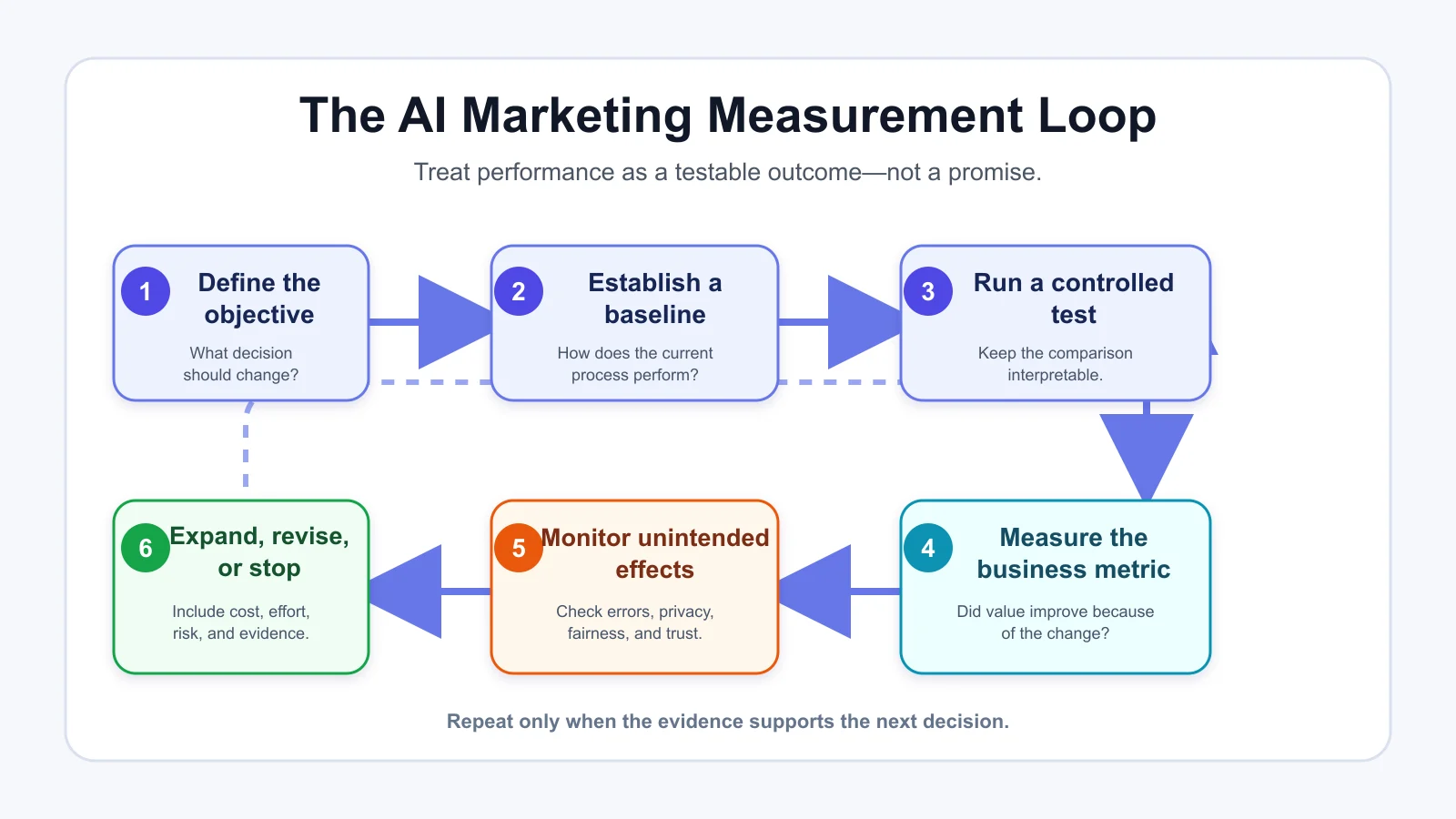
- Define the decision and objective. State what the system will change and why.
- Choose a business metric. Examples include qualified leads, conversion value, retention, cost per acquisition, or time saved with acceptable quality.
- Establish a baseline. Record current performance, costs, workflow time, and relevant quality or fairness measures.
- Run an appropriate comparison. Use a controlled experiment when practical, or a carefully designed before-and-after or holdout comparison when it is not.
- Measure incrementality. Ask what changed because of the system—not simply what the platform attributed to itself.
- Monitor unintended effects. Watch complaints, unsubscribes, brand errors, excluded audiences, privacy incidents, and performance drift.
- Decide whether to expand, revise, or stop. Include tool fees, review time, data work, and operational risk in the decision.
Do not change the model, audience, budget, creative, and conversion definition at the same time if you want a clear answer. Measurement is easier when the intervention and success criteria are explicit.
Privacy and Data Governance
Customer data can make targeting more specific, but that does not automatically make its collection or use appropriate. Marketing teams should understand:
- Purpose and minimization: collect and use only what is needed for a defined purpose.
- Permission and expectations: consider consent, notice, customer expectations, and jurisdiction-specific requirements.
- Sensitive data and proxies: avoid inappropriate use of health, financial, location, demographic, or inferred sensitive traits.
- Vendor handling: learn whether prompts or customer records are retained, used for training, shared with subprocessors, or available to other accounts.
- Access, retention, and deletion: limit who can use data and how long it remains available.
- Governance: document approved use cases, owners, review requirements, incident paths, and monitoring.
The NIST AI Risk Management Framework treats privacy, transparency, accountability, reliability, security, and harmful-bias management as connected trustworthiness considerations across the AI lifecycle. Legal requirements vary, so obtain qualified advice when a use case involves regulated data or consequential targeting.
Bias, Targeting, and Fairness
Bias is not only a training-data problem. Marketing outcomes can be shaped by the optimization objective, proxy variables, audience definitions, thresholds, feedback loops, measurement choices, platform constraints, and deployment context.
For example, optimizing only for the lowest near-term acquisition cost could repeatedly favor audiences that already receive more exposure, while excluding groups whose conversions take longer or are measured less completely. Teams should compare reach, delivery, error rates, offer access, and outcomes across relevant groups where lawful and appropriate.
Responsible targeting also means setting boundaries around manipulation, vulnerability, sensitive inferences, and exclusion. Continue with AI Ethics and responsible AI for the broader principles. This is the appropriate learning path for accountability and fairness—not a technical detour into symbolic AI.
Truthfulness and Human Review for AI-Generated Content
Treat AI-generated marketing content as a draft—not evidence.
Before publishing AI-assisted copy, images, demonstrations, or chatbot answers, verify product facts, prices, availability, comparisons, endorsements, testimonials, performance claims, disclosures, and any health or financial statements. Confirm that visual material does not misrepresent the product or customer experience.
The U.S. Federal Trade Commission says advertising must be truthful, non-deceptive, and supported by evidence when appropriate. AI generation does not reduce the advertiser’s responsibility. See the FTC advertising guidance for small businesses.
A practical review workflow assigns a named human owner, checks claims against approved evidence, verifies links and offers, reviews brand and accessibility requirements, records approval for higher-risk campaigns, and monitors the live result.
Will AI Replace Marketing Jobs?
AI is likely to automate or substantially change some marketing tasks, including first drafts, routine variations, reporting, classification, and parts of media optimization. The effect on individual jobs and roles will vary by specialization, organization, technology, adoption, and how work is redesigned.
The International Labour Organization’s research on generative AI and jobs finds that transformation is generally more likely than complete occupational replacement because jobs contain varied tasks and many still require human input. Exposure and impact differ across occupations and contexts. See the ILO’s refined global index.
Human responsibilities remain especially important for strategy, customer understanding, evidence, ethical boundaries, creative direction, risk decisions, stakeholder alignment, and accountability. That is not a guarantee against displacement; it is a reason to redesign work deliberately and build skills around judgment, measurement, and responsible tool use.
A Practical Starting Framework for Small Teams
- Choose one narrow problem, not “use AI everywhere.”
- Define the baseline and the metric that matters.
- Review what customer and company data the tool will receive.
- Use low-risk material first, such as brainstorming or internal summaries.
- Set a human review owner and clear publication rules.
- Run a limited test and include review time and tool cost.
- Expand only if the measured benefit exceeds the cost and risk.
For example, a small retailer could test AI-assisted subject-line drafts while keeping the audience, offer, approval process, and success metric stable. The team can then compare results and errors before allowing the tool into more sensitive personalization or customer-data workflows.
Frequently Asked Questions
What is AI in marketing?
It is the use of learned models to predict outcomes, generate material, classify information, rank choices, or optimize marketing decisions. Automation and analytics may support the same workflow, but they are not automatically AI.
Does AI automatically improve marketing performance?
No. Results depend on the use case, data, objective, configuration, baseline, measurement, deployment, and human oversight. Benefits should be tested against a relevant business metric.
Can AI create marketing content?
Yes, it can draft copy, images, summaries, and variations. Humans should verify facts and claims, review originality and brand fit, add real audience value, and approve publication.
Is AI marketing ethical?
It can be used responsibly when teams respect privacy, avoid deceptive or manipulative practices, monitor bias and exclusion, substantiate claims, provide appropriate transparency, and remain accountable for outcomes.
Continue the Learning Path
- AI Applications — the parent hub for real-world uses.
- AI in Business — the broader organizational context.
- Generative AI — how content-generating systems work.
- Natural Language Processing — how AI works with customer language.
- AI in Retail — commerce, inventory, pricing, and recommendations.
- AI in Social Media — feeds, moderation, content, and platform advertising.
- AI Ethics — privacy, fairness, transparency, and accountability.
Next step: choose one real marketing decision and write down its objective, baseline, business metric, data boundaries, and human reviewer before evaluating a tool.